
Your dashboards are up-and-to-the-right. Your pipeline isn’t. That gap? Zero-click. This is where trust—not just traffic—is won or lost.
Most searches end without a visit to your site. SparkToro’s 2024 analysis shows Google keeps 63% of search traffic inside its own results via AI Overviews, featured snippets, knowledge panels, and People Also Ask. Fewer clicks. More influence. Different math.
This playbook isn’t about gaming clicks. It’s about earning trust where decisions are made—on the results page—and proving ROI without the crutch of sessions.
Why zero-click wins (even when traffic dips)
Clicks are a lagging indicator. Consider what actually moves revenue.
Trust grows when your brand is repeatedly cited or surfaced as the answer—authority without the click.
Recall compounds as category questions trigger future branded searches and direct visits.
Selection sets tighten when AI answers put you on the short list—fast.
Zero-click is not a problem to fight. It’s a surface to own.
What zero-click is (and isn’t)
Zero-click visibility includes Google’s AI Overviews, featured snippets and People Also Ask, knowledge panels and entity cards, plus quick answers, definitions, and comparison boxes.
It is not a replacement for SEO, pure “rank zero” chasing, or a vanity project with no attribution.
It’s a different funnel stage. Treat it like top-of-funnel authority that compounds into mid- and bottom-funnel demand. For context on the strategic payoff, see the big-picture case for why AEO matters.
The Z.E.R.O. method
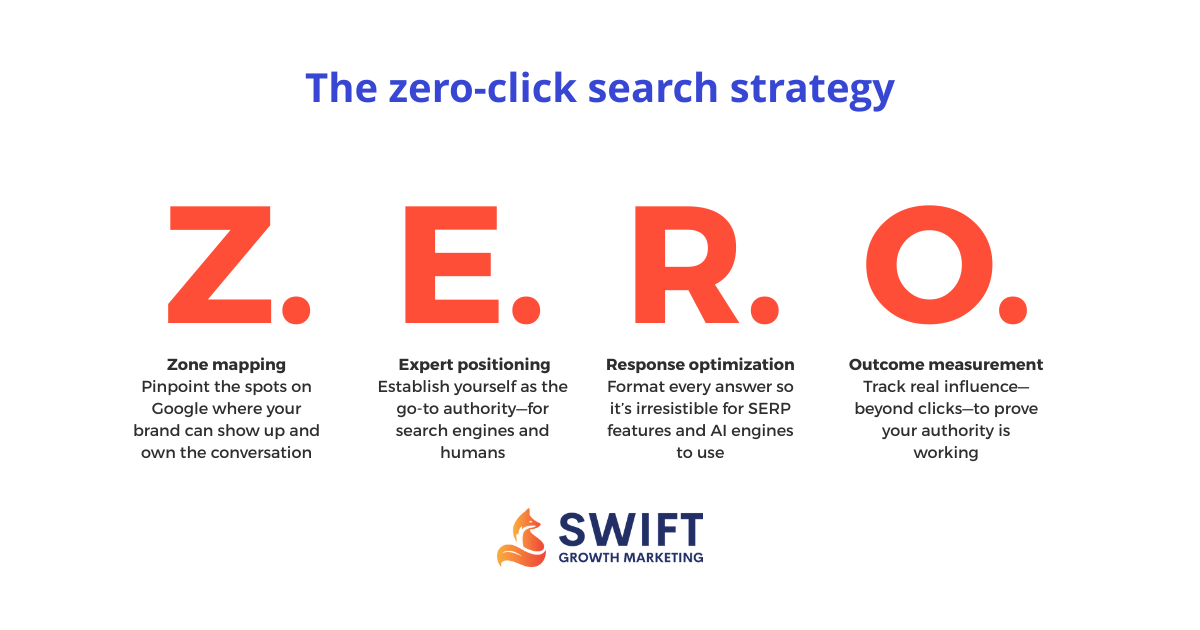
Zone Mapping: Pinpoint the spots on Google where your brand can show up and own the conversation.
Expert Positioning: Establish yourself as the go-to authority—for search engines and humans.
Response Optimization: Format every answer so it’s irresistible for SERP features and AI engines to use.
Outcome Measurement: Track real influence—beyond clicks—to prove your authority is working.
Short, sharp, and memorable. Next, we’ll break down each step and show exactly how to run it.
Zone mapping: find the real estate you can own
Use Google Search Console first. No guesswork.
Start by building an “Impressions Up, CTR Down” view in Google Search Console under Performance. Set the date to the last 28 days vs the previous period, then export queries where impressions rise while CTR falls. That list flags high-probability zero-click surfaces.
Next, classify intent and surface. Definitional queries (“what is…,” “define…,” acronyms), process queries (“how to…,” steps, checklists), and comparison queries (“X vs Y,” trade-offs, pricing snapshots) behave differently. Note which surface dominates for each—featured snippet, People Also Ask, AI Overview, or knowledge panel.
Expand your question set. Pull more from AnswerThePublic and AlsoAsked, group by theme and buyer stage, and prioritize commercially relevant questions over curiosity clicks.
Then set a beat. Choose three to five themes to own for six months. Publish weekly and refresh monthly. Consistency compounds authority.
Pro tip: Create a “SERP Surface Map” doc per theme with columns for Query, Intent, Primary Surface, Secondary Surface, Competing URLs, Notes. Keep it living.
Now that you know where to play, let’s talk about how to own the space.
Expert positioning: architect authority on and off the page
Machines favor clear, verifiable expertise. Humans do too. Build both.
Put real experts on the byline and add a short credentials block—years, scope, niche. Create author pages and use Organization and Person schema via Schema.org.
Show your work. Cite primary sources, original research, and standards. Link transparently and avoid hand-wavy claims.
Use precise language. Offer short definitions, unambiguous steps, and concrete numbers you can verify.
Make entities obvious. Be clear about brands, products, people, and acronyms. Keep naming consistent and reinforce with internal links.
Add structured data intentionally. Start with FAQ, HowTo, Organization, and Article. Use Google’s guide to structured data: https://developers.google.com/search/docs/appearance/structured-data/intro-structured-data
Write like this. Start with the answer in sentence one. Use tight subject-verb-object statements. Follow with three to five steps. Close with a short implication or next step.
That format is snackable for AI, scannable for executives.
Authority built. Now package it so results pages can lift it.
Response optimization: format for pull-through
Think in reusable answer blocks. Each section should stand alone if pulled into a snippet or AI Overview.
Define terms in one or two sentences. Present steps as short, numbered sequences only when necessary. Explain trade-offs plainly. Contrast options with tight side-by-side comparisons. Add concise FAQs with clear question-and-answer subheads.
Tactically, put definitions right after H2s. Keep sentences under 20 words when possible. Front-load nouns and verbs, and cut filler. Add FAQ and HowTo schema where it fits. Avoid fluff intros. Lead with value, not throat-clearing.
For platform nuances and prompt structure, use this deep, tactical checklist for answer engines.
Different from AEO and answer-engine content
Zero-click surfaces sit alongside your broader AEO program. Treat these placements as distilled answers that shape consideration. Prioritize clarity, entity strength, and regular refreshes so machines prefer citing you over the alternatives.
You’ve optimized responses. Now prove the lift.
Measurement that doesn’t depend on clicks
Without proof, authority is just a feeling. Here’s how to turn zero-click influence into data your CFO will love.
1) Branded search lift (baseline → trend)
Goal: prove that repeated zero-click visibility increases branded demand.
How: In Google Search Console > Performance, filter queries that contain your brand and product names. Track impressions and clicks weekly. Annotate major content publishes and SERP wins. Compare 28-day rolling averages month over month.
Bonus: Validate spikes with Google Trends for your brand versus two competitors.
Read on a single chart: If branded impressions rise while zero-click surfaces expand, you’re winning attention—before the click.
2) SERP delta analysis (impressions vs clicks)
Goal: understand where zero-click is happening and still claim the win.
How: For each target theme, list the top 10 queries. Pull impressions and clicks by query for the last 90 days. Flag queries with impressions up ≥20% and clicks flat or down. Tie those to the active SERP features (snippet/PAA/AIO) in your Surface Map.
Decision rule: If impressions are climbing and SERP features are present, treat that as authority growth—even when CTR dips.
3) “How did you hear about us?” (verbatim and single-select)
Goal: capture self-reported attribution that picks up zero-click influence.
How: Add a required “How did you hear about us?” to demo and contact forms. Offer options such as Referral, Social, Podcast, Event, “Saw us in Google results,” “AI answer mentioned us,” and Other (text). Mirror the field in your CRM to make analysis easy.
Weekly action: Review “Google results” and “AI answer” mentions. Copy standout verbatims to a living doc and share them with sales.
4) Consideration set surveys (fast and cheap)
Goal: measure whether you’re entering the short list.
How: Quarterly, run a one-question poll with your ICP: “Which brands come to mind for [category]?” Use Typeform or SurveyMonkey with a 30–50 respondent target. Supplement with a LinkedIn poll to your followers for directional signal.
Track: unprompted brand recall rate and movement from “not in set” to “in set.”
5) AI citation sampling (manual, quick)
Goal: log when and where you’re cited without fancy tools.
How: Maintain a spreadsheet with 20–30 key questions. Weekly, test in Google (incognito), check AI Overview, People Also Ask, and the featured snippet. Repeat in Perplexity and ChatGPT. Record whether you were cited, which URL appeared, and which competitors were referenced.
Outcome: a simple “Cited/Not Cited” score that trends over time.
6) A simple Looker Studio dashboard (30 minutes)
Goal: give executives a one-glance view of zero-click impact.
Build with Looker Studio:
- Connect GSC.
- Tabs: Theme Overview, Query Drilldown, Branded Lift.
- Visuals:
- Impressions vs Clicks (90 days)
- Branded Impressions (28-day rolling)
- Queries with Impressions Up/CTR Down
- Notes/Annotations panel
Meeting rhythm:
- 30 minutes, every two weeks. Review deltas. Decide next moves.
What to publish (and how often)
You don’t need a content factory. You need consistency and clarity.
Cadence: publish one zero-click asset per theme each week. Update your best performers monthly with fresh examples, new data, and tighter wording. Quarterly, prune, consolidate, and restructure for clarity.
Focus on formats that win zero-click. Lead with tight definitions and add a rule of thumb or heuristic. Share step-by-step frameworks in three to seven steps with outcomes stated up front. Explain comparisons through trade-offs, not just features. Close gaps with short FAQs that resolve common objections.
Make it unmistakably yours. Name your frameworks. Use crisp metaphors. End with a practical “do this next.”
On-page checklist (copy/paste this into your doc)
Answer in sentence one. Keep paragraphs to one–three sentences. Use numbered steps and bullets only when they add clarity. Add FAQ, HowTo, and Organization schema. Link to two or three authoritative sources (no paywalled junk). Add author credentials and an update date. Internally link to your related pillar and product pages. Compress images and keep them textless and clean.
Tool stack (only what you’ll actually use)
Use Google Search Console for performance and query deltas, Google Trends to validate branded interest, and Looker Studio for lightweight reporting. Add either Ahrefs or Semrush to find gaps and monitor snippets. Expand question sets with AnswerThePublic and AlsoAsked. Audit and check schema with Screaming Frog. Implement structured data with Schema.org and Google’s structured data docs.
Note: If you’re an enterprise team, BrightEdge can add SERP-feature tracking at scale, but don’t over-tool this. The basics above get you 80% there.
Implementation: a 90-day plan (simple, realistic)
Month 1 — Foundation
- Build your SERP Surface Map for 3–5 themes.
- Publish 8–12 zero-click assets (definitions, steps, comparisons).
- Add FAQ/HowTo/Organization schema.
- Stand up the Looker Studio dashboard.
- Add “How did you hear about us?” to forms and CRM.
Month 2 — Expansion
- Refresh the top three assets with better examples and tighter copy.
- Publish 8–12 more, prioritizing “Impressions Up/CTR Down” queries.
- Start weekly AI citation sampling.
- Run a 30–50 respondent consideration survey.
Month 3 — Scale and proof
- Consolidate overlapping pages; strengthen internal links.
- Publish 8–12 more; turn winning formats into templates.
- Present a zero-click impact readout:
- Branded impressions trend
- Queries with SERP deltas
- AI citation score
- Survey insights and verbatims
Decision gate: double down on the two themes with the clearest branded lift.
Executive FAQs (fast answers)
Q: Will this hurt our traffic?
A: Some CTRs will drop. That’s fine. Authority and branded demand rise when you’re the cited answer.
Q: How do we attribute revenue?
A: Blend: branded search lift + self-reported attribution + opportunity notes. You won’t get perfect attribution. You’ll get confident direction.
Q: How long to see signal?
A: 30–60 days for SERP surfaces. 60–90 for branded lift. It compounds with consistency.
Sources and references
Zero-click share: SparkToro’s 2024 study on Google retaining search traffic: https://sparktoro.com/blog/in-2024-google-keeps-more-search-traffic-than-ever-before/
Structured data basics: Google’s official guide: https://developers.google.com/search/docs/appearance/structured-data/intro-structured-data
The strategic shift, summed up
Clicks are a means, not the mission. Being the answer is the mission. When your brand shows up—consistently—on zero-click surfaces, you borrow trust at the exact moment people make choices.
Here’s the unlock: measure authority like a product. Ship weekly, track the right signals, and iterate. The compounding effect is real and durable.
Ready to stop chasing clicks and start owning the answer? Drop us a note. Let’s design your unfair advantage.