

Why Future-Proof Website Design Matters More Than Ever
Future proof website design means building websites with adaptable architecture and flexible technology to evolve with user expectations and tech advancements, avoiding constant rebuilds.
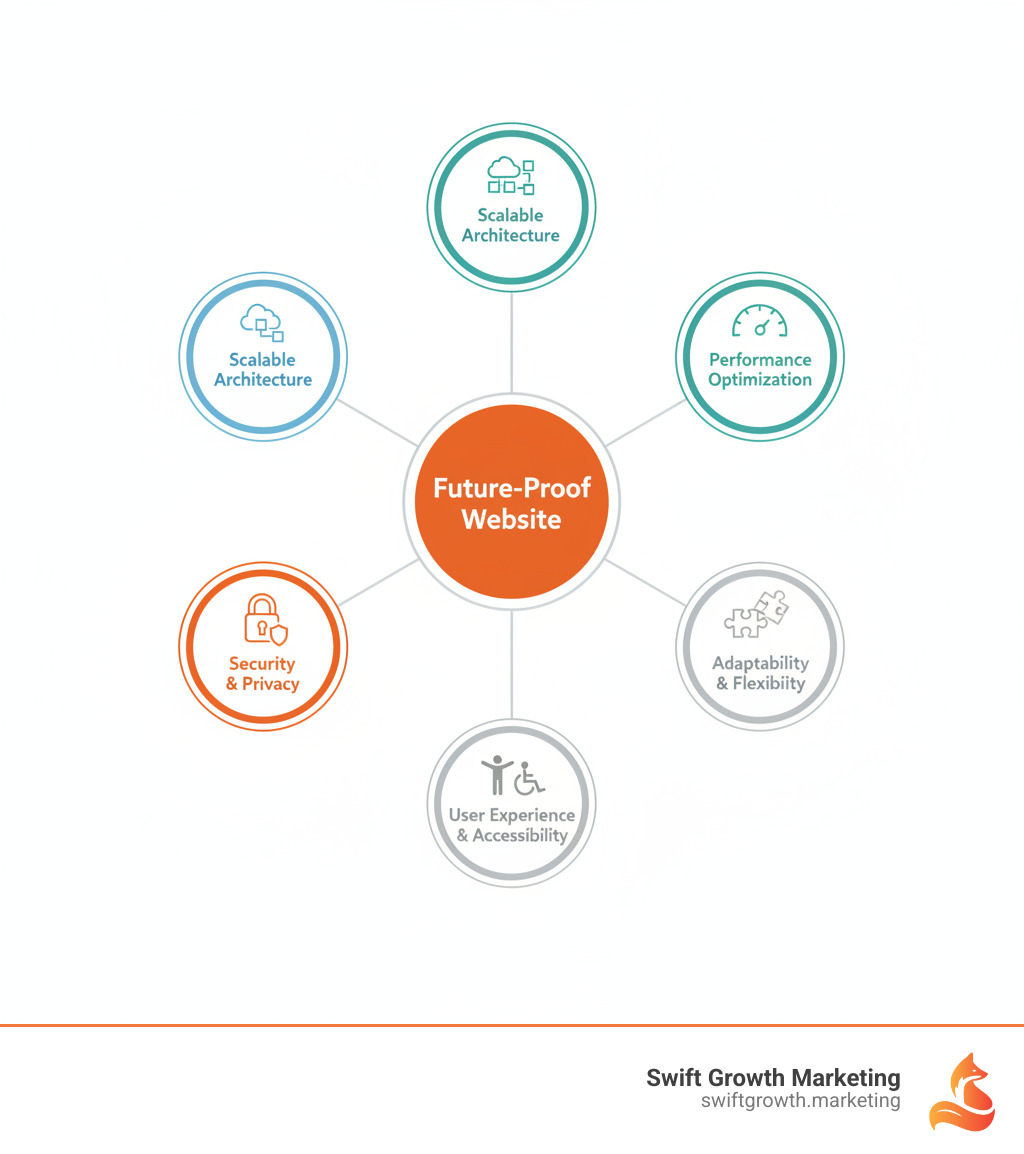
Key elements of a future-proof website include:
- Scalable Architecture – Cloud integration and microservices that handle growth
- Mobile-First Design – Responsive layouts that work seamlessly across all devices
- Performance Optimization – Fast load times through CDNs, image compression, and clean code
- Flexible CMS – Headless or modular systems that adapt to new channels
- Strong Security – Regular updates, encryption, and compliance with data privacy regulations
- Accessibility Compliance – WCAG standards that serve all users
- SEO Foundation – Structured data and semantic HTML for long-term visibility
The digital landscape shifts fast. A website redesign costs between $15,000 and $100,000, yet many businesses need major overhauls every 2-3 years. That’s not just expensive—it’s exhausting. The problem isn’t the pace of change; it’s how we build.
Most websites are designed for today, using rigid templates and monolithic systems that can’t adapt. They slow down with traffic spikes, break on new devices, and require complete rebuilds as business needs evolve.
Future-proof website design takes a different approach. It treats your website as a living system built on flexible foundations. Instead of chasing trends, it focuses on core principles that remain valuable: speed, accessibility, modularity, and adaptability.
The payoff is substantial. Companies building for longevity spend less on reactive fixes and more on strategic growth. Their sites scale smoothly, integrate new tech easily, and adapt to new platforms without breaking.
I’m Chris Hornak, Co-Founder of Swift Growth Marketing. We help education, staffing, and e-commerce brands transform their online presence with future-proof website design and SEO. For over a decade, we’ve built systems that grow with our clients, not hold them back.
The Core Principles of Future-Proof Website Design
Many websites suffer from the digital equivalent of planned obsolescence. Built with rigid templates and fleeting design trends, they look great today but crumble tomorrow. As your business grows or new devices emerge, they can’t keep up, forcing you into costly rebuilds.
Future proof website design takes the opposite approach. Instead of building for right now, we build for what comes next. The core principles are straightforward: scalable architecture that grows with your business, flexibility that adapts to change, user-centric design that puts people first, and continuous adaptability that evolves without breaking. These are the difference between a strategic asset and an expensive liability.
Here’s what happens when you build for obsolescence versus building for the future:
| Feature | Planned Obsolescence in Web Design | Future-Proof Website Design |
|---|---|---|
| Foundation | Rigid templates, fixed structures, built for current trends only | Flexible frameworks, custom CMS solutions, core principles of clarity and usability |
| Lifespan | Short shelf life (2-3 years), frequent, costly rebuilds | Designed for longevity, adaptability, and evolution, minimizing need for full rebuilds |
| Adaptability | Struggles with new technologies, devices, or business needs | Seamlessly integrates new features, scales with traffic, adapts to emerging trends without breaking |
| Cost | High long-term cost due to repeated major overhauls | Lower long-term cost, strategic investment, allows for refreshes rather than rebrands |
| Business Impact | Hinders growth, drains resources, creates competitive disadvantage | Strategic asset, competitive advantage, allows focus on growth and innovation |
| SEO & UX | Quickly becomes outdated, poor performance, accessibility issues | Maintained relevance, optimal performance, strong user experience, accessibility by design |
| Maintenance | Complex, often requires rebuilding large sections | Easier maintenance, modular updates, clear code, consistent support |
Building for Growth with a Scalable Architecture
A website that can’t scale is like a skyscraper built on a cottage foundation. Scalable architecture means your site can handle more traffic, content, and features without falling apart.
- Microservices break your site into smaller, independent components. If one part, like your checkout page, gets a traffic spike, the rest of the site remains stable.
- Cloud integration (e.g., AWS, Google Cloud) provides elastic scalability. Your site automatically adjusts to traffic spikes and scales back down, so you only pay for what you use.
- API-driven development allows seamless integration with other services, like CRMs or payment processors, without overhauling your entire system.
The business impact is real: less spending on emergency fixes and more focus on growth. For companies in Pittsburgh or Wheeling looking to expand their digital reach, this is essential. If you’re ready to build a foundation that supports real growth, check out our Business SEO services.
The Power of Modular and Responsive Design
Modular design is like building with LEGOs instead of pouring concrete.
Component-based architecture uses independent, reusable elements (modules). To update something, you only change that specific module. This follows atomic design principles, building from small “atoms” (buttons) into larger “organisms” (headers). 80% of web developers believe that modular website design is the best approach because it makes updates faster and ensures consistency.
Responsive design extends this flexibility to every screen. With over half of web traffic coming from mobile, a mobile-first approach is critical. We design for the smallest screen first, prioritizing core content, then progressively improve the experience for larger screens. This ensures a solid, consistent experience whether your customer is in Pittsburgh on a laptop or in Wheeling on their phone.
Enhancing UX and Accessibility for Lasting Relevance
Great technology is useless if people can’t use it. Good user experience (UX) is about making things work for real people. The ROI is clear: every dollar spent on UX design returns $100.
User journey mapping helps us understand how people interact with your site—their goals, paths, and obstacles. We then build intuitive navigation based on these real user patterns.
Accessibility compliance (WCAG standards) ensures everyone can use your site. This includes alt text for screen readers, keyboard navigation, and proper color contrast. This isn’t just good practice; it’s good business. You reach a broader audience and avoid legal risks, as 2,281 website accessibility lawsuits were filed in 2023 alone. A website built on solid UX and accessibility principles stays relevant.
Want to dive deeper into creating experiences that keep people coming back? Explore our insights on UX Optimization.
Essential Technical Foundations for Longevity
A beautiful website is only half the battle. The real magic happens beneath the surface, where technical excellence separates websites that endure from those that crumble. Without solid technical foundations—fast performance, strong security, and search engine visibility—even the most stunning design becomes a liability. These invisible powerhouses keep your site running smoothly while you focus on growing your business.
Optimizing for Speed and Performance
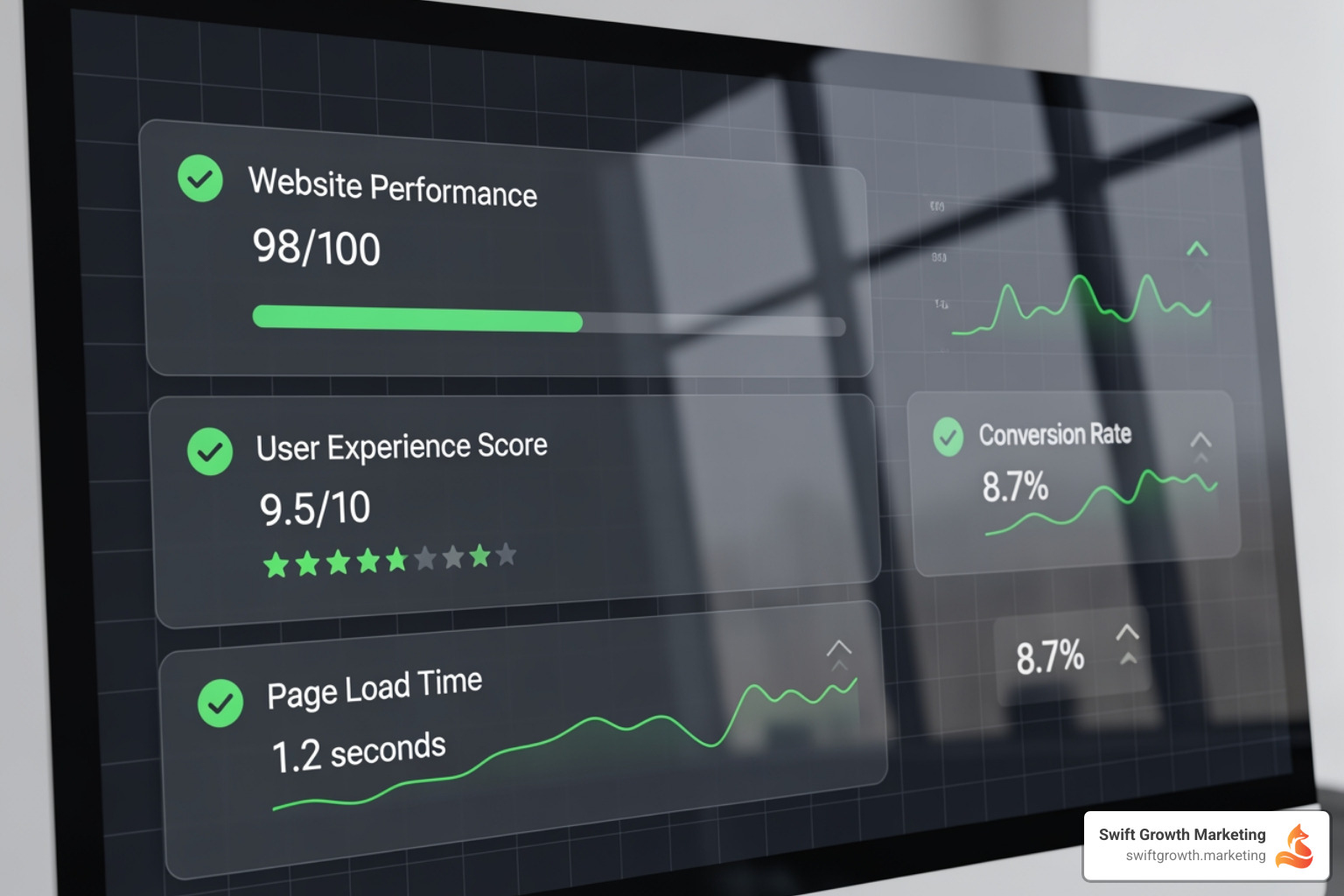
A one-second delay in load time can lead to a 7% reduction in conversions. Visitors won’t wait. Speed optimization is crucial for a future proof website design that performs under pressure. Google’s Core Web Vitals are the gold standard for measuring user experience, and fast sites rank better.
Strategic moves to increase speed include:
- Image compression with modern formats like WebP to slash file sizes.
- Code minification to strip unnecessary characters from HTML, CSS, and JavaScript.
- Content Delivery Networks (CDNs) to store your site on servers globally, delivering content from the closest location to your visitor.
- Lazy loading to load images and videos only when they’re about to appear on screen, speeding up initial page load.
Dive deeper into how technical performance impacts your search rankings with our guide to Core Web Vitals SEO.
Strengthening SEO and Search Visibility
A great website nobody can find is useless. SEO isn’t a one-time task; it’s an evolving conversation with search engines. That’s why future proof website design builds SEO into its foundation.
Structured data (Schema.org markup) helps search engines understand your content, boosting your chances of appearing in rich snippets and voice search results. As AI-driven search grows, optimizing for conversational, question-based queries is critical.
We build sites using clean, semantic HTML, which creates a logical structure for search engines and improves accessibility. Regular content audits keep your information fresh and aligned with audience searches, signaling to search engines that your site is actively maintained.
Building this foundation takes strategy. Our article on How to Build a Strong SEO Foundation with On-Page SEO walks you through the essentials for long-term visibility.
Advanced Security and Data Privacy Compliance
A data breach can cost millions and destroy customer trust. A future proof website design treats security as fundamental.
We start with HTTPS/SSL encryption to secure all data traveling between your site and its visitors. A Web Application Firewall (WAF) acts as a security guard, filtering malicious traffic and protecting against common attacks.
Security isn’t set-it-and-forget-it. Regular security audits and timely software updates are crucial to patch vulnerabilities before they’re exploited.
Data privacy laws like the General Data Protection Regulation (GDPR) are expanding, and non-compliance can lead to significant fines. We implement cookie consent management, anonymize user data where possible, and create transparent privacy policies to build trust and ensure compliance. This shows customers their privacy matters, creating a foundation of trust that pays dividends.
Embracing Modern Technologies for a Resilient Website
The digital landscape’s evolution is an opportunity, not a threat. A future proof website design welcomes innovation to improve user experiences and adaptability. This means thoughtfully integrating emerging technologies like AI, choosing a flexible content management system (CMS), and staying curious about what’s next.
The Role of AI in Personalization and Support
Modern AI-powered chatbots offer genuinely helpful, 24/7 support. They answer common questions, guide visitors, and capture leads, freeing up your team to focus on more complex issues.
Beyond chat, AI learns from user behavior to enable dynamic content personalization. Your site can show visitors relevant product recommendations or articles, creating a custom experience. 80% of consumers are more likely to purchase from brands that offer personalized experiences, making customers in Pittsburgh and Wheeling feel valued.
Predictive analytics takes this further by anticipating visitor needs. AI doesn’t replace the human touch; it amplifies it by handling routine tasks so your team can focus on high-value conversations.
Why a Flexible CMS is Crucial for Future-Proof Website Design
Your Content Management System is the framework of your digital home. A rigid CMS means you’re stuck, while a flexible one allows your site to evolve smoothly.
Traditional platforms often lock you into specific templates and technologies, making it difficult to publish content to new channels or integrate new tools. This turns a strategic asset into a headache.
A headless CMS is central to future-proofing. It separates your content (the “body”) from its presentation (the “head”). This API-first approach provides genuine flexibility. You can create content once and publish it to your website, mobile app, or even future platforms like voice assistants. Your developers can use the best front-end technologies without fighting rigid templates. For more on this, Adobe offers helpful resources on content management.
Preparing for the Next Wave: PWAs and Emerging Tech
The line between websites and mobile apps is blurring, thanks to technologies like Progressive Web Apps (PWAs). They deliver an app-like experience directly through a web browser—no app store required.
PWAs offer offline functionality, push notifications, and fast load times. Users can even “install” them on their home screen. This provides a reliable experience for users and simplifies development for businesses, who can maintain one codebase instead of separate web and native apps.
We’re also watching emerging technologies like Augmented and Virtual Reality become more practical. A flexible architecture makes it possible to integrate these innovations when you’re ready. The key is building with a Growth Marketing Mindset—always ready to test and adopt what serves your users. A future proof website design gives you the foundation to experiment without rebuilding from scratch.
Frequently Asked Questions about Future-Proofing
What are the first steps to making an existing website future-proof?
The journey to future proof website design doesn’t always require starting over. Begin with a comprehensive audit of your existing site’s performance, SEO, mobile-friendliness, and accessibility. This diagnostic phase reveals your strengths and vulnerabilities.
Prioritize fixing foundational issues first. Tackle slow load times and poor mobile performance immediately, as these directly impact conversions and user experience. Once the core is stable, you can plan for larger architectural improvements, like moving to a headless CMS or adopting a modular design.
How is future-proofing different from a standard website redesign?
A standard redesign typically focuses on cosmetic updates—new visuals, colors, and imagery—often on top of the same old infrastructure. The site looks modern for a year or two, but the underlying limitations remain.
Future proof website design is a strategic approach that rebuilds or optimizes the core architecture for long-term scalability and adaptability. A standard redesign is like repainting a house; future-proofing is like upgrading the foundation and electrical systems. One looks good now; the other ensures the house can adapt to future needs without major reconstruction. This strategic investment prevents the cycle of constant, costly rebuilds.
What is the most critical element of a future-proof website?
While all elements work together, the most critical is a scalable and flexible architecture.
Without it, even a beautiful, fast, and accessible site will eventually hit a wall. It won’t handle traffic spikes, integrate new technology, or adapt to business pivots. A scalable architecture is the foundation that makes all other aspects of future-proofing possible. It allows your website to grow with your business, handle surges without breaking, and integrate new tools without a complete overhaul. It’s what ensures your website remains a durable asset, not a temporary fix.
Conclusion: Build Your Website for Tomorrow, Today
Your website is the engine that drives leads, builds trust, and scales with your ambitions. The question isn’t if your site will need to evolve, but whether it’s built to adapt gracefully or will require constant, expensive rebuilds.
One path is reactive panic when technology shifts or traffic spikes break your site. The other is strategic planning, where your future proof website design becomes a competitive advantage.
At Swift Growth Marketing, we focus on outcomes. A beautiful website that can’t grow isn’t beautiful for long. We build digital foundations that evolve with your business through data-driven decisions and continuous improvement. We don’t predict the future, but we build systems flexible enough to handle whatever comes next.
For businesses in Pittsburgh, PA, and Wheeling, WV, this means sustained search visibility, lower long-term costs, better user experiences, and the freedom to focus on growth, not technical firefighting. When your website infrastructure is solid, you can respond to opportunities without wondering if your site can handle it.
Your website should be an investment that compounds over time, not an expense that resets every few years.
Ready to build a website that grows with your business? Explore Our Services and let’s discuss how we can future-proof your digital success.