

Why Ecommerce SEO is Your Most Powerful Growth Engine
An ecommerce SEO strategy is your roadmap for making your online store visible in search engines and attracting customers ready to buy. Since 75% of users never scroll past the first page of search results, ranking high is crucial. Unlike paid ads, where visibility stops when you stop paying, SEO builds compounding returns over time. Companies like Ruggable have driven over one million monthly visitors through SEO, outperforming paid traffic by a ratio of 10:1.
This guide outlines a systematic approach to building a strategy that scales with your business, covering:
- Strategic keyword research
- Optimized site architecture
- On-page SEO for product and category pages
- Technical SEO for site speed and mobile optimization
- Content marketing to attract and guide shoppers
- Quality backlink building
- Performance tracking with key tools
Ecommerce SEO is unique; it involves optimizing potentially thousands of product pages, managing complex site structures, and handling issues like duplicate content. It requires a comprehensive strategy that combines technical excellence with content that answers customer questions and guides them toward a purchase.
The Foundation: Strategic Keyword Research for Online Stores
Keyword research is about understanding the exact words customers use when searching for your products. For ecommerce, this means focusing on commercial intent keywords, which signal a desire to buy now. Instead of broad terms like “shoes,” target long-tail phrases like “men’s waterproof hiking shoes size 11.” These specific queries have less competition and higher conversion rates.
To find these keywords, use Amazon’s search suggestions, which reflect real customer searches. Analyze your competitors’ category pages and product titles to see what terms are working in your market. Also, explore Reddit communities and product reviews to find the natural language your customers use to describe their needs. For more on these fundamentals, see our guide on SEO Foundations.
B2B vs. B2C Keyword Strategy
Your keyword approach depends on your customer. B2C and B2B ecommerce require different strategies. B2C keywords are direct and action-oriented (e.g., “buy now,” brand names, product models), as the buying cycle is short. B2B keywords are more research-focused (e.g., “ergonomic seating solutions for call centers,” “bulk office furniture supplier”), as the buying cycle is longer and involves more stakeholders.
| Feature | B2C Ecommerce Keyword Research | B2B Ecommerce Keyword Research |
|---|---|---|
| Target Audience | Individual consumers | Businesses, decision-makers, procurement teams |
| Buying Cycle | Shorter, more impulsive | Longer, more complex, involves multiple stakeholders |
| Search Intent | Transactional (buy now), Commercial (researching products) | Informational (problem/solution), Navigational (specific vendors) |
| Keywords Focus | Product names, brands, models, discounts, “buy” terms | Industry terms, technical specifications, solutions, “supplier” terms, “quote” terms |
| Content Goal | Trigger a purchase | Educate, inform, generate leads, build trust |
| Key KPIs | Traffic, Average Order Value (AOV), Conversion Rate | Lead Generation, Customer Lifetime Value (CLV), Revenue |
Choosing and Prioritizing Your Keywords
Once you have a list of keywords, prioritize them based on these factors:
- Search volume: How many people search for the term monthly. Use tools like Google Keyword Planner to get estimates.
- Keyword difficulty: How hard it is to rank for the term. Look for a balance between decent volume and manageable competition.
- Product fit: Does the keyword directly relate to a product you sell?
- Search intent: Does the query indicate a desire to buy (transactional) or just research (informational)? Prioritize transactional intent for product pages.
- Seasonal trends: Use tools to identify seasonal peaks for products like Halloween costumes or pool supplies, and optimize in advance.
Building Your Digital Storefront: Site Architecture and On-Page SEO

Your site’s architecture is like the layout of a physical store; it must be easy to steer for both customers and search engines. A confusing structure hurts user experience and rankings. With 66% of online sales on mobile, Google uses mobile-first indexing, meaning your site is judged on its mobile performance. Our guide on UX Optimization for Ecommerce can help you create a smooth mobile experience.
A good site architecture follows the 3-click rule: any product should be reachable within three clicks of the homepage. A simple structure (Home → Categories → Subcategories → Products) is scalable and easy to understand. Internal linking connects your pages, distributing authority and guiding users.
Optimizing Category and Product Pages
Your category and product pages are your digital sales floor.
- Product Descriptions: Write unique, customer-focused descriptions instead of using manufacturer copy. This avoids duplicate content issues and helps you rank.
- Category Pages: Add a unique introductory paragraph (80-150 words) with your primary keyword to provide context for search engines.
- Title Tags: Keep them under 60 characters, include your main keyword, and use compelling modifiers like “Best” or “Free Shipping” to increase clicks.
- Meta Descriptions: While not a ranking factor, a good meta description (105-160 characters) acts as ad copy in search results, encouraging clicks.
- URLs: Use clean, descriptive URLs with hyphens and your target keyword (e.g.,
yourstore.com/mens-waterproof-hiking-boots). - H1 Tags: Each page should have one clear H1 tag that includes the primary keyword.
- Image Optimization: Compress images using modern formats like WebP to improve site speed. Use descriptive alt text with keywords to help images rank in Google Image Search and improve accessibility.
For a deeper dive, see our guide on How to Build a Strong SEO Foundation with On-Page SEO.
Leveraging Schema Markup for Rich Results
Schema markup is code that helps Google understand your content, enabling rich snippets in search results. These eye-catching listings can include star ratings, prices, and availability, which boosts click-through rates.
- Product schema provides details like price, brand, and stock status. See Google’s product markup guide for implementation.
- Review schema displays star ratings, building instant trust with searchers.
- FAQ schema can show questions and answers from your page directly in the search results.
The Engine Room: A Technical Ecommerce SEO Strategy

Technical SEO is the foundation that ensures search engines can efficiently crawl, understand, and index your site. As an ecommerce store grows, so does its technical complexity. Issues like duplicate content from product filters and variations can dilute your rankings if not managed properly. Our Ecommerce SEO Audit guide can help you identify and fix these problems.
Core Technical SEO Elements
These fundamentals are non-negotiable for a successful ecommerce SEO strategy.
- Site Speed: Slow pages kill conversions. A one-second delay can reduce conversions by 7%. Optimize images, minify code, and use a Content Delivery Network (CDN) to improve speed. Learn more in our guide on Core Web Vitals SEO.
- Mobile-First Indexing: Google ranks your site based on its mobile version. A responsive design with legible fonts and tappable buttons is essential.
- HTTPS Security: An SSL certificate protects customer data and is a confirmed, albeit lightweight, ranking signal. More importantly, it builds customer trust.
- XML Sitemaps: These files act as a roadmap for search engines, helping them find all your product and category pages.
- Robots.txt: This file tells search engines which pages to avoid crawling, such as internal search results or checkout pages, preserving your crawl budget for important content.
Managing Product Feeds and Duplicate Content
Ecommerce sites often struggle with duplicate content. Here’s how to manage it:
- Google Merchant Center: To appear in Google Shopping, you need an optimized product feed with accurate, descriptive titles and information.
- Canonical Tags: These tags tell Google which version of a page is the “master” copy. Use them for product variations (e.g., different colors) to consolidate ranking signals onto one URL.
- Noindex Tags: Use these to prevent search engines from indexing low-value pages, like filtered results with no search demand or “thank you” pages.
- Faceted Navigation: Product filters (for size, color, brand) can create thousands of thin or duplicate URLs. Use a combination of canonical tags, noindex tags, and robots.txt rules to control which filtered pages get indexed. The goal is to allow indexing for valuable filter combinations (e.g., “men’s running shoes” + “Nike”) while blocking the rest.
Attracting Shoppers: Content Marketing and Link Building
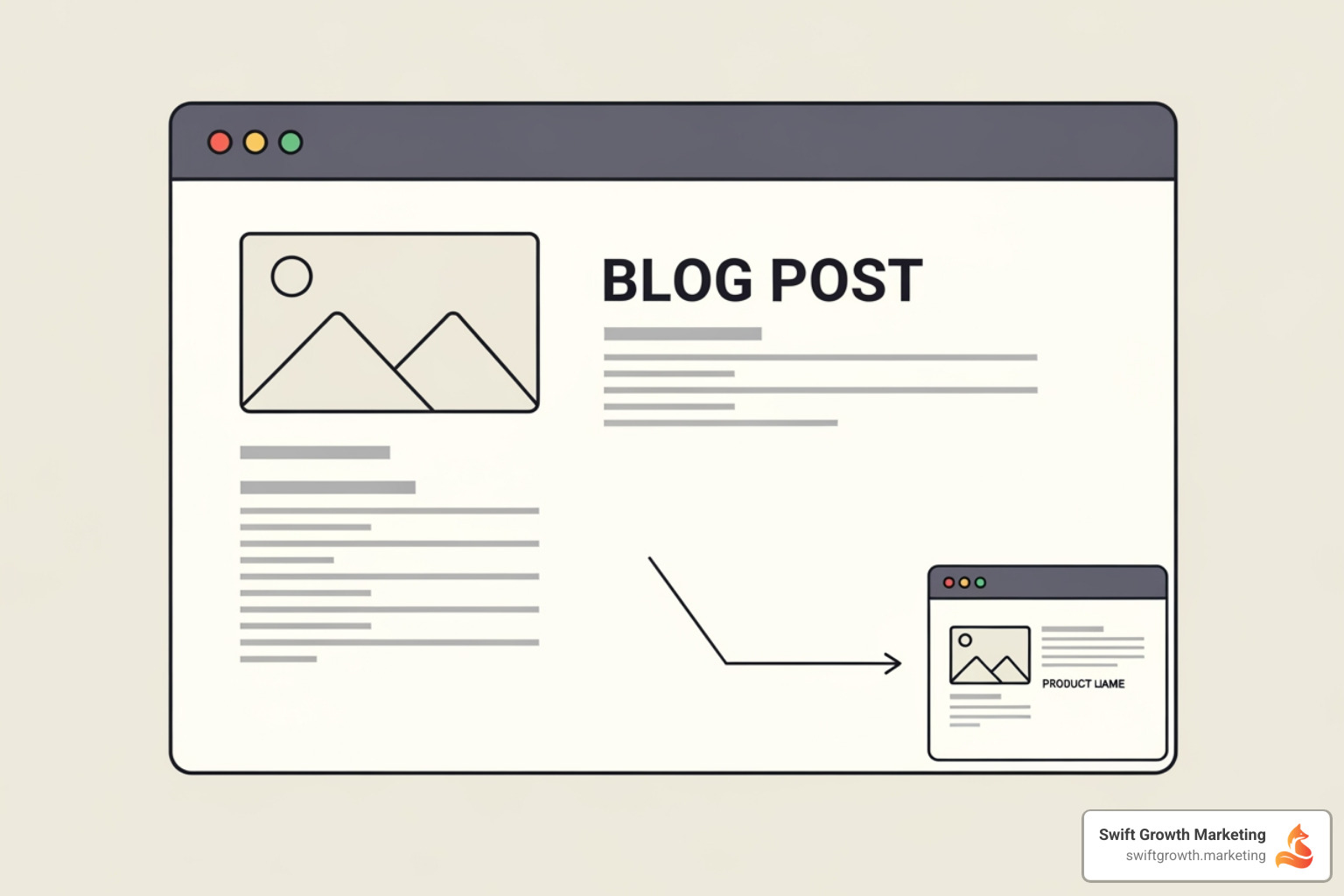
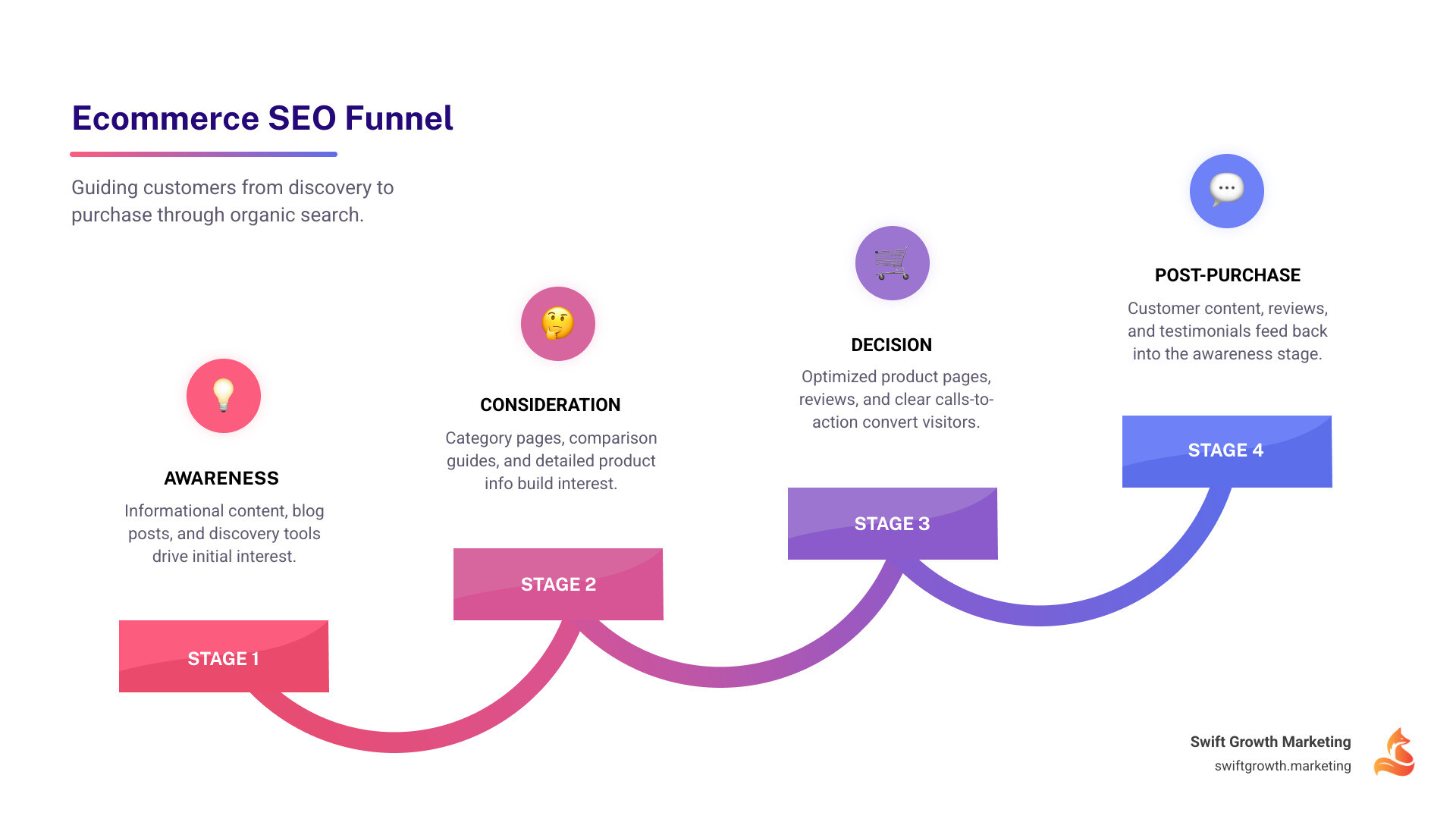
Product pages convert buyers, but content marketing attracts shoppers earlier in their journey. By creating helpful content, you build topical authority and establish your brand as a trusted expert. This top-of-funnel strategy builds relationships before a purchase decision is made. Learn how to structure this content in our guide on Content Clusters Build Topical Authority with Pillar Cluster Architecture.
Effective content types for ecommerce include:
- Blog Posts: Attract informational searches with articles related to your products, like “how to choose the right running shoes.”
- Buying Guides: Target customers who are actively researching with guides like “Best Home Espresso Machines Under $500.” These naturally link to your products while providing value.
- Comparison Posts: Help customers decide between different models or competitors with honest, helpful comparisons.
Acquiring High-Quality Backlinks
Backlinks are votes of confidence from other sites and a key Google ranking factor. Focus on quality over quantity.
- Guest Posting: Write valuable articles for relevant industry blogs that include a natural link back to your site.
- Unlinked Brand Mentions: Use tools to find mentions of your brand and politely request a link.
- Supplier/Distributor Links: Ask your partners to link to you as an authorized retailer.
- Digital PR: Create “linkable assets” like original research or infographics that other sites will want to share. Offering products for reviews or event prizes can also earn valuable links.
For more ideas, see our 10 Proven Link Building Tips to Boost Your SEO in 2023.
Measuring Success: KPIs and Tools for Your Ecommerce SEO Strategy
An ecommerce SEO strategy requires constant analysis and adjustment. The advantage of SEO is that its impact is measurable, allowing you to prove value and make data-driven decisions. Setting realistic goals is key, as SEO is a long-term effort. Our Google Search Console 101 guide is a great place to start learning about performance tracking.
Key Performance Indicators (KPIs)
Track these metrics to measure your success:
- Organic Traffic: The number of visitors from unpaid search results.
- Keyword Rankings: Your position in search results for target keywords.
- Click-Through Rate (CTR): The percentage of people who click your link in search results.
- Bounce Rate: The percentage of visitors who leave after viewing only one page. A high rate can indicate a mismatch between content and search intent.
- Conversion Rate: The percentage of organic visitors who make a purchase. This ties SEO directly to revenue.
- Average Order Value (AOV): The average amount spent per order by organic visitors.
- Revenue from Organic Search: The ultimate scorecard, representing total sales generated from SEO.
Essential Ecommerce SEO Tools
Use these tools to track KPIs and manage your strategy:
- Google Analytics: The central hub for understanding traffic sources, user behavior, and conversions. Get started with Google Analytics if you haven’t already.
- Google Search Console: A free tool from Google that provides data on keyword performance, technical issues, and crawl status.
- Ahrefs / Semrush: These platforms are essential for competitive research, keyword analysis, backlink monitoring, and site audits.
- Screaming Frog SEO Spider: A desktop crawler that audits your site for technical issues like broken links, duplicate content, and missing metadata.
Frequently Asked Questions about Ecommerce SEO
What is the difference between B2B and B2C ecommerce SEO?
The main difference is search intent and the customer journey.
- B2C ecommerce SEO targets individual consumers with product-focused, transactional keywords (e.g., ‘buy wireless headphones’). The sales cycle is short and often impulsive.
- B2B ecommerce SEO targets businesses with solution-oriented, informational keywords (e.g., ‘wholesale office furniture supplier’). The sales cycle is much longer, involving research, comparisons, and multiple decision-makers. The goal is often lead generation rather than an immediate sale.
How long does it take to see results from an ecommerce SEO strategy?
SEO is a long-term investment. While you may see minor improvements from technical fixes or long-tail keyword targeting in 3-6 months, significant results typically take 6-12 months. This is when you can expect to see higher rankings for competitive terms and a substantial increase in organic traffic and revenue. The exact timeline depends on your industry’s competitiveness, your site’s current health, and your budget.
Is SEO better than paid ads for ecommerce?
They are not competitors; they are teammates. The best strategy uses both.
- SEO builds sustainable, long-term traffic that compounds over time. Once you rank, you receive clicks without paying for them, and this traffic often has higher trust and conversion rates.
- Paid ads deliver immediate results. They are ideal for launching products, promoting sales, and gathering quick data on what converts.
Use paid ads for immediate revenue and testing, while your SEO efforts build a cost-effective growth engine for the future.
Conclusion: Build Your Ecommerce Empire
An ecommerce SEO strategy is not a one-time project but the core of your store’s sustainable growth. It involves continuous effort across keyword research, site architecture, on-page and technical optimization, content marketing, and link building.
While SEO is an ongoing process, the effort compounds. Unlike paid ads, which vanish when you stop paying, a strong SEO foundation builds on itself, creating a reliable traffic and revenue engine that grows stronger over time. This investment builds brand authority, earns customer trust, and creates a predictable, profitable sales channel.
Building an ecommerce empire requires a strategic, long-term approach. If you’re ready to build a lasting asset for your business, we’re here to help.
Ready to develop a winning strategy for your online store? Develop your winning SEO marketing strategy with us and let’s build your sustainable growth engine together.