Why DPT Program Marketing Is More Critical Than Ever
DPT program marketing requires a strategic approach to stand out in an increasingly competitive landscape. While the demand for physical therapists is booming, so is the number of DPT programs vying for a defined pool of qualified candidates.
Prospective students are more discerning than ever, researching programs online, comparing outcomes, and seeking evidence that your program will prepare them for success. To attract the best applicants, you need a marketing strategy as sophisticated as your curriculum.
Key Marketing Tactics for DPT Programs:
- Define your unique value proposition: Highlight specialized curriculum, faculty expertise, and program outcomes.
- Optimize your digital presence: 76% of consumers visit a website before a physical location.
- Leverage SEO strategically: SEO drives 1000%+ more traffic than organic social media.
- Build authentic community: Use student testimonials, alumni stories, and faculty spotlights.
- Measure what matters: Track website traffic, application rates, and cost per enrollment.
Effective DPT program marketing has moved beyond generic brochures. It now demands a multi-channel digital strategy that combines SEO, compelling content, authentic storytelling, and data-driven decisions. You must showcase the unique culture, research opportunities, and career outcomes that set your program apart.
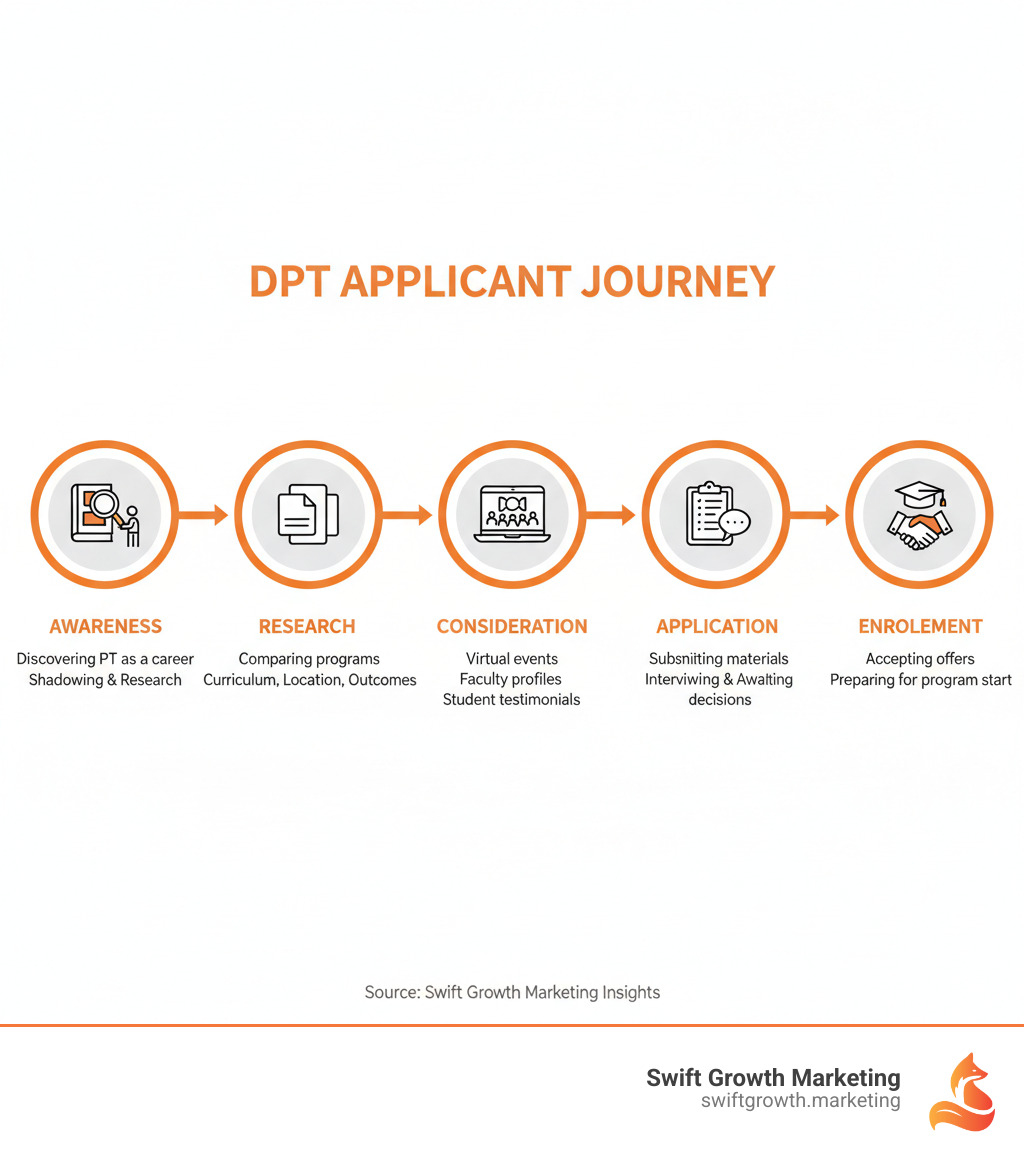
I’m Chris Hornak, Co-Founder of Swift Growth Marketing. We help education brands drive enrollment growth through strategic positioning and search optimization. This guide shares proven dpt program marketing tactics for the entire applicant journey, from initial awareness to enrollment.
Understanding the DPT Applicant & Competitive Landscape
To market effectively, you must understand your audience and the competition. The landscape for DPT program marketing has shifted, with increased competition and higher applicant expectations. Prospective students are more informed, comparing programs on outcomes, faculty, and unique features. They are looking for a launchpad for their careers and a program that aligns with their goals.
Defining Your Ideal Student Persona
Developing applicant personas helps you understand the people behind the applications. Start with the data: over 30% of doctor of physical therapy applicants majored in exercise science, with kinesiology, biology, and psychology also being common. These students often find PT through personal experience or shadowing.
However, non-traditional students and career changers are a growing demographic. Applicants from fields like engineering, marketing, or teaching bring unique skills like analytical thinking, business acumen, and strong communication. Your messaging should appeal to both traditional and non-traditional applicants, highlighting how diverse backgrounds enrich the learning environment.
Common undergraduate majors for DPT applicants include exercise science, biology, kinesiology, psychology, health sciences, and athletic training, as well as non-traditional paths like engineering, marketing, and teaching.

Differentiating Your DPT Program
In a crowded market, you must amplify what makes your program unique. Generic claims are not enough. Focus on specific strengths:
- Curriculum: Do you offer innovative teaching methods and clinical rotations, simulation labs, or interprofessional education opportunities?
- Faculty Expertise: Showcase faculty who are active clinicians, published researchers, or leaders in professional organizations. Applicants seek mentors, not just instructors.
- Research Opportunities: Highlight integrated research, faculty mentorship, and dedicated facilities to attract academically ambitious students.
- Program Outcomes: Be transparent with your NPTE pass rates, graduation rates, and employment statistics. Strong numbers are powerful proof of your program’s value.
- Facilities: Feature your state-of-the-art labs and clinical practice centers that provide hands-on experience.
- Unique Degrees: If you offer combined degrees, like an MBA/DPT, promote this as a key differentiator for students with entrepreneurial goals.
Identify your program’s authentic strengths and build your marketing narrative around them. Be something specific and valuable to the right students.
Building Your Foundational DPT Program Marketing Strategy
Your digital presence is the front door to your program. A strong foundational dpt program marketing strategy—built on strategic messaging, a high-performing website, and ethical practices—ensures you make an impressive first impression.

Crafting Compelling Key Messages
Your messaging should go beyond course lists. Resonate with applicants by focusing on storytelling. Highlight student success stories, diverse career outcomes, community impact (like pro bono work in Pittsburgh or Wheeling), and innovation in teaching, such as interprofessional education. Instead of just listing facts, use stories to create an emotional connection. Strategic messaging that builds trust and drives action is about painting a compelling vision of the student and graduate experience.
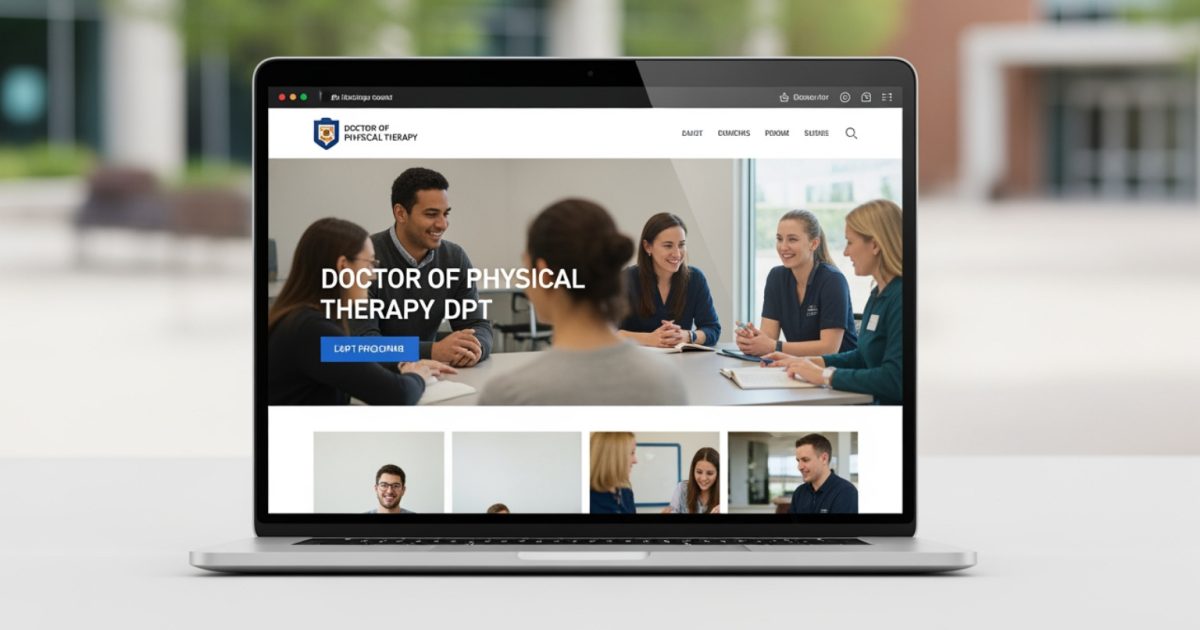
Creating a High-Converting Program Website
With 76% of consumers visiting a website before a physical location, your site is your 24/7 recruiter. To convert browsers into applicants, ensure your website has:
- Excellent user experience (UX) and mobile optimization for easy browsing on any device.
- Clear calls-to-action (CTAs), like a request information form or an “Apply Now” button, to guide visitors to the next step.
- Engaging content, including virtual tours, detailed faculty profiles, and easily accessible information on curriculum and admissions.
Your website should be an engaging hub that answers questions and simplifies the path to application. If you’re concerned about your site’s performance, is your website hurting brand credibility? Get an audit!.
Upholding Ethical Marketing Standards
In higher education and healthcare, trust is everything. Uphold ethical standards by committing to:
- Transparency in outcomes: Clearly share graduation rates, NPTE pass rates, and employment statistics.
- Avoiding misleading claims: Stick to verifiable facts about career prospects and program benefits.
- Adhering to CAPTE accreditation standards in all communications.
- Respecting data privacy and securing all personal information collected from prospective students.
As technology evolves, honesty remains the cornerstone of credibility and effective dpt program marketing. Learn more about building brand trust: generative AI’s impact on credibility. Build on that foundation, and everything else falls into place.
Dominating Digital Channels for Your DPT Program Marketing
Your ideal applicants are online, and a multi-channel digital approach is essential for visibility. By combining SEO, content marketing, social media, and paid advertising, you can create a comprehensive dpt program marketing strategy that captures attention throughout the applicant journey.
Mastering SEO for DPT Program Marketing
SEO should be the heart of your marketing, as it drives over 1000% more traffic than organic social media. When prospective students research programs, they turn to Google, using terms like “DPT programs Pittsburgh” or asking specific questions. To dominate search results:
- Conduct keyword research to target terms and questions your applicants are using.
- Optimize program pages with clear title tags, meta descriptions, and headers.
- Build topical authority by creating blog posts and pillar pages around key topics like admissions and career paths. Learn more about Content Clusters: Build Topical Authority with Pillar-Cluster Architecture.
- Strengthen your technical foundation. For a deeper dive, see how to build a strong SEO foundation with on-page SEO.
When students search for DPT programs, SEO ensures you are the answer they find.
Engaging Prospects with Content and Social Media
While SEO brings visitors to your site, engaging content makes them want to stay. Showcase your program’s personality and build community with:
- Student testimonials and “day in the life” videos for an authentic glimpse into the student experience.
- Faculty Q&As and research highlights to showcase expertise and make professors more accessible.
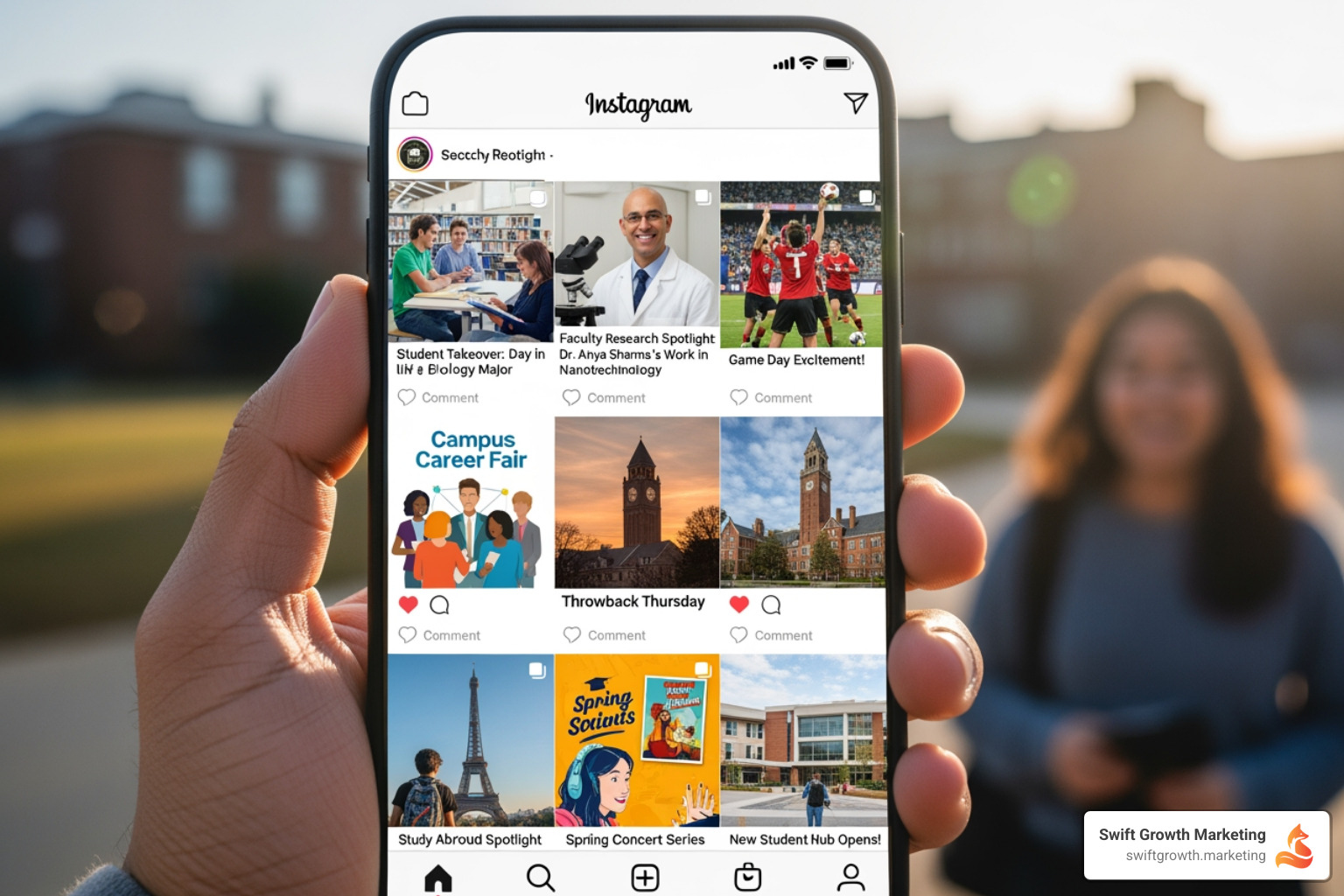
Use platforms like Instagram for visual storytelling and LinkedIn for professional achievements. For more ideas, explore How SMBs can use AI to win on social media in 2025.
Leveraging Paid Ads for Targeted Recruitment
Paid advertising provides immediate, highly targeted reach. Use it to complement your organic efforts:
- Google Ad campaigns; place your program in front of students actively searching for DPT programs in your area, like Pittsburgh or Wheeling.
- Social media ads allow for precise targeting based on undergraduate majors, interests, and demographics.
- Retargeting keeps your program top-of-mind for website visitors who haven’t yet applied.
- Geographic targeting focuses your budget on regions with qualified applicants.
A smart paid ad strategy puts your program in front of high-intent applicants. For a comprehensive guide, check out the Google Ads Growth Formula: How to Create Growth at Scale.
The Human Element: Leveraging Your Community for Recruitment
Your most powerful dpt program marketing assets are your people. The authentic stories from students, faculty, and alumni provide the social proof that prospective students need before committing to a program.
Activating Your Greatest Assets: Students, Faculty, and Alumni

Prospective students trust real experiences over polished brochures. Leverage your community to build that trust:
- Faculty members bring credibility. Faculty-led webinars and Q&As allow applicants to experience your teaching style and passion firsthand, creating powerful connections.
- Current students are peer ambassadors. Through ambassador programs, they can offer honest, relatable insights into daily life at your institution, from the workload at Carlow University to the community at Wheeling University.
- Alumni are your living proof. Alumni spotlights and testimonials demonstrate the long-term value of your education, showcasing graduates making an impact in Pittsburgh, Wheeling, and beyond.
Create testimonial videos to capture these authentic voices. As seen in this Vimeo showcase of student stories, these videos provide a genuine window into the student experience. Also, consider referral programs to encourage your community to spread the word.
Maximizing Virtual and In-Person Recruitment Events
Recruitment events are crucial for turning prospects into applicants. Offer a flexible mix of virtual and in-person options to meet different needs:
- Virtual open houses: Make them interactive with breakout rooms for small-group chats with faculty, students, and admissions staff.
- Campus tours: While irreplaceable for experiencing campus life at places like Pitt, they should be paired with high-quality virtual tours for 24/7 access.
- Informative events: Go beyond basic info sessions with application workshops to remove barriers and informal coffee chats with faculty to build personal connections.
Every touchpoint is a chance to build relationships. When prospective students can envision themselves as part of your community, your marketing transforms from information sharing to relationship building, which ultimately drives enrollment.
Measuring Success and Future-Proofing Your Strategy
A data-driven approach is essential to refine your dpt program marketing strategy, optimize your budget, and stay ahead of the competition. Measuring what matters allows you to make informed decisions instead of guessing what works.
Tracking the KPIs That Matter for DPT Program Marketing
To determine if your marketing is effective, track key performance indicators (KPIs) that connect directly to enrollment goals:
- Website Traffic & Lead Generation: Are your SEO and ad efforts driving visitors to your site and encouraging them to fill out request information forms?
- Application Rate: What percentage of leads submit an application? This measures the effectiveness of your messaging and engagement.
- Cost Per Application: How efficiently are you spending your budget? This helps identify the most cost-effective channels.
- Enrollment Metrics: What is your yield rate? This is the ultimate measure of success for programs at institutions like the University of Pittsburgh or Wheeling University.
Monitoring these KPIs helps you understand your return on investment (ROI). For more tips, read about getting a better ROI from your growth marketing budget.
Embracing Emerging Trends in Higher Education Marketing
Your strategy must evolve with the marketing landscape. The programs that thrive will be those that innovate while remaining authentic. Key trends include:
- AI-Powered Personalization: Use AI to send custom messages based on an applicant’s specific interests, creating a more personal experience at scale.
- Virtual Reality (VR) Tours: Offer immersive campus tours to prospective students anywhere, which is especially valuable for attracting out-of-state applicants to programs in Pittsburgh or Wheeling.
- Marketing to Non-Traditional Students: Tailor your messaging to address the unique concerns of career changers, who bring valuable experience to your program.
- Micro-Influencers: Leverage your own students and alumni, whose authentic stories on social media are highly persuasive and relatable.
The future of recruitment is personalized, immersive, and authentic. To learn how technology is shaping these trends, read more about AI and growth marketing.
Conclusion
Effective dpt program marketing weaves together digital strategy with authentic human connection. Success depends on three core pillars: a strong digital foundation, authentic storytelling, and data-driven decision-making.
First, build a strong digital presence. With SEO driving over 1000% more traffic than organic social media and 76% of consumers visiting a website first, your online visibility is paramount.
Second, leverage authentic storytelling. The voices of your students, faculty, and alumni build the trust that drives enrollment far more effectively than any brochure.
Third, commit to data-driven decisions. Tracking KPIs like lead generation, application rates, and cost per enrollment ensures you are continuously refining your strategy for maximum impact.
The marketing landscape will continue to evolve with trends like AI and VR. The programs that thrive will be those that innovate while remaining grounded in authenticity.
If you’re ready to implement these strategies and transform your enrollment outcomes, Swift Growth Marketing can help. We specialize in building comprehensive marketing strategies for education programs, helping you stand out in a competitive landscape. Learn more about our Growth Marketing Consultancy services and let’s discuss your program’s future.