

Why B2B SaaS Marketing Demands a Different Playbook
B2B SaaS marketing is the process of promoting subscription-based software to businesses, focusing on acquisition, activation, retention, and expansion. Unlike traditional B2B marketing, it uses a flywheel approach where customer success drives growth through referrals, renewals, and upsells.
Key differences that make B2B SaaS marketing unique:
- Subscription model – Revenue is recurring, not transactional.
- Longer sales cycles – Multiple stakeholders evaluate intangible products.
- Retention is critical – Customer churn directly impacts lifetime value.
- Product-led growth – The product itself can drive acquisition.
- Data-driven iteration – Continuous optimization based on user behavior.
The SaaS landscape is competitive. Research shows companies now spend 50% more on SaaS products than a few years ago, and the number of apps businesses use has jumped by 30%. This commoditization means standing out requires strategic positioning, authentic content, and a relentless focus on customer success.
A strong B2B SaaS marketing strategy can transform a startup, while the wrong approach burns through budgets. The difference is understanding that SaaS marketing builds strategies that drive brand awareness, user acquisition, and customer retention—not just lead generation.
I’m Chris Hornak, Co-Founder of Swift Growth Marketing. We’ve helped SaaS companies become category authorities through strategic positioning and search optimization. I’ve seen how an integrated approach—combining content, SEO, and customer-centric strategy—creates compounding growth.
Understanding the Unique Landscape of B2B SaaS Marketing
B2B SaaS marketing involves selling intangible, cloud-based solutions that solve complex business problems. We’re not just pitching features; we’re selling efficiency and a vision for our clients’ businesses.
This intangibility complicates the sales process. Cycles are longer because multiple stakeholders need convincing. The CFO wants ROI, the IT director needs security, and end users demand an intuitive interface. Your marketing must address all these concerns.
What truly separates B2B SaaS marketing is its focus on long-term partnerships, not single transactions. Success depends on customer lifetime value (LTV), making retention existential. Customer churn hits SaaS companies harder than almost any other business model because it erases future revenue streams.
That’s why our Growth Strategy Framework covers the entire customer journey—from acquisition to long-term delight.
What Makes B2B SaaS Marketing Unique?
The subscription model shifts the focus from one-time sales to Monthly Recurring Revenue (MRR). Every customer must renew, or the acquisition cost becomes a loss. This changes the marketing mindset from “close the deal” to “prove value continuously.”
Because of this, customer churn is the primary threat. Marketing must extend throughout the customer lifecycle to prove the product’s worth and adapt to changing needs.
The B2B buying process adds complexity, as we sell to committees, not individuals. Representatives from IT, finance, and operations all have different priorities, which naturally lengthens the sales cycle as they work toward a consensus.
However, the rise of product-led growth (PLG) offers a new advantage. The product itself can drive acquisition, allowing customers to experience its value firsthand, often without speaking to a sales rep. Companies like Asana and Dropbox built massive user bases with freemium models.
This is supported by self-service analytics and comparison tools that empower buyers to research options independently. Your product and content must work together to provide compelling, accurate information.
The Modern SaaS Funnel: From Funnel to Flywheel
The traditional marketing funnel ends at conversion. In B2B SaaS marketing, that’s just the beginning. The real growth happens after a user becomes a customer.
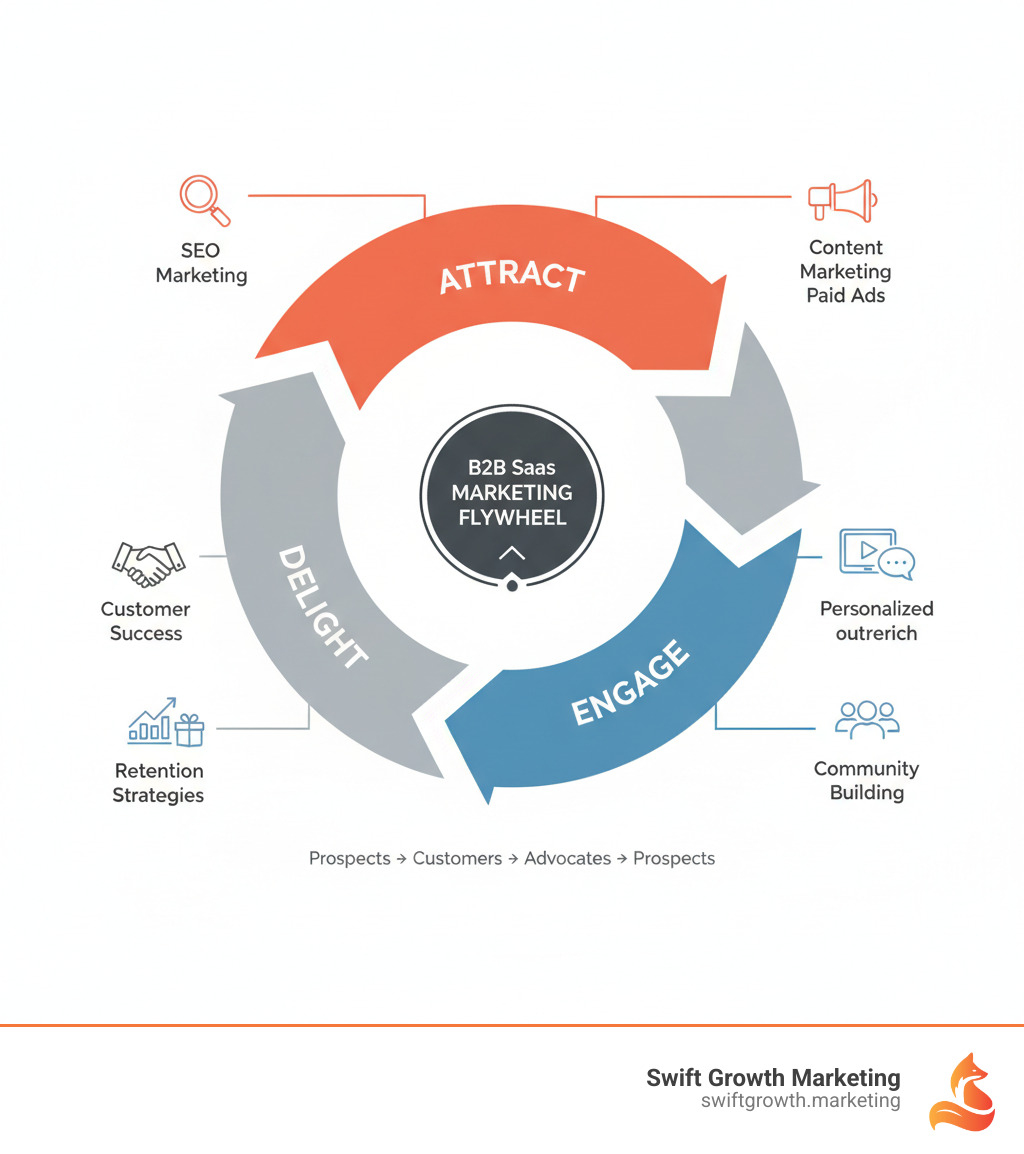
This is why we use the flywheel model, which recognizes that happy customers are your best marketing asset. They refer colleagues, leave positive reviews, and become case studies, creating a self-sustaining cycle of growth.
The flywheel has several stages: Acquisition brings in new users, Engagement guides them to value, Retention keeps them satisfied, and Expansion encourages upsells and deeper feature adoption.
The most powerful element is growth loops that integrate referrals directly into the product. Slack grows when users invite their teams. Platforms like beehiiv include a “Publish on beehiiv” badge in emails, driving recipients to explore the product. These loops generate compounding returns.
Foundational Elements Before You Start
Before choosing tactics, you need a solid foundation. As Brian Balfour, former VP of Growth at HubSpot, noted, your business model, channels, market, and product must align. There is no universal playbook.
- Business Model: Your model—freemium, free trial, or demo-request—shapes your marketing strategy and attracts different types of customers.
- Funding and Budget: Your budget determines your growth velocity. Bootstrapped companies often favor slower-burn strategies like SEO, while VC-backed companies prioritize rapid growth through paid channels. Large businesses like Salesforce may allocate 40-50% of annual revenue to marketing.
- Ideal Customer Profile (ICP): You need a clear ICP and detailed buyer personas. Who benefits most from your product? What are their roles and pain points? Without this, your marketing has no focus.
- Customer Pain Points: Successful B2B SaaS marketing positions your solution as indispensable by speaking directly to the problems your prospects face.
- Product-Channel Fit: The right marketing channels vary by product. Finding the fit requires continuous experimentation and analysis of what works for your specific product and market.
Core Strategies to Build Your Brand and Generate Demand
Building a strong brand and generating consistent demand are the lifeblood of B2B SaaS marketing. The goal is a sustainable growth engine that compounds over time. As we look toward 2025: The Year You Finally Win at Digital Marketing, the focus must be on creating value and establishing authority.

It’s important to distinguish between demand generation and lead generation. Lead generation collects contact info. Demand generation creates genuine interest in your solution before asking for a sale. This approach warms up your audience, leading to more satisfied customers, lower acquisition costs, and reduced churn.
Dominate Organic Search with Content Marketing and SEO
Content and SEO are the foundation of long-term B2B SaaS marketing success. Your website should be a resource hub that establishes you as a niche expert.
Effective content answers real buyer questions while being optimized for search engines. This includes feature pages explaining your product, use case pages showing industry benefits, and comparison pages that honestly position you against alternatives. Notion excels at this, building trust with detailed customer studies and testimonials.
Subject matter expertise is essential. When you create truly helpful content, you build trust and position yourself as a partner, not just a vendor.
To dominate organic search, organize your content using Content Clusters: Build Topical Authority with Pillar-Cluster Architecture. This involves creating broad pillar pages supported by specific cluster content, building a knowledge ecosystem around your expertise.
These pillar pages play a crucial role in your growth marketing strategy by acting as comprehensive guides that attract high-intent leads.
An effective SEO Marketing strategy drives leads without constant reliance on paid ads. One such strategy increased a client’s website traffic from 6,000 to 35,000 visitors in a year. We’re always exploring SEO Growth Hacks to stay ahead.
Engage Prospects with Video and Social Media
Video and social media deliver information quickly and engagingly. According to Wyzowl research, 66% of customers prefer watching a video to reading about a product. This signals that video should be central to your strategy. Use video snippets on LinkedIn, create FAQ series on YouTube, and share content where prospects spend their time.
Video is perfect for product demos, showing how your software solves problems in real-time. Webinars take this further by allowing direct interaction with prospects. Companies like Clearscope host webinars with industry experts to build brand credibility.
For B2B companies, LinkedIn is key. Social Media Marketing on LinkedIn provides direct access to decision-makers. Share blog snippets, tips, and polls to encourage engagement and build a community.
Understanding your Brand Voice on Social Media is crucial. Join conversations on platforms like LinkedIn and Twitter to let your brand’s personality shine.
Drive High-Intent Leads with ABM and Paid Advertising
While organic strategies build long-term authority, Account-Based Marketing (ABM) and paid ads can deliver high-intent leads more directly.
Account-Based Marketing (ABM) is highly effective for B2B SaaS. It aligns sales and marketing to target high-value accounts with personalized campaigns. Data shows 85% of SaaS companies say ABM delivers higher returns than other marketing approaches, focusing on quality over quantity.
Hyper-personalized targeting is non-negotiable. Use intent data and list segmentation to deliver messages custom to the needs of target accounts. Tools like Instantly and Apollo help build targeted lead lists for personalization at scale.
Pay-per-click (PPC) campaigns remain a popular B2B SaaS marketing tactic for the control they offer. They allow you to reach prospects actively searching for solutions, often at a lower cost than traditional advertising.
Our Google Ads Growth Formula: How to Create Growth at Scale explains how to leverage paid search by focusing on benefits and pain points to capture high-intent users.
Retargeting keeps your brand top-of-mind after a prospect interacts with you, nudging them down the funnel. Our B2B Growth Marketing Case Study shows how targeted paid campaigns and strong content can drive significant results when integrated.
Fostering Loyalty, Advocacy, and Scalable Growth
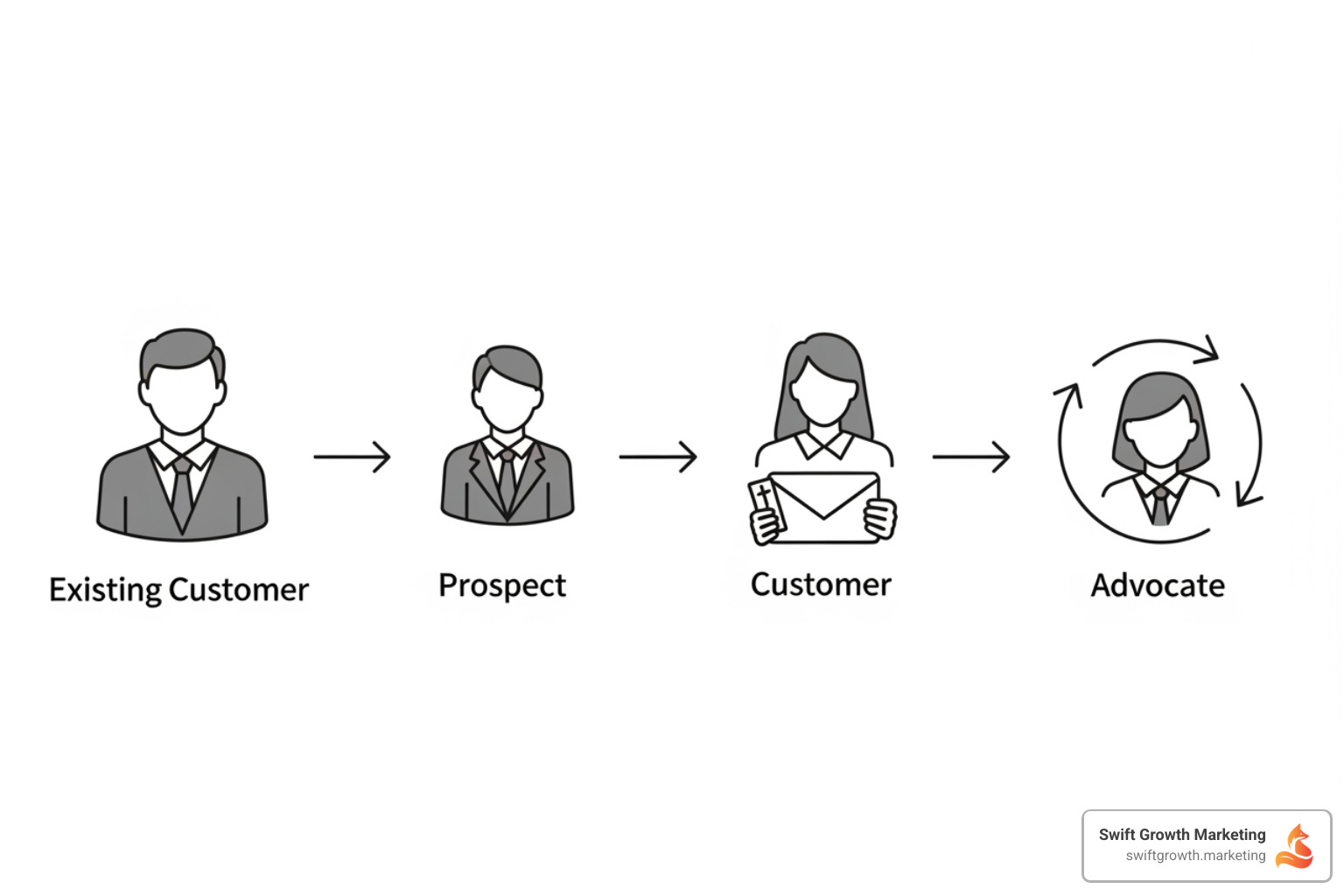
In B2B SaaS marketing, the real work begins after the sign-up. Post-purchase engagement is the engine that powers sustainable growth. When done right, customers become your most powerful growth channel—they stay longer, spend more, and refer others. This is where loyalty transforms into advocacy, creating word-of-mouth momentum no ad budget can buy.
Build a Thriving Community and Newsletter Audience
A community around your product creates a space for customers to connect, share insights, and engage with your brand. This facilitates connections that strengthen loyalty and provide invaluable feedback.
Gong’s Visioneer Community is a prime example, creating a space where customers network and learn from each other. When prospects see active, engaged customers, it signals long-term value and reduces buyer decision fatigue. These communities also create powerful user feedback loops, offering real-time intelligence on product use.
A well-crafted newsletter complements community building. The best newsletters provide genuine value that helps readers solve problems, with product updates as a side benefit. Animalz’s newsletter shares real-world marketing insights, generating sign-ups because people want to hear from them. We practice this with our own bi-weekly newsletter, The Loop Digest, building relationships through consistent value.
Scale with Affiliate Programs and Influencer Marketing
Word-of-mouth is the most trusted form of marketing, and you can amplify it with affiliate programs and influencer partnerships.
Affiliate programs offer predictable, scalable growth with controllable acquisition costs. You build a sales force that gets paid only for results. Jasper AI built a thriving program by offering ongoing commissions that keep partners motivated.
Many long-term customers will gladly refer others with a small nudge. Setting up a referral program with clear incentives makes this easy. Trello offers a free month of Trello Gold for each successful referral, turning users into promoters.
B2B influencer marketing focuses on micro-influencers who are genuine subject matter experts with niche audiences. These partnerships feel authentic because the influencers actually use and understand the tools they recommend. Sara Stella Lattanzio’s collaboration with Semrush is a perfect example; she shares real experiences using the tools, which feels helpful, not promotional.
Leverage Manual Outreach and Product Launches
For enterprise SaaS or products with long sales cycles, personalized manual outreach remains powerful. Generic email campaigns are ineffective; decision-makers spot templates easily. We recommend customizing at least 20% of each message, addressing specific company pain points and referencing recent industry news.
Tools like LinkedIn Sales Navigator and Hunter.io help identify decision-makers, but the magic is in crafting messages that show you’ve done your homework. Always lead with value—share a resource or insight to build trust and open doors for meaningful conversations.
Strategic product launches can generate massive visibility. Launching on Product Hunt can drive thousands of early adopters and tech professionals to your site in days. A successful launch requires community engagement and planning, but the resulting visibility and feedback are invaluable.
Measuring Success and Choosing Your Partners
In B2B SaaS marketing, data guides every decision. We don’t rely on hunches; we look at numbers to see if our efforts are driving real growth. We must track metrics that directly impact revenue and customer relationships.
Choosing the right partners is also critical to your growth. Whether building an in-house team or hiring an agency, you need people who understand the unique challenges of B2B SaaS marketing. If you’re considering external help, our guide on Choosing the Best Growth Marketing Consultancy for Your Business explains what to look for.
Key Metrics for Measuring B2B SaaS Marketing Success
We must look beyond surface-level indicators. As Growth Advisor Gaetano Nino DiNardi says, we need to examine the entire funnel and what happens after the sale. The customer journey doesn’t end at conversion.
Here are the metrics that show if your B2B SaaS marketing strategy is working:
| Metric | Definition | Why it Matters for SaaS |
|---|---|---|
| Customer Acquisition Cost (CAC) | The total cost of acquiring a new customer, including all marketing and sales expenses. | Measures the efficiency of converting prospects. If CAC is too high relative to customer payments, the model is unsustainable. |
| Lifetime Value (LTV) | The total revenue expected from a customer over their entire relationship with the company. | Shows the long-term value of customer relationships. A healthy business aims for an LTV:CAC ratio of at least 3:1. |
| Monthly Recurring Revenue (MRR) | The predictable revenue received each month from subscriptions. | This is the heartbeat of a SaaS business. Growing MRR indicates positive momentum. |
| Churn Rate | The percentage of customers who cancel their subscriptions in a given period. | Churn is the silent killer of SaaS companies. Even a small monthly churn rate compounds into significant annual losses. |
| Lead Velocity Rate | The month-over-month growth rate in qualified leads. | A leading indicator of future revenue growth. If the lead pipeline is growing, revenue should follow. |
Beyond these, the Lead-to-Customer Rate shows how effectively marketing and sales convert interest into revenue. A low rate indicates a conversion problem that needs to be addressed.
Common Pitfalls to Avoid in B2B SaaS Marketing
Even experienced marketers can make mistakes that derail a B2B SaaS marketing strategy.
- Ignoring customer retention: Many companies obsess over acquisition while existing customers leave. In a subscription business, retention is as important as acquisition.
- Focusing on lead quantity over quality: Thousands of poor-fit leads waste the sales team’s time. It’s better to have 50 high-quality leads than 500 who will never convert.
- Misaligned sales and marketing teams: When these teams don’t work together on goals and definitions, friction arises and prospects suffer. They should operate as a single revenue engine.
- Choosing the wrong agency: Not all agencies understand SaaS dynamics. Some apply tactics from e-commerce or traditional B2B that fall flat. Be aware of the Biggest SEO Mistakes that can hurt organic growth.
How to Choose the Right B2B SaaS Marketing Agency
Partnering with the right agency can accelerate growth, while the wrong one drains your budget.
- SaaS-specific expertise: This is non-negotiable. Ask about their experience with subscription models, MRR, churn, and product-led growth. Generic B2B experience isn’t enough.
- A data-driven approach: The best agencies back up promises with data. They should show how they’ll track performance, define KPIs, and optimize based on results.
- Focus on business outcomes: The right partner focuses on revenue, not just marketing metrics. They should structure their work around driving qualified leads, lowering churn, and increasing expansion revenue.
- Cultural fit: You’ll be working closely with this team. Ensure their communication style and values align with yours for a successful long-term partnership.
The vetting process should be thorough. Ask to speak with current and former clients. Our guide on 7 Essential Questions to Ask SEO Experts Before You Hire Them provides a solid framework for evaluating partners. The best agencies ask thoughtful questions to understand your unique situation before proposing a solution.