

Why Growth Marketing is the Future of Sustainable Business Expansion
Growth marketing is a data-driven, full-funnel approach to building sustainable business growth. It relies on continuous experimentation, customer-centricity, and optimization across the entire customer lifecycle—not just acquisition. Unlike traditional marketing, which often stops at the first purchase, growth marketing is concerned with the entire AAARRR funnel: awareness, acquisition, activation, retention, revenue, and referral.
Key elements that define this approach include:
- Full-funnel focus: Optimizing every stage from awareness to referral.
- Data-driven experimentation: Using A/B testing and analytics to validate decisions.
- Customer lifecycle emphasis: Prioritizing retention and referrals alongside acquisition.
- Agile iteration: Rapidly testing, learning, and scaling what works.
- Cross-functional collaboration: Integrating marketing, product, sales, and customer success.
This methodology emerged from the startup world, where Sean Ellis coined the term “growth hacking” in 2010 to describe this experimental, metrics-obsessed approach. It has since evolved into a dominant strategy for companies of all sizes, leveraging modern digital capabilities to track customer interactions, test campaigns quickly, and personalize experiences at scale. Growth marketing builds a systematic engine for expansion that compounds over time.
As Co-Founder of Swift Growth Marketing, I’ve used data-driven growth marketing to turn brands into category authorities, achieving results like a 764% traffic increase for our clients. This guide distills those lessons into a practical framework for your business.
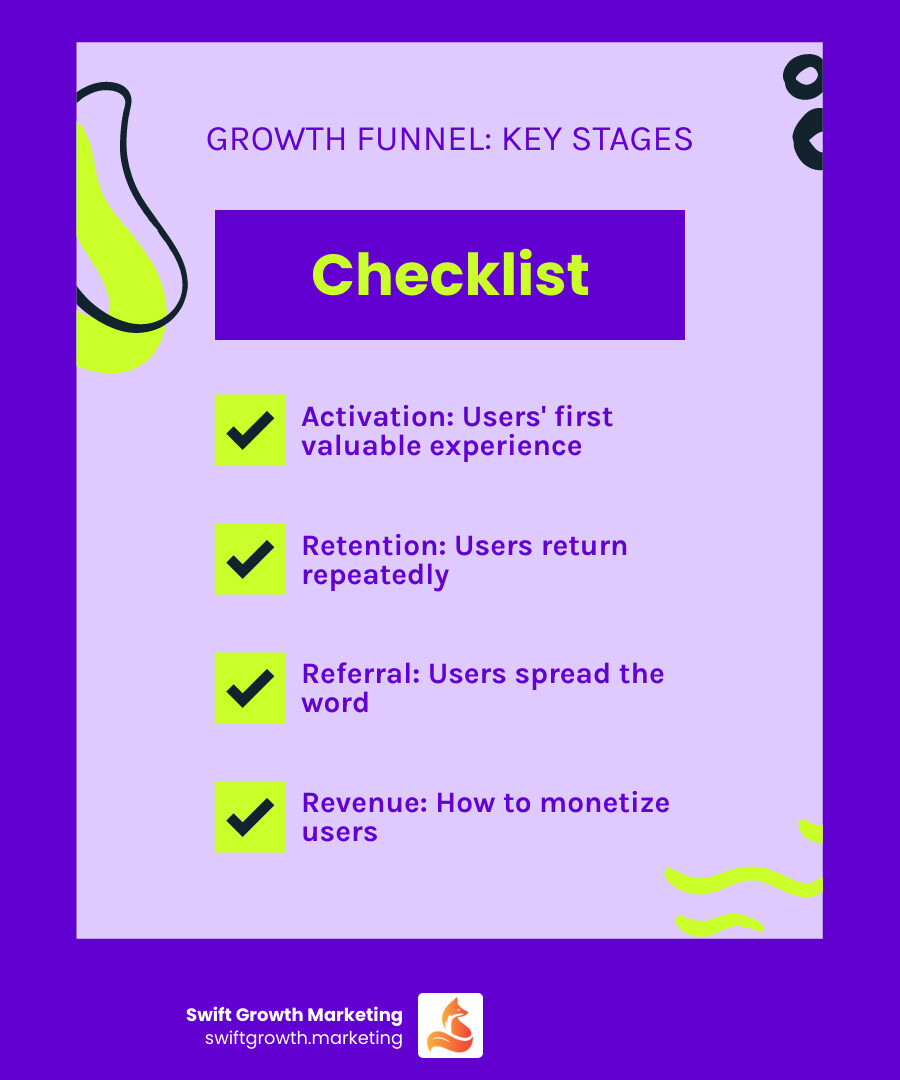
Foundations of Growth Marketing: Beyond Traditional Tactics
The story of growth marketing began in 2010 when Sean Ellis coined the term “growth hacking” to describe a new, data-obsessed approach to building businesses. This evolved into growth marketing, a more mature strategy focused on sustainable revenue growth by optimizing the entire customer journey, not just acquiring new leads.
While traditional marketing often focuses on filling the top of the funnel, growth marketing works to ensure customers stick around, get value, and become brand advocates. It’s concerned with activation, retention, referral, and monetization—maximizing what each customer relationship is worth over time.
Here’s how traditional marketing and growth marketing stack up:
| Traditional Marketing | Growth Marketing |
|---|---|
| Top-funnel focus | Full-funnel focus |
| Brand awareness | Customer lifetime value |
| Static campaigns | Iterative experiments |
| Limited data use | Data-centric |
The difference is a fundamental shift in strategy, centered on a few core principles.
How Growth Marketing Differs
Growth marketing views the customer journey as a continuous cycle, not a straight line to a sale. It emphasizes retaining existing customers, as it’s far more cost-effective than acquiring new ones. This requires a holistic approach where marketing, product, analytics, and support teams collaborate to improve the entire customer experience.
This strategy is defined by several key departures from traditional methods:
- Integration with Product: Growth marketers provide customer data to product teams, helping shape the product itself into a growth driver.
- Agile Process: Instead of long, static campaigns, growth marketers run quick experiments, measure results, and adapt rapidly based on data.
- Customer-Centricity: Every decision is informed by real customer behavior and feedback, with the goal of providing genuine value at every touchpoint.
- Scalability: The ultimate goal is to identify winning strategies through experimentation and then scale them across the business to create compounding growth.
By putting the customer at the center of an evidence-based, iterative process, growth marketing builds lasting relationships and sustainable success. To dig deeper, explore the Key Elements of Growth Marketing on our blog.
The Core Philosophy
At its core, growth marketing rests on a simple but powerful idea: put your customers at the center of everything you do. This customer-centricity isn’t just a buzzword—it means deeply understanding what your customers need, what frustrates them, and what makes them tick. Then you tailor every aspect of their journey to provide genuine value.
We’re not guessing what customers want. Growth marketing is an evidence-based process that leans heavily on data analysis. Every decision is informed by real numbers, real behavior, and real results. Instinct has its place, but data tells the truth. This analytical foundation ensures you’re not wasting resources on strategies that sound good but don’t actually work.
The magic happens through continuous optimization. Growth marketing accepts a culture of experimentation where you’re constantly testing new ideas, measuring results, and iterating based on what you learn. This cycle of testing, learning, and adapting never stops. Your marketing efforts are always improving, always getting sharper, always getting closer to what actually drives growth.
Of course, all this experimentation and optimization serves a bigger purpose: scalability. The goal is to identify what works and then scale it up across your entire business. When you find a winning strategy, you don’t just celebrate—you figure out how to make it bigger, reach more people, and create even greater impact.
But perhaps most importantly, growth marketing is about building relationships that last. We don’t view customers as transactions or numbers on a spreadsheet. The customer lifecycle is more like an hourglass than a funnel—it extends beyond that first purchase to create ongoing value, drive active engagement, and build genuine loyalty. When you understand your customers this deeply and serve them this well, they don’t just buy from you. They stick with you, they grow with you, and they tell everyone they know about you.
That’s the foundation of growth marketing—and it’s why this approach has become the dominant strategy for businesses that want to build sustainable, long-term success.
The Growth Mindset: Core Principles and Key Aspects

Effective growth marketing requires a scientific mindset. Instead of guessing, you test, measure, and learn. This approach is built on data-driven decision-making, where analytics and customer feedback guide every move. A culture of experimentation is essential, using tools like A/B testing to challenge assumptions and find what truly works.
This requires an agile and iterative mindset. Markets and customer preferences change, so your strategy must constantly evolve. Rather than focusing only on acquisition, growth marketing takes a holistic view, optimizing every stage of the funnel—from awareness to referral and revenue. For more on this, explore our thoughts on the Growth Marketing Mindset.
Benefits and Challenges
Adopting a growth marketing approach offers significant advantages but also comes with challenges.
Benefits:
- Higher-Quality Leads: Data-driven targeting attracts customers who are a better fit.
- Improved ROI: Optimizing the full funnel and focusing on retention maximizes the value of your marketing spend.
- Measurable Success: Constant feedback shows what’s working, allowing for efficient budget allocation.
- Rewards Innovation: A fast testing cycle allows you to outpace competitors.
Challenges:
- Requires Constant Change: The need to pivot based on data can be demanding.
- Risk of Failure: Not all experiments will succeed; a willingness to learn from failures is key.
- Needs Cross-Functional Buy-in: Success requires collaboration across marketing, product, sales, and service teams.
Customer-Centricity in Action
All the data and testing serve one primary goal: to better understand and serve the customer.
- Personalization at Scale: Use automation and data to deliver custom content and offers. McKinsey found 71% of consumers expect personalization.
- Understand User Pain Points: Actively gather feedback through surveys, interviews, and behavioral tracking to identify and solve customer frustrations.
- Improve the User Experience (UX): Use data to pinpoint and fix issues in the customer journey, such as confusing onboarding or a difficult checkout process.
- Build Brand Loyalty: Consistently delivering value and a great experience turns customers into loyal advocates who drive referrals. Happy customers stay longer, spend more, and bring their friends.
Building Your Growth Engine: Strategy, Frameworks, and Metrics
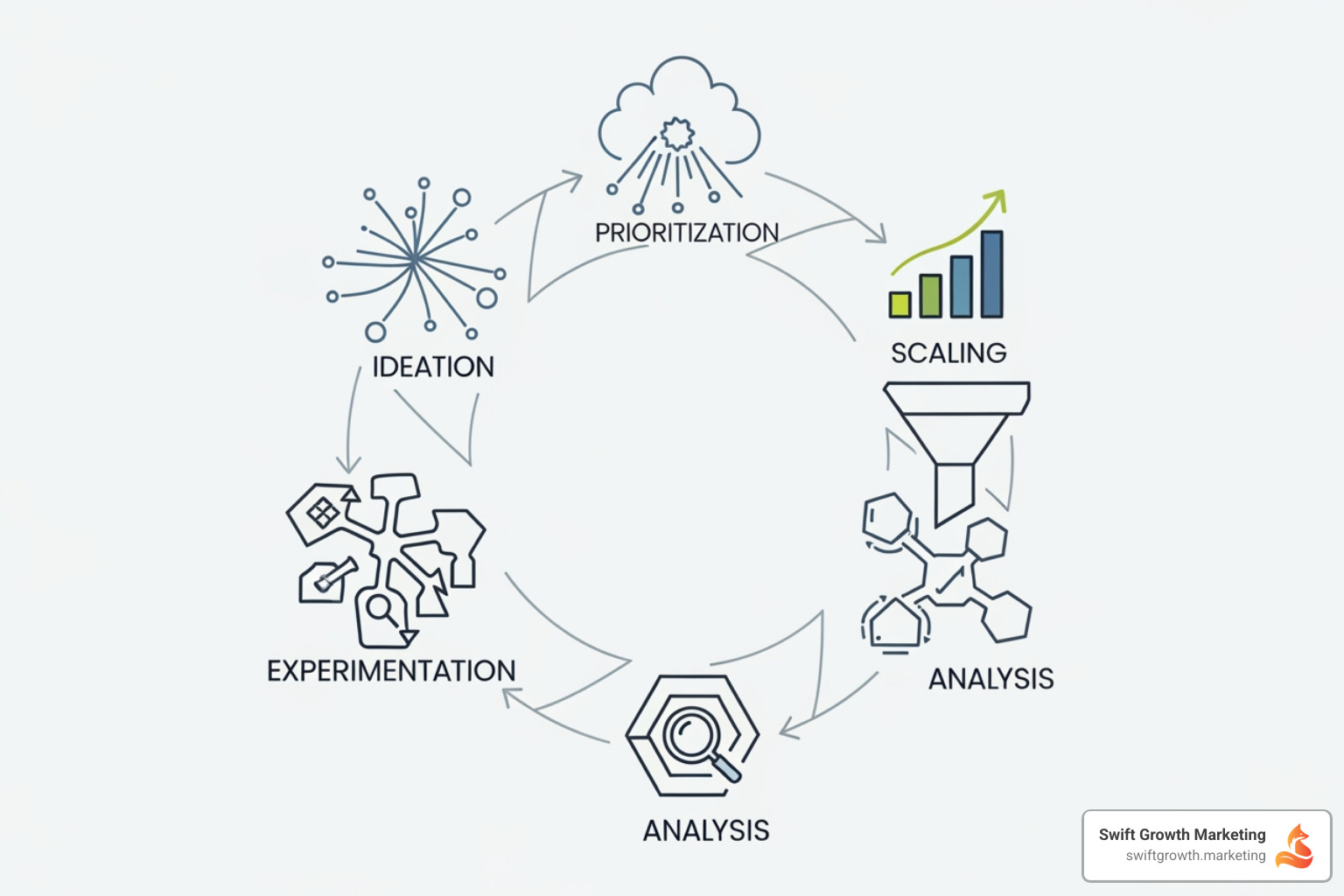
Building a growth marketing engine requires a clear strategy, reliable frameworks, and the right metrics. Success depends on knowing your destination (your North Star Metric), having a system to get there (your experimentation loop), and achieving product-market fit, where your product is so valuable that customers naturally spread the word.
The experimentation loop is a continuous cycle of ideating, prioritizing, testing, and analyzing growth opportunities. This rhythm becomes part of your company’s DNA. For a comprehensive look, check out our Growth Strategy Framework guide.
Essential Components of a Growth Marketing Strategy
A strong strategy optimizes every interaction with your brand.
- Full-Funnel Optimization: Pay attention to all stages of the AAARRR framework (Awareness, Acquisition, Activation, Retention, Referral, Revenue) to prevent a “leaky bucket” of customers.
- Prioritizing Ideas: Use objective frameworks like ICE (Impact, Confidence, Ease) to decide which experiments to run next, removing ego from the equation.
- Scaling and Documenting: When an experiment succeeds, scale it quickly while documenting the process to create a repeatable playbook for your team.
To dive deeper, explore our post on Growth Marketing Components: Accelerate Your Marketing Strategy.
Key Metrics to Track
In growth marketing, metrics are your reality check. Focus on these vital signs for your business:
- Customer Acquisition Cost (CAC): The average cost to acquire a new customer.
- Customer Lifetime Value (CLV): The total revenue you expect from a customer over their entire relationship with you. A healthy business has a CLV at least 3x its CAC.
- Conversion Rate: The percentage of users who take a desired action (e.g., sign up, purchase).
- Retention and Churn Rate: The rate at which customers stick around versus the rate at which they leave.
- Revenue Growth: The ultimate measure of success, often tracked as Monthly Recurring Revenue (MRR) for subscription businesses.
- Return on Investment (ROI): A measure of the profitability of your marketing efforts.
- Virality Coefficient: The number of new customers each existing customer generates through referrals.
- Engagement Metrics: Indicators like time on site or feature usage that show if users are finding value in your product.
Tools, Skills, and Careers in the Growth Ecosystem

The modern growth marketer is part analyst, part creative, and part technologist, leveraging a vast ecosystem of tools and skills to drive results.
Marketing Automation Impact
Marketing automation is fundamental to growth marketing, enabling personalization at scale, streamlined lead nurturing, and efficient customer relationship management (CRM). It allows businesses to send the right message at the right time, creating a consistent experience that builds loyalty and scales with your customer base.
AI in Growth Marketing
Artificial intelligence (AI) is further revolutionizing the field. With the rise of personal AI agents, the customer data landscape is shifting, challenging traditional attribution models. Gartner predicts a 25% drop in search traffic by 2026 due to AI. However, AI also presents immense opportunities for marketers to process vast amounts of data for deeper insights, automate repetitive tasks, and enable hyper-personalization. To learn more, read our article on AI and Growth Marketing.
Essential Tool Categories
A growth marketer’s toolkit includes various platforms:
- Analytics and Reporting: Google Data Studio, Tableau for creating dashboards and monitoring KPIs.
- A/B Testing: VWO, Optimizely, Hotjar for running experiments without extensive coding.
- CRM Software: Salesforce, HubSpot, Zoho for managing customer interactions and data.
- Social Media Management: Hootsuite, Buffer, Sprout Social to streamline social presence.
- SEO Tools: SEMrush, Moz, Ahrefs for keyword research, competitive analysis, and rank tracking.
Essential Skills for a Growth Marketing Professional
Success in this field requires a blend of hard and soft skills:
- Data Analysis: The ability to interpret data, spot trends, and translate numbers into strategy.
- Creativity and Curiosity: A mindset of constantly asking “what if?” and testing unconventional ideas.
- T-Shaped Marketer: Broad knowledge across many marketing disciplines with deep expertise in one or two areas.
- Technical Skills: Basic understanding of HTML/CSS, APIs, or SQL to be more self-sufficient.
- Channel Expertise: Deep specialization in a key channel like SEO, PPC, or content marketing.
- Project Management: The ability to juggle multiple experiments and initiatives effectively.
Career Paths and Roles
The rise of growth marketing has created several in-demand roles that require cross-functional collaboration with product, sales, and engineering teams.
- Growth Marketing Manager: Focuses on optimizing the funnel through data analysis and experimentation.
- Director of Growth Marketing: Operates at a strategic level, overseeing the entire growth strategy.
- Growth Hacker: Common in startups, this role focuses on rapid, low-cost experimentation.
- Product Marketing Manager: Collaborates with growth teams to communicate product value and messaging.
These roles are projected to see healthy demand, with the Bureau of Labor Statistics projecting 6 percent growth for marketing managers from 2022 to 2032.
Frequently Asked Questions about Growth Marketing
Here are answers to some of the most common questions we hear about growth marketing.
How can a small business start with growth marketing?
Growth marketing was born in the startup world, making it perfect for businesses with tight budgets. You don’t need expensive tools to begin.
- Start small: Pick one key metric to improve, like repeat purchases or client retention. This is your North Star.
- Listen to your customers: Read reviews, send simple surveys, and analyze support conversations. This feedback is a goldmine for insights.
- Run simple experiments: Use free tools like Google Analytics to test different headlines, email subject lines, or calls-to-action. Track the results and learn.
This cycle of testing, learning, and iterating is the heart of growth marketing. Small, consistent improvements compound into significant growth over time.
Is growth marketing just for startups?
No. While startups use it for rapid scaling, established companies apply the same principles to optimize existing channels, launch new products, and improve retention. A 2% improvement in retention at a large company can translate to millions in revenue. The core philosophy—using data to understand customers and experimenting continuously—works for any business size. It’s about culture, not company size.
What is the difference between growth marketing and performance marketing?
Though related, these terms have different scopes.
Performance Marketing is a subset of growth marketing focused on the immediate, measurable results of paid channels. It optimizes for short-term metrics like cost-per-click (CPC) and return on ad spend (ROAS).
Growth Marketing is a holistic strategy that covers the entire customer lifecycle (AAARRR). It uses both paid and organic channels (SEO, content, email) and focuses on long-term, sustainable growth by improving metrics like Customer Lifetime Value (CLV) and retention.
Think of performance marketing as a tactic within the broader growth marketing strategy. You need both to acquire customers efficiently and ensure they become long-term, valuable assets to your business.
Conclusion
We’ve explored growth marketing as a data-driven, full-funnel discipline that prioritizes continuous learning and customer-centricity. It’s a fundamental shift from traditional tactics, embracing agility and innovation to build sustainable growth.
The future of marketing is iterative. By adopting a growth marketing mindset, businesses can acquire, activate, and retain customers, turning them into loyal advocates. This approach provides a clear roadmap for success in today’s digital landscape.
At Swift Growth Marketing, we help businesses harness the power of growth marketing to open up their full potential. To implement these strategies and accelerate your expansion, explore our Growth Marketing Consultancy services.