

Why Investment Firm Marketing Strategy Matters More Than Ever
An investment firm marketing strategy is no longer optional—it’s the difference between firms that grow and firms that stagnate. Financial advisors with defined marketing strategies onboard 50% more clients than those without one, yet only 23% of advisors have a documented plan in place.
Core components of an effective investment firm marketing strategy:
- Brand Identity – Clear positioning that builds trust and differentiates your firm
- Digital Presence – Professional website optimized for conversions and search visibility
- Content Marketing – Thought leadership through blogs, whitepapers, and market insights
- SEO & SEM – Strategic search optimization to capture high-intent prospects
- Social Media – Targeted engagement on LinkedIn and other platforms where clients research
- Email Marketing – Personalized nurture campaigns that move prospects toward conversion
- Analytics & Measurement – Data-driven tracking of ROI and campaign performance
The investment landscape has fundamentally changed. Potential clients now spend days or weeks researching advisors online before making contact. If your firm doesn’t appear in those critical early research moments—or if your digital presence fails to communicate expertise and trust—you’ve already lost the opportunity.
The competitive pressure is real. Approximately 70% of businesses are increasing their content marketing budgets this year, and 92% of financial advisors on social media acquire more clients on the platforms they use. Meanwhile, nearly 90% of consumers will switch to a competitor after a poor website experience. The firms winning new business aren’t just better at investing—they’re better at marketing.
The challenge goes deeper than awareness. Investment firms face unique obstacles: strict compliance requirements, long sales cycles, difficulty measuring attribution, and internal teams stretched too thin. Sixty-five percent of financial advisors struggle to find time for marketing, and only 20% leverage third-party support. Yet growth-focused advisors invest four times more in marketing than their non-growth-focused counterparts—and see dramatically better results.
I’m Chris Hornak, Co-Founder of Swift Growth Marketing, where we’ve helped financial services brands build authority through strategic positioning and search optimization. Throughout this guide, I’ll show you how to build an investment firm marketing strategy that attracts qualified prospects and converts them into long-term clients.
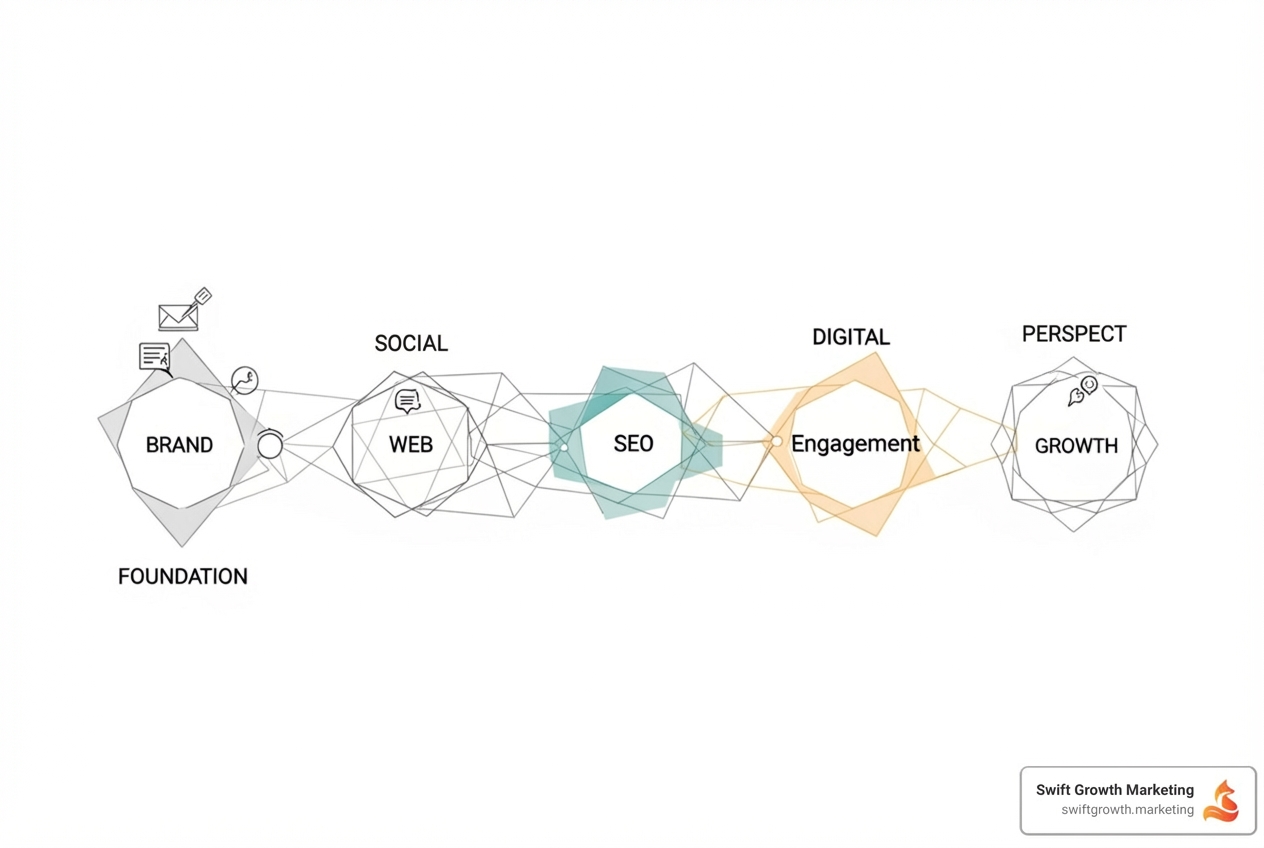
Know your investment firm marketing strategy terms:
Foundations of a Winning Investment Firm Marketing Strategy
A successful investment firm marketing strategy is built upon a solid foundation. This isn’t just about getting attention; it’s about establishing trust, clarity, and a reputation that resonates with your ideal clients.
Building a Brand That Inspires Trust
What role does brand identity play in building trust and credibility for investment firms? In a word: everything. Your brand is more than just a logo; it’s the sum total of how your firm is perceived. It encompasses your mission statement, your unique value proposition, and the consistent visual elements that represent you. A strong brand identity clearly communicates your expertise, transparency, and values, which are paramount in the investment industry.
For private equity firms, branding isn’t merely about standing out; it’s about creating tangible value. A clear, compelling identity uniquely positions your firm among limited partners (LPs), founders, intermediaries, and competitors. It tells a cohesive story—your investment philosophy, portfolio wins, sector insight, and leadership credibility. This narrative should clearly communicate your uniqueness, whether through your deal-making approach, operational expertise, or commitment to environmental, social, and governance (ESG) principles. Our guide on Strategic Messaging That Builds Trust and Drives Action digs deeper into crafting messages that resonate.
Consistency across all touchpoints, from your website to your pitchbooks, reinforces your brand’s credibility. It assures potential clients that you are a stable, reliable partner. Effective Financial Advisor Branding means building a potent brand identity that becomes the cornerstone of your success, fostering trust and long-term partnerships.
Identifying and Segmenting Your Ideal Client Audience
How can investment firms effectively identify and target their ideal client audience? This is a critical first step. Without a clear understanding of who you’re trying to reach, your marketing efforts will be like shouting into the wind—loud, but ineffective.
We start by defining your target audience. Consider factors like age, gender, income, location, and interests. For instance, are you aiming for High-Net-Worth Individuals (HNWIs) in Pittsburgh, PA, or institutional investors in Wheeling, WV? Perhaps you’re looking to attract the NextGen investors who are inheriting wealth.
Creating detailed client personas helps bring these audiences to life. Imagine a “Gen X Professional Pre-Retiree” persona—what are their financial concerns, their preferred communication channels, and their investment goals? By segmenting your audience, you can tailor your messaging and marketing channels to speak directly to their needs. A McKinsey report highlights that customer intimacy directly correlates with faster revenue growth rates, underscoring the importance of personalization.
The financial industry is experiencing a “great wealth transfer” from Baby Boomers to their heirs, making it crucial to understand how to reach younger demographics. Social media, for example, can be an ideal channel for this. Identifying niche markets allows you to become a specialist, carving out a unique position in a crowded landscape.
Creating a High-Performance Website: Your Digital Front Door
What is the importance of a professional and user-friendly website for investment firms? Simply put, your website is your digital storefront, often the first impression potential clients have of your firm. And first impressions matter. A staggering 98% of financial advisors are investing in their websites, recognizing its pivotal role.
Your website must be visually appealing, easy to steer, and packed with essential information. It needs to reflect the quality, experience, transparency, and value of your firm. Consider these statistics: nearly 90% of consumers will switch to a competitor after a poor website experience, and websites with excellent user experience boast 400% higher conversion rates. Moreover, 60% of people won’t recommend a business if its website renders poorly on mobile.
This means prioritizing:
- User Experience (UX): Is it intuitive and pleasant to use?
- Mobile Optimization: Does it look and function perfectly on all devices?
- Clear Calls-to-Action (CTAs): Do visitors know what step to take next?
- Fast Loading Speed: Visitors won’t wait around for slow sites.
A professional website is not just an online brochure; it’s a critical tool for building trust and generating leads. A comprehensive SEO Foundation Complete Guide will help ensure your digital storefront is not only beautiful but also findable.
Executing Your Digital Marketing Playbook
With a strong foundation in place, it’s time to execute your digital marketing playbook. This involves strategically deploying various channels to attract, engage, and convert your ideal clients.
Attracting Clients with Content Marketing and Thought Leadership
How can content marketing and thought leadership be leveraged to attract and retain clients? In the competitive investment landscape, content marketing is your secret weapon. It helps us build trust, establish thought leadership, educate target audiences, nurture relationships, and generate leads. Approximately 70% of businesses are increasing their content marketing budgets this year, and for good reason—it works.
We create valuable content such as:
- Blog Posts: Regular articles addressing common investor questions and market insights.
- Whitepapers & E-books: In-depth guides on complex financial topics, often gated for lead generation.
- Market Commentary: Our expert analysis on economic trends and investment opportunities.
- Case Studies: Showcasing how we’ve helped clients achieve their financial goals.
- Video Content: Explaining complex concepts or introducing our team in an engaging format.
This content positions us as trusted sources and problem-solvers. By simplifying complex financial concepts and offering original research, we differentiate ourselves and demonstrate our expertise. This approach builds authority and attracts the right people to your investment firm, acting like a powerful magnet. To dive deeper, explore our guides on Content Marketing for Brands and Content Strategy Brands Guide 2025.
Leveraging Social Media for Engagement and Growth
What are the most effective social media strategies for investment firms to engage with potential and existing clients? Social media is no longer just for personal updates; it’s a vital tool for connecting with investors. A Putnam survey found that 92% of financial advisors on social media acquire more clients on the platforms they use.
For investment firms, LinkedIn is often the platform of choice for sharing market commentary, case studies, and engaging with industry professionals. Facebook can be effective for broader brand reach and connecting with high-net-worth individuals, while YouTube is excellent for longer video content that highlights investment stories, firm culture, and thought leadership. Video, in particular, is the most human-scaled medium for communication, offering a way to build rapport and give prospects a sense of who you are before an in-person meeting.
Our strategy focuses on:
- Polished Profiles: Ensuring our social media presence is professional and trustworthy.
- Engaging Content: Sharing insights, starting conversations, and offering a behind-the-scenes look at our passionate team.
- Targeted Engagement: Optimizing posts and digital content to speak directly to your ideal client.
- Compliance: Navigating the regulatory landscape to ensure all social media activity meets industry standards.
By engaging authentically, we humanize your firm and build relationships that extend beyond business transactions.
Nurturing Leads with Strategic Email Marketing
How can email marketing be used to nurture client relationships and drive business growth? While social media might seem like the new kid on the block, email marketing remains incredibly powerful. Every dollar spent on email marketing earns businesses an average of $36, making it one of the most effective forms of digital marketing.
The key to successful email marketing lies in:
- Email List Building: Offering valuable content (like whitepapers or webinar registrations) in exchange for email addresses.
- Segmentation: Dividing your audience into subgroups based on their interests, demographics, and investment preferences.
- Personalization: Tailoring emails to individual recipients. Personalized emails are more likely to be opened and drive more revenue, as they speak directly to the audience’s needs. This can be as simple as using their name or referencing past interactions.
- Automation: Setting up automated workflows for lead nurturing, sending relevant content, event invitations, or updates based on client behavior.
We use email to provide investors with content specific to their interests and updates on relevant investments, fostering long-term relationships and driving business growth. Our approach ensures consistent, personalized, and properly targeted communication.
Dominating Search with SEO and SEM
How can digital marketing strategies, including SEO and SEM, improve the online presence and findability of investment firms? Investors use search engines more than any other means to research and evaluate potential investments. If your firm isn’t easily found, you’re missing out.
Our strategy for dominating search involves:
- Keyword Research: Identifying the specific terms your ideal clients are using to search for investment services (e.g., “fiduciary advisors Pittsburgh,” “wealth management Wheeling”).
- On-page SEO: Optimizing your website content, meta descriptions, headers, and images with these keywords.
- Technical SEO: Ensuring your website’s backend is structured for optimal search engine crawling and indexing.
- Local SEO: For firms in specific locations like Pittsburgh, PA, or Wheeling, WV, optimizing for local searches is crucial to capture nearby prospects. Our SEO Foundations guide provides a deeper dive into these techniques.
- Pay-per-Click (PPC) Advertising: Running targeted ad campaigns on platforms like Google to appear at the top of search results for high-intent keywords, providing immediate visibility.
- Search Engine Marketing (SEM): A broader term encompassing both SEO and PPC, ensuring your firm is findable through both organic and paid channels.
By implementing a robust SEO and SEM strategy, we ensure your firm appears when potential investors are actively seeking your services, enhancing your online presence and findability significantly.
Amplifying Your Reach and Authority
Beyond your core digital channels, amplifying your reach and establishing unquestionable authority requires strategic public relations and a holistic view of marketing.
The Role of PR and Media Engagement in Building Credibility
How can investment firms use PR and media engagement to establish credibility and authority? In finance, credibility is currency. Public relations and media engagement are powerful tools for earning that currency, providing third-party validation that money can’t buy.
We leverage PR to:
- Distribute Press Releases: Announcing major milestones, new fund launches, or significant portfolio successes.
- Secure Expert Commentary: Positioning our firm’s leaders as thought leaders by contributing articles or expert opinions to reputable financial and industry publications.
- Cultivate Media Relations: Building relationships with journalists and editors to secure interviews and features.
- Thought Leadership Placement: Ensuring our insights appear in respected outlets, amplifying our message and reach. Our Digital PR for SEO strategy integrates these efforts for maximum online impact.
This approach amplifies your firm’s message, builds a strong reputation, and establishes your leaders as credible, knowledgeable sources in the industry.
Integrating Traditional Marketing for a Holistic Approach
What are the benefits and best practices of using traditional marketing approaches for investment firms? While digital dominates, traditional marketing still plays a valuable role, especially in building local connections and providing tangible touchpoints.
We integrate traditional methods such as:
- In-person Events & Seminars: Hosting local workshops in Pittsburgh or Wheeling on topics like retirement planning or estate management. These provide direct interaction, foster trust, and offer networking opportunities.
- Webinars: While digital in execution, they often serve a similar purpose to seminars, allowing for broader reach and recorded content for future use.
- Direct Mail: Personalized mailers can still grab attention, especially for targeted high-net-worth individuals.
- Networking: Active participation in local business groups and industry associations.
- Print Advertising & Sponsorships: Strategic placements in local business journals or sponsoring community events can improve brand visibility and demonstrate local commitment.
Traditional marketing creates tangible touchpoints that go beyond advertised products, fostering lasting impressions in the physical world and complementing our digital efforts.
Tailoring Your Investment Firm Marketing Strategy for Niche Markets
Investment firms aren’t monolithic; their marketing strategies shouldn’t be either. We tailor our approach to fit the unique needs of niche markets.
Private Equity Marketing: For private equity firms, digital marketing is essential for attracting investors and building trust. Investors heavily use digital platforms for research. A strong online presence, including optimized websites and strategic social media (LinkedIn, YouTube), is crucial for findability. Content marketing, through thought leadership articles and case studies of successful portfolio companies, builds credibility and positions the firm as an industry leader. Email outreach, both cold and warm, with personalization, is key for maintaining relationships and finding new partners. Executive presence, through public speaking and media engagement, is also vital for building trust with LPs and potential portfolio companies.
Hedge Fund Marketing: Similar to private equity, hedge fund marketing is highly regulated and relationship-driven. It emphasizes performance attribution, risk management frameworks, and team pedigree. Marketing efforts often use private, permissioned channels like targeted emails and gated research. Thought leadership focuses on macro insights and strategy differentiation, delivered through non-promotional, educational content. A strong digital presence supports credibility with detailed team bios and secure investor portals.
Financial Advisor Marketing: For individual financial advisors, a successful marketing plan often comes down to the “5 Ps”: Product, Price, Place, Promotion, and People.
- Product: Clearly defining your unique services and value proposition.
- Price: Transparent and competitive fee structures.
- Place: Where your target market can be found (both online and offline).
- Promotion: The channels you use to communicate your value.
- People: Your team’s expertise and the clients you serve. Current trends highlight the importance of a professional website, leveraging social media (92% of advisors on social media acquire more clients), and consistent email marketing. Our Financial Advisory Marketing Complete Guide covers these elements in depth.
By understanding the nuances of each niche, we develop an investment firm marketing strategy that maximizes impact and resonates with the specific investor base.
Measuring, Optimizing, and Overcoming Challenges
Even the most brilliant strategy needs careful monitoring and adaptation. In the dynamic world of investment, continuous measurement and overcoming challenges are key to sustained success.
Key Metrics for Measuring Marketing Success
How can investment firms measure the success of their marketing strategies and campaigns? Measurement transforms marketing from guesswork into a performance discipline. We don’t just launch campaigns and hope for the best; we rigorously track what matters.
Key Performance Indicators (KPIs) we focus on include:
- Website Traffic: Volume, sources, and user behavior (time on page, bounce rate).
- Lead Conversion Rates: How many website visitors become qualified leads or inquiries.
- Cost Per Acquisition (CPA): The cost to acquire a new client.
- Client Lifetime Value (CLV): The total revenue a client is expected to generate over their relationship with your firm.
- Return on Investment (ROI): The ultimate measure of marketing effectiveness, comparing revenue generated against marketing costs. Our 5 Tips to Getting a Better ROI from Your Growth Marketing Budget offers practical advice.
We use advanced analytics tools to connect communication efforts to investor engagement and capital flow, showing which topics drive meeting requests and which channels influence allocators. This data allows us to refine efforts, eliminate ineffective work, and compound results.
Overcoming Common Problems in Your Investment Firm Marketing Strategy
What are the key challenges investment firms face in marketing and how can they overcome them? The financial industry presents unique problems that can derail even well-intentioned marketing efforts.
- Compliance Constraints: Strict regulatory oversight (like FINRA regulations) means every piece of marketing collateral must be carefully reviewed and approved. We build compliance checkpoints into every marketing workflow, ensuring all messaging meets legal requirements.
- Lack of Time: Many financial advisors struggle to find time for marketing, with 65% citing this as a major challenge. This often leads to inconsistent efforts. Overcoming this requires either dedicating internal resources or, more commonly, partnering with a specialized marketing agency that understands the financial sector. Only 20% of financial advisors currently leverage third-party marketing support, which is a missed opportunity for many.
- Long Sales Cycles: The sales cycle for high-value financial products can be lengthy, making direct attribution challenging. We address this by tracking engagement across the entire customer journey, focusing on mid-funnel KPIs and lead nurturing to bridge the gap.
- Measuring Attribution: Pinpointing exactly which marketing touchpoint led to a conversion can be complex. We implement sophisticated analytics platforms that map activities to outcomes, providing a clearer picture of what’s working.
- Lack of Internal Support: Marketing might not be seen as a core function, leading to under-resourcing. Educating internal stakeholders on the ROI of marketing and demonstrating tangible results helps build support.
By proactively addressing these challenges, an investment firm marketing strategy can become a powerful engine for growth rather than a source of frustration.
Conclusion
The investment landscape is more competitive and digitally driven than ever before. For an investment firm marketing strategy to succeed, it must be comprehensive, integrated, and client-centric. We’ve explored the core components, from building a brand that inspires trust and identifying your ideal clients to leveraging digital channels like content, social media, SEO, and email, and amplifying your reach with PR and traditional methods.
The key takeaway is that marketing is no longer a cost center; it’s a measurable driver of growth. Firms that prioritize a defined investment firm marketing strategy, invest in digital capabilities, and adapt to the evolving investor journey will be the ones that thrive. From Pittsburgh to Wheeling and beyond, a well-executed plan can transform prospects into portfolios, building lasting relationships and driving sustainable growth.
If you’re ready to move beyond disconnected tactics and build a robust, integrated marketing engine for your firm, we’re here to help. Take the next step to build a robust strategy and Partner with a Growth Marketing Consultancy that understands the unique nuances of the financial services industry.