
Why Growth Marketing for Established Brands Is Different
Growth marketing for established brands is fundamentally different from startup growth hacking. It’s about moving beyond short-term performance marketing to build sustainable, long-term value. This means:
- Leveraging your customer base and brand equity as competitive advantages.
- Adopting a full-funnel approach that engages customers from awareness to advocacy.
- Prioritizing customer lifetime value (CLTV) over new customer acquisition alone.
- Integrating brand-building with data-driven experimentation.
If your business was built on performance marketing—search ads, retargeting, conversion optimization—you’ve likely hit a ceiling where acquisition costs keep climbing and market share plateaus. The tactics that got you here won’t get you to the next level.
The truth is, a pure performance marketing approach is not enough for challenger brands to achieve their ambitions. You risk being outpaced by competitors who are investing in brand awareness and long-term customer relationships.
The shift to growth marketing is an evolution. It builds on a data-driven foundation but expands the focus to the entire customer journey, turning customers into advocates and prioritizing CLTV over immediate ROAS. The economics support this: retaining a customer offers a 60-70% chance of conversion, compared to 5-20% for new acquisitions. Focusing on retention can increase profits by 25% to 125%.
I’m Chris Hornak, Co-Founder of Swift Growth Marketing. We’ve helped established brands become category authorities by shifting from performance tactics to integrated growth marketing for established brands strategies. This guide will show you how.
The Great Divide: Performance vs. Growth Marketing for Established Brands
If you’re running an established brand, you know performance marketing. You’ve optimized ads and can recite your ROAS numbers. But performance marketing and growth marketing for established brands are not the same, and understanding the difference is key to your next level of growth.
Performance marketing is about speed and capturing immediate intent. Someone searches, clicks your ad, and converts. It’s clean, measurable, and focuses on bottom-of-funnel metrics like Cost Per Acquisition (CPA) and Return on Ad Spend (ROAS).
Growth marketing for established brands takes a broader view of the entire customer journey. It asks how people find you, why they choose you, and what keeps them coming back. The goal shifts from immediate sales to sustainable, compounding growth. Think of performance marketing as maintaining your position, while growth marketing is about expanding your territory.
The metrics reflect this difference. Growth marketing tracks Customer Lifetime Value (CLTV), retention, churn, and brand awareness. It’s the difference between asking “Did they buy?” and “Will they stay, spend more, and bring their friends?” This requires a cross-functional, experimental mindset, not a siloed, campaign-centric one. At Swift Growth Marketing, we help brands accept this fuller picture. You can dive deeper into the key elements of growth marketing to see how these pieces fit together.
| Feature | Performance Marketing | Growth Marketing |
|---|---|---|
| Focus | Short-term sales, immediate conversions | Long-term revenue growth, entire customer lifecycle |
| Goals | Maximize ROAS/CPA, direct transactions | Increase CLTV, retention, market share, brand equity, advocacy |
| Metrics | ROAS, CPA, conversion rate, cost per lead | CLTV, churn rate, retention rate, referral rate, engagement, brand awareness lift |
| Funnel Stage | Primarily bottom-funnel (conversion) | Full-funnel (awareness, consideration, conversion, retention, advocacy) |
| Mindset | Maintaining current market position, optimizing existing channels | Expanding market share, exploring new channels, continuous experimentation, innovation |
| Approach | Campaign-centric, often siloed | Cross-functional, iterative, data-driven, customer-centric |
From Transactions to Relationships
Established brands have built valuable brand equity and customer trust. Growth marketing leverages this by treating each sale as the beginning of a relationship, not a one-off transaction. The numbers are compelling: focusing on customer retention can increase profits by 25% to 125%.
This shift means building an emotional connection and fostering customer advocacy. When customers feel connected, they stay longer, buy more, and recommend you to others. This creates a flywheel effect where your best customers become your best marketers. This is a core business strategy, as detailed in this guide to putting marketing at the core of your growth strategy.
Expanding Beyond the Low-Hanging Fruit
Performance marketing is great for capturing ready-to-buy customers, but what happens when that low-hanging fruit is gone or becomes too expensive? This is where growth marketing for established brands shines by building awareness with audiences who aren’t ready to buy today.
This means creating educational or entertaining content to be present in your future customers’ world before they’re actively shopping. For example, Porsche’s interactive Twitch stream reached nearly a million people, building brand interest with a future generation of buyers. This full-funnel strategy creates a robust pipeline while performance marketing captures immediate sales. Understanding the different types of growth marketing channels is crucial for building a comprehensive strategy, whether you’re in Pittsburgh, PA, Wheeling, WV, or beyond.
The Strategic Pivot: Shifting from Maintenance to Momentum
When should an established brand pivot from performance to growth marketing? The signs are often clear: plateauing market share, climbing acquisition costs, and campaigns that no longer deliver. If you’re working harder but not getting further, it’s time to shift from maintenance to momentum.

This pivot requires fundamental shifts in mindset, strategy, and execution.
The mindset shift is about thinking in years, not quarters. Instead of focusing on monthly targets, ask how to build relationships that compound over time. This means embracing experimentation and accepting that some tests will fail. The goal is progress, not perfection. We help clients in Pittsburgh, PA, and Wheeling, WV, develop this growth marketing mindset.
The strategy shift expands your view beyond the bottom of the funnel. You must invest in building awareness and nurturing consideration, recognizing that brand equity is a competitive advantage. Growth marketing for established brands is about making brand building and performance marketing work together.
The execution shift breaks down departmental silos. Growth happens when marketing, product, sales, and customer service collaborate with shared objectives, using agile methods like rapid testing and iteration. Successful brands start with one initiative, prove its value, and use that momentum to drive broader change.
Adopting a Full-Funnel Mindset
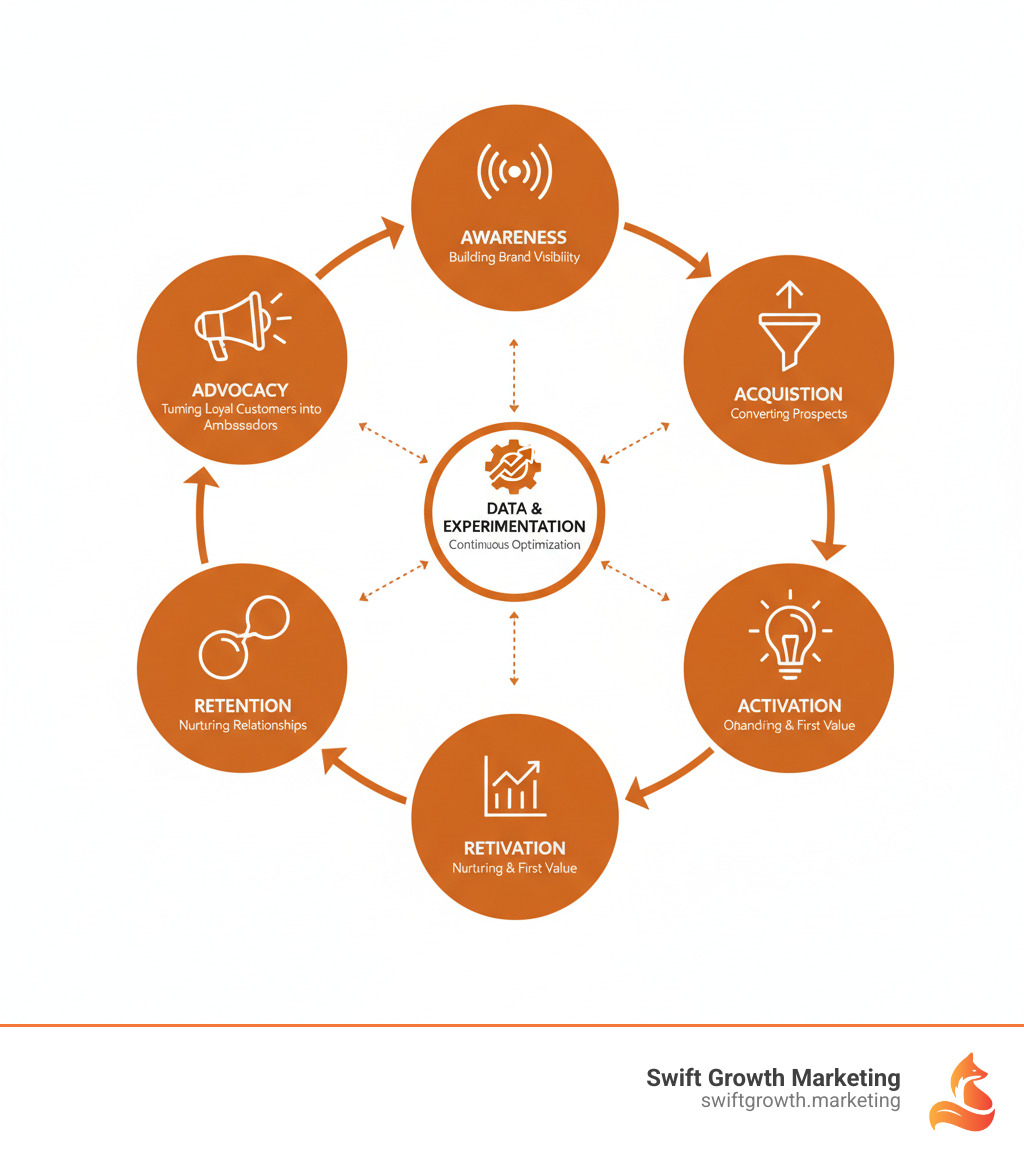
Growth marketing’s power lies in its comprehensive approach. Every touchpoint matters, from first awareness to final advocacy. This journey can be seen in five interconnected stages:
- Awareness: Potential customers first encounter your brand through content or word-of-mouth.
- Consideration: Prospects know you and are evaluating if you’re the right solution. Educational content and customer stories are key here.
- Conversion: A prospect becomes a customer. This is easier and cheaper when you’ve built awareness and consideration.
- Loyalty: Keeping customers engaged and encouraging repeat purchases. This is where profits multiply, as retention can boost profits by 25% to 125%.
- Advocacy: Loyal customers become marketers, leaving reviews and referring friends.
This AARRR framework (Awareness, Acquisition, Activation, Revenue, Retention, Referral) creates a flywheel where momentum builds over time. The Blueprint for Brand Growth offers more insight on this.
Integrating Brand and Growth Marketing
Brand and growth marketing are not competing strategies; they are complementary forces. Brand marketing creates the emotional foundation—your story, values, and identity. Growth marketing amplifies that foundation with data and experimentation, ensuring your story reaches the right people at the right time.
For example, a brand film is pure brand marketing. Growth marketing would analyze its performance, see which audiences engage, and use those insights to optimize distribution and measure its impact on CLTV. The key is consistent messaging across all touchpoints. When brand and growth work together, you get emotional resonance backed by measurable results. Storytelling is a powerful tool in this integrated approach. You can discover how to use storytelling in content marketing to drive business outcomes. At Swift Growth Marketing, we bridge this gap, because brand without growth is ineffective, and growth without brand is soulless.
Leveraging Your Legacy: Effective Growth Marketing Strategies for Established Brands
As an established brand, you possess powerful assets: your existing customer base and brand equity. The key is to use them strategically to fuel your next phase of growth.

At Swift Growth Marketing, we help brands turn these legacy assets into growth engines. Your customer data reveals behaviors, preferences, and opportunities for smarter audience segmentation. Your years of trust and recognition are a foundation startups can’t replicate. Growth marketing for established brands builds on this by turning satisfied customers into advocates and using your reputation to attract new audiences.
Effective strategies focus on two tracks: deepening relationships with existing customers and capturing new markets by leveraging your credibility.
Deepen Relationships with Your Existing Customer Base
Your current customers already chose you. The goal is to make them feel so valued they become part of your growth story.
- Personalization: Go beyond using a first name. Tailor experiences based on customer data. 81% of Gen Z consumers like personalized ads, showing that understanding your customer pays off.
- Loyalty Programs: These create a framework for engagement, signaling that the relationship matters and increasing Customer Lifetime Value (CLTV).
- Community Building: Transform customers into connected advocates. Notion’s growth was fueled by users who voluntarily created content and managed communities.
- Customer Feedback Loops: Actively solicit and use feedback. L’Oreal thrived during a 60% e-commerce jump by adopting a “conversation mindset,” making customers feel heard.
- Upselling & Cross-selling: When done well, offering complementary products based on purchase history adds value and deepens the relationship.
Capture New Markets with Targeted Initiatives
While nurturing existing customers, you must also expand your reach. Your established brand makes this easier.
- Content Hubs & Pillar Pages: Position yourself as an authority by creating comprehensive content. This builds trust over time, making you the obvious choice when prospects are ready to buy. See how pillar pages play a role in your growth marketing strategy.
- Video Marketing: This is the most shared content type online. Porsche’s interactive Twitch ad reached a younger demographic, building long-term brand awareness.
- Influencer Marketing: People trust recommendations. FabFitFun drove 300% annual sales growth by partnering with influencers who gave them access to massive, engaged audiences.
- Strategic Partnerships: Tap into complementary customer bases through co-marketing or joint offerings. Shell achieved a record-breaking ROI through strategic placements and partnerships.
These strategies work together, creating a compound effect where each initiative strengthens the others.
The Engine Room: Data, Experimentation, and Measurement
Think of growth marketing for established brands as a high-performance engine. Data is its fuel, experimentation is its fine-tuning, and measurement is its monitoring system. This isn’t about guesswork; it’s a systematic approach where decisions are informed by real customer behavior.

The foundation is your North Star Metric—the single number that captures the core value you deliver (e.g., hours watched for Netflix). Aligning your teams and experiments to this metric provides focus. From there, you establish Key Performance Indicators (KPIs) to track progress across the customer journey. These should be meaningful indicators, not vanity metrics. You can learn to build your own growth marketing strategy framework to establish this foundation.
The Central Role of Data and Experimentation
Data and experimentation work in a continuous cycle to drive measurable improvement. Instead of relying on old tactics, you make choices based on what your customers are telling you through their actions.
This starts with a hypothesis-driven approach. You formulate testable ideas, such as: “If we add testimonials to our landing page, conversions will increase by 15% due to social proof.” Then, you use iterative testing (A/B tests, multivariate tests) to validate or invalidate these hypotheses.
What matters most is your learning velocity—how quickly you can run tests, analyze results, and implement learnings. The faster this cycle, the faster you improve. This process naturally helps you identify bottlenecks in your customer journey, like a high bounce rate on a key page.
This is where Conversion Rate Optimization (CRO) comes in. It’s a systematic approach to improving your website and marketing assets to increase desired actions. We use psychological principles and user behavior analysis to refine every element. For more on this, explore psychology-based landing page optimization.
Measuring the Business Impact of Growth Marketing for Established Brands
How do you measure success? The answer goes beyond this month’s conversion numbers.
- Customer Lifetime Value (CLTV): The total revenue you expect from a customer. It’s the ultimate measure of long-term value.
- Customer Acquisition Cost (CAC): The cost to acquire a new customer. Your CLTV should be at least 3x your CAC for a sustainable model.
- Net Revenue Retention (NRR): Reveals revenue growth from existing customers. Over 100% means your customers are spending more over time.
- Market Share Growth: Shows if you’re expanding your piece of the pie. Lego’s refocus in 2018 led to a 4% increase in sales and profits by targeting new markets.
- Brand Awareness Lift: An increase in brand recognition, which makes all other marketing more efficient.
- Referral Rate: The percentage of new customers from recommendations—a pure indicator of customer satisfaction.
Tracking these metrics demonstrates the real ROI of growth marketing. To optimize your spending, get a better ROI from your growth marketing budget.
Navigating the Transition: Common Challenges and How to Overcome Them
Shifting to growth marketing for established brands isn’t always easy. At Swift Growth Marketing, we’ve helped businesses in Pittsburgh, PA, and Wheeling, WV, steer common roadblocks. The good news is they’re all solvable.
A major challenge is organizational silos. Marketing, sales, product, and customer service often work in isolation. Growth marketing requires these teams to collaborate and share insights. PepsiCo’s International Foods Division solved this by bringing functions closer to marketing, which boosted revenue and team collaboration.
Another hurdle is resistance to change. Teams comfortable with proven performance campaigns may be hesitant to experiment. Start small with a quick experiment to show fast results. A simple A/B test can demonstrate value and build buy-in for a culture where it’s okay to fail in the pursuit of progress.
Budget allocation can be tricky. Why shift funds from predictable channels to long-term brand initiatives? The answer is mindset: growth marketing is an investment in assets like brand equity and CLTV. The returns may take longer, but they compound. Use data to project the long-term ROI.
Many brands also struggle with legacy systems that hinder agility and a unified customer view. You don’t need to replace everything at once. Start by integrating critical systems or adopting new tools incrementally to make data accessible.
Finally, proving ROI for brand initiatives is a common challenge. It’s harder to track than a direct sale from an ad. The solution is to use different metrics. Correlate brand awareness with long-term revenue, and focus on CLTV and Net Revenue Retention (NRR). MoneySuperMarket did this by introducing tools to build long-term value rather than chasing quick conversions.
One of the most effective ways to steer these challenges is to create a growth team. Even a small, dedicated team can act as a catalyst for change by demonstrating agile methods and running experiments. The transition takes time. Start with small wins, prove the value, and gradually expand your efforts.
Conclusion
Making the leap into growth marketing for established brands is about fundamentally rethinking how your business grows. The old playbook of pure performance marketing eventually hits a wall. The brands that thrive tomorrow are those willing to evolve today.
This evolution means shifting your focus from immediate conversions to the entire customer journey. Instead of just chasing the next transaction, you’re building relationships that compound in value over time. Your existing customer base and brand equity are powerful assets for this journey. The key is leveraging them strategically.
The path forward requires a full-funnel mindset, where awareness and consideration are as important as conversion. It means integrating brand-building with data-driven experimentation and fostering cross-functional collaboration. This creates a culture where testing, learning, and adapting are second nature.
Challenges like budget allocation, legacy systems, and internal resistance are real, but they are surmountable. Start with small wins, demonstrate value with pilot programs, and let data on customer lifetime value and retention tell the story.
At Swift Growth Marketing, we’ve guided established brands in Pittsburgh, PA, and Wheeling, WV, through this exact transition. We’ve seen companies transform from maintaining their position to actively expanding it.
Your brand’s legacy isn’t a limitation—it’s your greatest competitive advantage. The question isn’t whether to evolve, but how quickly you can begin. The brands that treat growth as an ongoing journey are the ones that don’t just survive—they lead.
Ready to transform your established brand into a growth powerhouse? Partner with a growth marketing consultancy to navigate your transition and find what’s possible. Your next chapter of sustainable success starts now.