

Your page has seconds to earn trust and momentum. First impressions form fast—within 50 milliseconds, per peer-reviewed research by Lindgaard et al. (2006) on website aesthetics and credibility. And when load time drifts to three seconds, bounce risk jumps sharply, as shown in this Google/SOASTA analysis. This guide shows how to build psychology-based landing page optimization into your growth engine.This isn’t about bigger buttons. It’s about how minds decide.Every pixel either earns belief or adds friction. Every sentence either clears the path or creates doubt. Match the page to how people process information, and conversion becomes the default.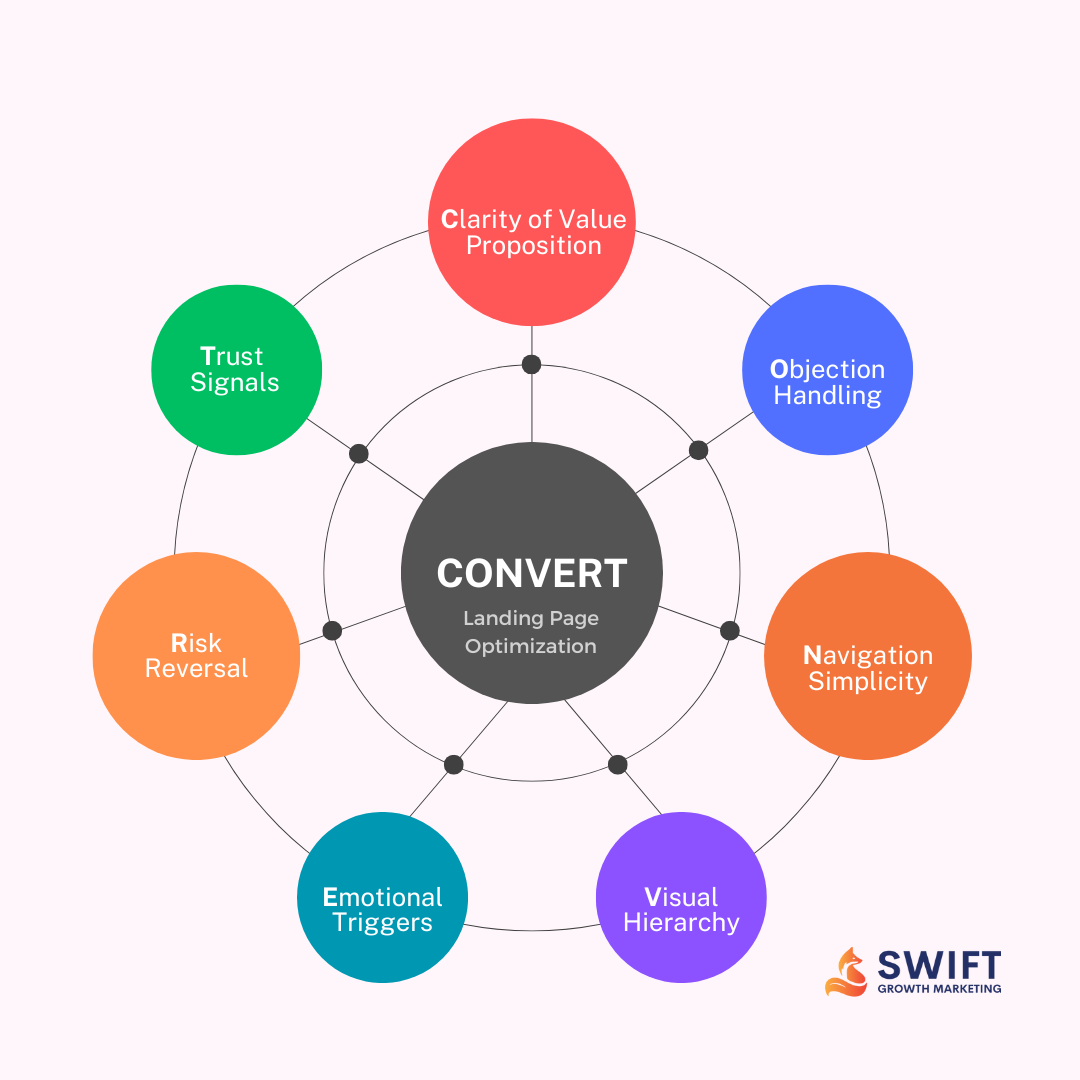 Great pages aren’t accidents. They’re systematic. Use CONVERT to audit what matters—and align your strategic messaging across the journey:
 Trust has two layers: the explicit (testimonials, guarantees) and the implicit (speed, polish, coherence). Both matter.
The Psychology Behind High-Converting Landing Page Optimization
Our brains reward ease. Research on processing fluency shows people prefer information that’s easy to mentally process—and fluency increases perceived truth and choice. For the underlying evidence, see Alter and Oppenheimer’s work. When your page is cluttered or contradictory, it forces effort and triggers avoidance.That’s why layout and copy must reduce cognitive load while elevating emotional relevance. High-performing pages feel obvious. They anticipate questions. They remove detours. Use visual hierarchy to signal what matters now, keep copy concrete and specific, and create a single path to action without competing calls. If your site needs a baseline cleanup, start with our SEO foundations to support smarter landing page optimization.The CONVERT Framework for Landing Page Optimization
Great pages aren’t accidents. They’re systematic. Use CONVERT to audit what matters—and align your strategic messaging across the journey:- Clarity of Value Proposition
- Objection Handling
- Navigation Simplicity
- Visual Hierarchy
- Emotional Triggers
- Risk Reversal
- Trust Signals
Clarity of Value Proposition
Answer three things in five seconds: What do you do? Who is it for? Why now?Avoid slogans. Choose specifics. If a smart outsider can’t explain your value in one breath, you’re making buyers work. Tighten the headline, then support with a sharp subhead and one proof point. Rename features into outcomes. “Automated routing” becomes “Cut ticket response time 35%.”Objection Handling
Every buyer brings baggage: time, risk, ROI, security, integration. Map the top five objections and address each where it’s most relevant. For implementation, show the timeline and owner. For security, link to your policy and certifications. For ROI, include a short case with numbers, not adjectives. For switching costs, offer migration support. Your tone should feel like mind-reading, not arm-twisting.Navigation Simplicity
More choices slow decisions. As Nielsen Norman Group explains in Hick’s Law, decision time increases with choice complexity. Create “tunnel vision” toward one action: remove global nav on dedicated landing pages, keep one primary CTA consistent top-to-bottom, and cut off-ramps that don’t serve the conversion.Visual Hierarchy
Design for scanning. Eyetracking consistently shows F-pattern scans on text-heavy pages; see Nielsen Norman Group’s overview. Use size, contrast, and spacing to ladder attention from headline to proof to action. Keep one main headline, place proof near claims, position CTAs after you’ve resolved objections, and use generous spacing and short paragraphs.Emotional Triggers
Logic validates. Emotion initiates. Tie outcomes to felt motivations—control, speed, certainty, recognition. Use verbs that imply momentum (launch, unlock, accelerate). Mirror the buyer’s language from calls and reviews. Show stakes: what improves if they act, and what erodes if they wait.Risk Reversal
Reduce perceived downside. Guarantees, trials, and phased starts lower anxiety. Loss aversion—our bias to avoid losses more than we pursue equivalent gains—is formalized in Prospect Theory by Kahneman and Tversky (1979). Use it ethically. Clear money-back terms beat vague promises. Trials must deliver value fast. For services, offer milestone-based engagements.Trust Signals
People trust what feels consistent and real. Specific testimonials with outcomes beat vague praise. Use real logos, names, and titles—not stock avatars. Fast load, clean design, and zero errors build subconscious trust. When you reference certifications, link to their official registry. For the bigger picture on brand credibility in an AI-shaped landscape, this deep dive shows what actually moves trust.Industry-Specific Landing Page Optimization Strategies
Different buyers, different psychology. Tune the page to motivation and risk profile.SaaS Landing Page Optimization
Software buyers are risk-sensitive and data-driven. Lead with outcomes, not features. Then answer technical anxieties fast. Start with a quantified result. Add security and compliance details near the fold. Offer a low-risk start: trial, sandbox, or pilot. For inspiration on outcome-first messaging and frictionless starts, study how product-led companies like HubSpot structure their pages.E-commerce Conversion Psychology
Shoppers worry about fit, quality, and hassle. Remove doubt before it forms. Use authentic reviews and Q&A to preempt objections. Clarify shipping costs and returns early. Create ownership before purchase with clear, contextual imagery and use cases. Market leaders like Amazon normalize transparency with reviews, policies, and delivery expectations where decisions happen. If you’re optimizing PDPs, use this playbook to improve product page conversion rate.Professional Services Psychology
You’re selling the invisible. Make the intangible tangible. Showcase case studies with numbers, not superlatives. Explain your methodology in 3–5 steps. Add leadership bios and credentials that map to the buyer’s world. Strategy firms like McKinsey publish specific case narratives and frameworks to signal rigor and reduce risk.Testing Methodology for Landing Page Optimization
Optimization without rigor is gambling. Treat A/B testing as a learning system grounded in a growth marketing mindset.Hypothesis-Driven Testing
Articulate the psychological bet behind each change: the belief about behavior or bias, the change you’ll make, and the metric that should move—and why. Even a “failed” test teaches you about your buyer’s psyche. For compounding content wins, here’s how to refresh and scale what works.Sequential Element Testing
Test from widest impact to narrowest.- Headlines (maximum visibility)
- Value propositions (maximum impact)
- Visual hierarchy (processing ease)
- Trust signals (credibility)
- CTA design (final conversion step)
Statistical Significance and Sample Size
Don’t stop tests early. Power them correctly. Size tests before launch with Evan Miller’s A/B sample size calculator. Run for full business cycles to avoid day-of-week effects; Microsoft’s experimentation guidelines outline best practices at scale. Predetermine stop rules, track guardrail metrics (e.g., qualified leads, not just CTR), and log learnings centrally to compound knowledge.Trust and Credibility in Landing Page Optimization
Trust has two layers: the explicit (testimonials, guarantees) and the implicit (speed, polish, coherence). Both matter.