

Why Becoming a Category Leader Transforms Your Business
Become category leader in your industry, and you fundamentally change how customers find, evaluate, and choose your solution. Instead of competing on features or price in a crowded market, you define the space itself—owning the problem, shaping the conversation, and capturing the majority of market value.
Here’s what it takes to become a category leader:
- Define a new market space – Create or redefine a category around a specific problem only you solve uniquely
- Own a strategic problem – Position yourself as the authority on a multi-million-dollar challenge your buyers face
- Engineer the customer journey – Show up first and most credibly across all platforms where your audience searches
- Build an ecosystem – Develop content, partnerships, and proof points that reinforce your category’s identity
- Defend, grow, and innovate – Dominate core terms, expand into adjacencies, and pioneer new channels
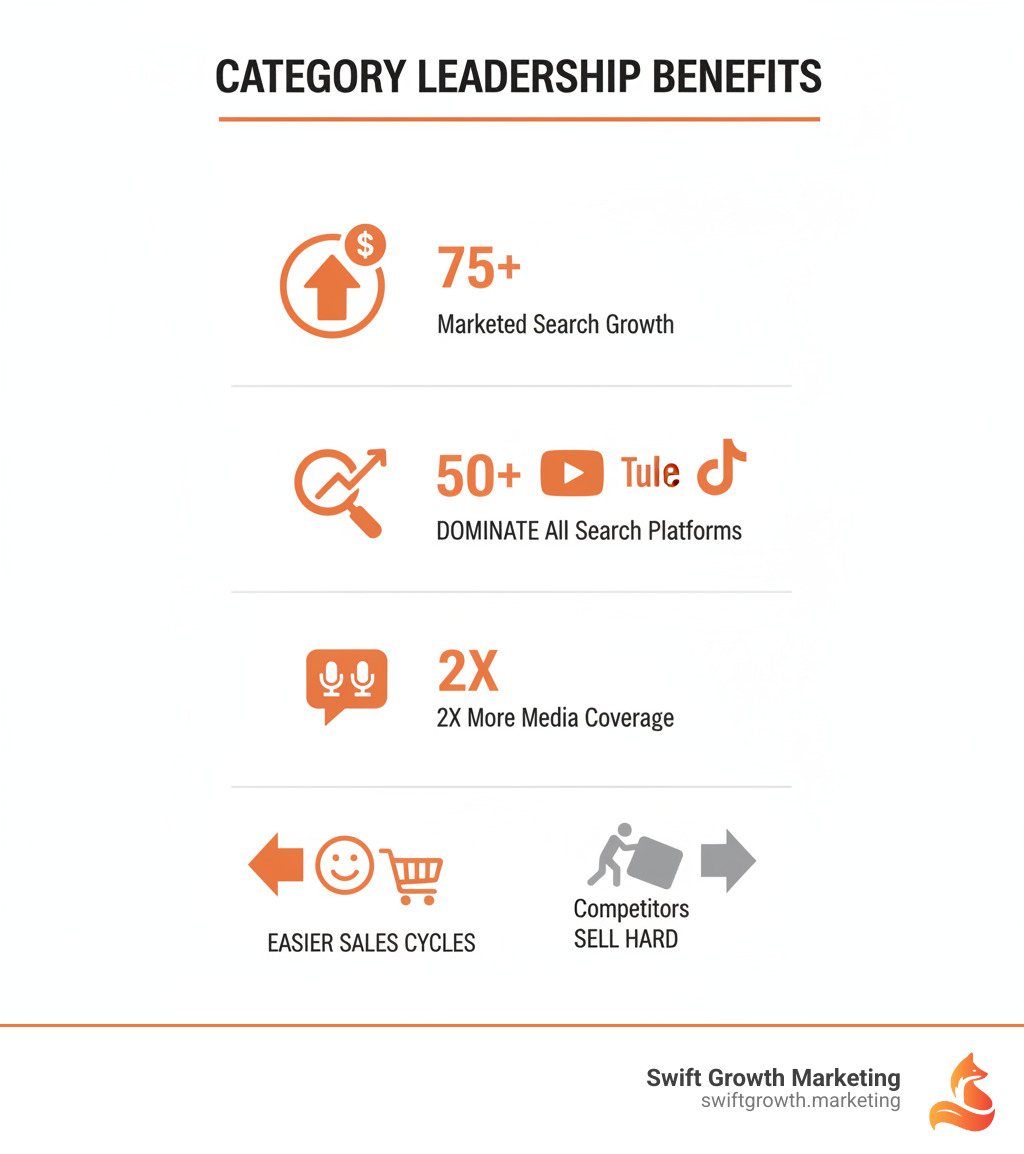
The rewards are substantial. Category leaders capture over 75% of their market’s value. They win the easy sales while competitors fight for scraps. They attract top talent, command premium pricing, and build sustainable competitive advantages that compound over time.
But the path has changed. The old playbook—rank #1 on Google, build backlinks, optimize conversion rates—isn’t enough anymore. Gen Z finds brands on TikTok as often as Google. Buyers research on Reddit, YouTube, and LLMs. Success now requires engineering presence across an entire ecosystem, not just one search engine.
This shift separates leaders from followers. Category leaders don’t just win clicks. They shape demand before it exists. They influence how buyers understand their problems and evaluate solutions. They become the default choice—the “nobody ever got fired for buying IBM” option in their space.
I’m Chris Hornak, Co-Founder of Swift Growth Marketing, where we’ve helped established brands and ambitious startups become category leader through strategic positioning, content authority, and search optimization across multiple platforms. Our work has transformed invisible brands into industry authorities by combining category design principles with modern findy optimization.
Understanding the Power and Purpose of Category Leadership
Having a great product isn’t enough anymore. You need to become category leader—the brand that defines the entire playing field. And here’s the thing: category leadership isn’t just about having the biggest market share. It’s about owning the conversation itself.
Here’s the difference. A market leader might sell the most units in an existing market. But a category leader? They create or completely redefine that market. They become the default answer. The thought leader. The brand people think of first when they have a problem to solve.
And the rewards are real. Companies that dominate a category within six to ten years of its creation typically capture the majority of its market value. In software categories, category leaders often claim over 75% of the total market cap. That’s why venture capitalists pay such close attention to which startups are positioned to lead a category—the money flows to the leaders.
Category leadership also transforms your sales process. When you’re the category leader, you win the easy sales. Buyers already see you as the established, low-risk choice. Your competitors have to fight tooth and nail for every deal, constantly justifying why someone should pick them over you. It’s the modern version of “nobody ever got fired for buying IBM.” When you lead a category, you inherently build brand trust and become the safe choice.
What Defines a Category Leader Today?
So what does it actually take to become category leader in today’s market? It’s changed dramatically, especially with Gen Z reshaping how people find brands.
Today’s category leaders don’t just win clicks or views. They engineer the entire customer journey. They don’t wait for demand—they shape it before it even exists.
The modern search experience is fragmented across dozens of platforms. Gen Z finds brands on TikTok as often as Google. People research on YouTube, ask questions on Reddit, browse on Pinterest, shop on Amazon, and even query AI chatbots. A true category leader needs a multi-platform presence, showing up first and most credibly wherever their audience searches.
This means owning attention across the entire ecosystem. We can’t think of search as a single channel anymore. It’s an environment we need to map, influence, and defend. Category leaders engineer every touchpoint—from the moment someone recognizes a problem, through their research phase, all the way to their purchase decision. Your strategic messaging needs to resonate across all these diverse platforms, clearly communicating how you uniquely solve the buyer’s core problem.
It’s not about being everywhere. It’s about being unmissable where it matters.
Why Winning Has Evolved Beyond Traditional SEO
Ranking #1 on Google used to be the holy grail. It’s still valuable, don’t get me wrong. But it’s no longer enough to become category leader.
The attention economy has rewritten the rules. Social platforms like TikTok and YouTube aren’t just for entertainment—they’re powerful search engines, especially for younger buyers. If you’re not showing up where your audience actually spends their time, you’re handing market share to someone who is.
Modern category leadership requires optimizing for these new findy channels. That means understanding what builds credibility on each platform. User-generated content matters. Authentic reviews matter. Social shares, video content, and genuine engagement all signal to both algorithms and humans that you’re the real deal.
The proof points that matter have expanded beyond traditional backlinks and domain authority. Today’s algorithms look at social signals, video engagement, conversation volume, and how often people actively seek out your brand. Our Answer Engine Optimization Makes You Unmissable approach reflects this shift—we help clients become the unmissable answer across every relevant search interface, not just Google.
The old playbook focused narrowly on one search engine. The new reality demands visibility and credibility across a dynamic, fragmented digital ecosystem. That’s where category leaders win.
The Strategic Playbook: How to Become a Category Leader
When you set out to become category leader, you’re not just tweaking your marketing strategy—you’re fundamentally reimagining how you approach your market. This isn’t about fighting harder in a crowded space. It’s about creating your own space entirely.
Think of it this way: most companies are stuck in what strategists call the “Red Ocean”—bloody waters where everyone’s fighting over the same customers, slashing prices, and competing on features. But category leaders? They’re swimming in Blue Oceans, where competition becomes irrelevant because they’ve created something entirely new.
The difference is profound. In a Red Ocean, you’re trying to beat competitors and exploit existing demand. In a Blue Ocean, you’re creating demand that didn’t exist before. You’re not making trade-offs between value and cost—you’re breaking that trade-off entirely. This is the foundation of our strong SEO strategy at Swift Growth Marketing: we don’t just help you compete better; we help you compete differently.
Here’s what separates these two approaches:
| Feature | Red Ocean Strategy (Competing in Existing Markets) | Blue Ocean Strategy (Creating New Markets) |
|---|---|---|
| Market Focus | Compete in existing market space | Create uncontested market space |
| Competition | Beat the competition | Make the competition irrelevant |
| Demand | Exploit existing demand | Create and capture new demand |
| Value/Cost | Make the value-cost trade-off | Break the value-cost trade-off |
| Goal | Align the whole system of a firm’s activities with its strategic choice of differentiation or low cost | Align the whole system of a firm’s activities in pursuit of differentiation and low cost |
Category Design takes this concept further. It’s the deliberate process of defining a problem so clearly and owning it so completely that your solution becomes the obvious choice. When you develop a unique viewpoint on the market and articulate it powerfully, you don’t just attract customers—you reshape how they think about their problems entirely.
Defining Your Blue Ocean: Creating Uncontested Market Space
The Red Ocean is where most businesses find themselves: competing for existing customers in markets that are already well-defined. The water turns red from all the competition. But Blue Oceans? Those are untapped market spaces where you can grow without constantly fighting for every customer.
To become category leader, you often need to create your own Blue Ocean. And here’s something important: this isn’t about being first to market. It’s about being a category creator. Research shows there’s a significant difference between a first mover and a category creator. First movers might get there early, but category creators define the space in ways that matter. They solve problems in entirely new ways rather than just being the initial entrant. You can learn more info on the difference between a first mover and a category creator from Harvard Business Review’s research.
The ERRC Framework gives us a practical way to find our Blue Ocean. It asks four powerful questions: What should we eliminate that the industry takes for granted? What should we reduce well below industry standards? What should we raise well above what’s normal? And what should we create that’s never been offered before?
When you eliminate unnecessary complexity, reduce costs that don’t matter to customers, raise the quality of what truly matters, and create entirely new value, you’re not just improving your offering. You’re creating new demand. You’re giving customers something they didn’t even know they needed—but now can’t imagine living without.
The Art of Category Design: How to become a category leader by Owning a Problem
Here’s where many companies get it wrong: they position around their product when they should be positioning around a problem. Bob Wright, a positioning expert, sees this constantly—marketers leading with features when they should be focusing on the buyer’s pain.
To become category leader, you need to own a big, strategic, multi-million-dollar problem that keeps your target audience up at night. This requires deeply understanding your buyer’s journey and asking different questions. Instead of “What does our product do?” we ask: What’s the massive problem you solve for your buyer? Why now? What unique capabilities let you solve it in ways nobody else can? How will you make their life genuinely better?
This approach demands developing a strong viewpoint and leveraging your unique intellectual property. You’re taking a stand on important issues and connecting it directly to the problem your company solves. You’re making the conversation about your unique capabilities and how they address critical pain points, not just competing on a checklist of features.
Think about it this way: when everyone else is bunched in the middle of the room offering similar solutions, you need to “take a corner of the room.” You need to clearly distinguish what you do that they don’t—and why that matters deeply to buyers. This type of strategic messaging builds trust and drives action because buyers can clearly see your unique value. The insights from How to Be a Category King [Entire Talk] reinforce this approach, and our guide on Strategic Messaging That Builds Trust and Drives Action shows exactly how to execute it.
The Defend-Grow-Innovate Framework: How to become a category leader and maintain dominance
Becoming a category leader is challenging. Staying one? That’s even harder. That’s why we advocate for the Defend-Grow-Innovate framework with our clients in Pittsburgh, PA, and Wheeling, WV. This model provides a roadmap not just for breaking through, but for sustained dominance.
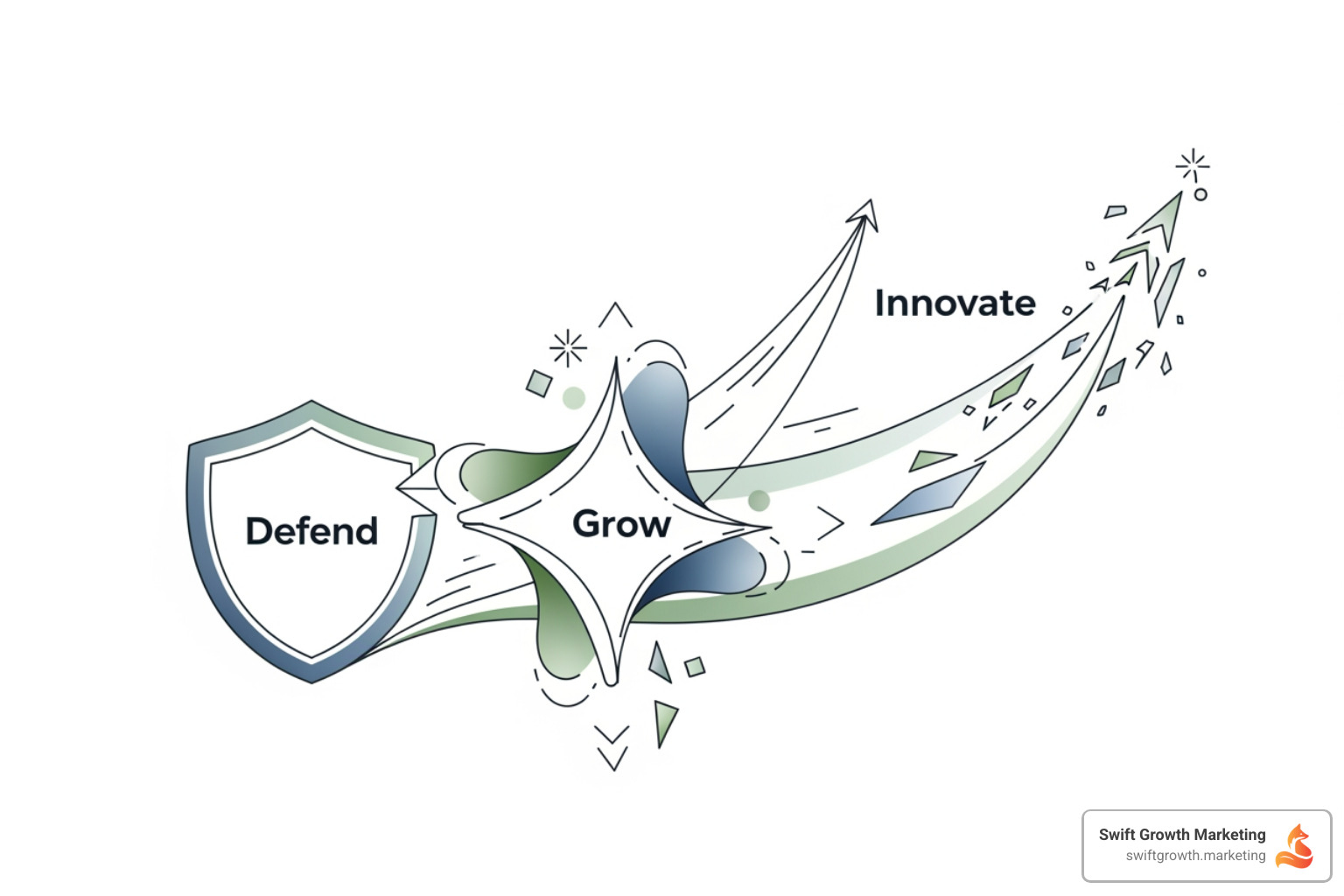
Defend the Core is about protecting what you’ve already won. You need to own high-intent searches for your brand terms and core category keywords. Monitor competitor activity closely so you can preempt challenges before they gain traction. Continuously optimize your core product or service to maintain superior quality. Leverage customer loyalty programs and exceptional support to keep your existing base happy. A robust foundation here—what we call SEO Foundations—ensures your primary offerings stay dominant.
Grow into Adjacencies means expanding your influence into related areas that naturally complement your core offering. Identify adjacent keywords and topics where your expertise extends naturally. Build topical authority through comprehensive content clusters and pillar pages—our Content Clusters Build Topical Authority with Pillar Cluster Architecture approach excels here. Develop new products or services that solve related problems for your existing customers. Form strategic partnerships with complementary businesses to expand your reach.
Innovate Across Channels is where you create new demand and reach new audiences by pioneering new platforms and content formats. Experiment with emerging social search platforms like TikTok and YouTube. Develop engaging, platform-specific content that resonates with how people actually use those platforms. Monitor evolving consumer findy habits and adapt quickly. Invest in thought leadership that anticipates future market needs and positions you as a visionary, not just a vendor.
This dynamic framework ensures you’re not just defending your position—you’re continuously exploring new avenues for growth. That’s how you cement your position as the undeniable category leader, today and tomorrow.
Amplifying Your Leadership and Measuring Success
Here’s where strategy meets reality. Once you’ve carved out your category and positioned yourself as the authority, the real work begins: amplifying that leadership and tracking what actually matters. This isn’t about vanity metrics or feel-good numbers. It’s about tangible business outcomes that show you’re on the path to become category leader in your space.

Think of it as a two-part engine. Demand generation creates awareness and interest in your category—often before customers even realize they have the problem you solve. You’re educating the market, building thought leadership, and shaping how people think about their challenges. Demand capture ensures that when someone finally searches for a solution, you’re the first name they see and the most credible option they find.
Both sides of this equation matter equally. Generate demand without capturing it, and you’re just warming up the market for competitors. Capture demand without generating it, and you’re stuck fighting over a shrinking pool of existing searches.
This is where social proof becomes your secret weapon. Tech buyers trust journalists and industry publications. When you secure consistent media coverage with quality backlinks, you’re not just boosting your SEO—you’re building credibility that money can’t buy. Customer testimonials, detailed case studies, and reference accounts work the same way. They validate that your category is real and that you’re the leader within it.
And here’s something counterintuitive: when large incumbents finally enter your category, that’s actually good news. As David Sacks observed, it’s validation of everything you’ve been saying for years. It confirms the market exists and that you were right to create it. Your job isn’t to panic—it’s to stay focused on innovation and continue solidifying your leadership. Smart use of diverse growth marketing channels ensures your message reaches every corner of your market.
The New Rules of Findy: Engineering the Customer Journey
The customer journey has become beautifully messy. People don’t just Google anymore—they TikTok, they YouTube, they Reddit. Gen Z finds brands on social platforms as often as traditional search engines. This fragmentation isn’t a problem to solve; it’s the new reality to master.
To become category leader, you need to engineer presence across this entire ecosystem. Show up first, show up most often, and show up with genuine credibility wherever your audience searches. That means dominating multiple Search Engine Results Pages—not just Google, but TikTok, YouTube, Amazon, and anywhere else your buyers spend time.
The tools in your arsenal are diverse. High-quality content that answers real questions. Strategic links and PR that build authority. User-generated content that proves others love what you do. Reviews that validate your claims. Video content that engages and educates. These aren’t separate tactics—they’re interconnected proof points that both algorithms and humans use to determine who’s trustworthy.
Your goal is to become unignorable. Not through volume alone, but through strategic omnipresence. When someone has a problem you solve, your brand should be impossible to miss. This requires understanding how each platform’s algorithm works and creating content that feels native to that environment. With advances in AI and growth marketing, we can now analyze user behavior and content performance with incredible precision, allowing us to fine-tune strategies for maximum impact.
Tangible Business Outcomes of Category Leadership
Let’s talk numbers, because that’s what ultimately matters for our clients in Pittsburgh, PA, and Wheeling, WV. When you successfully become category leader, the results show up clearly in your metrics.
We worked with a tech client who saw their branded search jump 50% year-over-year in the UK and 33% in Spain. Even better? They overtook their main competitor for brand demand, becoming the second most searched brand in their entire category. That’s not luck—that’s strategic category leadership creating direct consumer intent.
The commercial impact was equally impressive. Their organic revenue grew 66% in Spain and 63% in the UK. This directly demonstrates how category leadership translates into actual money in the bank.
Media amplification played a huge role in their success. They secured 724 media placements, which generated 668 valuable backlinks. Each of those backlinks boosted their authority and organic visibility, creating a compounding effect that strengthened their market position.
Sign-ups increased 70% year-over-year, with non-brand clicks up 43%. These aren’t vanity metrics—they represent engaged demand from people actively seeking solutions. The brand also improved their average ranking for a key category keyword (with 49,000 monthly searches) from position 10.3 to 4.9, dramatically enhancing their findability.
These results aren’t isolated wins. They represent a fundamental shift in market position. By focusing on smart, strategic approaches, we help our clients maximize their ROI from their growth marketing budget and build sustainable competitive advantages that compound over time.
Frequently Asked Questions about Category Leadership
What is the difference between a category leader and a market share leader?
Here’s something that surprises many business owners: having the highest sales doesn’t automatically make you a category leader. A market share leader simply sells more units than anyone else in an existing market. They’re often locked in fierce battles over price and features, competing for the same pool of customers.
A category leader operates on an entirely different level. They don’t just win in an existing market—they define what the market actually is. They reshape how buyers understand their problems and evaluate solutions. When you become category leader, you’re not just selling products; you’re establishing the rules of the game itself.
Think about it this way: a market share leader might answer the question “Who sells the most?” But a category leader answers “Who do we think of first?” They become the default choice, the thought leader, the brand that defines the entire space. This distinction matters enormously because category leaders capture the majority of the market’s total value—often over 75%—even if another company temporarily has higher sales in a sub-segment.
How long does it take to become a category leader?
If you’re hoping for a quick win, I’ll be honest with you—category leadership isn’t that. It’s a marathon, not a sprint. The research tells us something fascinating: companies that create and dominate a category within six to ten years of its creation tend to capture the majority of its market value.
Why so long? Because real category leadership requires time to educate the market, build an ecosystem, and establish your brand as the definitive authority. You’re not just promoting a product; you’re teaching buyers to think about their problems in a new way. You’re creating demand where none existed before.
This timeline isn’t a limitation—it’s actually an advantage. It means your competitors can’t simply throw money at the problem and overtake you overnight. When you commit to the long-term journey to become category leader, you’re building something defensible and valuable that compounds over time. Every piece of content, every media mention, every customer success story adds another brick to your leadership position.
Can a small business or startup become a category leader?
This is where things get exciting. Not only can a small business or startup become a category leader—they’re often the ones who do it best. Some of the most powerful category leaders started as scrappy challengers who saw the world differently.
Why? Because smaller companies have advantages that big incumbents don’t. You can move faster. You can take bolder risks. You can connect more authentically with a specific audience. While established players are stuck defending their current market position, you’re free to imagine something entirely new.
Strategies like Blue Ocean and Category Design were specifically created to help challengers like you create and own uncontested market space. You don’t need the biggest budget to become category leader—you need the sharpest insight into an unsolved problem and the courage to stake your claim on it.
We’ve seen this pattern repeatedly with our clients in Pittsburgh, PA, and Wheeling, WV. The companies that succeed aren’t necessarily the largest or best-funded. They’re the ones with clarity about the problem they solve, conviction in their unique approach, and consistency in how they show up across every platform where their buyers search. That’s something any ambitious business can achieve with the right strategy and partner.
From Challenger to Champion with a Strategic Partner
The path to become category leader isn’t something that happens by accident. It’s a deliberate, strategic journey that requires a fundamental shift in how you think about your market. Throughout this guide, we’ve explored the essential elements: creating uncontested market space, positioning around problems instead of products, engineering the customer journey across multiple platforms, and maintaining dominance through the Defend-Grow-Innovate framework.
What ties all of these strategies together? A growth marketing mindset that treats every initiative as a learning opportunity. This mindset accepts experimentation, values data-driven insights, and understands that true category leadership is built through consistent, strategic action over time—not overnight wins.
The reality is that most businesses don’t have the internal bandwidth or specialized expertise to execute category leadership strategies while running their day-to-day operations. This is where the right partnership becomes transformative.
At Swift Growth Marketing, we’ve worked with businesses in Pittsburgh, PA, and Wheeling, WV, helping them move from being just another competitor to becoming the defining voice in their space. We understand the new rules of findy—how to engineer presence across Google, TikTok, YouTube, Reddit, and emerging AI platforms. We know how to build the content ecosystems, strategic messaging, and multi-platform authority that category leaders require.
But more importantly, we understand that every market is different. Every category has unique dynamics. Your path to leadership will look different from another company’s journey, and that’s exactly how it should be. We don’t believe in cookie-cutter solutions. We believe in understanding your specific market, identifying the problem you uniquely solve, and building a customized strategy that positions you as the undeniable authority.
Category design requires both strategic vision and flawless execution. It demands expertise in positioning, content strategy, SEO across multiple platforms, PR amplification, and continuous optimization. It requires someone who understands that ranking #1 on Google is just one piece of a much larger puzzle.
If you’re ready to stop competing on features and price, and instead want to define your own market space, we’re here to help. To effectively design and dominate your category, you need a partner that understands the new rules of findy and growth. Explore our Growth Marketing Consultancy services to start your journey from challenger to champion.
Let’s build something remarkable together—a brand that doesn’t just participate in a market, but creates and owns it.