

Why Answer Engine Optimization Is Reshaping Digital Visibility
An answer engine optimization strategy is how you make your brand the default answer when AI tools like ChatGPT, Google’s AI Overviews, and voice assistants respond to user questions. It involves:
- Research: Identifying audience questions, not just keywords.
- Content: Structuring clear answers with E-E-A-T signals.
- Technical: Using schema markup and optimizing site performance.
- Distribution: Building authority where AI engines source information.
- Measurement: Tracking AI visibility, citations, and mentions.
For years, “Googling” meant sifting through ten blue links. That era is ending. Today, a majority of younger users prefer AI engines for search, and zero-click results are reducing organic traffic by up to 25%. People want immediate, conversational answers, and AI delivers.
The stakes are real. If your brand isn’t in AI-generated answers, you’re invisible. When a user asks ChatGPT, “What’s the best project management tool for remote teams?” your competitors are getting mentioned—and you’re not.
But here’s the opportunity: AI search visitors convert at 4.4 times the rate of traditional organic traffic. They are further in their research and asking specific questions. When AI cites your brand, you gain instant credibility.
Traditional SEO got you found. Answer engine optimization ensures you don’t get ghosted.
This shift is happening now. Gartner predicts 25% of organic traffic will move to AI chatbots by 2026. Businesses winning in this new landscape aren’t just chasing rankings; they’re engineering content for AI to extract, cite, and recommend. They think in questions, not keywords, and structure content for machine understanding.
This guide will show you how to do the same. We’ll cover the research, on-page tactics, technical signals, and measurement for a complete answer engine optimization strategy.
I’m Chris Hornak, Co-Founder of Swift Growth Marketing. Developing an effective AEO strategy has become essential for our clients in education, staffing, SaaS, and e-commerce—and it’s now central to every engagement we undertake.
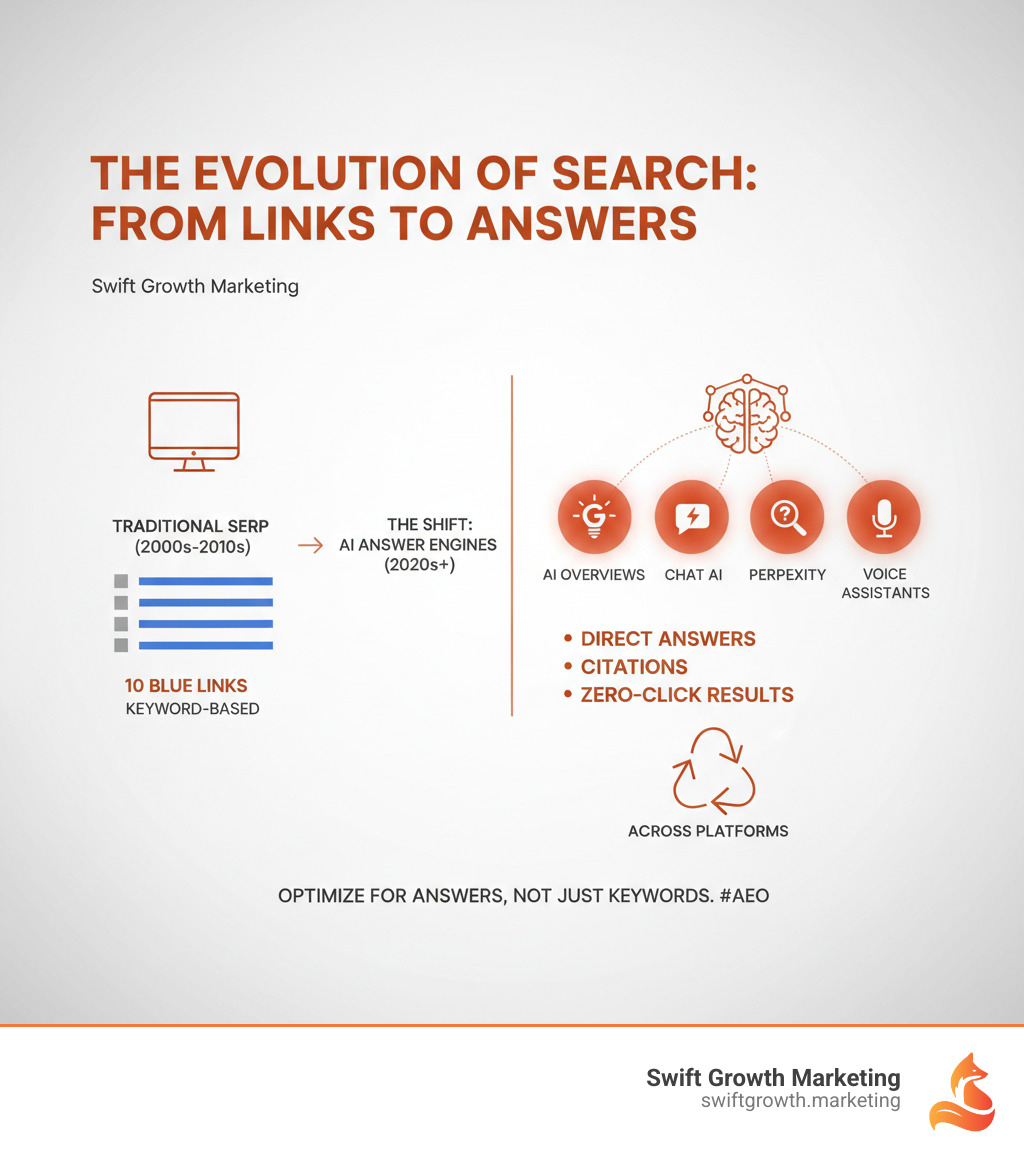
The Shift to Answer Engines: Why AEO is Critical for Your Business
A fundamental change in how people find information online is underway. Instead of scrolling through search results, users now ask ChatGPT, Google’s AI Overviews, and voice assistants for direct answers. This shift in user behavior is reshaping the digital landscape.
According to Gartner, 25% of organic traffic will shift to AI chatbots by 2026. This “zero-click” phenomenon means fewer website visits, but it also presents a massive opportunity for businesses that adapt.
The visitors who do arrive from AI search are gold. The average AI search visitor is 4.4 times more valuable for conversion than a traditional organic visitor. They have a specific problem, are further down the funnel, and are ready to make a decision. An effective answer engine optimization strategy is designed to capture this high-intent traffic.
The Business Impact of AEO
The results are already clear. NerdWallet, for example, grew revenue by over 35% despite a 20% drop in traffic, proving that quality trumps quantity. This is the promise of AEO: attracting the right people at the right moment.
When AI systems cite your brand, you gain:
- Higher Conversion Rates: AI-referred visitors show 35% higher engagement and conversion rates. AEO strategies can also cost 40-60% less than paid ads for similar brand exposure.
- Brand Authority: An AI citation is a powerful third-party endorsement. Building Brand Trust: Generative AI’s Impact on Credibility is more achievable than ever.
- Competitive Advantage: While competitors focus on old SEO tactics, you can engineer your content to be the default answer AI provides, creating a significant market edge.
At Swift Growth Marketing, we see this firsthand. The intersection of AI and Growth Marketing is how we help clients thrive as the search landscape evolves. The question isn’t whether to adapt, but how quickly you can start.
AEO vs. SEO: Understanding the New Rules of Search
While traditional SEO focused on ranking in Google’s ten blue links, the game has changed. Answer Engine Optimization (AEO) is about making your brand become the answer in AI-generated summaries.
Think of it this way: SEO helps people find you. AEO makes you the answer they don’t need to look beyond.
The mindset shifts from keywords to questions. Instead of optimizing for “project management software,” you optimize for “What’s the best project management tool for remote teams?” The goal is not just traffic, but direct citation in an AI response.
Here’s how they compare:
| Feature | Traditional SEO | Answer Engine Optimization (AEO) |
|---|---|---|
| Primary Goal | Drive traffic to website via rankings | Get content cited directly in AI-generated answers |
| User Intent | Keyword-centric, information gathering, browsing | Conversational, question-based, immediate answers |
| Content Focus | Keyword optimization, comprehensive articles | Direct answers, concise summaries, structured data, E-E-A-T |
| Key Metrics | Rankings, organic traffic, impressions, click-through rate | AI citations, brand mentions, share of answers, sentiment, conversion quality |
| Core Tactics | Keyword research, backlink building, technical SEO, on-page optimization | Question research, conversational content, schema markup, authority building, prompt testing |
While traditional SEO encourages long articles, AEO demands clarity, directness, and structured data that machines can easily parse. It also heavily relies on E-E-A-T (Experience, Expertise, Authoritativeness, Trustworthiness) signals to build confidence with AI systems.
Crucially, AEO doesn’t replace SEO; it builds on it. A Strong SEO Strategy provides the essential foundation—page speed, mobile-friendliness, and site authority. AEO is the next layer, optimizing your content to be the definitive answer AI systems trust. If you have a solid SEO foundation, you’re already halfway to a winning answer engine optimization strategy.
Building Your Answer Engine Optimization Strategy for 2025
An effective answer engine optimization strategy methodically engineers your content so AI systems can find, understand, and cite it. This requires a structured approach covering research, content, technical optimization, and measurement.
Foundational Research: Think in Questions, Not Keywords
AI thinks in questions and answers, not keywords. Your research must shift accordingly. Instead of targeting “retirement planning,” focus on specific user queries like “how should I plan for retirement if I’m self-employed?”
- Listen to your audience: Mine sales calls, support tickets, and online forums for real questions.
- Use research tools: Explore Google’s “People Also Ask,” AnswerThePublic, and AlsoAsked.com to find related queries.
- Analyze competitors: See what content is already being cited in AI Overviews and by ChatGPT. Note its structure and phrasing.
- Build topic clusters: Group related questions together. A Hub and Spoke SEO model works perfectly here, with pillar content for broad topics and spokes for specific questions.
On-Page AEO: Crafting the Perfect Answer Engine Optimization Strategy
Structure your content for easy extraction by AI. If an answer is buried, it will be missed. Follow these guidelines:
- Answer directly: Start each section with a concise summary that answers the core question.
- Use clear headings: Write H2s and H3s that mirror user questions (e.g., “Why Does AEO Matter for Small Businesses?”).
- Structure with lists: Use bullet points and numbered lists, as AI-generated answers frequently use them.
- Keep it concise: Use short paragraphs (2-3 sentences) and simple language to improve machine readability.
- Define concepts: When introducing a new term, define it immediately. Pages that do this score better for AI inclusion.
Most importantly, signal E-E-A-T (Experience, Expertise, Authoritativeness, Trustworthiness). AI systems prioritize content from verifiable, authoritative sources. Do this by including author bios with credentials, showcasing original research, citing credible sources, and adding visible update dates. This approach is the core of The Helpful Content Formula: content that helps humans and is structured for AI.
Technical AEO: Signaling Your Content to AI
Technical signals tell AI what your content is about and why it’s trustworthy. Without them, even great content can be overlooked.
- Implement Schema Markup: Use structured data like FAQPage, HowTo, and QAPage schema (in JSON-LD format) to translate your content for machines. Always validate your markup.
- Maintain an XML Sitemap: A clean, updated sitemap acts as a roadmap for AI crawlers, ensuring they find all your relevant pages.
- Build Internal Links: Connect related content to help AI understand topical relationships and reinforce your authority.
- Optimize Page Speed: Aim for load times under 2.5 seconds. Slow sites can prevent AI from processing your content efficiently.
- Ensure Mobile-Friendliness: AI prioritizes content that works seamlessly on all devices.
These technical elements are the SEO Foundations of your AEO strategy. Get them right to build a stable infrastructure for long-term AI visibility.
Measuring Success and Navigating the Future of AEO
Tracking AEO success requires a shift from traditional SEO metrics. Instead of focusing on rankings and traffic, you must measure influence and citations, even when they don’t result in a click.

How to Track Your AEO Performance
To measure your answer engine optimization strategy, focus on whether your brand is becoming the answer in your niche. Here’s how:
- Prompt-Based Testing: Manually enter customer questions into ChatGPT, Perplexity, and other AI platforms. Track if your brand is mentioned or cited and who your competitors are.
- Monitor SERP Features: Use tools like Semrush or Ahrefs to track your performance in featured snippets and “People Also Ask” boxes, as these are often precursors to AI citations.
- Analyze Google Search Console: Look for question-based queries with high impressions but low clicks. This often indicates your content is being used in AI Overviews. Learn more about How to Optimize Content for ChatGPT Perplexity and AI Answer Engines.
- Use AI Visibility Tools: Invest in emerging platforms like Goodie AI that provide an “AI Visibility Index,” tracking citation frequency, sentiment, and competitive benchmarks.
Your key metrics are citation frequency, brand mention quality, and “Share of Answers” across AI platforms.
The Future of AEO and What to Expect Next
The evolution of AI search is just beginning. Expect these future trends:
- Personalized Answers: AI will tailor responses based on user data like location and search history.
- Multimodal Search: AI will synthesize answers from text, images, video, and audio, making all content types valuable for optimization.
- Programmatic Content: AI tools will help scale content creation to target thousands of long-tail questions.
- Deeper Integration: AI will move from answering questions to taking action, like booking appointments or making purchases. For more on this, see Kevin Indig’s analysis.
- Trust and Ethics: Transparency, clear authorship, and accuracy will become even more critical for earning AI trust.
Expect to invest three to six months to see significant AEO results. As an early adopter, you gain a massive advantage. This is happening now, making 2025: The Year You Finally Win at Digital Marketing. The businesses that thrive will be those with the clearest, most authoritative answers.
Frequently Asked Questions about Answer Engine Optimization
Here are answers to common questions about creating an answer engine optimization strategy.
What is the main goal of Answer Engine Optimization (AEO)?
The primary goal of AEO is to make your content the direct answer cited by AI systems like ChatGPT, Google’s AI Overviews, and voice assistants. It’s about earning visibility and brand authority at the moment of user intent, often without requiring a click. Instead of just ranking in a list, you become the answer, establishing instant credibility.
How do AI engines like ChatGPT and Google’s AI Overviews source content?
AI engines use a process called Retrieval-Augmented Generation (RAG). They scan the web and their training data to find relevant information that matches a user’s query. They then synthesize an answer, prioritizing content from sources that demonstrate strong E-E-A-T (Experience, Expertise, Authoritativeness, Trustworthiness) signals. Well-structured content with clear authorship, verifiable claims, and technical signals like schema markup is more likely to be chosen as a source.
Can AEO replace traditional SEO completely?
No. AEO and SEO are complementary. Think of traditional SEO as the foundation: it makes your site technically sound, authoritative, and findable. AEO is the next layer, structuring your content on that foundation so AI can easily extract and feature it. A Strong SEO Strategy is essential for AEO to be effective. You need both to win in the modern search landscape. The most successful strategies integrate both, using SEO to get in the game and AEO to win it.
Conclusion: Make Your Brand the Answer
The way people find information has been rewritten. For businesses in Pittsburgh, PA, Wheeling, WV, and beyond, an answer engine optimization strategy is no longer optional—it’s essential for survival and growth.
AI search visitors convert at higher rates because they are asking specific, high-intent questions. When an AI engine cites your brand as the answer, you gain instant credibility at the most critical point in the buyer’s journey.
The future of search is conversational, immediate, and intelligent. The winners won’t be the businesses with the most content, but those with the clearest, most authoritative answers that AI systems trust and recommend.
This is where you have a choice. You can watch as AI recommends your competitors, or you can take action to ensure your brand becomes the default answer.
At Swift Growth Marketing, we specialize in this. We build comprehensive AEO strategies that integrate with your SEO foundation to make your brand impossible for AI to ignore. We know how to structure your content, anticipate customer questions, and position you as the industry authority.
The question isn’t if AI will reshape your industry—it already is. The question is whether you will adapt and capitalize on this shift.
Don’t let a competitor become the answer. Let’s make it your brand.
Start building your growth marketing strategy today, and let’s make your brand the answer everyone is looking for.