

Why Search Engines Now Reward Content Networks, Not Lone Pages
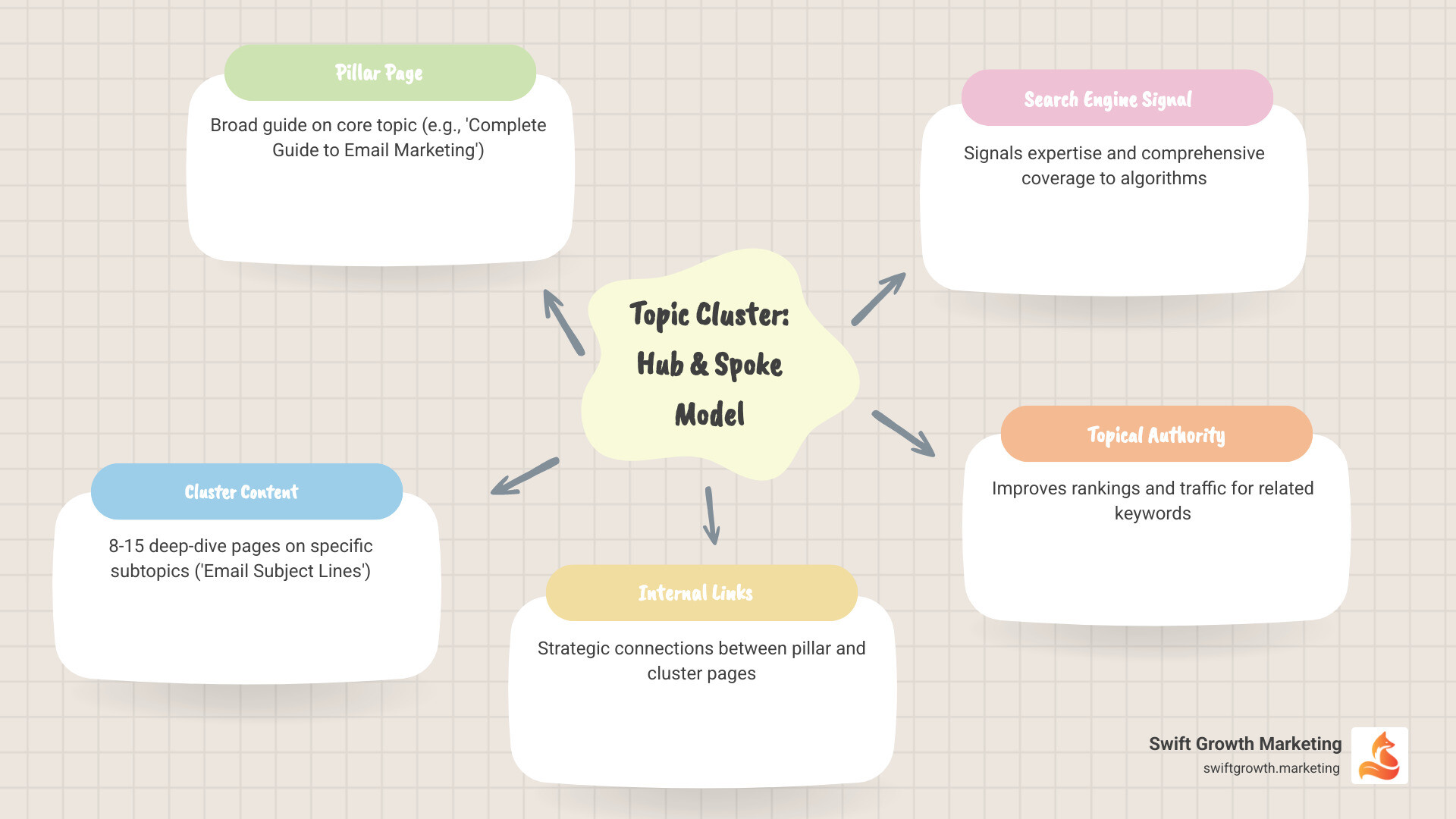
Topical cluster SEO is a content strategy that organizes your website around interconnected groups of pages. Instead of creating isolated articles, you build a network where one comprehensive “pillar page” covers a broad topic and links to multiple “cluster pages” that dive deep into specific subtopics. All pages are internally linked together.
This model consists of:
- Pillar Page: A comprehensive guide covering a main topic broadly (e.g., “Complete Guide to Email Marketing”).
- Cluster Content: 8-15+ supporting pages exploring specific aspects in depth (e.g., “Email Subject Line Best Practices”).
- Internal Links: Strategic connections between pillar and cluster pages.
This structure helps search engines recognize your site as a comprehensive resource, improving your topical authority and rankings across all related pages. Google’s algorithms, especially after updates like Hummingbird (2013) and RankBrain (2015), shifted from matching keywords to understanding topics and user intent. Demonstrating comprehensive coverage signals expertise that both search engines and users value.
I’m Chris Hornak, and at Swift Growth Marketing, we’ve used topical cluster strategies to grow a local business from 400 to 45,000 monthly visitors and achieve a 764% traffic increase for an e-commerce client. This approach works because it aligns with how modern search engines evaluate authority.
The ‘Why’: How Topic Clusters Build Unbeatable Authority
Think of Google as a librarian. Years ago, it matched words from a search query to words in a book. Today, it evaluates entire sections of the library, looking for the most comprehensive collections that answer every related question a visitor might have.
This is why topical cluster SEO is so effective. It’s not about gaming the system; it’s about becoming a genuine expert resource. When you build a complete topic cluster, you demonstrate topical authority, signaling to search engines that you’ve covered a subject from every angle. This is crucial not just for search results but also for getting your content featured in AI-powered tools like ChatGPT and Perplexity, making this dual visibility more valuable than ever.
Google’s E-E-A-T guidelines (Experience, Expertise, Authoritativeness, and Trustworthiness) reward what topic clusters provide. An organized content hub shows you’re building a knowledge base, not just writing random articles.
This structure also improves user experience. A visitor interested in email marketing can find answers on subject lines, segmentation, and automation without returning to Google. This extended engagement sends powerful signals about your content’s value. A practical benefit is preventing keyword cannibalization, where multiple pages compete for the same keywords. With a clear pillar-and-cluster model, each page has a distinct purpose.
In today’s landscape of Generative Engine Optimization (GEO), this comprehensive approach is vital. AI tools reference authoritative sources, and building complete topic clusters increases your chances of being cited. For a deeper look at building content that search engines love, check out our guide on The Helpful Content Formula. To understand the planning behind these clusters, our Topical Map SEO guide is a great resource.
The Shift from Keywords to Concepts
Old-school SEO was a keyword-matching game. That world is gone. The change began when search engines started understanding intent. Google’s Hummingbird update in 2013 was a turning point, teaching the algorithm to process phrases and relationships between concepts.
Then came RankBrain in 2015, a machine learning algorithm that interprets context. It connects keywords and phrases to understand what a user is really asking. This evolution led to semantic search, the technology that makes the topic cluster model so effective. Search engines now evaluate whether your content satisfies the complete intent behind a search, not just if it contains keywords. A single page is often not enough; you need interconnected content that addresses the full spectrum of questions on a topic.
Building Trust and Topical Authority
Trust is everything in SEO, and topical authority is how you earn it. You prove to users and search engines that your site is the definitive resource on a subject.
This is achieved through breadth and depth of coverage. Your pillar page provides the broad overview, while cluster pages dive deep into specifics. Together, they demonstrate a comprehensive understanding that isolated articles cannot.
However, coverage alone isn’t enough. You must also show expertise signals. A simple phrase like, “When I built my first website, I struggled with…” signals real-world experience that AI-generated content can’t replicate. These personal touches, combined with detailed knowledge, create the expertise Google’s E-E-A-T framework rewards.
User engagement metrics tell the story. When visitors stay on your site, navigating through your interconnected content, it signals quality. The “perfect click”—when a user finds your result and never returns to the search page—is the ultimate validation. By building topic clusters with strategic internal linking, you create pathways for users to explore your expertise, building trust while demonstrating authority to search engines. For more on this, explore our Topical Map SEO Guide 2025.
The Core Components of Topical Cluster SEO
Building a topic cluster is like organizing a library. You don’t scatter books randomly; you arrange them in clear sections with connections between related topics. A topic cluster has three essential pieces: a pillar page, cluster content, and internal links connecting them.
It’s important to distinguish between topic clusters and keyword clusters:
| Feature | Topic Clusters | Keyword Clusters |
|---|---|---|
| Primary Goal | Build topical authority on a broad subject. | Optimize a single page for a group of related keywords. |
| Structure | Hub-and-spoke model: one pillar page linking to many cluster pages. | Group of keywords with similar intent targeting one page. |
| Content Scope | Broad topic on pillar page, in-depth subtopics on cluster pages. | Focused content on a single page for variations of a core query. |
| SEO Benefit | Signals expertise, improves site architecture, prevents cannibalization. | Maximizes ranking potential for a specific intent. |
| Relationship | Keyword clusters are often used within cluster content pages. | Can exist independently but are more powerful in a topic cluster. |
The key takeaway is that keyword clusters help individual pages rank, while topic clusters help your entire site become an authority. They work best together.
The Pillar Page: Your Content Cornerstone
Your pillar page is the foundation of your cluster. It provides a comprehensive overview of your chosen topic, touching on all major aspects without getting lost in every detail. Pillar pages should target broad keywords with high search volume, such as “The Complete Guide to Content Marketing” or “Everything You Need to Know About Local SEO.”
These pages are substantial, often 3,000-5,000 words, creating a resource that answers a user’s high-level questions. It’s not about diving deep into technicalities—that’s for your cluster content. Instead, you’re creating a roadmap that introduces each subtopic and guides readers to the specific information they need. This approach keeps people on your site and positions you as a comprehensive resource. For more on how these pages fit into your marketing, see our guide on How Pillar Pages Play a Role in Your Growth Marketing Strategy.
Cluster Content: The Supporting Spokes
If the pillar page is the overview, cluster content pages are the deep dives. They take the subtopics mentioned on your pillar and explore them thoroughly. For example, if your pillar page introduces “email segmentation,” a cluster page would be an entire article dedicated to that one topic, complete with examples and step-by-step instructions.
Each cluster page targets more specific, long-tail keywords that reflect a particular search intent, like “how to segment email lists by customer behavior.” These pages are typically 1,500-2,000 words, providing in-depth analysis on a single, focused angle. For a pillar on “Digital Marketing for Small Businesses,” cluster content might include “Local SEO for Wheeling, WV Businesses” or “Creating a Content Calendar That Works.”
This approach shows search engines you’ve covered a topic from every angle, proving you’re an authority. When users find your content helpful, they stay longer and explore more, sending positive engagement signals that search engines reward. To see how these pages work together, explore our insights on Content Hubs.
A Step-by-Step Guide to Building Your First Topic Cluster
Building your first topic cluster takes effort, but the payoff is a content foundation that establishes your business as an authority. It’s a strategic process of creating an interconnected content network that grows organic traffic and topical authority.

Here are the 6 steps to create a topic cluster:
- Choose a Core Topic: Identify a broad, relevant subject.
- Research Your Topics: Uncover related keywords and subtopics.
- Identify Pillar Pages and Subpages: Map out your content structure.
- Create Quality Content: Develop a comprehensive pillar page and in-depth cluster content.
- Build an Internal Linking Structure: Connect all pages strategically.
- Measure Cluster Performance: Track and refine your strategy.
Let’s walk through the key steps.
Step 1: Choosing and Researching Your Core Topic
Your core topic should be at the intersection of your expertise, business goals, and audience needs. A content audit can help identify gaps and opportunities.
Start with your buyer personas. What are their pain points? For a local business in Pittsburgh, PA, a topic like “Local SEO” might be relevant. Your business goals should also guide this decision. If you offer web design, a cluster around “Website Development” makes sense.
Next, use keyword research tools to find broad keywords for your pillar page and related long-tail keywords for your cluster pages. Analyze competitors to see what’s already ranking and where you can offer more comprehensive content. This research is the foundation of a Strong SEO Strategy.
Step 2: Crafting the Pillar and Cluster Content
Before writing, create detailed content outlines for your pillar page and each cluster page. The pillar page outline should cover all major subtopics to provide a solid overview. The cluster page outlines should focus on diving deep into a single subtopic, targeting specific long-tail keywords.
Write for humans first. While on-page SEO is important (including keywords in titles, meta descriptions, and headings), never sacrifice readability. Use descriptive anchor text for your internal links. Instead of “click here,” use phrases like “learn more about internal linking strategies.” This gives context to both users and search engines, strengthening your content network.
Step 3: Implementing a Strategic Internal Linking Structure for Topical Cluster SEO
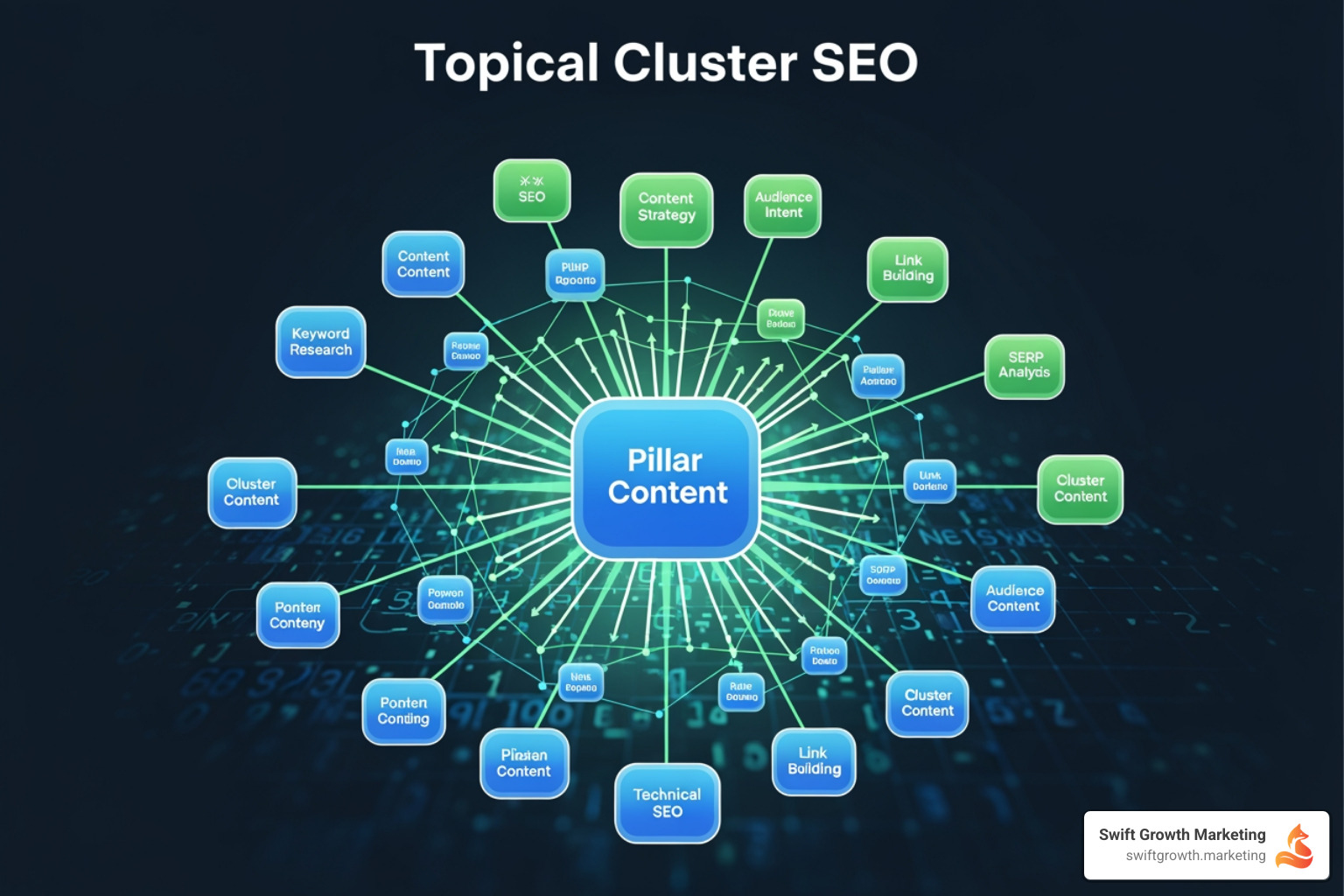
Internal linking transforms individual articles into a powerful, interconnected network. We use the hub-and-spoke model: the pillar page (hub) links out to all cluster pages (spokes), and every cluster page links back to the pillar.
This structure distributes link equity throughout your cluster. When your pillar page earns authority, it shares that power with the linked cluster pages, and vice versa. It’s a virtuous cycle that lifts all content together.
From a user experience perspective, this creates seamless navigation, keeping people on your site longer and signaling value to search engines. Use descriptive anchor text to tell users and search engines what they’ll find when they click, improving the coherence of your topic cluster. For a deeper dive, check out our guide on Hub and Spoke SEO.
Measuring Success and Finding Inspiration
Building a topic cluster is an ongoing process. Once implemented, you must measure performance and refine your strategy for continuous growth.
At Swift Growth Marketing, we use a data-driven approach to gauge the effectiveness of our topic cluster strategies for clients in Pittsburgh, PA, Wheeling, WV, and beyond. The beauty of this model is that it’s measurable, providing clear performance indicators that can be tied to business outcomes like leads, sales, and revenue.
Tools and Methods for Planning and Tracking
Tracking performance requires the right tools and a strategic approach.
- Google Search Console: This free tool is your first stop. It shows which keywords your pages are ranking for, their impressions and clicks, and any technical issues. We use it to monitor the performance of both pillar and cluster pages.
- Dedicated SEO Platforms: Tools like Semrush or Ahrefs take analysis to the next level. They are excellent for keyword gap analysis (finding keywords competitors rank for that you don’t) and position tracking to monitor your cluster’s overall ranking performance.
- Google Analytics: This provides insights into user behavior. We examine metrics like time on page, bounce rate, and user flow to see how visitors interact with your content. Movement between pages in a cluster is a strong positive signal.
- ROI and Conversions: We track conversions, leads, and sales attributed to your topic clusters to demonstrate their return on investment. For more on auditing performance, our guide on How to perform an Ecommerce SEO Audit provides additional insights.
Successful Topic Cluster Examples
Seeing this strategy in action is the best way to understand its power.
- Shopify’s Ultimate Guide to Dropshipping: This is a masterclass in pillar page design. The comprehensive guide serves as a central hub, linking to dozens of supporting articles on specific subtopics. This establishes Shopify as the go-to resource for dropshipping.
- Hotjar’s guide on heatmaps: This multi-chapter cluster includes a detailed pillar page and specific articles on different types of heatmaps. These articles collectively rank for over 530 keywords and drive significant monthly traffic, showing the compounding effect of a well-executed cluster.
- Salesforce’s CRM cluster: Salesforce dominates the search landscape for CRM-related queries with a comprehensive pillar page for “What is CRM?” that links to numerous supporting articles. This deep, interconnected coverage makes them an undeniable authority.
Frequently Asked Questions about Topic Clusters
We hear a lot of questions about topical cluster SEO. Here are answers to some of the most common points of confusion we encounter when working with businesses in Pittsburgh, PA, Wheeling, WV, and beyond.
What is the difference between a topic and a keyword in SEO?
Think of a topic as an entire library section (e.g., “Email Marketing”), while a keyword is the specific book title someone searches for (e.g., “how to write email subject lines”). A topic is the broad concept you want to be known for. A keyword is the specific phrase a user types into Google. In a topic cluster, the pillar page addresses the broad topic, while cluster pages target specific keywords related to that topic.
Can a website rank without using topic clusters?
Yes, a single great article can rank well on its own. However, you’re leaving significant potential on the table. A topic cluster strategy amplifies your entire content library. Instead of each article performing in isolation, you create a network where each piece strengthens the others. This helps you compete for more difficult terms, prevents internal keyword competition, and creates a better user experience, establishing you as a definitive resource rather than just a site with a few good answers.
How many topic clusters should a website have?
The number depends on your business and resources, but the best approach is to start with one core topic that is central to what you do. Build this cluster completely, with a comprehensive pillar page and 15-20 in-depth cluster articles. Once that first cluster is performing well, you can expand to a second or third. Quality and comprehensiveness always trump quantity. It’s far better to dominate two or three topics than to have ten half-finished clusters.
Conclusion
Building a successful online presence requires a deliberate, interconnected web of content that demonstrates your expertise. That is exactly what topical cluster SEO delivers. By organizing your content into these comprehensive networks, you signal to search engines and users that you are an authority on a subject.
This approach improves your SEO, prevents your pages from competing against each other, and creates a better experience for your visitors. In an era of AI-powered search, having deep topical authority is essential for appearing in both traditional search results and generative AI answers.
At Swift Growth Marketing, we’ve seen how powerful this approach can be, changing online visibility for businesses in Pittsburgh, PA, Wheeling, WV, and beyond. A well-executed topical cluster SEO strategy signals authority, leading to better rankings and more qualified traffic.
As a digital marketing partner, Swift Growth Marketing can help you build a powerful content architecture that drives results. Ready to master your niche? Contact our SEO agency today, and let’s create a content strategy that works as hard as you do.