

Why Financial Advisors Struggle Without a Marketing Plan
Financial advisory marketing is the strategic process of attracting and retaining clients. A winning plan includes a defined target audience, a multi-channel strategy (SEO, content, social media), consistent branding, lead generation systems, performance tracking, and a compliance framework.
The data is stark: fewer than 30% of financial advisors have a defined marketing strategy. Yet those who do generate 168% more leads and onboard 50% more clients annually. The gap isn’t budget—it’s a structured plan.
Most advisors cite finding time for marketing (85%), developing a cohesive strategy, and measuring results as their biggest obstacles. This guide provides a roadmap to build a marketing plan that works, helping you position your services, create content that builds trust, and leverage digital tools to grow your practice.
I’m Chris Hornak, Co-Founder of Swift Growth Marketing. We specialize in helping service companies build authority through strategic positioning and search optimization. The principles of effective financial advisory marketing—clear positioning, trust-building content, and measurable growth—are universal, and we’ve applied them to deliver proven results across multiple industries.
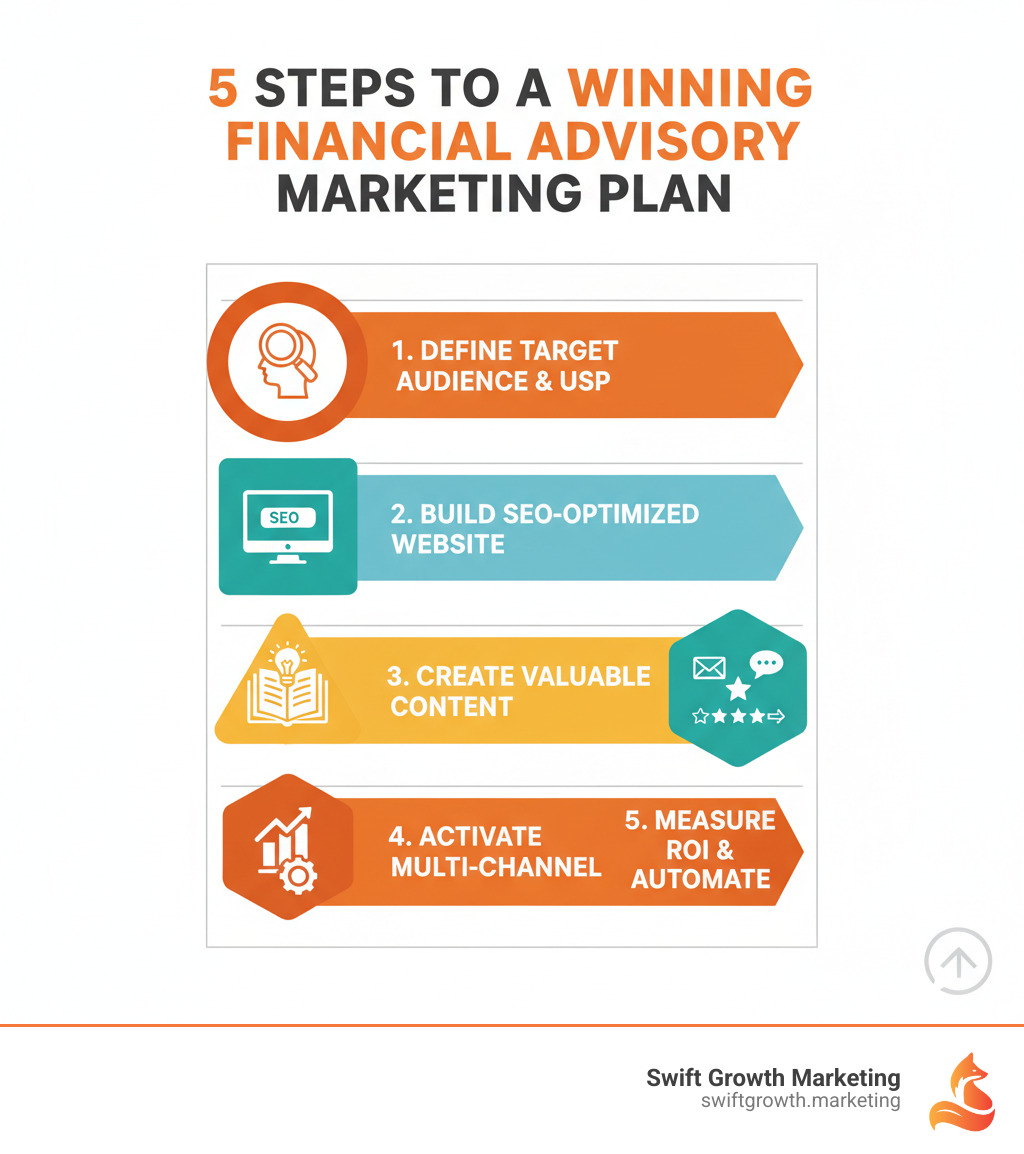
Laying the Foundation: Strategy, Branding, and Budget
Your marketing plan is the blueprint for growth. Without clear goals, a defined brand, and a realistic budget, your efforts will lack direction. Advisors with a defined marketing strategy are 34% more confident in their business growth because they’ve set SMART goals (Specific, Measurable, Achievable, Relevant, Time-bound) tied to business objectives like lead generation or client retention.

Once you know your goals, analyze the competitive landscape to find your Unique Selling Proposition (USP). Your USP is why a client chooses you. Understanding your objectives, competitors, and unique value is the first step in crafting Strategic Messaging that resonates.
Defining Your ‘Who’ and ‘Why’: Target Audience & USP
You can’t market to everyone. Defining your ideal client persona—their demographics, financial goals, and pain points—is essential. Niche marketing is powerful; specializing in tech professionals or small business owners allows for highly targeted messaging.
Different demographics require different approaches. Millennials and Gen Z prefer digital interactions, while older clients may value face-to-face meetings. Your marketing must match these preferences. Research shows that emotional factors like trust and communication quality are primary drivers for hiring an advisor. Your Strategic Messaging should address these emotional needs directly.
Your credentials (CFP®, CFA®) are powerful trust signals. Highlighting them is crucial, especially as AI-generated content becomes more common. Your human expertise is a key differentiator, and Building Brand Trust: Generative AI’s Impact on Credibility is more important than ever.
The Blueprint for Success: Branding, Budget, and Timeline
Branding is more than a logo; it’s the expectation and feeling clients associate with your firm. Strong, consistent branding across your website, social media, and emails builds recognition and trust. Your Brand Voice Elements should be uniform everywhere a client encounters you.
How much should you budget? Independent advisors typically invest 2-4% of revenue in marketing, but the average firm spends 8.7%. Growth-focused advisors invest even more, averaging around $15,908 per year. You don’t need to match these numbers immediately, but a clear budget is non-negotiable.
Marketing campaigns need time to work. Plan your budget and activities in quarterly sprints, giving strategies enough runway to generate results. The goal is to spend wisely. For actionable ideas, see our 5 Tips to Getting a Better ROI from Your Growth Marketing Budget.
Building Your Digital Presence: Website, SEO, and Content
When potential clients need financial advice, their search starts on Google. Your digital presence is their first impression of your firm, making it an essential component of your marketing. The modern investor values both technology and human guidance, so your digital tools should complement your personal touch.

This blend of tech and personal connection is the core of modern financial advisory marketing. Instead of cold calling, you attract clients with helpful online resources. This inbound approach allows prospects to build trust on their own terms before ever speaking to you.
Your Digital Front Door: The Role of a High-Converting Website
A visitor forms an opinion of your website in just 50 milliseconds. Yet, 62% of advisors find their websites ineffective at generating leads. A high-converting website must have a mobile-first design, as over half of all emails are opened on mobile devices.
Great user experience is critical. Visitors should find what they need easily, guided by intuitive navigation and clear calls-to-action (CTAs) like “Schedule a Consultation.” Your lead capture forms should be simple, asking only for essential information. Applying Psychology-Based Landing Page Optimization That Converts can dramatically improve your conversion rates.
Getting Found: A Financial Advisor’s Guide to SEO and Paid Ads
75% of people never scroll past the first page of Google. If you’re not ranking for terms like “financial advisor Pittsburgh,” you’re invisible. A Strong SEO Strategy helps you get found by targeting the keywords your ideal clients are searching for.
Your site needs a solid technical foundation (fast, mobile-friendly, secure) and quality content that answers real questions. Local SEO is crucial for advisors serving specific areas like Pittsburgh, PA, or Wheeling, WV. Optimizing your Google Business Profile and earning local reviews helps you appear in location-based searches.
For faster results, Pay-Per-Click (PPC) advertising on platforms like Google Ads places you at the top of search results immediately. You only pay when someone clicks, making it a highly measurable way to generate leads for a webinar or downloadable guide.
Creating Compelling Content That Builds Trust
Content marketing operates on a simple philosophy: “Help first, sell second.” By consistently providing value, you build trust naturally. Storytelling in Content Marketing makes complex financial topics relatable by sharing anonymized client successes.
The Helpful Content Formula provides a framework for creating content that addresses your audience’s true concerns. Focus on topics that resonate locally, like “College Savings Strategies for Pittsburgh Families.”
Effective content formats include:
- Blogs: Powerful for SEO and establishing thought leadership.
- Videos: Increase website traffic and build a personal connection. 78% of businesses report video increases traffic.
- Podcasts: Ideal for reaching busy professionals. 51% of Americans have listened to a podcast.
- Infographics: Simplify complex data for easy sharing.
- Webinars: Combine education with lead capture.
Consistency is key. Regularly publishing valuable insights establishes you as the go-to resource in your market.
Activating Your Audience: Channels for Financial Advisory Marketing
With a solid foundation, it’s time to activate your audience on the right marketing channels. A multi-channel strategy for financial advisory marketing ensures you reach clients where they spend their time, but prioritization is key. Understanding the Types of Growth Marketing Channels helps you focus on what will drive client acquisition and engagement.

Mastering the Inbox: Email Marketing for Client Engagement
Email is the workhorse of digital marketing. With half the world’s population using email, it’s no surprise that email marketing earns $36 for every $1 spent—the highest ROI of any marketing activity.
Success comes from building and segmenting your email list. A business owner in Pittsburgh has different needs than a young couple in Wheeling. Custom messages feel personal and drive engagement. Regular newsletters, market insights, and cross-selling opportunities keep you top of mind, while personal touches like birthday messages strengthen loyalty.
Navigating the Social Sphere: A Guide to Social Media
Social media for advisors requires balancing brand building with strict compliance. Every like, share, and comment can be considered implied investment advice, requiring documentation. Despite this, advisors who accept social selling outperform their peers by 72%. Success requires consistency—active advisors post around 35 times per month. Your Brand Voice on Social Media must be engaging yet compliant.
- LinkedIn: Your professional home for sharing thought leadership and connecting with business owners and executives in Pittsburgh or Wheeling.
- Facebook: Offers a personal touch to showcase your team, celebrate client milestones, and build rapport by being human.
- YouTube: Excellent for educational videos that explain complex topics, building trust with prospects 24/7.
A consistent content cadence is crucial. Mix educational, personal, and firm-related posts to keep your audience engaged. Social media is a marathon, not a sprint.
Building Credibility: Online Reviews, Testimonials, and PR
Trust is the currency of your business, and social proof is how you earn it. The updated SEC Marketing Rule allows advisors to proactively ask for testimonials and use ratings. Your satisfied clients in Pittsburgh and Wheeling can be your best advocates.
Implement a systematic Google review strategy by updating your Form ADV and making it easy for happy clients to leave feedback. Data shows that firms with more reviews tend to have higher ratings, creating a virtuous cycle of visibility and growth. AI Brand Reputation Management can help you monitor and respond to feedback effectively.
Also, pursue local PR opportunities. Being quoted in the Pittsburgh Post-Gazette or appearing on a Wheeling radio show establishes you as a local expert, building credibility that leads to referrals.
Measuring, Automating, and Staying Compliant
Financial advisory marketing can be overwhelming. The advisors who succeed are those who treat marketing as an investment: they measure performance, automate repetitive tasks, and adhere to regulations. A Growth Marketing Mindset focuses on using data to refine what works and technology to handle inefficiencies.
Proving Your Worth: Measuring Marketing ROI and KPIs
Just as you track investment performance, you must track your marketing. Key Performance Indicators (KPIs) are the vital signs of your marketing health.
- Website traffic: How many people find you online.
- Conversion rates: The percentage of visitors who take a desired action.
- Cost Per Lead (CPL): How much you spend to generate one inquiry.
- Client Acquisition Cost (CAC): The total cost to land one new client.
These metrics show where to invest and where to pull back. Fast Marketing Wins Happen When You Listen to Customer Data. Calculating ROI (revenue minus costs, divided by costs) proves whether your marketing is paying for itself.
Streamlining Your Efforts: The Power of Marketing Automation
With 85% of advisors struggling to find time for marketing, technology is a game-changer. Research on marketing obstacles for advisors confirms this challenge. Automation tools give you hours back each week.
- Email automation nurtures leads from initial interest to consultation without manual effort.
- Social media scheduling tools allow you to plan a week’s worth of content in one sitting, ensuring consistency.
- Content curation platforms help you find relevant articles to share, positioning you as a knowledgeable resource.
Integrating these tools with your CRM ensures no lead falls through the cracks. The technology works in the background while you focus on clients.
Staying Above Board: Key Compliance Considerations for Financial Advisory Marketing
Unlike most businesses, advisors must follow strict SEC and FINRA rules. The SEC Marketing Rule 206(4)-1 governs how you can advertise. Recent amendments allow for testimonials and ratings, but with specific disclosure requirements about compensation and typical client experience.
FINRA rules add another layer, often requiring supervision and retention of all communications, including social media posts. The SEC’s definition of “advertising” is broad, covering your website, emails, social media, and webinars. We recommend reviewing the SEC’s marketing FAQs regularly.
Record-keeping is critical: you must maintain copies of all marketing materials for at least five years. Working with a marketing partner who understands these regulations, like Swift Growth Marketing, ensures your campaigns are both effective and compliant, allowing you to market your practice confidently.
Frequently Asked Questions about Financial Advisor Marketing
Here are straightforward answers to the most common questions we hear from advisors.
What is a realistic marketing budget for a financial advisor?
It depends on your growth goals. Independent advisors typically spend 2-4% of their revenue on marketing, while the average firm invests 8.7%. Growth-focused advisors average $15,908 annually. For new or ambitious advisors in markets like Pittsburgh, a starting point of 5-10% of gross revenue is a solid recommendation. The key is to have a defined budget and track your return on investment.
How long does it take to see results from digital marketing?
Expectations should be realistic. Paid advertising (PPC) can generate leads within weeks. However, organic strategies like SEO and content marketing often take 3-6 months or more to gain traction. While client referrals convert faster (1.7 months vs. 3.6 months for marketing prospects), a combined approach is best. Consistency is crucial; strategies given at least six months to work almost always outperform short-term tactics.
What is the single most effective marketing channel for acquiring new clients?
There is no single best channel for every advisor. However, email marketing consistently delivers the highest ROI, earning an estimated $36 for every $1 spent. For lead conversion, LinkedIn and Facebook are top performers for advisors, while referrals remain the most efficient path to new clients.
A multi-channel approach is most effective. Your website, content, email, and social media all work together to build trust and attract clients. The best channel for you is where your ideal clients spend their time. At Swift Growth Marketing, we help you identify those channels and build an integrated strategy that fits your goals and budget.
Conclusion
You now have the roadmap for a winning financial advisory marketing plan—from strategy and branding to execution and compliance. Advisors with a defined marketing strategy onboard 50% more clients annually because they treat marketing as an investment, not an expense.
By being consistent, data-driven, and compliant, you build a growth engine that works for you around the clock. Your ideal clients in Pittsburgh, PA, Wheeling, WV, and beyond are searching for an advisor they can trust. Your job is to ensure they find you.
If you’re ready to stop guessing and start growing, Swift Growth Marketing can help. We build authority and attract the right audience with strategies that deliver results. Take your practice to the next level with a tailored Growth Marketing Consultancy designed for your digital success.