

Why Category Defining Brands Win the Market Before the Competition Realizes There’s a Game
A category defining brand doesn’t just compete—it creates a new playing field where it’s the only player that matters. These brands become synonymous with the solution itself (think Kleenex or Google) by teaching the market a new way to think.
What Defines a Category-Defining Brand:
- Creates new language around problems and solutions.
- Solves problems people didn’t know they had.
- Owns the category, capturing over 70% of the market value.
- Teaches the market a new perspective.
- Becomes a proprietary eponym, where the brand name is the category name.
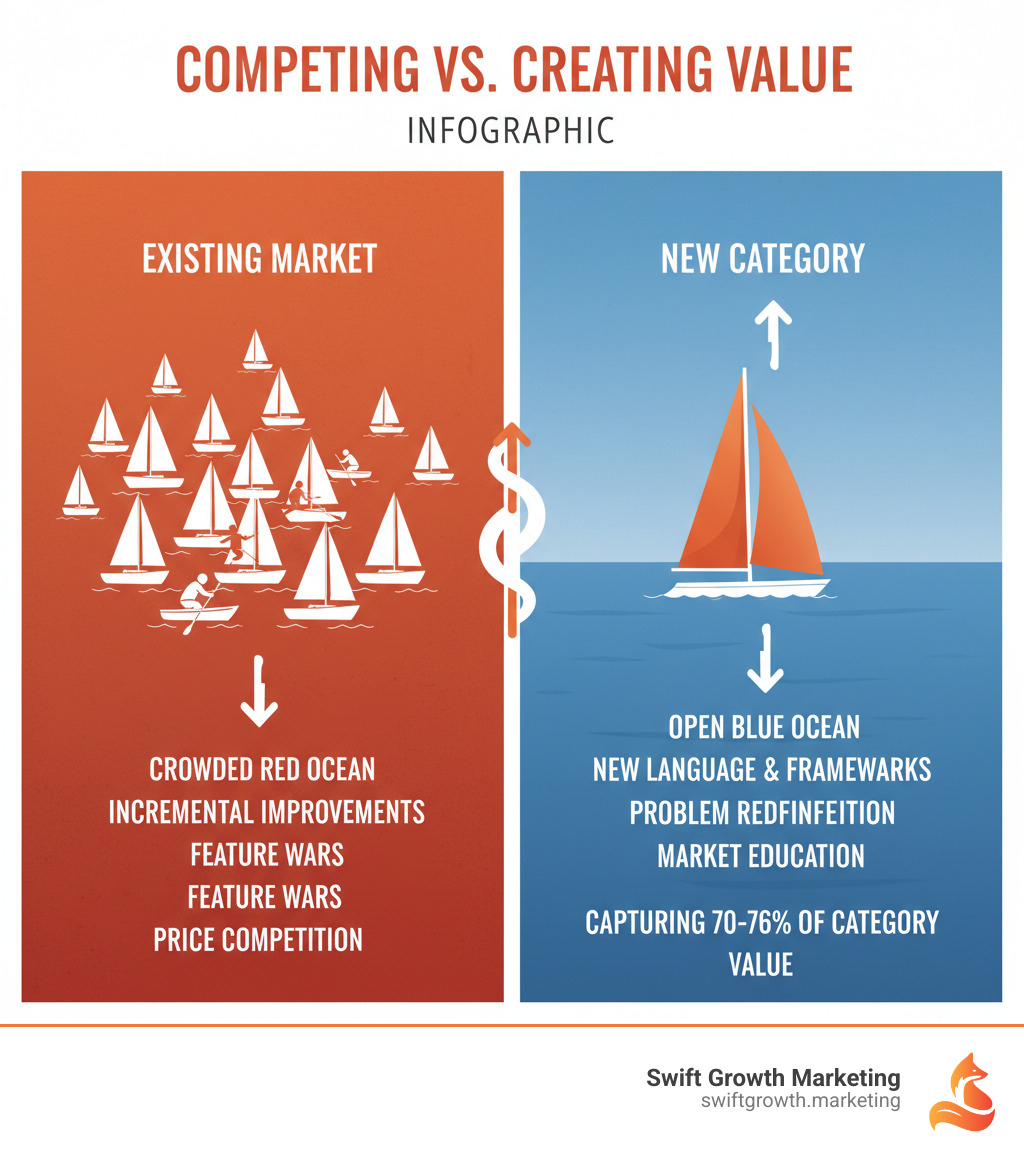
Most companies compete on features or price, positioning themselves as “better than” the competition. Category defining brands reject this. They ask, “What new category can we create where we’re the only logical choice?”
The difference is profound. Category leaders earn trust by educating the market, not just promoting their brand. This isn’t about clever positioning; it’s about solving real problems in ways that make old solutions obsolete. It’s about being different when everyone else is trying to be better.
I’m Chris Hornak, Co-Founder of Swift Growth Marketing. We transform brands into category authorities using strategic positioning, search optimization, and content marketing. I’ve seen how category defining brands break through the noise, like when we helped a client achieve a 764% traffic increase through strategic repositioning.
The Founder’s Mindset: The Human Element Behind Category Creation
Many believe category defining brands start with a brilliant strategy or product. The truth? It starts with a person or team who sees the world differently. Behind every market-disrupting company is a founder driven by something deeper than market share. The key differentiator isn’t just the idea; it’s the human element.
Founders who create new categories share a few traits: genuine passion, a focus on building something great, relentless forward movement, and a healthy disregard for perfection.

The Power of Passion and Authenticity
Passion isn’t a buzzword; it’s the fuel that sustains founders through the inevitable rough patches when success isn’t obvious. The best ideas often trace back to a personal frustration or obsession.
But here’s the counterintuitive part: most category-defining founders don’t set out with that explicit goal. They’re trying to build something great and solve a real problem. The category-defining status is a byproduct of obsessive focus. Authenticity can’t be faked, and since seven out of ten customers choose to purchase more from brands they trust, building that trust through genuine passion is essential. That’s why building brand trust is a critical part of our work.
Your personal brand as a founder also plays a huge role. It builds trust, creates opportunities, and puts a human face on a new category, making it relatable. People connect with people, not positioning statements. Remember: consistency beats creativity. Branding earns trust; marketing gets attention.
Why ‘Progress Over Perfection’ is the Mantra
Category-defining founders move forward relentlessly, even when things aren’t perfect. This momentum comes from self-awareness and a laser focus on their core reason to succeed.
Self-awareness helps founders understand their strengths and weaknesses, enabling them to hire people smarter than themselves. As Gabriella Owens wisely stated, “progress beats perfection in storytelling EVERY DAMN TIME!” This applies to everything. The pursuit of the perfect product or team leads to analysis paralysis.
The alternative to moving forward imperfectly is standing still perfectly. In innovation, standing still is a death sentence. This bias toward action is central to the growth marketing mindset. The founders who create category defining brands are willing to be imperfect in public, learn faster than their competition, and keep moving when others freeze.
What is Category Design? From Blue Oceans to Market Dominance
If the founder’s mindset is the engine, then category design is the blueprint. It’s a business strategy that flips traditional thinking on its head by creating and developing a new market category, then establishing your company as its leader. The magic happens when you stop trying to be “better” and start being “different”—then teach the world to see their problems in a new way.
This is the “Blue Ocean” approach: instead of battling in crowded red oceans, you carve out a new space where competition is irrelevant. You’re not playing their game; you’re creating your own. When you define the category, you define the rules and avoid the exhausting feature wars that commoditize your offering.
Content is your primary tool for this. It’s how you educate your market, drive demand, and establish authority. Through strategic content, you establish a clear Point-of-View (POV) that sticks in people’s minds. This is where strategic messaging becomes your secret weapon.
Legendary category designers didn’t just do things differently—they created entirely new paradigms. Picasso created Cubism, Bob Marley defined Reggae, and Sarah Blakely created Spanx, redefining shapewear.
Here’s how traditional brand marketing differs from category design:
| Feature | Traditional Brand Marketing | Category Design Marketing |
|---|---|---|
| Primary Goal | Compete within existing categories, gain market share | Create and dominate a new category, make competition irrelevant |
| Focus | “Better than” competitors, features, price, service | “Different from” existing solutions, new problems, new solutions |
| Approach | Differentiate within established rules | Rewrite the rules, educate the market on a new way to think |
| Message | “Look at me!” (brand-centric) | “I understand your unarticulated problem and have a new solution” (customer/problem-centric) |
| Outcome | Incremental growth, often commoditization | Exponential growth, market leadership, high valuations |
Key Characteristics of a Category Defining Brand
A category defining brand solves a problem that people didn’t know they had or couldn’t imagine being solved differently. The ultimate achievement is becoming a proprietary eponym, where your brand name becomes the generic term for the category (e.g., asking for a “Kleenex” instead of a tissue). This is the gold standard of category design.
Brands achieve this by entering the market first with a new solution, marketing that solution to a previously unrecognized problem, and then shifting focus to universal needs. Kleenex, for example, was originally for removing cold cream before it pivoted to disposable handkerchiefs, creating the facial tissue category.
Category vs. Brand: Why You Shouldn’t Use Your Category for Differentiation
Here’s a counterintuitive point: you should not use your category for differentiation. The purpose of your category is to highlight what makes you similar to others in a competitive set. It answers the prospect’s basic question: “What is it?”
Categories create “hygiene factors”—the basic features people expect. If you call yourself a “diving watch,” you’d better be water-resistant. Consumers choose a category before they choose a brand. The Segway stumbled because its category was unclear.
Believing that branding elements like logos and colors alone can drive growth is a dangerous myth. If you’re not defining a category, you’re just a feature or product, which leads to comparison shopping, not loyalty. Consumers, not brands, ultimately dictate categories. Your category statement should use the vocabulary your audience already uses, which is why crafting a unique brand voice that resonates is so important. The category gets you in the door; your brand makes them choose you.
The 6-Step Blueprint to Defining Your Brand’s Category
Defining your brand’s category is a strategic journey. It requires curiosity about your audience and the courage to question your assumptions. We’ve distilled the process into six clear steps.

Step 1-3: Hypothesize, Research, and Validate
Start with a hypothesis. What category do you believe you’re in? Write it down. This is your starting point, a concrete idea to test against reality.
Next, talk to your target audience. This is the most important step. Have real conversations to find the words they use to describe their problems and potential solutions. Structured surveys via tools like Survey Monkey can help, but don’t skip open-ended discussions that uncover deep insights.
Validate with data. Use tools like Google Search Trends to see if the language your audience uses appears in search behavior. Check search volumes and competitor categorization. This ensures your category defining brand is built on market demand, not wishful thinking. The goal is alignment between your hypothesis, audience feedback, and market data.
Step 4-6: Define, Position, and Communicate
Make the big decision: new category or existing one? Based on your research, you’re at a crossroads. If you can realistically lead an existing category, that’s your path. But if you’re stuck in a crowded market or your offering is diminished by existing labels, it’s time to create something new. This means solving a problem in a new way and teaching the market why it matters.
Craft your category statement and positioning with precision. Your category statement should be factual and concise (e.g., “project management software”). For a new category, define your positioning:
- The WHO—A value-based description of your audience (e.g., “optimists planning for independence,” not just an age bracket).
- The WHAT—A conceptual description of your offering (e.g., “long-term wellness through comfort”).
- The WHY—The highest emotional benefit you deliver (e.g., “vibrancy”). This emotional core should connect to your differentiators and customer needs. Understanding psychology-based landing page optimization helps craft messaging that resonates.
Make your category impossible to miss. Communicate your category clearly on your homepage, product pages, and about page. No visitor should have to guess what you do. Optimize your main pages with your category name for search engines. This clarity is foundational to a strong SEO strategy. Use the same category language everywhere—website, social media, sales materials—to reinforce your position.
Fueling the Fire: The Role of Content in Becoming a Category Defining Brand
You’ve defined your category. Now you must make the world care. This is where content becomes your most powerful strategic weapon. Content isn’t just about blog posts; it’s a dynamic asset that educates customers, drives demand, and establishes authority.
When you create a new category, you’re teaching people a new way of thinking. Educational content is highly effective, making consumers significantly more likely to buy. You’re not just selling a product; you’re selling a perspective. Strategic content planning allows you to own market share by becoming the go-to resource in your new space.

Crafting Content for a Category Defining Brand
Many brands fall into the “content disease”—publishing for quantity over quality. For a category defining brand, quality is everything.
- Understand your audience deeply. Immerse yourself in their world and speak their language.
- Set clear objectives. Every piece of content should have a purpose, whether it’s to educate, inspire, or convert.
- Prioritize quality over quantity. One insightful piece is worth more than ten generic posts. This aligns with the helpful content formula.
- Incorporate data and research. Back up your ideas with credible statistics to combat skepticism.
- Use strong visuals. Infographics and videos make complex ideas digestible, as most consumers prefer visual content.
- Craft compelling headlines. Your headline is your first and often only chance to capture attention. Learn more with the universal headline framework that works.
Establishing Thought Leadership Through Content
Thought leadership is about having different thoughts and articulating them so well that others adopt your perspective. To achieve this, you must consistently offer unique insights and develop a strong Point-of-View (POV). Research shows that high-quality thought leadership content helps businesses achieve better outcomes. When you teach people to see problems differently, they remember who taught them.
A great approach is creating pillar pages and content clusters. These comprehensive resources establish your brand as the definitive source of information on your category. Learn how content clusters build topical authority.
Content Promotion and Measurement
Brilliant content needs an audience. Promotion is how you spread your new way of thinking.
- SEO optimization ensures people find your content when searching for solutions.
- Multi-channel promotion through email, social media, and partnerships amplifies your reach. Guest blogging on relevant sites is a powerful way to reach new audiences. Explore why you should write guest blog posts.
- A robust social media strategy, especially on platforms like LinkedIn for B2B, sparks real conversations. Our insights on social media marketing on LinkedIn can help.
- Measure and refine continuously. Use analytics to track what resonates and adjust your strategy accordingly.
Frequently Asked Questions about Category Defining Brands
What is the difference between a brand’s story and its strategy?
Your brand’s story is the “why”—the emotional core that explains your purpose and beliefs. It’s the founder’s journey and the problem that sparked the solution. The story creates an emotional hook that makes people care.
Your strategy is the “how”—the concrete plan for turning that story into reality. It includes market positioning, product roadmaps, and marketing tactics. Strategy is logical and measurable.
A strong story fuels the strategy, giving it meaning. When story and strategy work together, every decision feels authentic, and category defining brands are born.
When is it crucial to define a new category?
Defining a new category is essential in three situations:
- When you’re not the leader in a crowded category. Creating a new category lets you step off the competitive hamster wheel and become the leader from day one.
- When your offering’s value is diminished by comparison. If existing terms don’t do your innovation justice, you need a new category to properly frame its value.
- When you solve a problem in a fundamentally new way. If you’re introducing a paradigm shift, you need a new category to educate the market on your new way of thinking.
How does a founder’s personal brand contribute to a category-defining company?
A founder’s personal brand is invaluable for making a new, unfamiliar category feel approachable and trustworthy.
- It builds trust at scale. People connect with people. A founder’s authentic story fosters trust long before the company is widely known.
- It creates leverage and opportunities. A strong personal brand opens doors to partnerships, talent, and media attention, acting as a megaphone for the new category.
- It acts as a survival tool. Products and companies evolve, but a founder’s personal brand endures, providing a stable platform through pivots and changes.
A human champion with a strong personal brand is often the difference between a category that takes root and one that withers.
Conclusion: Stop Competing, Start Creating
Building a category defining brand requires courage and vision, but the rewards are extraordinary. It starts with a founder’s mindset rooted in passion and progress, is executed through strategic category design, and is fueled by content that educates and establishes authority.
The difference between competing and creating is profound. When you compete, you measure yourself against others. When you create a category, you set the standard. You’re not asking prospects to choose you over the competition; you’re teaching them to see their problem in a new light, where your solution is the only logical answer.
This means choosing to be “different” rather than just “better.” Better is incremental. Different is changeal. Better gets you a slice of the pie. Different lets you bake a whole new one.
At Swift Growth Marketing, we’ve seen this strategy transform businesses, helping them achieve results like a 764% traffic increase by articulating a unique vision.
The market doesn’t need another “me too” brand. It needs pioneers. If you’re ready to stop competing and start creating, let’s build your category-defining strategy together.
Your category is waiting to be defined. Will you be the one to define it?