

Why Topical Map SEO is Changing Content Strategy
Topical map SEO is a strategic approach to organizing your website’s content around core themes and subtopics, creating a clear hierarchy that helps search engines understand your expertise and improves user experience.
Quick Answer:
- What it is: A visual framework mapping your content into interconnected topics and subtopics
- Why it matters: Builds topical authority, signals expertise to search engines, and improves rankings
- Key benefit: Sites that fully cover a subject often outrank competitors with fewer backlinks
- How it works: Create pillar pages linking to supporting cluster content in a logical hierarchy
- Result: Search engines see you as an authoritative source, leading to higher rankings across related keywords
The days of keyword stuffing are over. Search engines have evolved to understand topics, not just isolated phrases, prioritizing sites that demonstrate comprehensive expertise. This shift requires a new content strategy.
Instead of a scattered, keyword-by-keyword approach, topical mapping involves covering a subject comprehensively. Addressing every angle and subtopic signals authority to search engines, leading to better rankings and more organic traffic, often reducing the need for expensive link building. Companies implementing topical maps have seen dramatic growth, with some achieving a 295% increase in organic traffic or growing from zero to over 100,000 monthly visits.
Topical maps also create a better user experience. Logically organized content with clear internal links helps visitors find answers faster and stay engaged longer, making your site easier to steer for both humans and search engine crawlers.
With the rise of AI Overviews and answer engines, this structure is more critical than ever. AI systems need structured content built around entities and relationships to cite you as an authoritative source, and topical maps provide exactly that. This guide will walk you through everything you need to know to build your own topical authority.
Moving Beyond Keywords to Build Topical Authority
At its heart, topical map SEO is about demonstrating comprehensive expertise. Google’s algorithms have evolved to understand the context and intent behind a search query, rewarding sites that cover a topic in-depth. This aligns with Google’s Helpful Content System, which prioritizes content that truly helps users.
By organizing your content into a clear hierarchy, you signal that you comprehensively cover a topic. This approach builds “topical authority” and demonstrates expertise. When Google sees you as an authority, it trusts your content more, leading to higher rankings for all related articles. A well-executed strategy can significantly reduce your need for link building, as sites that fully cover a subject often outrank competitors with fewer links. For a deeper dive, explore our guide on Content Clusters Build Topical Authority with Pillar Cluster Architecture.
How Topical Maps Improve User Navigation and Engagement
While powerful for search engines, topical map SEO is equally beneficial for users. A well-structured topical map creates a logical site structure that makes it easier for users to steer. When content is organized with clear pathways, users can easily find answers and explore related information. This improves the user experience, leading to a reduced bounce rate and longer time on page.
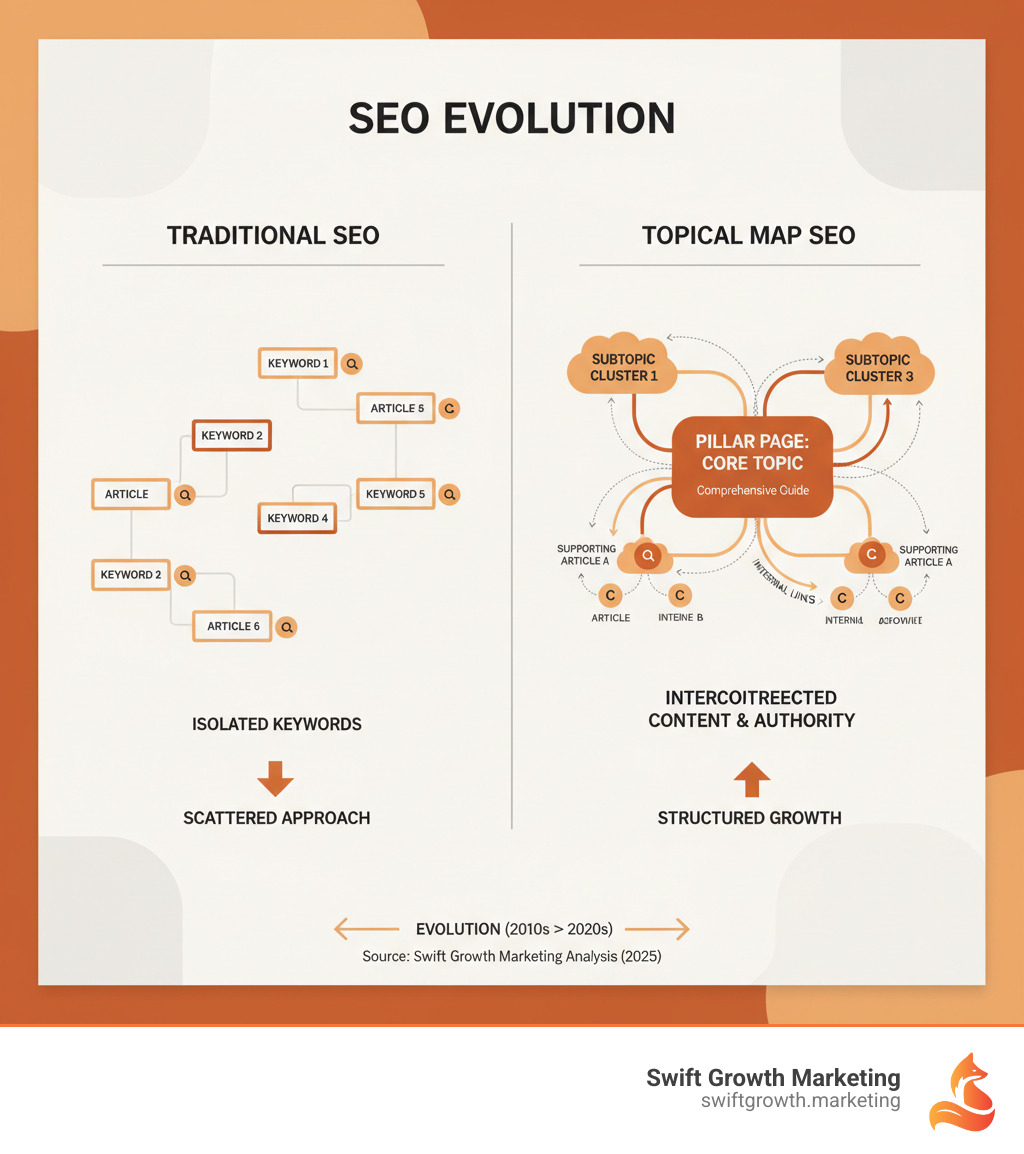
A main topic page (pillar page) links to several supporting articles (cluster pages), which link back to the pillar and to each other. This strategic interlinking guides the user journey, ensuring they find the depth of your expertise. A positive user experience is a ranking factor, as it signals to search engines that your content is valuable. We dig into this further in our insights on UX Optimization.
Mastering Topical Map SEO: From Strategy to Execution

Building a topical map SEO strategy is like drawing a map before a road trip—it provides a clear route and saves time. Let me walk you through our step-by-step approach at Swift Growth Marketing.
Step 1: Identify Your Core Topics and Business Relevance
The foundation of your map is determining what your site should be about. Start by defining your site’s core focus. Be specific: “Email marketing for e-commerce brands” is better than “Marketing.” Ask what you want to be known for and what topics are truly relevant to your business goals and customers. Avoid creating content on tangential subjects that don’t drive conversions.
Every topic you choose should genuinely help your customers and contribute to your business goals. To make this process easier, we’ve created an SEO Topic Map Template (Google Sheets) that helps you stay focused on what matters most.
Step 2: Brainstorm and Cluster Supporting Subtopics
Once your core topics are set, it’s time to build out the branches of your content tree. Think of your core topic as a tree trunk and subtopics as the branches. Everything should connect back to that central trunk.
We use several methods to uncover these subtopics:
- Competitor analysis: Tools like Ahrefs show what topics top competitors are covering.
- Google’s search features: Autocomplete, “People Also Ask,” and “Related Searches” offer direct insights.
- Wikipedia: The table of contents for any major topic is essentially a pre-built topical map.
- Keyword research tools: These are still useful for identifying long-tail keywords and search intent.
- User questions and forums: Customer support emails and Reddit discussions reveal what your audience is asking.
The goal is to gather everything related to your core topic and organize it into logical groups. Each group becomes a content cluster, ensuring you’re building a Strong SEO Strategy that search engines reward.
Step 3: The Core Difference: Topical Map SEO vs. Traditional Keyword Research
Understanding this difference is crucial. Traditional keyword research is like playing checkers, while topical map SEO is like playing chess—the strategic depth is completely different.
| Feature | Traditional Keyword Research | Topical Map SEO |
|---|---|---|
| Focus | Individual keywords, search volume | Broader topics, user intent, conceptual relationships |
| Goal | Rank for specific keywords | Establish topical authority, answer all user questions within a topic |
| Content Strategy | Standalone articles for each keyword | Interconnected content clusters (pillar pages + supporting articles) |
| Search Engine Perception | Keyword relevance | Comprehensive expertise, contextual understanding, entity recognition |
| Result | Fragmented content, potential cannibalization | Cohesive content ecosystem, improved user journey, improved authority |
The old approach of writing disconnected articles for individual keywords results in fragmented content. Topical map SEO flips this by building a comprehensive network of content around entire subject areas. You’re not just trying to rank for one term; you’re establishing yourself as the authority on the whole topic.
Search engines now understand context and reward sites with deep expertise. Keywords are still ingredients, but the topic is the whole meal.
Step 4: Auditing and Integrating Existing Content
If you already have content, you’re not starting from zero. A topical map SEO strategy is the perfect opportunity to make your existing content work harder.
Start with a content audit to review everything you’ve published. Next, map existing pages to your new topical structure. This will immediately reveal where you have strong coverage and where you have glaring content gaps. These gaps become your roadmap for new, strategic content.
You may also find consolidation opportunities. Three thin articles on similar topics are often more powerful as one comprehensive guide. This prevents keyword cannibalization and concentrates your authority.
This integration process organizes and improves your past work, giving every piece of content a clear purpose within your content ecosystem. For businesses with extensive catalogs, a detailed Ecommerce SEO Audit can reveal significant opportunities.
The Future is Now: Topical Maps for AI Search and Generative Intent

The search landscape is shifting rapidly due to AI. ChatGPT, Perplexity, and Google’s AI Overviews now answer questions directly. Your content might not get clicked if an AI doesn’t understand it well enough to cite it. A well-structured topical map is exactly what these systems need to recognize you as an authority worth referencing.
What is ‘Generative Intent’ and How Do Topical Maps Cater to It?
Beyond traditional search intents (informational, commercial, etc.), AI has introduced Generative Intent. This is when a user wants a synthesized answer—a plan, comparison, or complete explanation—not just a list of links. For example, a request to “plan a weekend trip to Pittsburgh, PA” demands a coherent itinerary, not ten separate articles.
AI systems can only synthesize what they understand, and they best understand content organized around clear concepts and relationships. This is precisely what topical map SEO provides.
When you structure content in interconnected clusters, you create a web of knowledge that AI can reason across, extract, and cite with confidence. The relationships between topics are clear, and the hierarchy makes sense. Our guides on how to optimize content for ChatGPT, Perplexity and AI Answer Engines and why Answer Engine Optimization Makes You Unmissable dig deeper into these strategies. A topical map is like a completed puzzle; AI systems can see the whole picture and understand how each piece contributes.
Structuring Content for AI: Entities, Schema, and the Knowledge Graph
To be understood and cited by AI, your content needs to speak its language, which is built on entities, structured data, and the Knowledge Graph.
An entity is a distinct, real-world concept (e.g., “Pittsburgh”), not just a keyword. Google has focused on entities for years, shifting from “strings to things” with its Introducing the Knowledge Graph update. A topical map SEO strategy naturally organizes content around entities and their relationships.
Structured data, using a vocabulary from Schema.org, acts like labels for your content, making it machine-readable. This helps AI systems quickly identify and extract information, increasing the chances your content will be cited. It’s not just about rich results; it’s about making your content easy for AI to process.
All of this feeds into Google’s Knowledge Graph, a massive database of entities and their relationships. When your content is organized with clear entity relationships and marked up with structured data, you are contributing to this knowledge base and aligning with the Evolution of Google’s Search Algorithm. This positions your site as an authority for both current and future AI-driven search.
Measuring Success and Maintaining Your Topical Map

Building a topical map SEO strategy is just the beginning. To see it flourish, you must track its performance and keep it fresh, much like tending a garden.
How to Measure the Effectiveness of Your Topical Map SEO Strategy
Success with topical map SEO is measured across the entire content ecosystem, not just one page. Key metrics to watch include:
- Organic traffic growth: Look for rising traffic across the entire topic cluster, not just the pillar page.
- Keyword rankings for clusters: Track how well you rank for a variety of related terms, including long-tail variations.
- User engagement metrics: Longer time on page, reduced bounce rates, and exploration of multiple articles signal that the map is guiding users on a valuable journey.
- Conversion rates: The ultimate measure is whether visitors from your topical content are becoming leads or customers.
- Internal link clicks: This shows how users and crawlers move through your content, helping you refine pathways.
One of the best indicators of topical authority is when your content appears in featured snippets or is cited in AI Overviews. Tools like Google Search Console provide the data to track these metrics and see the bigger picture.
Best Practices for Maintaining and Updating Your Map
Your topical map SEO is a living strategy that needs regular attention. The digital world moves fast, and your map must keep pace.
Conduct regular reviews every three to six months. Look for outdated content (content decay), spot new keyword opportunities, and notice shifts in audience search behavior. Staying aware of algorithm changes, like the Google Helpful Content Update, helps you stay ahead of the curve. Monitoring search trends in your industry allows you to spot emerging topics before competitors.
Proactively address content decay by updating or refreshing underperforming articles. Sometimes, consolidating weaker articles into one comprehensive piece has a bigger impact. The key is to stay agile and refine your map based on data. By treating your topical map as an evolving strategy, you ensure your content stays fresh, relevant, and authoritative, driving continuous organic growth.
Frequently Asked Questions about Topical Maps
You’re serious about implementing topical map SEO, but a few questions might remain. Let’s clear them up.
How is a topical map different from a content cluster?
This is an important distinction. A topical map is the master blueprint for your entire subject area, outlining all the pillars and clusters needed to establish comprehensive authority. It’s the bird’s-eye view of your content strategy.
A content cluster is a single component of that map. It consists of one pillar page (a broad overview of a main topic) and all the supporting sub-topic pages that dive into specific aspects of that pillar, linking back to it and to each other.
In short, the map is the overall plan; the clusters are how you execute it, one topic at a time.
How long does it take to see results from a topical map strategy?
Results vary based on your niche’s competitiveness and content quality. However, you can typically expect initial improvements in rankings and traffic within 3-6 months as new content is indexed and Google begins recognizing your growing authority.
The most transformative results, where topical authority fully compounds, often unfold over 6-12 months or longer. This is a long-term strategy for building a foundation that drives sustainable growth, so patience and consistency are key.
Can I use a topical map for an existing website with lots of content?
Absolutely. A topical map is an excellent tool for auditing and organizing an existing website. It helps you:
- Identify gaps where you’re missing crucial subtopics.
- Consolidate or update outdated or underperforming articles to avoid keyword cannibalization.
- Build a strategic internal linking structure that turns isolated articles into a cohesive, authoritative content ecosystem.
This process gives your old content new purpose and power, leveraging what you already have to accelerate growth.
Build Your Authority and Dominate the SERPs
Topical map SEO is the foundation for establishing authority in the modern search landscape. By organizing your content strategically, you signal deep expertise to search engines and create a helpful experience for visitors. A well-structured map anticipates a user’s entire journey, guiding them from an initial question to a deeper understanding and building trust that leads to conversions.
At Swift Growth Marketing, we use a data-driven approach to build comprehensive SEO Marketing strategies. Our topical maps are living blueprints that drive sustainable, long-term growth, helping businesses become the recognized experts in their field. The results are clear: significant traffic increases and becoming the go-to authority in your niche.
Ready to dominate the SERPs? Our team knows how to transform scattered content into a cohesive strategy that serves your audience and drives results. Contact our SEO Agency today! and let’s start mapping your path to topical authority.