


Mastering Your Niche: The Path to Unquestionable Category Authority

Why Mastering Your Niche with Category Authority is Essential
To build category authority means to establish your brand as the definitive, most trusted source for information and solutions within a specific topic area. It’s how you become the go-to expert in your niche.
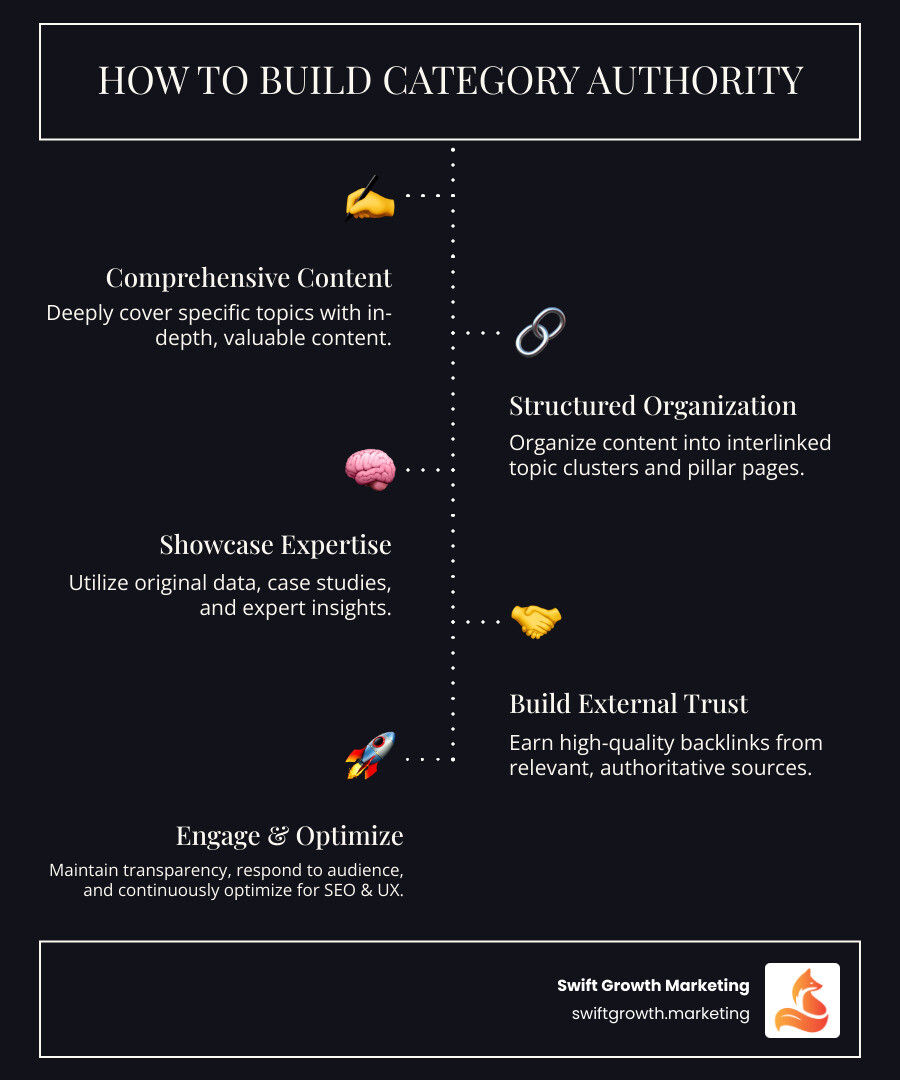
Here’s a quick overview of how to build category authority:
- Deeply cover a specific topic with comprehensive content.
- Organize content into interlinked topic clusters and pillar pages.
- Showcase expertise through original data, case studies, and expert insights.
- Earn high-quality backlinks from relevant, authoritative sources.
- Maintain transparency and responsiveness with your audience.
- Continuously optimize for search engines and user experience.
This strategy isn’t just about SEO. It’s about building genuine trust with your audience and with search engines. When you consistently provide valuable, in-depth content, Google and other algorithms recognize your expertise. They prioritize your site, pushing you higher in search results.
This recognition directly impacts your business. It means more organic traffic, better lead generation, and stronger customer relationships. In fact, research shows that 48% of companies awarded business to an organization after engaging with their thought leadership content. That’s real impact.
I’m Chris Hornak, Co-Founder of Swift Growth Marketing. We help established brands and ambitious startups build category authority through strategic positioning, creative execution, and search optimization.
Terms related to build category authority:
Understanding Category Authority and Its Impact on Your Brand
When we talk about digital marketing, we often hear about “authority.” But what does that mean, and why is it so crucial for your brand’s growth? Let’s break it down—because understanding this concept is the first step to changing how your audience sees you.
What is Category Authority?
Think about the last time you needed advice on something specific. You probably turned to Google and clicked on a result from a brand you recognized as knowledgeable—maybe even the expert—in that area. That’s category authority in action.
Category authority is your brand’s recognized expertise within a specific topic. It’s about being the go-to resource when someone has a question related to your niche. When people think of your topic, they think of you first—and more importantly, so does Google.
This is different from domain authority, which is a broader metric measuring your entire website’s strength. Category authority is about demonstrating topical relevance—showing you comprehensively cover a particular subject. Search engines have gotten smarter at recognizing these expertise signals. Google’s Helpful Content System, for instance, is designed to connect users with sources that demonstrate real knowledge.
This ties directly into Google’s E-E-A-T guidelines, which stands for Experience, Expertise, Authoritativeness, and Trustworthiness. The more you prove your expertise in your category, the more Google will reward you. If you’re curious about how we help brands establish this kind of reputation, our branding services are designed to position you as the authority in your space.
Why It’s a Non-Negotiable for Growth
In today’s digital landscape, you need to stand out as an undeniable expert. When you consistently publish accurate, in-depth, and genuinely helpful content, people start to trust you. Trust leads to repeat visits, customer loyalty, and word-of-mouth recommendations.
This trust naturally boosts your brand credibility and directly translates to higher rankings. Websites that build category authority receive 47% more organic traffic for related queries. Google actively rewards sites that thoroughly address what users are searching for.
When you rank organically for relevant keywords, your reliance on paid advertising decreases, leading to reduced marketing spend over time. It’s a sustainable competitive advantage that lowers your customer acquisition costs. We explored a related concept in our article on Building Brand Trust: Generative AI’s Impact on Credibility.
The Direct Impact on Business Goals
What does this mean for your bottom line? First, there’s lead generation. Authoritative content acts as a magnet for qualified leads. When someone finds comprehensive, helpful information on your site, they’re far more likely to share their contact information or request a consultation.
Then there are customer relationships. By consistently providing value through educational content, you build something deeper than a transactional relationship. Your customers see you as a partner, which increases customer lifetime value and retention.
Finally, let’s talk about conversions. Credibility and trust are powerful conversion drivers. According to research by Edelman and LinkedIn, 54% of companies made a purchase after engaging with a company’s thought leadership content. When potential customers perceive you as an authority, their confidence in your offerings skyrockets, making the sale easier. This is what we mean by strategic messaging that builds trust and drives action.
The Strategic Framework to Build Category Authority
Building category authority isn’t accidental. It’s the result of careful planning and consistent execution. To build category authority that moves the needle for your business, you need a clear framework.
Foundational Research and Topic Mapping
Everything starts with understanding the terrain. Before writing a single sentence, we dig deep into your topic area to map out the complete landscape.
We begin by identifying topic clusters—groups of related subtopics that all connect back to a broader theme. Instead of chasing random keywords, we’re looking at how your audience thinks about your subject.
Keyword research helps us understand the exact language your audience uses. We analyze the intent behind each query, and tools like AlsoAsked can reveal the “People Also Ask” questions that show what users genuinely want to know.
Then comes competitor analysis. We examine what others in your space are doing—not to copy them, but to find opportunities. Where are the gaps in their coverage? These “topical authority holes” become your competitive advantage.
By identifying content gaps, we create a data-driven roadmap of exactly what content you need to produce to become the definitive resource in your niche. Our Topical Map SEO Guide 2025 walks you through this process, and our approach to Content Hubs shows how to organize your findings.
Structuring Your Site with Pillar and Cluster Architecture
Once you know what topics to cover, the next step is organizing your content. This is where the pillar and cluster architecture comes in.
Your pillar pages are comprehensive, in-depth guides that cover a broad topic from every angle. They’re designed to be the ultimate resource on that subject.
Your cluster content consists of individual articles that dive deep into specific subtopics related to your pillar page. Each one addresses a particular question or aspect.
Internal linking is crucial here. Every cluster article links back to its pillar page, and the pillar page links out to its supporting content. This creates a hub-and-spoke model that signals to Google that you’ve covered the topic comprehensively.
This structure also helps visitors steer your content naturally, moving from broad overviews to specific answers. Learn more about how Content Clusters Build Topical Authority with Pillar Cluster Architecture and find How Pillar Pages Play a Role in Your Growth Marketing Strategy.
Creating Consistent, High-Quality Content
Strategy and structure are vital, but it all comes down to your content. A solid content calendar ensures you’re regularly publishing valuable information. Consistency matters to your audience and to search engines.
However, quality always trumps quantity. Google is committed to showing its users the most helpful content, and its algorithms can spot thin, superficial articles. Publishing fewer pieces of genuinely comprehensive, well-researched content is far more effective.
Every piece should start with understanding user intent. What is the person searching for this topic actually trying to accomplish? When you align your content with what users truly need, everything else falls into place.
Our Helpful Content Formula guides this process, ensuring every article delivers real value. It’s not about gaming algorithms—it’s about genuinely helping people, which is exactly what search engines reward.
Crafting Authoritative Content That Resonates
Alright, so you’ve got your content strategy mapped out. Now comes the exciting part: creating content that doesn’t just fill a page, but resonates with your audience. This is about being so trustworthy and insightful that your readers feel they’ve hit the jackpot. This is how we work to build category authority for your brand – becoming the voice everyone turns to.
Leveraging Data, Research, and Expert Sourcing
To make your content authoritative, we back up every claim with solid evidence. We start by weaving in relevant and up-to-date statistics. These numbers are the factual bedrock that supports your arguments and builds trust.
Compelling case studies are also powerful, showing real-world success and tangible proof of the value you offer. Want to see some examples? Dive into our case studies portfolio!
We also tap into the wisdom of others through expert quotes, bringing fresh perspectives and credibility to your content. But if you really want to stand out, original research is your secret weapon. When your brand publishes unique data, you instantly become a thought leader. Other reputable sites will quote and link to your work, amplifying your authority. As one expert put it, “Original research gets quoted, linked, and resurfaced by AI tools whether you asked for it or not. It’s a multiplier, not just a tactic.”
We believe in a data-driven path to beating goliaths in your industry, and leveraging these elements is key.
The Power of Transparency and Responsiveness
People connect with people, not just logos. That’s why transparency and responsiveness are so powerful. We work to build a vibrant community around your content by encouraging interaction and listening to what your audience has to say.
When someone leaves a comment, responding promptly and thoughtfully shows you value your audience and builds trust. It positions your brand as approachable and engaged, similar to how platforms like the Microsoft Community have built a massive knowledge base through active engagement.
We also believe in using user feedback to constantly improve and meet audience needs. Your brand voice is also vital; a consistent, authentic voice makes your brand relatable and memorable. Want to fine-tune that voice? Check out our insights on developing your brand voice on social media.
Advanced Tactics to Build Category Authority
Ready to boost your efforts? We use smart, advanced tactics to help you build category authority faster. One powerful way is through guest posting on other reputable, industry-relevant websites. This exposes your brand to new audiences and earns valuable backlinks that signal your expertise to search engines.
Then there’s Digital PR. Our strategies focus on getting your brand mentioned and linked by top-tier media outlets, skyrocketing your online visibility and credibility. Want to learn more? Dive into our Digital PR for SEO services.
Another clever move is content licensing, a shortcut to filling content gaps by leveraging existing authoritative material from established publications. Finally, we cultivate thought leadership by positioning key individuals within your organization as go-to experts through interviews, webinars, and podcasts. This humanizes your brand and adds a powerful layer of expertise, helping you create content that is highly trusted by users and algorithms alike.
Measuring Success and Maintaining Momentum
Building category authority isn’t a one-and-done project; it’s an ongoing journey. It needs constant care and regular check-ups to flourish. We continuously watch how things are growing and adjust our plans to make sure you keep gaining ground.
Key Metrics for Tracking Your Progress
How do we know if our hard work to build category authority is paying off? We watch key performance indicators that tell us if we’re moving in the right direction.
First, we watch your organic traffic. An increase here means more people are finding you through search engines, a great sign of better visibility.
Next, we track your keyword rankings, focusing on how well you rank for entire “topic clusters.” When rankings improve across a whole cluster, it tells us that search engines see you as an authority on that subject.
We also monitor SERP visibility and impressions. This shows how often your website appears in search results. An upward trend here means Google is starting to see your site as more relevant.
Finally, we look at your backlinks. When reputable sites link to your content, it’s a strong vote of confidence and a clear signal of trust to search engines. We use tools like Google Analytics (GA4) and Google Search Console to track these numbers and report on your progress.
Common Pitfalls and How to Avoid Them
Even with the best plans, it’s easy to hit a snag. We know what to watch out for.
- Inconsistent publishing: Irregular content sends confusing signals. A steady content calendar is essential.
- Poor quality content: Thin or unhelpful articles can harm your authority. We always put quality first.
- Diluted focus: Trying to be an expert on everything often means you’re an expert on nothing. We help you stay focused on your niche.
- Ignoring promotion: Great content needs to be seen. We build solid promotion plans to get your work in front of the right people.
Avoiding these missteps is key to a strong SEO strategy and steering clear of major SEO mistakes.
How to Maintain and Build Category Authority Over Time
Category authority is a valuable asset that needs ongoing care.
We regularly perform content refreshes, updating existing articles with new facts and ensuring they still meet user intent. This tells Google your site is a living, valuable resource.
As your first topic clusters become strong, we look for ways to expand topic clusters by finding related sub-topics to cover. This continuous growth deepens your expertise.
Finally, we accept continuous improvement. We have a growth marketing mindset, always analyzing what’s working and what new opportunities are emerging. This way, your strategy stays sharp and effective. Our goal is to help you build category authority that lasts, so that 2025 can be the year you finally win at digital marketing.
Examples of Brands That Mastered Category Authority
Learning from successful brands can illuminate the path to building category authority. While we respect our clients’ confidentiality, we can explore how different types of organizations have used this strategy to dominate their niches.
Consider a marketing platform that became famous for its educational resources. Instead of just selling tools, they invested heavily in content that taught people how to do marketing better. Their blog became a destination for millions, changing them from a software vendor into a trusted advisor—and that trust translated directly into growth.
Then there’s the SEO software provider that built its brand on transparency. By openly sharing insights about search optimization, they established themselves as an authority people trusted. When users needed tools to implement what they’d learned, this brand was the natural choice.
In the healthcare space, some health information sites have mastered this by creating comprehensive topic ecosystems. Instead of one article on a condition, they build entire content universes covering symptoms, treatments, and patient stories. This depth allows them to rank for thousands of related queries and become the go-to resource.
What ties these examples together? They made a deliberate choice to become the most helpful resource in their specific niche. They understood that when you genuinely help people, category authority follows naturally.
These brands also recognized that to build category authority isn’t about having the biggest budget. It’s about a sustained commitment to your audience’s needs. The beauty of this approach is that it works at any scale. Smaller companies can often focus more narrowly and go deeper than larger competitors. When you commit to being the best resource for a specific topic, you create opportunities that size alone can’t match.
This is the kind of strategic positioning we help our clients achieve at Swift Growth Marketing. We identify topical authority opportunities and build the sustained strategies that turn authority into long-term market leadership.
Frequently Asked Questions about Building Category Authority
Here are some common questions we hear about how to build category authority and what it means for your brand.
What is the difference between category authority and domain authority?
Category authority is your recognized expertise in a specific topic or niche. It signals deep knowledge on a certain subject. Think of it as being the go-to expert for vintage comic books, not just books in general.
Domain authority, on the other hand, is a broader score for your entire website. It’s a metric that predicts how well a whole site will rank, often based on the quantity and quality of its backlinks. While strong domain authority is helpful, category authority is what truly tells the world you’re the expert in your chosen field.
How long does it take to build category authority?
Building category authority is a marathon, not a sprint. You might see positive changes in visibility within 3 to 6 months of consistent effort.
However, to truly establish yourself as a leader, you’re typically looking at 12 to 18 months of dedicated work. This involves consistently creating top-notch content and optimizing your strategy. The exact timeline depends on your niche’s competitiveness, content quality, and consistency. There are no quick fixes, just sustained, smart work.
Can a small business compete with large brands using this strategy?
Absolutely. This is where this strategy truly shines for smaller businesses. Large brands often have a broad focus, which can leave “topical authority holes”—specific niches where they haven’t gone deep enough.
A small business, whether you’re in Pittsburgh, PA, or Wheeling, WV, can strategically choose a niche and become the absolute best resource for it. By providing deeper, more comprehensive content than larger, more general competitors, you can outrank them. It’s all about strategic focus and unparalleled expertise.
Conclusion
Building category authority isn’t a sprint—it’s a marathon that pays dividends for years to come. When you commit to this approach, you’re choosing to build something lasting: a brand that people trust, search engines respect, and customers genuinely value.
It starts with understanding your niche, mapping topics, and organizing your content to showcase your knowledge. Then comes the consistent work of creating genuinely helpful content—backed by data, enriched with expert insights, and focused on solving real problems. Along the way, you’re building relationships and establishing yourself as the voice people turn to for answers.
The beauty of this strategy is that it compounds over time. Every comprehensive article and thoughtful response adds another layer to your authority. Before long, you’re not just competing—you’re leading.
We’ve seen this change happen again and again at Swift Growth Marketing. We know what it takes to move from being just another voice in the crowd to becoming the trusted resource in your category. It requires patience, strategic thinking, and a genuine commitment to serving your audience. The results speak for themselves: more organic traffic, stronger customer relationships, and a competitive advantage that’s difficult to replicate.
Your expertise deserves to be recognized. Your audience deserves to find you. And your business deserves the growth that comes from being seen as a true authority.
Ready to make it happen? Partner with a Growth Marketing Consultancy to build your authority and let’s turn your expertise into the digital asset it was meant to be.

chris
Insights on brand authority, positioning, and growth strategy from the Swift Growth Marketing team.