


Your Brand’s Blueprint: Crafting an Effective Content Strategy

Why Every Brand Needs a Content Strategy Blueprint
A content strategy for brands is the foundation that transforms random content creation into a systematic approach for building trust, authority, and business growth. Without a clear strategy, brands waste resources on content that doesn’t serve their business goals or reach their target audience.
A content strategy for brands includes:
- Clear business goals – What you want to achieve (awareness, leads, retention)
- Defined target audience – Who you’re creating content for and what they need
- Unique value proposition – What makes your brand’s perspective different
- Content types and formats – What you’ll create (blogs, videos, podcasts)
- Distribution channels – Where you’ll publish and promote content
- Brand voice and messaging – How you’ll communicate consistently
- Success metrics – How you’ll measure performance and ROI
The average internet user spends over six hours online daily, searching for answers and solutions. Your brand’s content is how you meet them where they are. Yet, many marketers operate without a documented content strategy. Those who do report higher effectiveness and stronger results across every metric.
A documented strategy is the difference between executing with purpose and shifting aimlessly from tactic to tactic. Content isn’t just marketing collateral; it’s a business asset that builds trust and drives sustainable growth. When done right, it generates qualified leads, reduces acquisition costs, and creates lasting customer relationships.
I’m Chris Hornak, Co-Founder of Swift Growth Marketing. We’ve helped brands transform from invisible to authoritative through strategic content and execution, producing over 15,000 blog posts and achieving traffic increases of up to 764% for our clients.
Similar topics to content strategy for brands:
What is a Content Strategy and Why is it Your Brand’s North Star?
Think of a content strategy for brands as the master plan behind every blog post, video, and social update you create. It’s not just about producing content; it’s about planning for the creation, delivery, and governance of useful and effective content that serves your audience and business goals.
Your content strategy acts as a North Star, ensuring every piece of content aligns with your business objectives. Many brands skip this step and jump to tactics, wasting resources on content that is pointless for users and profitless for the business. A robust content strategy for brands ensures every piece of content serves a purpose, impacting everything from brand recognition to user experience. It’s the foundation for all digital marketing, including Strategic Messaging and Content Marketing for Brands.
Content Strategy vs. Content Marketing: A Critical Distinction
People often confuse content strategy with content marketing, but the distinction is crucial.
- Content strategy is the “why.” It defines your goals, audience, and unique value. It’s the blueprint. According to pioneer Kristina Halvorson, it’s “the ongoing practice of planning for the creation, delivery, and governance of useful, usable, and effective content.”
- Content marketing is the “how.” It’s the execution—scheduling, publishing, and promoting content to attract and engage your audience.
- Content tactics are the specific actions, like writing a blog post or creating a video.
Strategy guides marketing, and marketing executes tactics. Without strategy, your efforts are just random acts of content.
| Feature | Content Strategy | Content Marketing | Content Tactics |
|---|---|---|---|
| Goals | Define overarching business objectives for content | Attract, engage, and retain customers through content | Execute specific content pieces |
| Scope | Holistic plan for all content (creation, governance) | Execution of content for marketing purposes | Individual content items (e.g., a single blog post) |
| Outputs | Documented plan, guidelines, content audit | Published content, distribution, promotional campaigns | Blog posts, videos, social media updates |
The Benefits of a Documented Strategy
Consider this: 65% of the most successful content marketing teams have a documented plan, compared to just 14% of the least successful. A documented strategy drives real results by creating:
- Team Alignment: Everyone knows the goals, preventing siloed efforts.
- Resource Efficiency: You allocate your budget and time to content that matters, saving money and reducing waste.
- Consistency: A unified brand voice across all platforms builds trust and recognition.
- Measurable Success: Defining KPIs upfront allows you to track performance, prove ROI, and justify marketing spend.
A documented content strategy for brands is a living blueprint that guides your growth. It’s an integral part of any Growth Strategy Framework that delivers results.
The Core Components of a Winning Content Strategy for Brands
Building a content strategy for brands is like assembling a puzzle; every piece is essential for creating a complete picture that moves your brand forward. Here are the core components.
Defining Your Goals and KPIs
First, answer the critical question: What are you trying to achieve? Your content strategy must be anchored in clear, measurable goals (SMART goals are a great framework). Common goals include:
- Brand Awareness: Driving website traffic and expanding social reach.
- Lead Generation: Using thought leadership to capture contact information.
- Customer Retention: Nurturing existing relationships. Acquiring a new customer costs 5 to 25 times more than keeping an existing one, making retention-focused content a high-impact part of your Growth Funnel.
- Establishing Authority: Building credibility with high-quality, helpful content.
Once goals are set, define Key Performance Indicators (KPIs) like organic traffic, conversion rates, or time on page to track your progress.
How to Define Your Target Audience for Your Content Strategy for Brands
If you don’t know who you’re talking to, your content won’t resonate. Go beyond basic demographics and dig into psychographics, motivations, and challenges.
Develop detailed buyer personas based on real data. These should include demographics (age, occupation), psychographics (values, goals), and, most importantly, their pain points. What problems can your brand solve for them? Also, consider their content consumption habits—do they prefer blogs, videos, or podcasts?
A deep understanding of your audience allows you to create content that speaks directly to their needs, a key reason why Fast Marketing Wins Happen When You Listen to Customer Data.
Identifying Your Unique Topic Authority and Value Proposition
In a noisy digital world, your brand needs to stand out. A content strategy helps you carve out a unique space. Start with competitor analysis to find content gaps and opportunities. Let your Unique Selling Proposition (USP) shine through in everything you create. What makes your brand different?
Focus on your niche expertise. Create content around topics where you have deep knowledge to produce authoritative content that can’t be easily replicated. This is how you build Content Clusters: Build Topical Authority with Pillar-Cluster Architecture and ultimately Become Category Leader in your niche.
Establishing a Consistent Brand Voice and Messaging
Your brand’s voice is its personality. Is it formal, friendly, witty, or authoritative? This personality should be consistent across all content. While your tone might shift slightly (e.g., informative on a blog, conversational on social media), it should always align with your core personality.
A messaging framework and style guide ensure everyone on your team communicates with a unified voice. This consistency in your Brand Voice Elements builds familiarity and trust, which is fundamental to Strategic Messaging That Builds Trust and Drives Action.
A Step-by-Step Guide to Building Your Content Strategy
Now that we understand the components, let’s walk through how to build a content strategy for brands. This is your roadmap from scattered efforts to strategic execution.
Step 1: Audit Your Existing Content and Analyze Competitors
Before moving forward, you need to know your starting point. A content inventory and performance analysis will show what’s working and what isn’t. Simultaneously, a competitive gap analysis reveals what your competitors are doing and where you can offer something better or more unique. This process is a foundational part of our Ecommerce SEO Audit and is crucial for growth.
Step 2: Conduct Keyword Research and Generate Topic Ideas
Keywords connect your audience’s searches to your content. Focus on search intent—what a user is truly looking for—rather than just search volume. Map keywords to different stages of the customer journey to create content that satisfies specific needs. This research helps build your Topical Map SEO and strengthens your overall SEO Foundations.
Step 3: Choose Your Content Formats and Channels
Here’s where strategy gets practical. Match the format to your message and audience preferences. Blog posts are great for SEO, videos for engagement, podcasts for commuters, and case studies for proving value. Just as important is the channel. Focus your efforts where your audience actually spends their time, rather than spreading yourself thin across every platform. Understanding the purpose of each format, like a Pillar Page vs. Landing Page, is key to leveraging different Types of Growth Marketing Channels.
Step 4: Create a Content Calendar
A content calendar turns your strategy into an actionable plan, ensuring consistency and preventing last-minute scrambles. We recommend planning quarterly to remain strategic yet flexible. Your calendar should include content topics, formats, distribution channels, responsibilities, and key deadlines. This operational backbone keeps your entire team aligned.
Step 5: Establish a Content Creation and Optimization Workflow
Great content comes from a deliberate process. Start with a content brief to align everyone on the topic, audience, and goals. The workflow should include drafting, editing, and refining, always guided by The Helpful Content Formula to ensure genuine value. On-page SEO should be integrated from the start, not tacked on as an afterthought. This is how you Build a Strong SEO Foundation with On-Page SEO. While AI can assist, the human touch and your brand’s unique expertise are what make content authoritative.
Step 6: Plan for Content Distribution and Promotion
Creating content is only half the battle; people need to see it. Distribution is integral to your content strategy for brands. Leverage your owned channels (website, email list), seek earned media (PR, guest posts), and use paid promotion strategically to amplify your reach. Our Digital PR for SEO services are designed to earn these valuable endorsements. A smart distribution plan ensures your content reaches and resonates with your target audience.
Step 7: Define How You’ll Measure Success
What gets measured gets managed. Continuously monitor the KPIs you established in step one, such as organic traffic, engagement, and conversions. Use tools like Google Analytics and Google Search Console to gather data. Regular reporting connects these metrics to business outcomes, proves ROI, and reveals opportunities for improvement. This feedback loop is how you apply 5 Tips to Getting a Better ROI from Your Growth Marketing Budget and turn a good strategy into a great one.
Avoiding Common Pitfalls and Ensuring Long-Term Success
Even the best plans can fail. Understanding common pitfalls is just as important as building the initial strategy to ensure your content strategy for brands stays strong for the long haul.
Common Pitfalls in Creating a Content Strategy for Brands
Many brands stumble by making avoidable mistakes. The most common pitfalls include:
- Having no documented plan: This leads to sporadic, disconnected efforts.
- Ignoring audience research: Creating content based on assumptions misses the mark.
- Inconsistent publishing: This causes a loss of audience engagement and SEO benefits.
- Focusing on quantity over quality: Thin, unhelpful content hurts brand credibility.
- Lacking a promotion strategy: Great content won’t find an audience on its own.
- Ignoring data and analytics: Without data, you can’t learn, adapt, or prove value.
Avoiding these “random acts of marketing” is critical. If your website shows these signs, it might be Hurting Brand Credibility? Get an Audit.
How Often Should You Review and Update Your Strategy?
Your content strategy for brands is a living document, not a one-time project. The digital world moves fast, and your strategy must be agile.
We recommend quarterly reviews to make nimble adjustments based on performance data and market trends. A more comprehensive annual planning session is also crucial for reassessing overarching goals and aligning your content vision with the brand’s ambitions for the year ahead.
Your strategy must also adapt to external factors like the Evolution of Google’s Search Algorithm and other market shifts. By consistently reviewing and updating your plan, you ensure your content remains impactful and aligned with your brand’s journey, whether you’re in Pittsburgh, PA, or Wheeling, WV.
Conclusion
Your content strategy for brands is more than a document; it’s a living blueprint that guides every piece of content you create, ensuring it serves a purpose and moves you toward your business goals. It’s your GPS for digital success, providing a clear path forward.
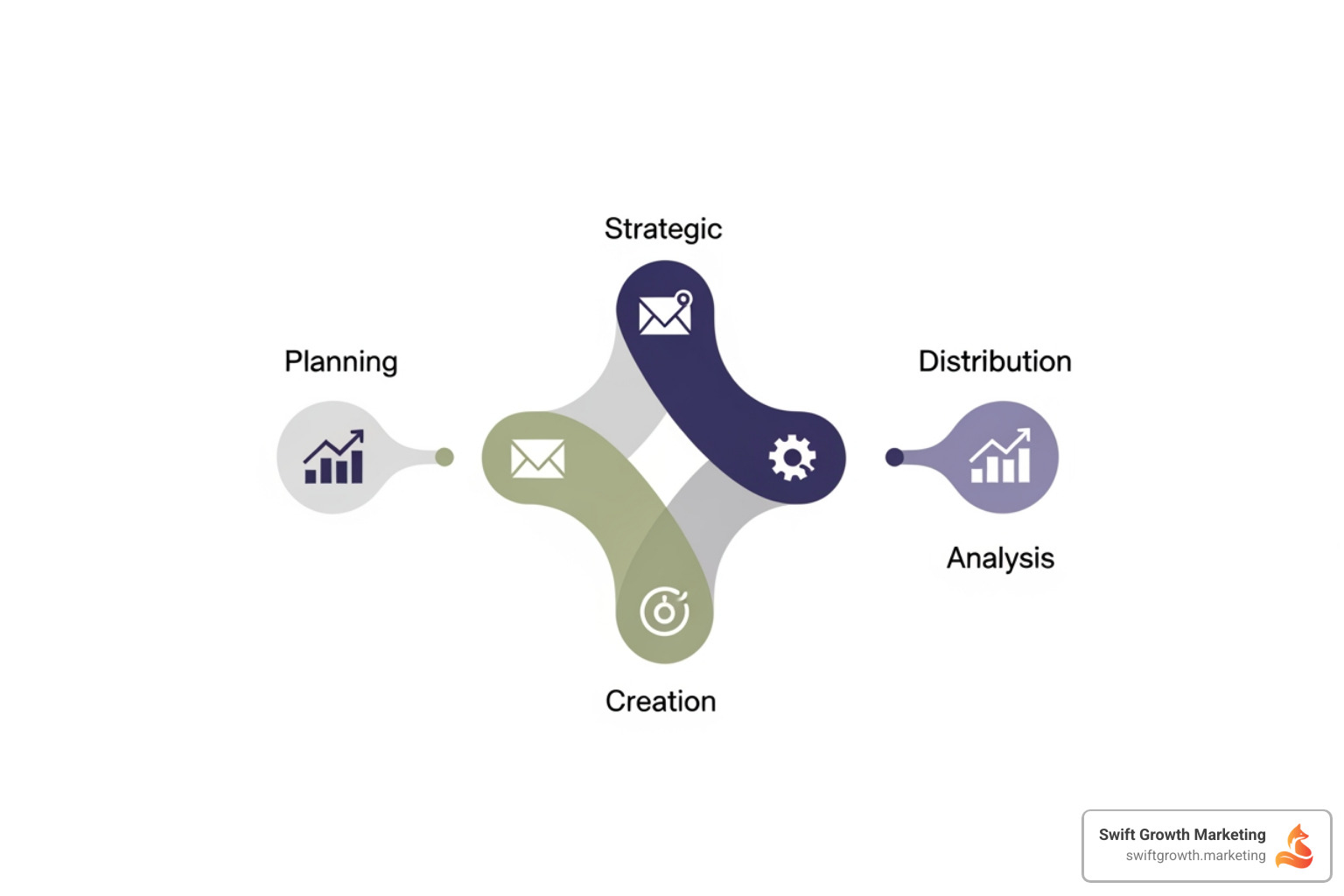
We’ve covered the essential components, the step-by-step process, and the common pitfalls to avoid. The real power of a content strategy lies in its continuous nature—a cycle of planning, creating, measuring, and refining. As your audience, market, and business evolve, your strategy must adapt alongside them.
At Swift Growth Marketing, we’ve seen a well-executed content strategy transform brands in Pittsburgh, PA, and Wheeling, WV, from invisible to authoritative. Content is a valuable business asset that builds trust, answers questions, and drives sustainable growth that compounds over time.
The difference between brands that thrive and those that struggle often comes down to a clear, documented strategy that the entire team executes consistently.
Ready to build your brand’s blueprint? Explore our SEO services and let’s craft a strategy for success. Let’s turn your content from random acts of marketing into a strategic asset that drives real, measurable growth.

chris
Insights on brand authority, positioning, and growth strategy from the Swift Growth Marketing team.