

Beyond the Basics: Advanced Enterprise SaaS Marketing for Big Wins

Why Enterprise SaaS Marketing Demands a Different Playbook
Enterprise SaaS marketing is not just scaled-up SMB marketing—it’s a fundamentally different discipline. While small business deals might close in weeks, enterprise deals take 6-12+ months and involve buying committees of 5-10+ stakeholders. The stakes are higher, with Annual Contract Values (ACVs) reaching $100K to $1M+ and complex procurement, legal, and IT requirements.
Quick Answer: What Makes Enterprise SaaS Marketing Different?
- Longer Sales Cycles: 6-12+ months vs. under 90 days for SMB
- Higher ACVs: $25K-$1M+ per deal vs. $1K-$25K
- Complex Buying Committees: 5-10+ stakeholders vs. 1-3 decision-makers
- Sales-Led Motion: Account-Based Marketing (ABM) and demand generation vs. product-led growth
- Higher CAC, Higher LTV: More expensive to acquire but significantly more valuable over time
- Full-Funnel Strategy Required: Must educate and build trust long before prospects are ready to buy
Data shows that 70% of B2B buyers fully define their needs before ever talking to a sales rep. Success requires a strategic shift from volume-based lead generation to precision-targeted demand generation, where you actively create and nurture interest through a complex, multi-stakeholder journey.
I’m Chris Hornak, Co-Founder of Swift Growth Marketing. We help ambitious brands build strategic positioning and execute long-term growth plans for complex buyer journeys. My experience lies in developing integrated content and demand generation strategies that build category authority—an essential foundation for enterprise SaaS marketing success.
The Enterprise Gauntlet: Understanding the Unique Landscape
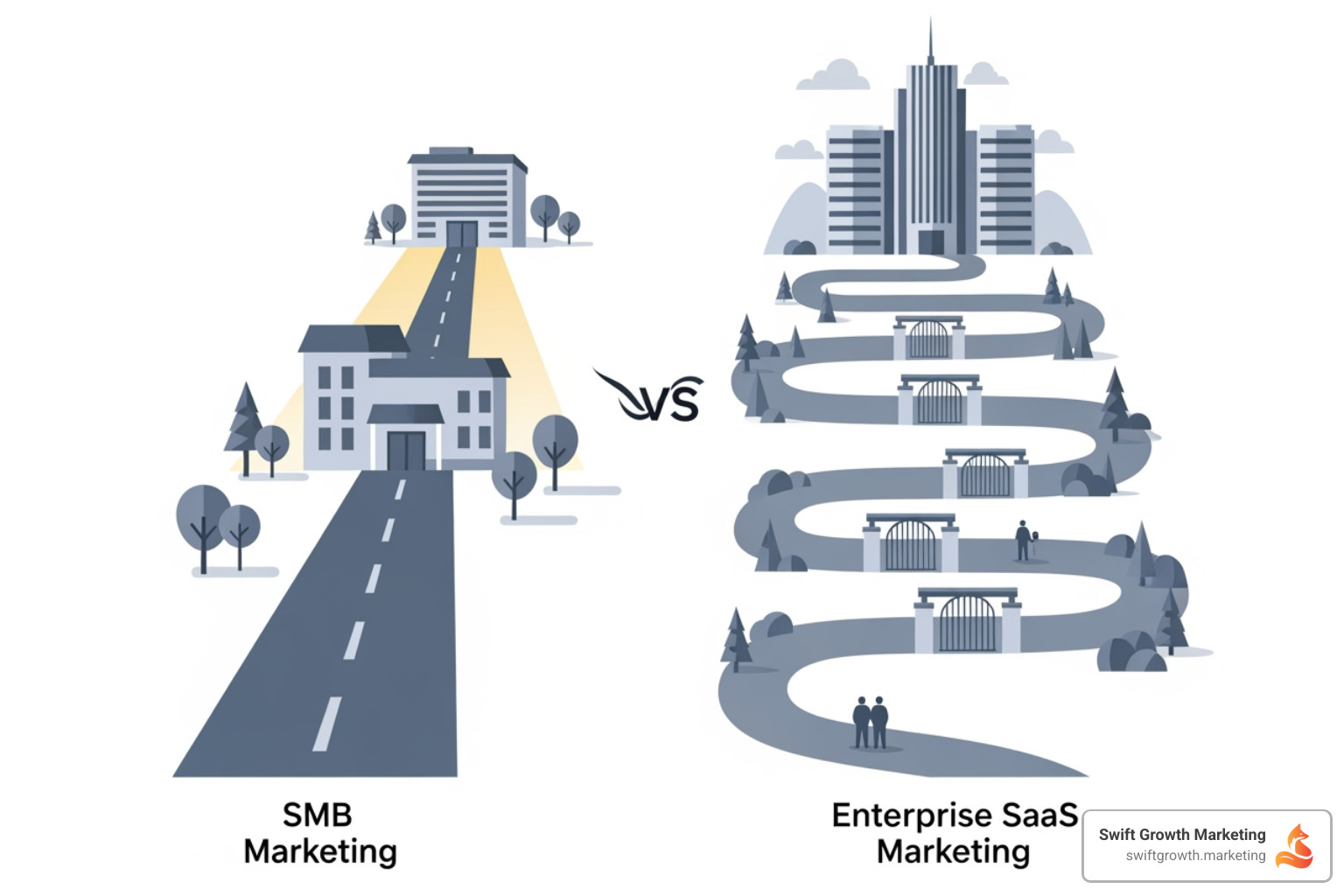
If you’ve been marketing to small businesses, you can’t just scale up the same playbook for enterprise clients. Enterprise SaaS marketing is an entirely different beast. The stakes are higher, the buying process is labyrinthine, and the journey from initial contact to a signed contract is long and complex.
Selling to an enterprise is like selling a fleet of buses to a city’s transportation department, not a bicycle to a commuter. The decision involves more people, more money, and more time.

Let’s look at how enterprise and SMB marketing stack up:
| Feature | Enterprise SaaS Marketing | SMB SaaS Marketing |
|---|---|---|
| Sales Cycle | 6-12+ months | < 90 days |
| ACV | High ($25k – $1M+) | Low-to-Mid ($1k – $25k) |
| Buying Committee | 5-10+ stakeholders | 1-3 decision-makers |
| Primary Motion | Sales-led, ABM | Product-led, Inbound |
| CAC | High | Low |
| Key Challenge | Navigating complexity | Scaling volume |
The Fundamental Differences
These differences fundamentally change your marketing approach:
- Longer sales cycles (6-12+ months) require patience and sustained nurturing. Enterprise buyers are thorough because a bad software decision can cost millions and affect thousands of employees.
- Higher customer lifetime value makes the effort worthwhile. A single enterprise client can generate revenue equal to hundreds of SMB clients, justifying a higher customer acquisition cost (CAC).
- Product complexity means your marketing must demonstrate how your solution solves specific business problems, meets enterprise-grade security requirements, and delivers measurable ROI. At Swift Growth Marketing, we help brands articulate these complex value propositions. Learn more about our Enterprise SaaS Marketing services.
- Multiple stakeholders form a buying committee of 5-10+ people (CFO, CIO, IT directors, end-users, procurement). Each has different priorities, pain points, and definitions of success.
Primary Challenges and How to Mitigate Them
Enterprise sales present several key challenges:
- Bureaucratic Inertia: Large companies resist disruption. Your marketing must show how your solution integrates smoothly and provide clear implementation paths.
- Procurement and Legal: These processes can add months to your sales cycle. Anticipate this by providing security documentation, compliance certifications, and clear pricing frameworks early on.
- Lack of Visibility into Buyer Intent: Enterprise buyers do extensive research before they ever raise their hand. In fact, 70% of B2B buyers fully define their needs before talking to a sales rep. Your brand must be an authoritative resource throughout their research journey. Read about the T2D3 framework for understanding buying committees to better understand their research process.
- Engaging All Stakeholders: Each member of the buying committee needs to see themselves in your messaging. The CFO needs ROI projections, while the CIO needs security assurances. Your marketing must speak all these languages.
To overcome these challenges, focus on education and thought leadership. Become a trusted resource long before anyone is ready to buy. Empower internal champions by giving them the case studies, ROI calculators, and security documentation they need to advocate for your solution internally.
Building Your Foundation: Strategic Goal Setting and Audience Alignment
Before jumping into tactics, you need a solid foundation. This means getting crystal clear on what you’re trying to achieve and who you’re trying to reach. Without this clarity, your marketing campaigns will miss the mark.
Establishing Clear Marketing Goals
In enterprise SaaS marketing, your goals must be tied to business outcomes, not vanity metrics. We help clients set S.M.A.R.T. goals (Specific, Measurable, Attainable, Relevant, and Timely) that focus on:
- Increasing market share
- Lowering Customer Acquisition Cost (CAC) over time
- Improving user retention and client loyalty
- Expanding to new markets
- Improving customer engagement
The key is aligning these marketing goals with broader business objectives, like hitting a specific Annual Recurring Revenue (ARR) target. We believe in cultivating a Growth Marketing Mindset that prioritizes measurable impact.
Defining Personas for Enterprise SaaS Marketing
Enterprise marketing isn’t about a single person; it’s about an entire buying committee. First, define your Ideal Customer Profile (ICP)—the type of company that’s a perfect fit. Then, create detailed personas for the key roles within that company:
- C-Suite Decision-Makers (CEO, CFO): They care about strategic impact, ROI, and long-term value.
- IT and Security Directors: They focus on integration, data security, compliance, and technical feasibility.
- Procurement Managers: They are concerned with pricing, contract terms, and vendor risk.
- End-Users (Department Managers): They care about usability and whether the product makes their jobs easier.
- Internal Champions: These advocates need to be armed with data and case studies to fight for your solution internally.
Mapping the pain points and motivations for each persona is critical. Our approach to Strategic Messaging That Builds Trust starts with this deep understanding.
Crafting Messaging That Resonates
Once you understand your audience, you can create messaging that resonates. Generic, one-size-fits-all messaging will fail in the enterprise space.
Start with strong value propositions that focus on business outcomes, not just features. We use a “pains, claims, gains” framework: identify a persona’s pain, claim how your product solves it, and outline the tangible gains. For a CFO, the pain might be unpredictable cash flow; the claim is real-time financial visibility; the gain is better forecasting.
Tailor messages to different stakeholders. The CFO needs ROI projections, while the IT director needs security documentation. Your messaging must be flexible yet consistent. This helps establish category leadership, making you the obvious choice. We help companies Establish Category Leadership by positioning them as the go-to resource.
Finally, building trust through communication is paramount. Emphasize reliability, proven results, and comprehensive support through case studies, testimonials, and transparent communication.
The Modern Playbook for Enterprise SaaS Marketing
With a solid foundation, it’s time to build a modern playbook for enterprise SaaS marketing that shifts from volume-based lead generation to precision-targeted demand creation.
Mastering Demand Generation: The Flywheel Approach
Enterprise buyers do their homework long before filling out a contact form. Traditional lead generation alone falls short. Demand generation is different: instead of just capturing existing interest, you actively create it by educating the market.
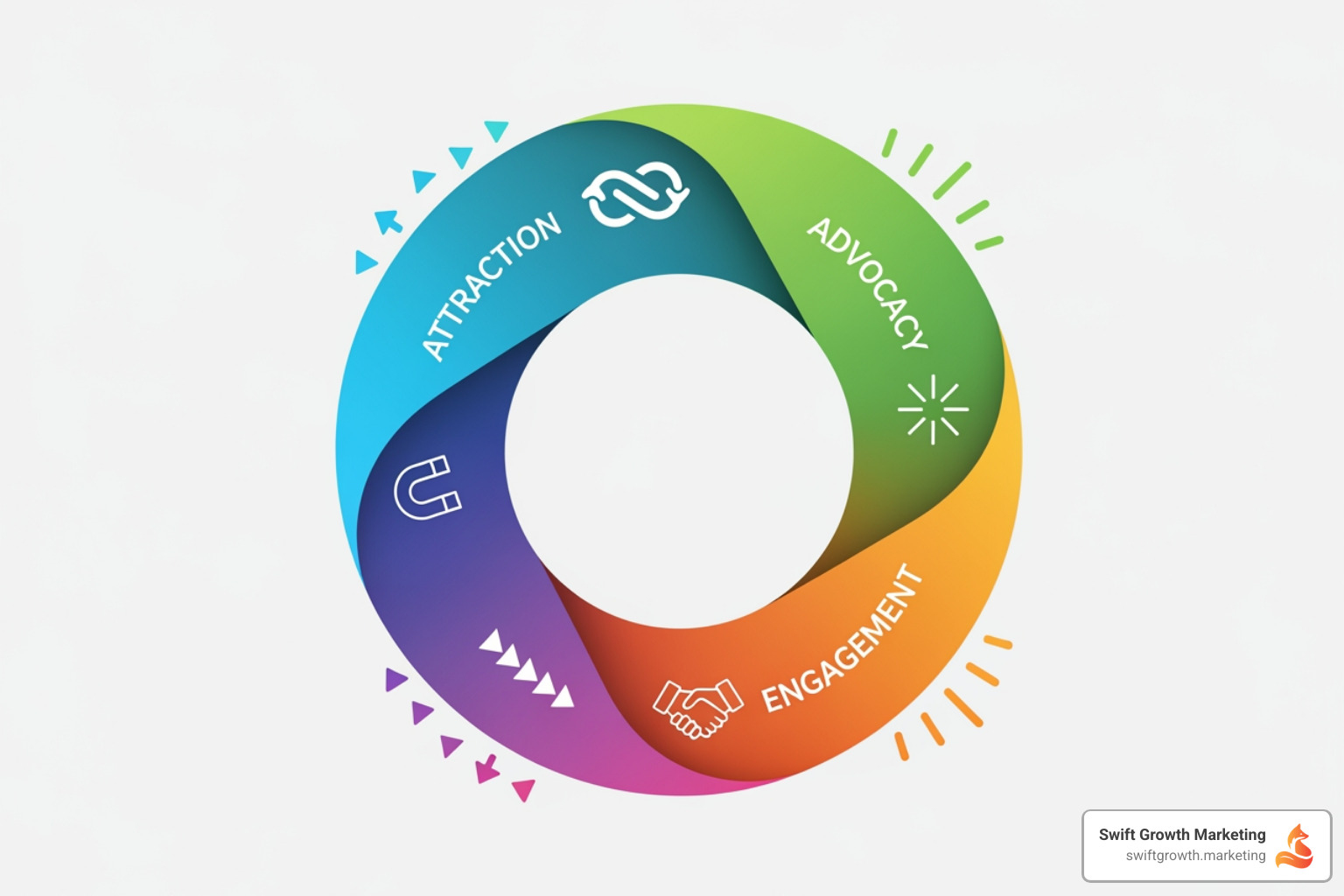
Think of it as a flywheel, not a funnel. This approach creates a self-sustaining cycle where satisfied customers become advocates, fueling more awareness. You address prospects at every stage: from problem unaware to problem aware, solution aware, and finally product aware. This full-funnel approach builds relationships and trust over the long 6-12+ month sales cycle.
At Swift Growth Marketing, we focus on building robust Growth Funnel strategies that create this continuous, self-reinforcing cycle. We don’t just generate leads; we build a market that actively seeks you out.
Account-Based Marketing (ABM): The Spear of Enterprise Acquisition
When you’re hunting elk instead of rabbits, you need a rifle, not a net. That’s the essence of Account-Based Marketing (ABM). Instead of casting a wide net, you identify your ideal high-value accounts first and then craft highly personalized campaigns for them.
ABM is crucial for enterprise SaaS marketing because a single deal can represent $500K+ in ARR. It makes sense to invest significant resources in winning that account. ABM treats each target account as a market of one, with sales and marketing working together to orchestrate personalized touchpoints across multiple stakeholders.
We use one-to-one approaches for top-tier targets and one-to-few approaches for small clusters of similar accounts. Tools like Instantly and Apollo can help build lists and execute outreach, but the real power is in the strategy and messaging.
Dominating with Content and SEO
A sobering statistic: 70% of B2B buyers define their needs before ever talking to a sales rep. This means your content is your real sales team. In the enterprise space, content must establish thought leadership and position you as the authoritative voice in your category.
This requires creating genuinely valuable resources: in-depth research reports, executive guides, and whitepapers that tackle complex problems. This is content that comes from deep expertise.
Keyword research for enterprise SaaS should target high-intent, problem-specific queries, such as comparisons against established players or use-case-specific solutions. The hub-and-spoke model is an effective way to organize this content. You create comprehensive pillar pages (hubs) and detailed cluster content (spokes) that link back, guiding prospects and signaling expertise to search engines. Our Topical Map SEO Guide 2025 explains how to build this architecture.
Case studies and whitepapers are especially important, as they provide the social proof and detailed problem-solving that enterprise buyers need. Organic search delivers one of the lowest customer acquisition costs in B2B marketing, providing compounding returns over time.
Activating Your Strategy: Channels, Tactics, and Measurement
Now it’s time to bring your strategy to life across the right channels. But execution without measurement is just guesswork. We need to know not just what we’re doing, but whether it’s moving the needle on revenue.
Optimizing Paid Channels for High-Value Targets
Paid advertising in enterprise SaaS requires a sniper rifle, not a shotgun. The secret is precision targeting to manage high CACs.
- LinkedIn Ads are ideal for targeting specific job titles, company sizes, industries, and even individual accounts. You can reach the exact people on the buying committee.
- Paid Search (PPC) captures active intent. We focus on high-intent keywords, comparison terms, and solution-specific searches that signal a user is close to making a decision.
- Remarketing keeps your brand present during the long consideration period, gently reminding prospects of your value as they visit your site and consume your content.
The trick is an obsessive focus on quality over quantity, constantly refining targeting and cutting campaigns that don’t generate qualified pipeline. Our approach to Maximizing the ROI of Paid Media centers on this principle.
Leveraging Social Media and Community for Long-Term Trust
Social media matters enormously in enterprise SaaS, but it’s about building authority, not just posting updates. The real magic happens when your key executives become active voices in industry conversations on LinkedIn. Decision-makers connect with people, not logos. Our guide on Social Media Marketing on LinkedIn walks through practical steps to make this happen.
Beyond LinkedIn, niche communities like Slack groups and industry forums are gold mines for building relationships. The key is to show up to help, not to sell. Answer questions and share useful resources. Over time, you become a trusted voice, and when someone needs what you offer, you’re top of mind. The golden rule is to provide value first, always.
Measuring What Matters: Critical KPIs for Enterprise SaaS Marketing
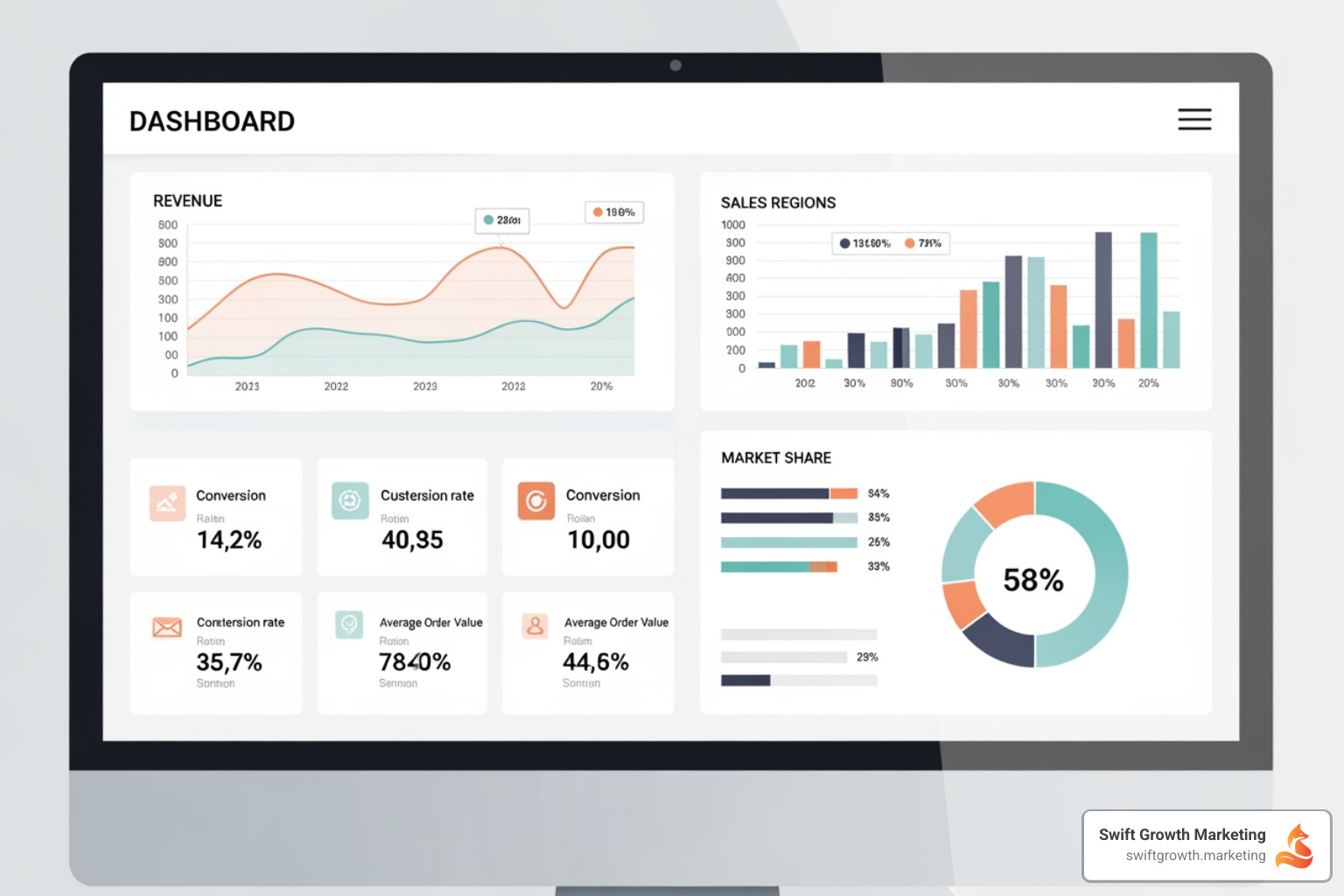
Vanity metrics don’t pay the bills. We track the metrics that show whether our marketing contributes to revenue and sustainable growth:
- LTV to CAC Ratio: This is your north star. Are you generating at least 3x the lifetime value for every dollar spent on acquisition?
- Lead-to-MQL & MQL-to-SQL Conversion Rates: These show how effectively we’re attracting the right interest and moving leads toward sales-readiness.
- Sales Cycle Length & Pipeline Velocity: Tracking these helps identify and address bottlenecks in the sales process.
- Annual Churn: High churn can signal a mismatch between marketing promises and product delivery. Retention is paramount.
- Account Engagement Scores: For ABM, this tracks how deeply target accounts are interacting with your content and outreach.
This data-driven approach ensures every marketing dollar is working as hard as possible. It’s how we help clients follow a Data-Driven Path to Beating Goliaths in Your Industry.
Frequently Asked Questions about Enterprise SaaS Marketing
What is the biggest mistake in enterprise SaaS marketing?
The biggest mistake is focusing only on bottom-of-the-funnel, product-focused marketing. The reality is that 70% of buyers define their needs before they ever talk to a sales rep. If you weren’t part of their early education process, you’re already behind.
Enterprise SaaS marketing success requires a full-funnel demand generation strategy that builds trust and educates prospects long before they’re ready to buy. Neglecting the early stages of awareness means you’re playing catch-up instead of leading the conversation.
Is inbound or outbound better for enterprise SaaS?
A hybrid approach is optimal. You need both. Inbound marketing and SEO build a cost-effective, long-term foundation that attracts and educates buyers during their independent research.
However, you can’t just wait for high-value accounts to find you. That’s where outbound and Account-Based Marketing (ABM) are non-negotiable. Outbound methods allow you to proactively engage your Ideal Customer Profile, ensuring you aren’t leaving your pipeline to chance. The two approaches work together: inbound content makes outbound outreach more credible, and outbound drives the right people to your inbound assets.
How long does it take to see ROI from enterprise marketing?
If you’re looking for overnight results, enterprise SaaS marketing isn’t for you. The timeline for ROI mirrors the 6-12+ month sales cycle. While paid channels can show initial lead-gen signals within weeks, true ROI is measured in closed deals.
Content and SEO strategies may take 6-12 months to gain significant traction, but they deliver compounding, cost-effective returns over time. The key is patience, consistent execution, and measuring pipeline progression, not just vanity metrics. Focus on metrics like pipeline velocity and MQL-to-SQL conversion rates to demonstrate the true impact of your marketing efforts.
Conclusion
Enterprise SaaS marketing is a marathon, not a sprint. It’s not about quick wins but about building a lasting foundation of trust and authority. Success in this space means becoming the trusted advisor that enterprise buyers turn to for transformative decisions.
We’ve covered what makes enterprise marketing different: long sales cycles, complex buying committees, and the need for a sophisticated strategy. The modern playbook—centered on demand generation, Account-Based Marketing, and thought leadership—is built on a simple truth: you must be part of the buyer’s journey from the very beginning, providing value and building trust long before a sales conversation happens.
This requires optimizing channels for precision, leveraging social media for authority, and measuring what truly matters, like the LTV:CAC ratio and pipeline velocity. The path isn’t easy, but the rewards—high-value, long-term customers—are worth the effort.
At Swift Growth Marketing, we guide brands through this exact journey. We build comprehensive strategies that account for every stakeholder and every stage of the buyer journey.
If you’re ready to build a robust strategy for your enterprise SaaS, we’d love to help you steer the complexities and accelerate your growth.
Explore our comprehensive SaaS marketing solutions and let’s start a conversation about what’s possible for your business.

chris
Insights on brand authority, positioning, and growth strategy from the Swift Growth Marketing team.