


Own Your Niche: A Guide to Unrivaled Category Leadership

Why Category Leadership is the Ultimate Competitive Advantage
Establish category leadership and you don’t just win market share—you capture up to 76% of your category’s total market capitalization. This isn’t about being slightly better than competitors; it’s about defining the rules of the game itself.
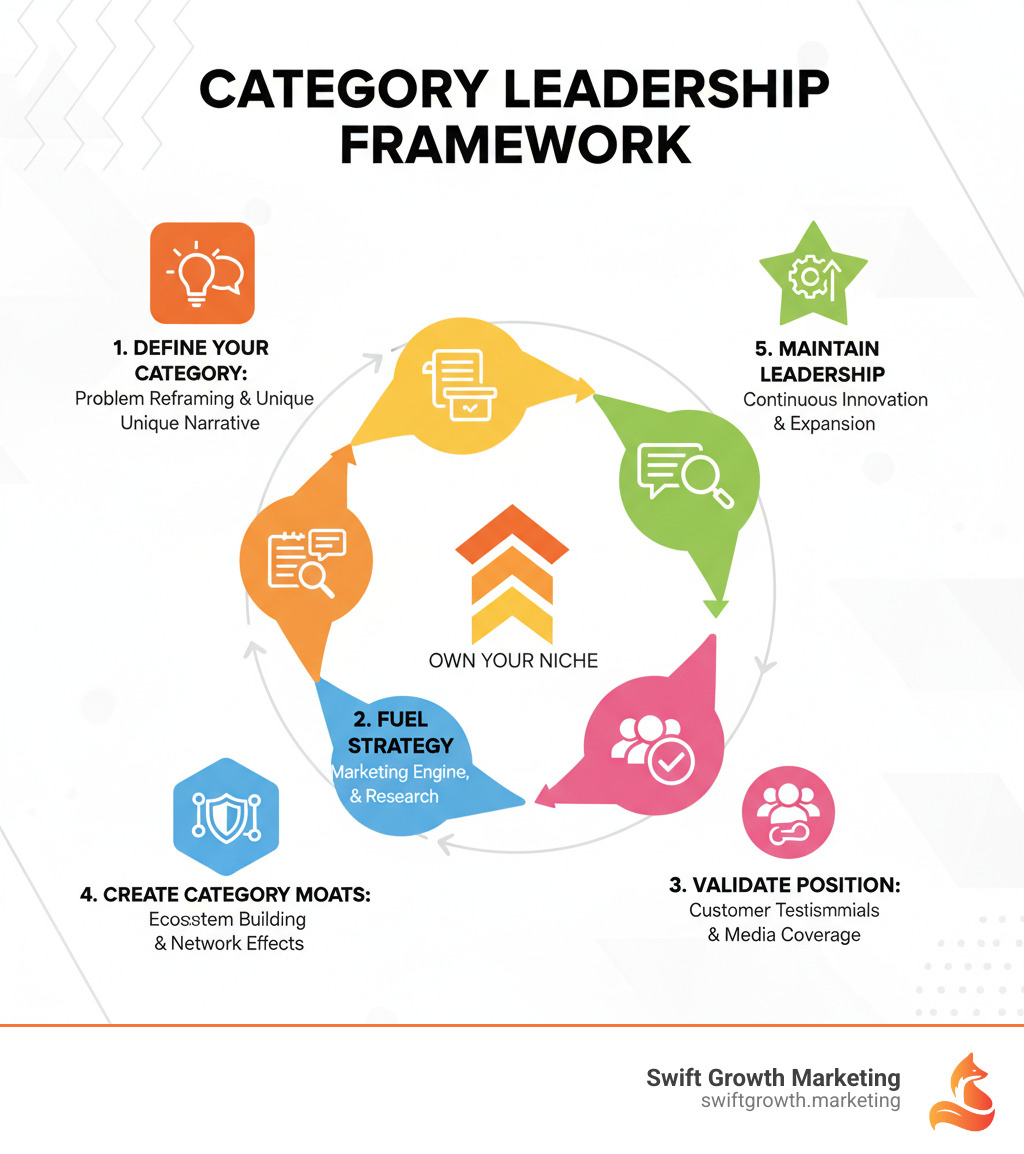
To achieve this, you must:
- Define your market category with a clear problem and unique narrative.
- Build a content marketing engine to educate your audience and establish thought leadership.
- Validate your position with customer proof, media coverage, and endorsements.
- Create category moats through network effects and dominant mind share.
- Maintain leadership through continuous innovation.
Category leadership isn’t just for tech giants. Salesforce didn’t invent CRM—they created the SaaS category. Uber didn’t build a better taxi—they created ridesharing. HubSpot didn’t just sell software—they created inbound marketing.
The difference is profound. Competitors fight over existing demand. Category leaders generate new demand by revealing problems people didn’t know they had. While competitors divide the pie, category creators bake an entirely new one.
The stakes are high: the leader captures 76% of market capitalization, while second place gets 18%. VCs and customers alike bet on category leaders to minimize risk.
Crucially, you don’t need to invent a category from scratch. You can redefine an existing one around new verticals, platforms, or underserved needs. The key is framing the problem and solution in a way that positions you as the standard.
I’m Chris Hornak, co-founder of Swift Growth Marketing. We’ve spent over a decade helping brands establish category leadership through strategic positioning, content marketing, and search optimization, applying the exact frameworks in this guide.
What is Category Leadership (And Why It’s Not Just Thought Leadership)
A great product isn’t enough in today’s crowded digital landscape. Most businesses play a “me too” game, shouting about similar features.
Category leadership changes the game. Instead of fighting for attention, you create your own market. You position yourself as the definitive solution to a problem that you’ve helped the market understand. You’re not just an expert voice in the conversation; you’re the one who started it.
The magic happens when you stop answering questions and start helping people see problems they didn’t know they had. This is where building brand trust becomes natural—because you’re educating, not just selling.
Defining the Difference
Category leadership and thought leadership sound similar, but one shapes the market while the other operates within it.
| Feature | Category Leadership | Thought Leadership |
|---|---|---|
| Primary Goal | Defines the problem and creates the market | Answers questions and operates within the existing market |
| Focus | The “Why” – why this new problem, why this new solution | The “How” – how to solve existing problems |
| Market Impact | Shapes market perception, creates new demand | Influences opinions, builds credibility within existing demand |
| Competitive Stance | Makes competition irrelevant or secondary | Competes on expertise within established frameworks |
| Value Creation | Bakes an entirely new pie | Seeks a larger slice of an existing pie |
Thought leadership is valuable for building credibility, but it plays within lines someone else drew. Category leadership draws new lines. It focuses on the “why”—why a problem matters now and why a new approach is needed. When you establish category leadership, you’re not fighting for a bigger slice of the pie; you’re baking a new one.
From Expert to Icon
The journey from expert to icon requires a dominant share of voice. When someone has the problem you’ve defined, your name should be the first one they think of. This isn’t about ego; it’s about making buying decisions easier and less risky for your customers. You become the standard.
Setting the standard means your strategic messaging becomes the industry blueprint. You’re not doing this alone; category leadership thrives on community and ecosystem building. You evangelize a vision, not just a product. This is how you become an icon, shaping the future of your industry.
The Unbeatable Advantage: Why Category Leadership is Crucial
When you establish category leadership, you rewrite the rules of winning. The benefits are disproportionate in today’s winner-take-all markets.

Capturing the Lion’s Share of the Market
The number that matters: category leaders capture 76% of their category’s total market capitalization. The second-place player gets 18%, and everyone else fights over scraps. This isn’t an anomaly; it’s the structure of modern markets. When you define the category, you become the standard.
This dominance translates to pricing power. You’re not just a better version of something else; you’re the solution to a problem you helped define. Customers pay a premium because they aren’t making a direct comparison.
Venture capitalists know this. As Harvard Business Review points out, funding flows to category creators. You’re not fighting over a fixed pie; you’re baking a new one, which is the foundation of any serious growth strategy framework. This investor perception creates a virtuous cycle: more funding leads to faster innovation, reinforcing your leadership.
Winning the Easy Sales
Category leadership also transforms the sales process. The category leader wins the easy sales while everyone else fights for every deal.
Customers are risk-averse. They gravitate toward the perceived leader—the safe choice. When you’ve defined the category, your brand authority becomes a magnet, and customers come to you. This shift dramatically lowers customer acquisition costs, shortens sales cycles, and improves close rates.
The conversation changes. Instead of convincing prospects they have a problem, you’re talking to people who already understand it because you taught them. They’re not asking “Do I need this?” but “When can we start?”
Your psychology-based landing pages convert better because visitors arrive pre-sold on the category. You become the default choice. Meanwhile, competitors face an uphill battle, forced to explain why customers should choose an alternative to the standard. When you establish category leadership, you become the reason people realize they need a solution in the first place.
The Playbook: Key Strategies to Establish Category Leadership
Category leadership requires a deliberate blueprint. You’re not just playing the game; you’re designing it. This process involves defining your category with a compelling narrative, fueling visibility with content, and validating your position with social proof. This approach works for any company size, providing the tools to establish category leadership and follow a data-driven path to beating goliaths in your industry.

Define Your Category with a Powerful Narrative
The foundation of category leadership is reframing the problem. Instead of leading with your solution, start by revealing a problem people didn’t realize they had. Articulate a high-value problem that only your unique approach can solve.
Next, name your category with two to four clear, descriptive words. This creates a cognitive container that helps people understand and remember what you do. Then, create new language around your category. When people adopt your terminology, they are thinking within the framework you created. Your storytelling in content marketing should focus on why this new category exists and why it matters.
Fuel Your Strategy with a Content Marketing Engine
Once your category is defined, you must educate the market. A robust content marketing engine is your most powerful asset for establishing expertise and capturing a market-leading share of voice.
- Pillar pages and content hubs form your foundation. These comprehensive resources cover core topics in-depth, building powerful topical authority with pillar-cluster architecture that search engines reward. Organizing content into content hubs clarifies your expertise.
- Original research reports set you apart. By identifying unique buyer challenges, you generate proprietary data that positions your brand as the trusted expert.
- Webinars, videos, and case studies make complex concepts accessible and provide real-world proof that your approach works.
Your content needs strong SEO foundations and should follow the helpful content formula to build trust and establish you as the definitive voice in your category.
Validate Your Position with Social Proof and Endorsements
People trust what others say about you more than what you say about yourself. Third-party validation is essential to establish category leadership.
- Customer testimonials and case studies are your most credible proof. They demonstrate real-world results and melt away prospect skepticism.
- Media coverage and analyst reports amplify your credibility. Endorsements from respected journalists and publications provide validation that money can’t buy. Knowing how to write a press release that gets noticed is a valuable skill.
- An ecosystem of advocates, including partners and influencers, creates unstoppable momentum. When multiple voices point to you as the leader, your position becomes nearly unchallengeable.
Playing a Different Game: Advanced Tactics for Market Dominance
Once you’ve laid the foundation, it’s time to change the rules of competition entirely. The companies that truly establish category leadership play a different game, one where traditional competitive dynamics don’t apply.
Create New Demand with a Blue Ocean Strategy
Category leadership means creating a “Blue Ocean”—a new market space where competition is irrelevant. Think of Cirque du Soleil: they didn’t build a better circus; they redefined entertainment by blending circus arts with theater, making traditional circuses obsolete.
The secret is value innovation: pursuing differentiation and low cost simultaneously. You’re not choosing one or the other; you’re finding a way to be both.
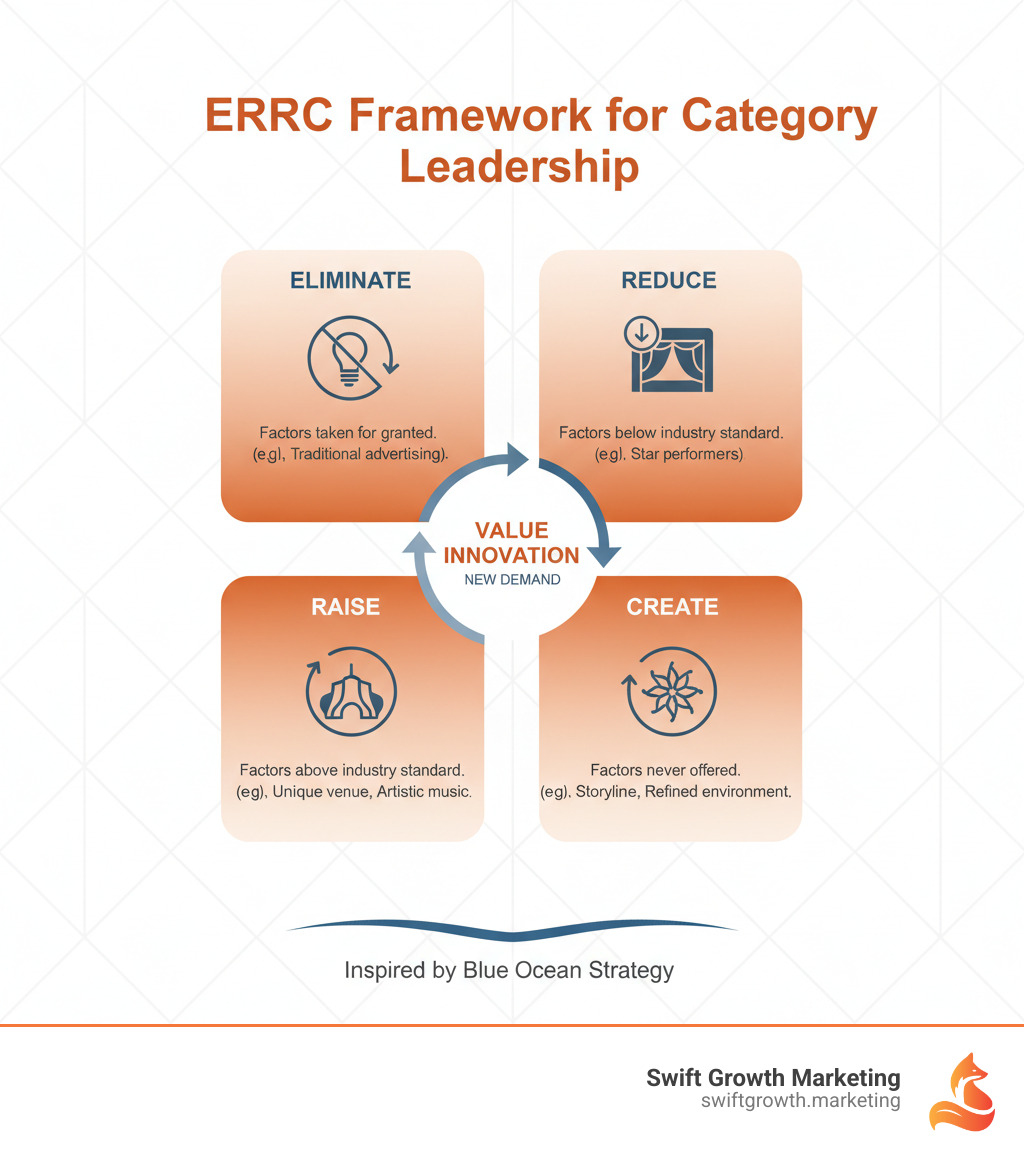
The ERRC framework helps you design your blue ocean by asking four questions: What industry factors should you Eliminate? Which should you Reduce? Which should you Raise? And what should you Create that has never been offered?
This framework helps you identify a niche you can own by focusing on what customers truly want. It requires a growth marketing mindset focused on market creation. For a deeper dive, the book Play Bigger: How Pirates, Dreamers, and Innovators Create and Dominate Markets is essential reading.
How to establish category leadership in niche markets
Niche markets are often the best place to establish category leadership because you can own them completely. The key is hyper-targeting with personalized messaging, like Account-Based Marketing (ABM).
Your biggest challenge is that customers may not realize they have the problem you solve. Use educational content (blogs, webinars) to help them see their situation differently. Testimonials are critical in skeptical niche markets; one glowing review from a respected player can open doors. For businesses in areas like Pittsburgh, PA, or Wheeling, WV, engaging with local industry communities is highly effective.
Niche buyer journeys are often long and complex. Use multi-touch campaigns (email, retargeting) to stay present. As we discuss in How SMBs Can Use AI to Win on Social Media in 2025, AI can help personalize these interactions at scale.
Navigating Incumbents and New Competitors
When you succeed, competitors will appear. How you handle this attention determines your long-term dominance.
First, welcome competition as validation. When a major player enters your category, it proves the market is real and you were right. That said, don’t be passive. Pick noble fights against legacy incumbents, but stay positive and product-focused. Highlight why your new approach is fundamentally better for customers.
Your most powerful defense is focusing on architectural strengths. Salesforce didn’t try to build better on-premise software; they championed the cloud’s superiority (easier updates, lower costs). This strategic positioning, combined with proactive AI brand reputation management, ensures your narrative remains dominant.
The Long Game: Maintaining and Evolving Your Leadership
Establishing category leadership is a continuous journey, not a destination. The real challenge is maintaining leadership as the market evolves.

The Role of Innovation and Continuous Evolution
Maintaining leadership demands relentless product evolution and a willingness to challenge your own success. The category you define today won’t be the same in three years. If you’re not the one evolving it, someone else will.
You must balance defending your core territory while expanding the category definition—both vertically (deeper solutions) and horizontally (adjacent problems). Staying ahead of trends is crucial. The rapid evolution of AI and growth marketing shows how technology can reshape categories. Integrating new capabilities early helps maintain your lead.
The greatest threat to leaders is complacency. Companies that stop innovating lose relevance. Your job is to stay at the front of the movement, continually redefining what’s possible. Implementing customer feedback loops ensures your evolution aligns with real market needs.
How to establish category leadership through company culture
Your ability to establish category leadership is fundamentally rooted in your company culture. Internal alignment creates external impact. When every employee understands and believes in the category, they become powerful evangelists.
- Your sales team evangelizes a new way of thinking.
- Your customer service team reinforces the narrative in every interaction.
- Your product team architects the future of the category.
This shared vision transforms employees into authentic advocates whose enthusiasm is contagious. The most enduring leaders embed customer-centric DNA into their organization. Leadership is about the value you create and the ethical standards you uphold. These elements define your brand voice elements and separate sustainable leaders from temporary disruptors. A culture focused on customer success creates a virtuous cycle, strengthening your leadership because it’s authentic, not manufactured.
Frequently Asked Questions about Category Leadership
How long does it take to establish category leadership?
Establishing category leadership is a marathon, not a sprint. It requires years of consistent effort. The timeline varies, but the goal is creating a durable competitive moat for a decade or more.
There’s a pattern called the “6 to 10 law”: categories often take about six years to mature as the market needs time to understand the new problem and solution you’ve defined. Patience and persistence are key.
Can a small business or startup become a category leader?
Absolutely. Category leadership is about strategic vision, not budget size. Startups often have an advantage because they aren’t weighed down by legacy products or thinking. They are nimble and free to reimagine the playing field.
By identifying an unsolved problem and crafting a unique solution with a compelling narrative, small businesses can outmaneuver large incumbents. Your size isn’t a limitation; it’s an asset.
How do you measure success in category leadership?
Success goes beyond market share. The real indicators of category leadership are:
- Share of Voice: Are you dominating the conversation around your category? Is your name mentioned first?
- Brand Synonymity: Has your brand become shorthand for the category itself (e.g., “Google it”)?
- Inbound Lead Quality: Are high-quality customers coming to you, already understanding the problem and seeking your solution?
- Ecosystem Vitality: Is there a thriving network of partners and developers building on or around your category?
- Category Market Capitalization: The ultimate measure. The leader often captures the vast majority—76% or more—of the total economic value in the category.
Conclusion: From Competitor to King
The journey to establish category leadership isn’t about playing the same game better; it’s about changing the rules. It’s a strategic choice to invent the future rather than fight over the past.
By defining a new problem, crafting a compelling narrative, and building an ecosystem around your solution, you create a new playing field where competition becomes secondary. While competitors fight for scraps, category leaders capture 76% of their category’s value, command premium pricing, and attract the best customers.
This path requires vision, persistence, and a commitment to educating your market. It’s not reserved for giants with unlimited budgets. Some of the most successful category creators started small, with a clear vision and the courage to define their own market. Establishing category leadership is about how clearly you think and how boldly you act.
Ready to define your category and build a legacy of leadership? Swift Growth Marketing partners with ambitious brands to develop and execute the strategies that create market icons. We’ve spent over a decade helping companies move from invisible players to industry authorities. Explore our Growth Marketing Consultancy services to start your journey from competitor to category king.

chris
Insights on brand authority, positioning, and growth strategy from the Swift Growth Marketing team.