


Why Your Financial Advisor Branding Isn’t Just a Pretty Face

Beyond the Logo – What Branding Really Means for Advisors
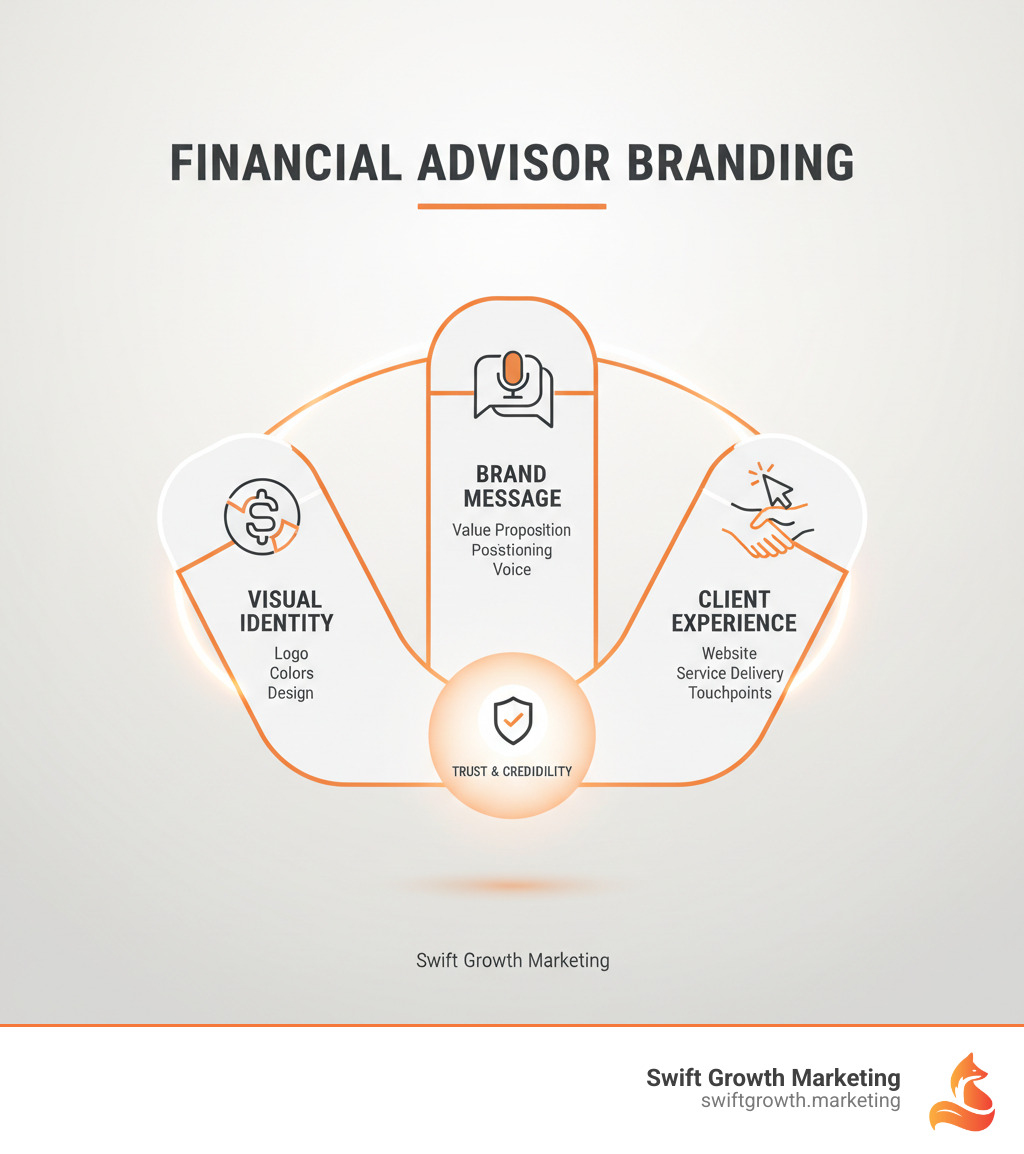
Financial advisor branding is the complete picture of how clients and prospects perceive you—from your visual identity and messaging to the experience you deliver. It includes:
- Visual Identity: Your logo, colors, and design elements.
- Brand Message: Your unique value proposition and who you serve.
- Client Experience: Every interaction a client has with your firm.
- Trust and Credibility: The reputation you build through consistency and expertise.
The challenge? Research shows 63% of investors think all financial advisors make the same promises and struggle to tell them apart. This is a massive opportunity for advisors who get branding right.
Your brand isn’t just about looking professional; it’s about being memorable. It’s about helping the right clients find and trust you. In an industry built on relationships, that trust is everything.
When a prospect visits your website or checks your LinkedIn profile, what do they feel? What comes to mind when they think of you? That’s your brand at work.
The good news is that 70% of financial advisors earning $1 million or more per year focus on a particular niche. They’ve figured out that trying to be everything to everyone means being nothing to no one, building brands that speak directly to specific people.
I’m Chris Hornak, Co-Founder of Swift Growth Marketing. In my work with financial advisor branding, I’ve seen how a strategic approach transforms invisible advisors into authorities who attract ideal clients consistently.
The Foundation: Crafting Your Unique Value Proposition

Effective financial advisor branding starts with knowing what makes you different in a way that matters to clients. Your Unique Value Proposition (UVP) answers three questions: What problems do you solve? Who do you solve them for? And why should they choose you?
Without clear answers, you’re just another advisor in a sea of advisors, where 63% of investors think all financial advisors make the same promises.
Defining your niche is where the magic happens. A key stat: 70% of financial advisors earning $1 million or more per year focus on a particular niche. They aren’t trying to be everything to everyone. Whether you specialize in tech professionals, pre-retirees, or families with complex estates, going narrow opens more doors.
When you define your niche, you can craft Strategic Messaging that speaks directly to your ideal audience. Your marketing becomes sharper and your conversations become easier.
Identifying your target audience means going beyond demographics. What are their biggest financial fears and goals? Creating detailed client personas helps you step into their shoes, anticipate their questions, and speak their language—not financial jargon.
Leveraging your unique experiences gives you an edge. Investors want advisors who understand their world. If you’ve worked in their industry or steerd similar life transitions, that connection is gold. These personal insights build trust in ways technical expertise alone never could.
What is a Branding Statement and Why Does it Matter?
Your branding statement is a concise declaration—one to three sentences—that captures who you are, what you do, and what makes you different. It’s the foundation of your financial advisor branding strategy, crystallizing your message and highlighting your unique value.
In a crowded market, a strong branding statement makes you memorable and answers the prospect’s key question: “Why should I choose you?” It clearly demonstrates your value, making it easy for potential clients to understand what they’ll get. When we develop Strategic Messaging That Builds Trust and Drives Action, the branding statement is our starting point to ensure all communication reinforces your core promise.
Branding Statement vs. Slogan vs. Tagline
People often confuse these terms, but they serve distinct roles in financial advisor branding.
- Branding Statement: A comprehensive declaration (1-3 sentences) defining your unique value. It guides internal strategy and is used in detailed materials like “About Us” pages.
- Tagline: A short, memorable phrase (3-7 words) capturing your brand’s essence. It’s used consistently on logos, websites, and business cards.
- Slogan: A catchy, temporary phrase for specific marketing campaigns.
| Feature | Branding Statement | Slogan | Tagline |
|---|---|---|---|
| Purpose | Defines who you are, what you do, and what makes you unique. | Catchy phrase for specific campaigns or products, often temporary. | Enduring phrase that captures your brand’s essence and promise. |
| Length | 1-3 concise sentences. | Short, memorable phrase (e.g., 3-7 words). | Short, memorable phrase (e.g., 3-7 words). |
| Audience | Internal (guides strategy) and External (in-depth understanding). | External (campaign-specific recall). | External (long-term brand association). |
| Where Used | “About Us” sections, mission statements, internal strategy documents, detailed pitches. | Advertisements, product launches, specific marketing initiatives. | Logo, website header, business cards, consistent marketing materials. |
While all three are important, your branding statement is the foundation where your unique value lives.
The Core Components of Effective Financial Advisor Branding

Your financial advisor branding lives where visuals and messaging meet. It’s about creating a complete experience that feels unmistakably you.
Consider this: 80% of communication is visual. Before a prospect reads a word, they’ve formed an impression based on your colors, fonts, and images. These elements speak volumes about your trustworthiness.
But visuals alone aren’t enough. Your brand voice and the stories you tell are equally powerful. Consistency across all platforms is essential. When your website says one thing and your LinkedIn profile says another, you create confusion, which kills trust.
Building a Cohesive Visual Identity
Since people process images 60,000 times faster than text, your visual identity is a powerful communication tool. A thoughtful design makes clients feel secure before they read your credentials.
- Logo: Make it simple, distinctive, and memorable.
- Color Psychology: Choose colors that evoke the right emotions. Blue conveys trust, while green suggests growth. Your choices should be strategic, not just personal preference.
- Typography: Stick to 2-3 complementary, easy-to-read fonts to project a clear personality.
- Imagery: Skip generic stock photos. Use authentic images that reflect your actual clients and approach. Keep your photo editing style consistent.
A simple one-page style guide listing your logo, colors, fonts, and image guidelines is crucial. It acts as your brand’s instruction manual, ensuring everything remains cohesive across all platforms.
Finding Your Voice and Telling Your Story
Your brand voice is the personality in your writing and speech. Are you a reassuring expert, an innovative thinker, or an approachable guide? Defining your voice is key to connecting authentically. We help clients develop their Brand Voice Elements.
Storytelling is your secret weapon. Good branding tells a story about who you are, why you do this work, and what you believe. Share your journey, your values, and why you became an advisor. When you open up about your own experiences, clients see you as a person who understands their concerns.
As the saying goes, “people don’t care what you do professionally until they know who you are personally.” Through Storytelling in Content Marketing, you can connect on a human level and build the trust that turns prospects into long-term clients.
Effective financial advisor branding is built on authenticity and consistency. Your visuals catch attention, your voice keeps it, and your stories build trust. When these elements work together seamlessly, your brand becomes truly memorable.
Activating Your Brand: Digital Presence and Personal Branding

Your online presence is likely a potential client’s first impression. Before they meet you, they’ve Googled your name and checked your website and LinkedIn profile. This digital footprint is a critical part of your financial advisor branding.
The modern investor wants both technology and human guidance. They expect a professional website and a connection with a real person. This balance is what makes digital branding so powerful.
Your online reputation matters. Content marketing establishes you as a trusted financial mentor. With 64% of Gen Zers learning about finances through online research, you’re invisible to a future generation of clients if you’re not showing up with valuable content.
Building Your Personal Brand: The Key to Effective Financial Advisor Branding
Generic corporate branding—stock photos, vague mission statements—can hurt you. Financial advisor branding is about how people perceive you, not just your firm. Your personal brand, built on your unique experiences and values, is what sets you apart.
The numbers back this up: 74% of Americans are more likely to trust someone with an established personal brand, and 82% agree companies are more influential when their executive has a personal brand.
Authenticity is your competitive advantage. When you consistently share your expertise through content, you establish thought leadership. We help advisors use SEO Marketing to ensure their insights get found by people searching for help.
Networking online and in your community amplifies this effect. Be present where your ideal clients are. A strong personal brand grows from delivering results and looking out for your clients’ best interests, becoming your most powerful marketing asset over time.
Mastering Your Digital Channels
Your website is your digital office and the central hub for your financial advisor branding. It’s where your visual identity, voice, and story converge to build trust. A well-designed site sets the tone for all communication. If you’re concerned about yours, find out if Your Website is Hurting Brand Credibility.
- Blogging: Demonstrate your expertise by writing about market trends and complex financial concepts. This builds authority and positions you as a mentor, especially for younger investors.
- Social Media: Platforms like LinkedIn are great for social selling—developing relationships with prospects. Maintain a consistent Brand Voice on Social Media while respecting compliance.
- Podcasts: Audio content is uniquely personal. With 51% of Americans having listened to a podcast, it’s a powerful channel for building trust by letting people hear your voice and insights.
Staying Compliant While Building Your Brand
The financial services industry has strict regulations, and your financial advisor branding must comply. Effective marketing and compliance require thoughtful planning, not opposition.
- SEC Marketing Rule 206(4)-1: This governs advertising, with a broad definition that includes testimonials and performance claims.
- FINRA Guidelines: These add another layer, especially for social media, where a “like” or “share” could be seen as implied advice. You must be careful about what you post and how it could be interpreted.
All branding materials with testimonials, endorsements, or performance data require careful review and record-keeping. We help clients steer the SEC’s marketing FAQs to build a brand that is both powerful and compliant. Staying within the lines is critical, as a great brand is worthless if it leads to regulatory trouble.
Measuring Success and Avoiding Common Pitfalls
A strong financial advisor branding strategy isn’t a set-it-and-forget-it task. Like a client’s portfolio, it needs regular measurement and fine-tuning.
A recognizable brand gives you a competitive advantage, helps attract clients, and boosts revenue. But how do you know if your efforts are paying off? The answer is in data-driven decisions and continuous improvement. By tracking the right metrics and avoiding common pitfalls, your brand can become a genuine growth engine.
How to Measure Your Branding and Marketing Efforts
The challenge of digital marketing isn’t just measuring, but knowing which metrics matter. Key indicators of your brand’s performance include:
- Website Analytics: Use tools like Google Analytics to see how visitors interact with your site. High traffic with low conversions may signal a need to adjust your calls-to-action.
- Social Media Engagement: Look beyond likes. Comments and direct messages signal deeper interest and potential leads. Quality of followers matters more than quantity.
- Lead Source Tracking: Identify where your best clients come from (e.g., LinkedIn, referrals) to focus your efforts on what works.
- Client Feedback and Surveys: Directly ask clients what attracted them to you. This provides invaluable context that numbers can’t.
- Net Promoter Score (NPS): This simple question—how likely are you to recommend us?—is a powerful indicator of client loyalty and satisfaction.
Listening to this information is how Fast Marketing Wins Happen When You Listen to Customer Data. It allows you to pivot quickly and capitalize on opportunities.
Common Mistakes in Financial Advisor Branding and How to Avoid Them
Most branding mistakes are avoidable once you know what to watch for. Here are the most common pitfalls:
- Being Too Generic: With 63% of investors thinking all advisors make the same promises, generic messaging like “we put clients first” makes you invisible. The fix: Define a strong UVP and a specific niche.
- Inconsistent Messaging: If your website is formal and your social media is casual, you confuse prospects and erode trust. The fix: Use a clear brand voice and style guide to ensure every touchpoint is consistent.
- Ignoring Your Online Presence: An outdated website or inactive social media profile makes you invisible to modern investors who research online. Your digital presence should build trust 24/7.
- Not Defining a Target Niche: Trying to appeal to everyone appeals to no one. 70% of top-earning advisors focus on a niche. Specificity is strength.
- Failing to Evolve: Markets and client expectations change. Your brand must evolve too. Review your strategy annually to ensure it remains relevant.
Successful financial advisor branding is about awareness and continuous improvement. Avoiding these pitfalls turns your brand into a powerful, compounding asset.
Conclusion: Your Brand is Your Most Valuable Asset
Successful financial advisors stand out because of how they make people feel. The trust, clarity, and consistency they deliver is financial advisor branding at work.
Your brand is the foundation of your practice. It’s why a prospect takes a meeting, a client makes a referral, and someone chooses you over a competitor. It’s not an afterthought; it’s everything.
We’ve covered the essentials: crafting a UVP for a specific niche, building a cohesive visual identity, finding your authentic voice, and activating your brand online. These pieces work together to create a powerful, compounding impression.
The data is clear: 70% of top-earning advisors focus on a niche, and a strong brand gives you a competitive edge in a market where 63% of investors see no difference between advisors. A focused brand attracts better clients, improves retention, and builds deep trust.
Your brand is your most valuable asset. It works 24/7 to generate referrals, open doors, and turn a good practice into a great one.
At Swift Growth Marketing, we help financial advisors build unforgettable brands. We understand the challenges, from compliance to market competition, and know how to build something authentic and powerful.
If you’re ready to build a brand that attracts your ideal clients, we’re here to help. For expert guidance, explore our Growth Marketing Consultancy. Let’s create something remarkable together.

chris
Insights on brand authority, positioning, and growth strategy from the Swift Growth Marketing team.