


Focus on the Future: Rebranding Your Photography Business Successfully

Why Rebranding Your Photography Business Matters
Rebranding your photography business is a strategic decision that goes far beyond updating your logo or choosing new colors. Here’s what you need to know:
Key Rebranding Fundamentals:
- What it is: A comprehensive strategy that changes your business name, logo, website, photography style, niche, target audience, and overall brand perception
- When to do it: When your business has evolved, you’re attracting the wrong clients, your visuals feel dated, or you lack market distinctiveness
- Expected results: Well-executed rebrands can increase revenue by 10-20% and boost customer engagement by 15-25%
- Timeline: Plan for a year or more for a complete rebrand
- Investment range: $10,000 to over $1 million depending on scope, with professional services increasing success rates by 50%
Rebranding isn’t just a cosmetic change; it’s how you reshape public perception. Your brand is more than visuals—it’s the feeling clients get from your work and marketing.
In the crowded photography industry, a strategic rebrand helps you stand out, attract ideal clients, and align your visual identity with your business goals. However, it’s risky. Poor planning can lead to lost brand equity, client confusion, and wasted resources.
The key is understanding the why before jumping into the how. Rebranding out of boredom is a red flag. Rebranding because your audience, pricing, or services have changed is strategic.
I’m Chris Hornak, Co-Founder of Swift Growth Marketing, where we’ve helped established brands and growth-stage startups transform their positioning through strategic rebranding, creative execution, and search optimization. We’ve seen how a well-planned rebranding project can become a turning point for attracting better clients and commanding higher prices.
Is It Time for a Rebrand? 4 Key Signs for Photographers
Deciding to rebrand your photography business is a significant step. Think of it like this: your business grows and changes over time. What fit perfectly when you started might feel like an ill-fitting suit years later. According to research on corporate rebranding, over 70% of rebranding efforts are undertaken to signal growth or a change in business strategy. Here are four clear indicators that it might be time for your photography business to consider a rebrand.
Your Business Has Evolved Beyond Your Brand
Perhaps you started as a generalist, but now you specialize in weddings, commercial work, or fine art portraits. Your services, niche, or artistic vision have evolved.
Many photographers find that the visual identity they created when they were just starting out no longer fits once their style and business direction become clearer. If your name, logo, or aesthetic no longer reflects your current work or future direction, it’s a strong sign. For example, a name like “Asher Studios” is misleading if you now only shoot on-location weddings.
A rebrand in this scenario is about aligning your external presentation with your internal reality. It is an essential part of your Company Rebranding Strategy to ensure your brand tells your current story.
You’re Attracting the Wrong Clients (or Not Enough)
Constantly battling clients over pricing or feeling unappreciated by your audience points to a brand misalignment. If your brand’s perception isn’t attracting your dream clients, it’s time for a change.
If you’re struggling to attract the right clients, a rebrand may be the solution. Your brand should create an emotional connection that inspires potential clients to book your services. If your current brand isn’t inspiring them, it might lack that crucial “oomph.”
A strategic rebrand can clarify your Strategic Messaging, helping you communicate your value proposition more effectively and filter out those who aren’t a good fit.
Your Visuals Feel Dated or Uninspiring
A website from seven years ago can feel ancient today. Outdated fonts, a stale color palette, or inconsistent visuals can make your business seem unprofessional and out of touch.
Around 40% of rebrands are driven by the need to update an outdated visual identity. This is about relevance, not just aesthetics. If your brand doesn’t excite you, it won’t excite your clients. Your business should evoke the same compelling feeling as a well-branded store.
If you DIY’d your brand in the early days, that’s understandable. But as your business grows, a more polished look becomes necessary. An outdated visual identity can hinder your Brand-Led Growth Strategy and prevent you from attracting higher-end clients.
Your Brand Lacks Distinctiveness
In a crowded market, blending in means being forgotten. If your brand looks like every other photographer’s, you’re missing the chance to stand out. Using similar templates and palettes creates a sea of sameness.
Your brand should be a unique reflection of you and your artistic vision. If you’re struggling to differentiate yourself, a rebrand can help you carve out a distinct identity. This is about becoming a Category Defining Brand rather than just another option. It’s about showing potential clients why you are the only choice for them.
The Strategic Foundation of Your Rebranding Photography Business
A rebrand is more than a logo refresh; it’s a deep dive into your business’s essence. Before considering visuals, build a solid strategic foundation: craft your brand story, define your mission, vision, and values, establish your brand voice, and conduct a competitive analysis. As we emphasize in our guide, A rebrand is more than a logo, it’s about redefining your identity.
Defining Your New Brand Story and Messaging
Your brand story is the narrative connecting you with your audience emotionally. It’s your why, who you serve, and the change you provide. This work clarifies your purpose and makes your brand magnetic to ideal clients.
To define your new brand story and messaging, ask yourself these core questions:
- What is your mission? What impact do you want to make?
- What are your core values? What principles guide your work?
- Who is your ideal client now? What are their aspirations, pain points, and desires?
- What is your unique selling proposition (USP)? What makes you different and better?
- What is the emotional connection you want to create with your clients?
- What is your brand voice? (e.g., playful, authoritative, warm, edgy)
As one expert noted, “emotions are more important than a new font choice or logo.” Your ‘why’ fosters customer loyalty. This ‘brand homework’ translates your vision into compelling messages. Mastering your Brand Voice Elements and AIDA Storytelling Crafting Brand Narratives That Convert is invaluable here.
Ensuring Your New Brand Resonates with Your Target Audience
A beautiful brand is useless if it doesn’t speak to the right audience. After defining your ideal client, ensure your new brand resonates with them through client personas, market research, and feedback.
Think about how you want your ideal clients to feel when they land on your website. “They should think, ‘Wow, she’s talking to me. It’s like she made this for me.'” This connection comes from truly understanding your audience’s desires and aligning your brand’s style and offerings accordingly.
This strategic alignment is crucial for any Growth Strategy Framework. It’s not about what you like, but what they need and respond to. Surveys and feedback can provide invaluable insights.
Handling the Legal and Logistical Problems
Changing your business name involves legal and logistical problems. Don’t overlook these critical steps to avoid future headaches and potential lawsuits.
- Business Name Change: If you’re changing your business name, first ensure the new name is available.
- Trademark Search: Conduct a thorough trademark search to ensure your new name and logo aren’t already in use in your industry. This protects your brand and prevents legal disputes.
- DBA (“Doing Business As”): If operating under a name different from your legal business entity, you might need to register a DBA.
- Domain Name Availability: Secure your preferred domain name and corresponding social media handles as soon as possible.
- Updating Legal Documents: Notify the appropriate authorities, such as the Secretary of State, and update contracts, invoices, and other legal paperwork.
- Insurance and Banking: Inform your insurance provider and bank about the name change.
If you change your name, get a timeless logo and secure your domain. These decisions are a key part of your Rebranding Your Photography Business: Risks, Legalities, and Strategy and require meticulous attention.
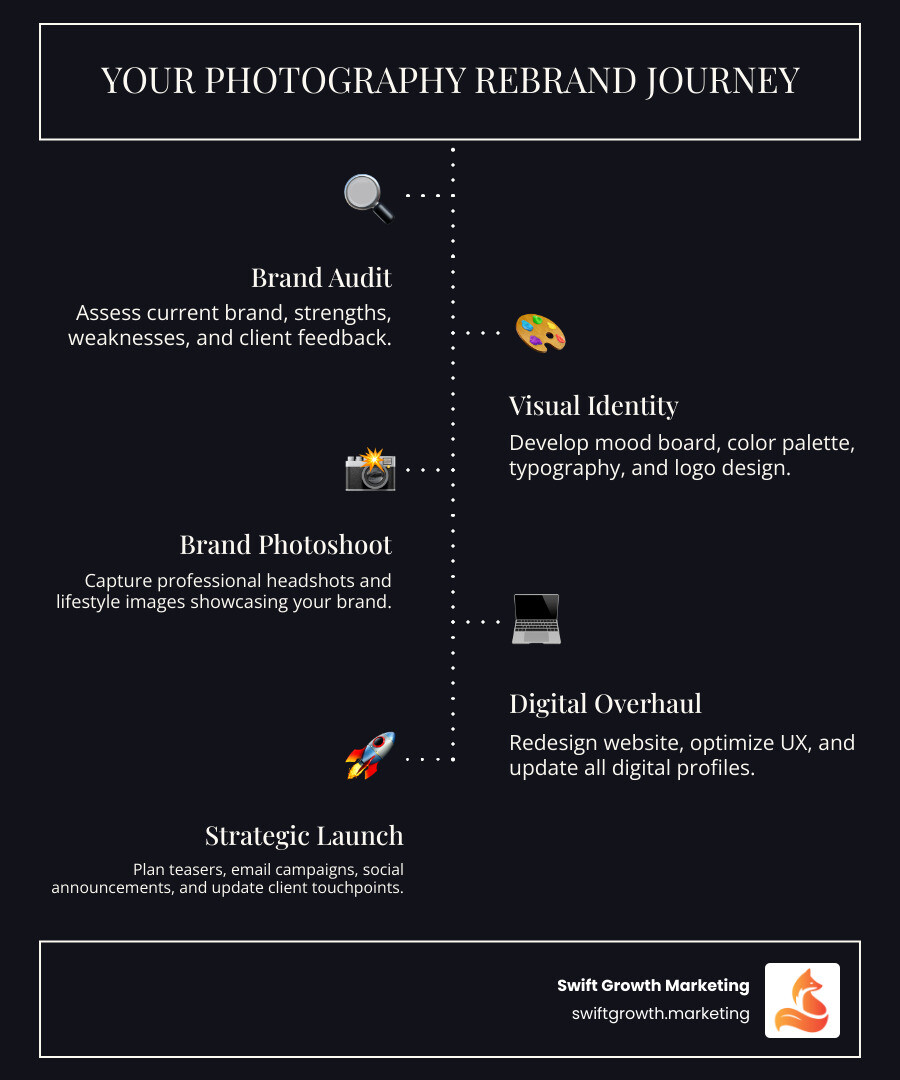
The Rebranding Roadmap: A 6-Step Guide for Photographers
With the strategy set, it’s time for the practical journey of your rebrand. This is a marathon requiring careful planning, budgeting, and implementation. Use this as your roadmap.
Step 1: Conduct a Thorough Brand Audit
First, understand what you’re working with. A brand audit assesses your current brand’s strengths, weaknesses, opportunities, and threats.
- Current Brand Assessment: Gather all materials (logos, website, social media) to check for message consistency.
- Website Analytics Review: Analyze data to see which pages perform well, where visitors drop off, and what keywords drive traffic.
- Client Feedback Analysis: Use surveys and testimonials to learn what clients love and what could be improved.
- Competitive Analysis: Study competitors’ branding and messaging to find opportunities for differentiation.
This audit will inform every subsequent step, ensuring your rebrand is data-driven and a key component for accelerating your marketing strategy, as outlined in Growth Marketing Components Accelerate Your Marketing Strategy.
Step 2: Create Your New Visual Identity
Here, your strategy becomes visual. Your visual identity is a powerful communication tool, not just a pretty picture.
- Mood Board: Collect images, colors, and fonts that evoke your new brand’s feeling to guide your designer.
- Color Psychology: Choose a color palette that aligns with your brand’s personality and desired emotional response.
- Typography: Select fonts that reflect your brand’s voice and use them consistently.
- Logo Design: Your logo should be unique, memorable, and timeless. Professional help is highly recommended here, as noted by photographers who stress its importance.
Working with a professional designer can bring your vision to life and help you develop a Brand Messaging Framework that translates into a cohesive visual style.
Step 3: Execute a Professional Brand Photoshoot
As a photographer, you know the power of images. A professional brand photoshoot is non-negotiable for visually telling your new brand story.
- Showcasing Your Personality: Your brand photoshoot should capture your unique personality and approach.
- Headshots: Invest in professional, updated headshots that convey approachability and expertise.
- Lifestyle Images: Include photos of you in action to add authenticity and context.
- Studio/Workspace Shots: If applicable, feature your creative space to give clients a glimpse into your world.
One photographer found hiring professionals for a dual photo and video shoot to be a valuable investment. They can direct you to get the best results, and gorgeous branding photos make a huge difference. For more ideas, explore Brand photography tips and Brand videography insights.
Step 4: Overhaul Your Website and Digital Presence
Your website and social media are your digital storefront and billboards. Your new brand must shine on these critical touchpoints.
- Website Redesign: Your new site must reflect your updated visuals, messaging, and services. Focus on a clean, intuitive user experience (UX).
- Mobile Optimization: Ensure your site is fully responsive for a seamless experience on all devices.
- Updating Social Media Profiles: Update profile pictures, banners, and bios across all platforms to reflect the new brand.
- Content Updates: Update all website copy, blog posts, and portfolio images to align with your new brand.
Website templates can offer a polished look and save time, though they still require formatting. This hybrid approach can be cost-effective. Don’t forget a Strong SEO Strategy during this overhaul. For guidance, check out our advice on Website template guidance.
Step 5: Update All Client Touchpoints
For consistency, ensure every client interaction point reflects your new identity.
- Email Signatures: Update your professional email signature with your new logo and brand colors.
- Invoices and Contracts: Ensure all financial and legal documents feature your new branding.
- Welcome Guides & Pricing Sheets: These must be impeccably branded and aligned with your new messaging.
- Gallery Delivery: Customize your online gallery platform with your new logo and brand colors.
- Printed Materials: Update business cards, stationery, packaging, and any other printed items.
This step is time-consuming but crucial for a cohesive experience. It means swapping old assets for new ones everywhere. For more insights, read about the Lessons learned from rebranding.
Step 6: Plan a Strategic Launch
The launch is your grand reveal. It’s your chance to generate excitement and announce your new identity.
- Launch Timeline: Create a detailed schedule for your launch activities.
- “Coming Soon” Teasers: Build anticipation with “behind-the-scenes” glimpses on social media.
- Email Marketing Campaign: Design a series of emails to announce your rebrand and explain the “why.”
- Social Media Announcements: Create engaging posts and stories using your new visuals and messaging.
- Involving Your Audience: Make your audience feel part of the journey to maintain engagement.
- Press Release: For a significant rebrand, consider a press release. Learn How to Write a Press Release to announce your news.
A well-executed launch ensures a smooth transition and maximizes the impact of your rebrand.
Navigating the Risks, Costs, and Common Mistakes
Rebranding is powerful but has challenges. The biggest risk is a “loss of relevancy” from drastic changes that make you unrecognizable to your audience. This can cause client confusion, lower engagement, and a loss of brand equity. It’s crucial to be aware of these pitfalls.
Costs can range from $10,000 to over $1 million, highlighting the financial commitment. Without proper planning, budget overruns and inconsistent rollouts are common. As experts advise, you need to Update Your Photography Branding with care.
The Pros and Cons of DIY vs. Outsourcing Your Rebranding Photography Business
You’ll face the “DIY or outsource?” dilemma. Both have merits, but a hybrid model often works best for photographers.
| Aspect | DIY Rebrand | Outsourcing Rebrand |
|---|---|---|
| Cost | Lower upfront | Higher investment |
| Time Commitment | High | Lower (delegated) |
| Quality of Result | Dependent on your skills | Professional expertise |
| Creative Control | Full control | Collaborative, guided by experts |
A hybrid approach allows you to retain creative control over passion projects while hiring experts for technical tasks like logo design or photography. For example, some photographers choose to outsource design and photo/video but handle website customization themselves.
The key is knowing where you need help. As one expert said, “Admit that you can’t do it all yourself.” For more on this, see our guide on How to balance DIY and outsourcing.
Budgeting for Your Rebrand: What to Expect
A rebrand is an investment, not an expense, and it often costs more and takes longer than expected.
Here’s a breakdown of potential expenses:
- Brand Strategy & Findy: Fees for consultants or agencies.
- Designer Fees: For logo creation, brand guidelines, and color palettes.
- Website Costs: Redesign, development, platform fees, and template purchases.
- Photography Investment: Professional brand photoshoot.
- Copywriting: Hiring a professional for brand messaging and content.
- Legal Fees: Trademark searches and business registration changes.
- Printed Materials: Business cards, stationery, and packaging.
- Software/Tool Subscriptions: For new design or marketing platforms.
- Marketing & Launch: Advertising and promotional costs.
Though costly, professional rebranding makes businesses 50% more likely to succeed. To maximize your return, review our 5 Tips to Getting a Better ROI from Your Growth Marketing Budget.
Common Mistakes to Avoid in Your Rebranding Photography Business
Learning from common rebranding missteps can save you time, money, and heartache.
- Rebranding Out of Boredom: Rebranding should solve a business problem, not just because you’re bored with your logo. Superficial changes rarely yield strategic results.
- Copying Trends: Chasing trends makes your brand generic and dated. Aim for a timeless, distinctive look that doesn’t mirror competitors.
- Neglecting Brand Story: Focusing only on visuals is a mistake. Your ‘why’ and brand message are what truly resonate with people.
- Poor Communication: Failing to explain the ‘why’ behind your rebrand can alienate existing clients. Involve them in the process to avoid confusion.
- Inconsistent Rollout: A disjointed rollout with mixed old and new branding looks unprofessional. Ensure all touchpoints are updated simultaneously.
- Not Investing Enough: Cutting corners on critical elements like professional design undermines the entire effort. A rebrand needs proper investment to make an impact.
Avoid these pitfalls by being intentional and strategic. For more insights, read our guide on How To Rebrand Your Photography Business.
Conclusion
Rebranding your photography business is a significant journey and a strategic investment. It goes beyond a new logo to the core of your mission and client connection. We’ve covered the signs it’s time for a change and provided a 6-step roadmap, from brand audit to strategic launch, to guide you.
Understanding the risks, managing your budget, and avoiding common mistakes are crucial. The goal is to create an authentic brand that reflects your current business and future aspirations. A successful rebrand can boost revenue, engagement, and purpose, setting your photography business in Pittsburgh, PA, and Wheeling, WV, up for future growth.
A successful rebrand aligns your passion with your presentation, attracting your ideal clients and setting the stage for future success. If you’re ready to lift your photography business and ensure your rebrand is a resounding success, we invite you to Explore our comprehensive branding services to ensure your rebrand is a success.

wadeo
Insights on brand authority, positioning, and growth strategy from the Swift Growth Marketing team.