


The Growth Framework Playbook for Sustainable Success

Why Every Business Needs a Framework for Growth
A framework for growth is a structured, systematic approach that transforms sporadic business expansion into predictable, sustainable success. A comprehensive growth framework includes:
Core Components:
- Market & Customer Intelligence – Understanding your audience and competitive landscape
- Product Optimization – Refining your offering based on feedback and data
- Marketing & Demand Generation – Identifying and scaling channels that work
- Sales & Monetization – Converting interest into revenue efficiently
- Operations & Scalability – Building systems that support expansion
Many businesses struggle with strategy execution; 74% of companies confess they struggle to execute their strategy effectively. The difference between companies that achieve consistent growth and those stuck on a treadmill isn’t luck—it’s having a deliberate system in place.
Without a framework, businesses make reactive decisions, chasing the latest marketing tactic or launching unvalidated products. This leads to brief spikes in growth followed by stagnation. A framework changes this by providing a clear roadmap to identify opportunities, prioritize initiatives, and measure progress. It aligns the entire organization around shared goals, turning growth from an accident into a repeatable process.
Research shows that companies with integrated growth systems—combining market intelligence, product development, demand generation, sales, and operations—consistently outperform their peers, earning higher valuations and adapting more successfully to market shifts.
I’m Chris Hornak, Co-Founder of Swift Growth Marketing, where we’ve spent years developing and refining our framework for growth with established brands across education, staffing, SaaS, and e-commerce. We’ve seen how the right framework transforms invisible brands into category authorities.
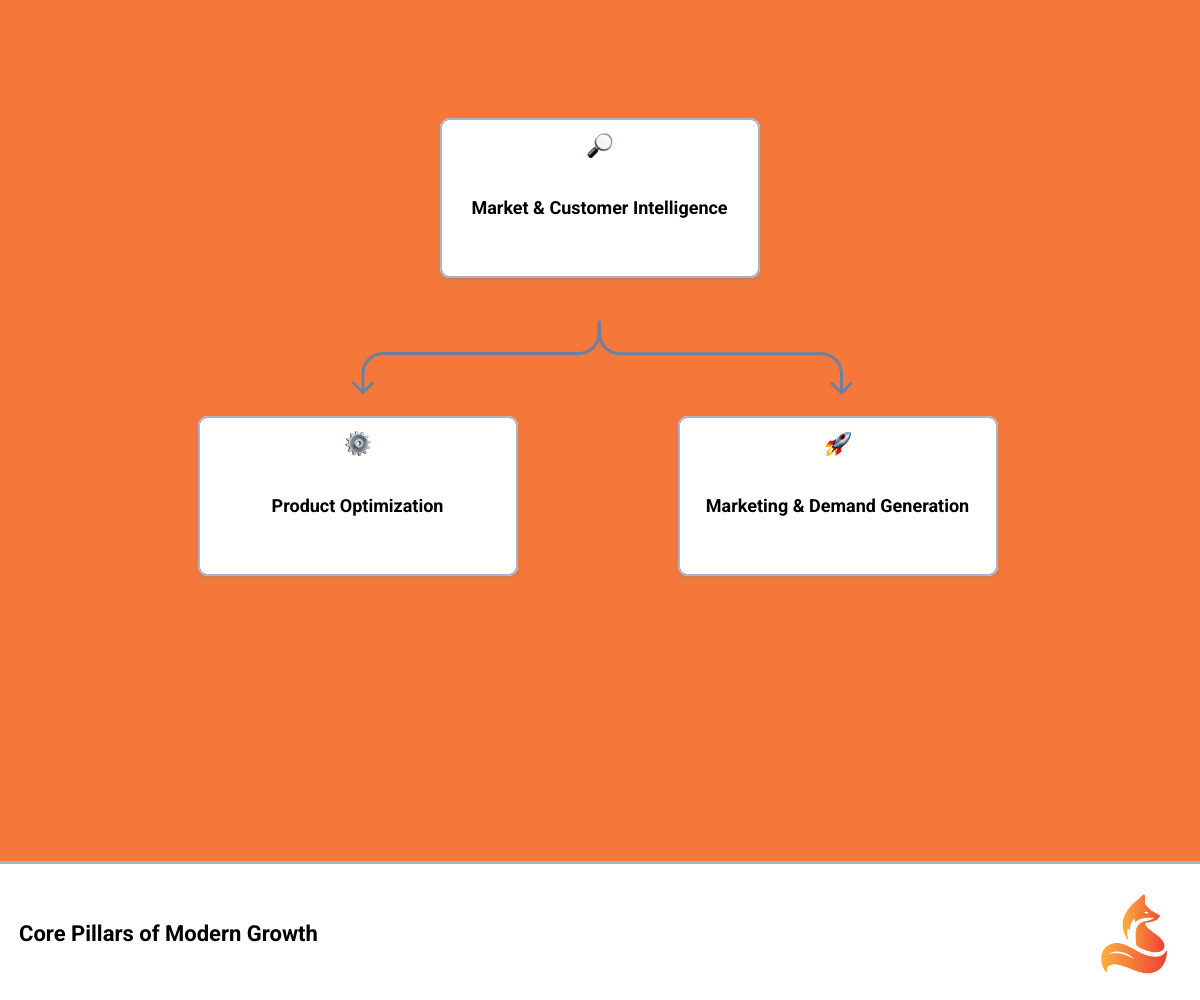
The Core Pillars of a Modern Growth Strategy Framework
Think of a growth framework as the blueprint for your business expansion. Instead of building rooms in a house, you’re building interconnected systems across marketing, sales, product, and operations that work together toward shared goals. This isn’t about chasing quick wins; it’s about creating a predictable, repeatable process for sustainable success.
At Swift Growth Marketing, we’ve found that a solid framework for growth stands on five interconnected pillars. Each one supports the others, creating a system that helps businesses thrive. You can explore more about the Key Elements of Growth Marketing in our other resources.
Pillar 1: Market & Customer Intelligence
Everything starts with a deep understanding of your market and customers. This pillar involves market analysis to spot trends and size up opportunities. More importantly, it’s about understanding your target audience on a human level: What are their problems and motivations?
The Jobs-to-be-Done framework is powerful here. Instead of asking what features customers want, we ask what job they’re hiring your product to do. Harvard Business Review’s piece on Know Your Customers’ “Jobs to Be Done” explains this concept well. We also analyze the competitive landscape to find their strengths, weaknesses, and the untapped opportunities they’re missing. This intelligence ensures you’re creating real value, not just building solutions for imaginary problems.
Pillar 2: Product & Service Optimization
Once you know what customers need, your product must deliver on that promise. This is where you achieve product-market fit—the point where your offering perfectly matches market demand. Your value proposition must be crystal clear: Why should someone choose you over all other options?
Optimization is a continuous process. Markets and customer needs evolve. This pillar includes building an innovation roadmap and user feedback loops to stay ahead. We track feature adoption to see what’s valuable and use agile development principles to make quick, incremental improvements. This cycle ensures your product evolves with your customers. Our article on Growth Marketing Components Accelerate Your Marketing Strategy explores this connection further.
Pillar 3: Marketing & Demand Generation
A great product needs to be finded by the right people. This pillar focuses on identifying scalable channels to consistently attract new leads and customers. A strong content strategy, including organic content and SEO, forms the backbone of sustainable demand generation by capturing people actively searching for solutions.
Customer journey mapping helps us optimize the touchpoints where people make decisions. The AARRR metrics (Awareness, Acquisition, Activation, Retention, Referral, Revenue) provide a complete view of the user lifecycle. This pillar may also include paid acquisition, influencer partnerships, and retention marketing to build lasting brand awareness. Check out our deep dive on Growth Marketing Channels for more strategic insights.
Pillar 4: Sales & Monetization
Converting interest into revenue is essential. This pillar ensures you have the right sales models, whether it’s product-led, sales-led, or a hybrid approach. Your pricing strategy must align with your unit economics. We analyze Customer Lifetime Value (CLV) and Customer Acquisition Cost (CAC) to ensure profitability.
Sales enablement provides your team with the necessary playbooks and training. We also focus on expansion revenue through smart upsell and cross-sell strategies, as existing customers are often your biggest growth opportunity. Revenue operations ties these pieces together, enabling accurate forecasting and a clear view of your sales pipeline.
Pillar 5: Operations & Scalability
Growth without operational excellence leads to chaos. This pillar is about building the infrastructure to scale sustainably. Standard operating procedures (SOPs) ensure consistency and quality as you grow, while automation handles repetitive tasks, freeing your team for more strategic work.
Your team structure must evolve as you scale, incorporating cross-functional collaboration and specialized roles. Quality assurance processes maintain high standards across product and marketing. Finally, scalable customer support models are crucial for maintaining user satisfaction as your base grows. By optimizing these operational aspects, you future-proof your business for sustained growth.
How to Build and Implement Your Framework for Growth
Building a growth framework is an ongoing process, not a one-time setup. It’s a living system that you must nurture and adapt as your business evolves.

Step 1: Define Your Vision and Set SMART Goals
Effective growth starts with a clear destination. First, define your company’s vision for the next one, three, and five years. Then, translate that vision into concrete goals using the SMART framework: your objectives must be specific, measurable, achievable, relevant, and time-bound. For example, instead of “grow sales,” a SMART goal would be “increase Monthly Recurring Revenue by 20% within six months.”
We also recommend identifying your North Star Metric—the single metric that best captures the core value your product delivers. For a SaaS company, it might be active users; for e-commerce, it could be repeat purchase rate. This metric becomes the primary focus that aligns your entire organization.
Step 2: Prioritize Initiatives with Scoring Models
You’ll likely have many ideas for growth, but limited resources. Prioritization frameworks like ICE scoring (Impact × Confidence × Ease) or RICE scoring (Reach × Impact × Confidence / Effort) help you evaluate each initiative objectively. By scoring ideas, you can identify the best use of your time and budget.
The goal is to balance quick wins (high-impact, low-effort projects) with long-term strategic investments. Quick wins build momentum, while bigger bets can transform your business over time. Smart resource allocation is key. For more guidance, see our article on 5 Tips to Getting a Better ROI from Your Growth Marketing Budget.
Step 3: Differentiating Your Framework
A growth framework is often confused with other strategic documents. Understanding the differences is key to using each tool effectively.
| Feature | Growth Strategy Framework | Business Plan | Marketing Strategy |
|---|---|---|---|
| Primary Purpose | Systematic, repeatable process for sustainable, scalable growth across the entire business. | Comprehensive overview of a company’s mission, vision, market, and financial forecasts. | Plan focused on attracting and converting customers through specific channels. |
| Scope | Holistic, integrates product, marketing, sales, and operations. | Broad, covers all aspects of the business, often for investors or internal guidance. | Narrow, focuses specifically on customer acquisition, retention, and branding. |
| Nature | Dynamic, iterative, experimental, data-driven, and continuously evolving. | Static document, updated periodically, usually for a specific period (e.g., 3-5 years). | Dynamic, but primarily within the marketing domain, often campaign-specific. |
| Key Output | Experiments, KPIs, feedback loops, optimized processes for continuous growth. | Mission statement, market analysis, financial projections, operational plans. | Campaign plans, content calendars, channel selection, messaging. |
| Focus | How to achieve growth intentionally through actionable steps and measurement. | What the business is, where it’s going, and how it will operate. | How to communicate value and reach target audiences. |
A business plan is a static snapshot of your company’s mission and financial projections. A marketing strategy focuses specifically on attracting and converting customers. A framework for growth, however, is a dynamic, integrated system that turns your vision into actionable experiments across product, marketing, sales, and operations. It’s the engine that drives your business forward.
Step 4: Measure Success and Create Feedback Loops
What gets measured gets managed. Rigorous tracking and analysis are essential for growth. Start by building dashboards that provide a real-time view of your key metrics, pulling data from your CRM, analytics platforms, and financial software into a single source of truth.
Use cohort analysis to understand how customer behavior changes over time and A/B testing to make data-driven decisions instead of guessing. This scientific approach allows small, incremental improvements to compound into significant growth.
Finally, schedule quarterly reviews to assess the bigger picture, learn from both wins and failures, and adjust your strategy. This continuous cycle of measuring, learning, and adapting keeps your growth framework effective as markets and customer preferences evolve. Learn how AI and Growth Marketing can improve this process.
Enhancing Your Framework with Complementary Models
Your growth framework provides the backbone of your strategy, but complementary models can act as precision tools for specific challenges. These models offer different lenses to view and open up your business potential.

The Ansoff Matrix for Market Opportunities
The Ansoff Matrix helps you decide where to grow next by mapping four distinct growth paths based on your products and markets:
- Market Penetration: Selling more of your current products to your existing market.
- Product Development: Creating new products for your existing market.
- Market Development: Taking existing products to new markets (e.g., expanding to new cities like Pittsburgh or Wheeling).
- Diversification: Developing new products for new markets. This is the riskiest path but can offer huge rewards.
We use this matrix to systematically evaluate growth paths, balancing potential rewards against risks.
McKinsey’s Three Horizons for Innovation
McKinsey’s Three Horizons model helps you balance current performance with future innovation, ensuring you’re building for tomorrow while managing today.
- Horizon 1: Your core business, generating most of today’s revenue. The focus is on optimizing and defending what works.
- Horizon 2: Emerging opportunities that could become your next core business. These require investment and patience to scale.
- Horizon 3: Radical, long-term ideas that could disrupt your industry. These are speculative but essential for long-term relevance.
This model forces you to think across different time horizons simultaneously. McKinsey’s research on The three horizons of growth offers deeper insights.
The AARRR “Pirate Metrics” Funnel
Dave McClure’s AARRR funnel provides a simple way to track the entire customer lifecycle through five critical stages:
- Acquisition: How do people find you?
- Activation: Do users have a great first experience and understand your value?
- Retention: Do users come back over time?
- Referral: Do users like your product enough to tell others?
- Revenue: How do you monetize these relationships?
By analyzing metrics at each stage, we can pinpoint where users are dropping off and run targeted experiments to improve the customer journey. Our guide on Types of Growth Marketing Channels explores how channels fit into this lifecycle.
Frequently Asked Questions about Growth Frameworks
Business owners often have questions about how a growth framework works in practice. Here are answers to the most common ones.
What is the difference between a growth strategy framework and a business plan?
Think of a business plan as a static snapshot: it describes what your business is and where it’s headed, often for investors or annual planning. A growth framework is a dynamic, living system: it details how you will achieve that growth through an integrated, iterative process of experimentation and measurement across the entire business.
How do I know if my framework for growth is working?
A well-designed framework provides its own feedback. You’ll know it’s working if:
- Your KPIs are improving: Look for consistent growth in metrics like Monthly Recurring Revenue (MRR) and Customer Lifetime Value (CLV), and a decreasing Customer Acquisition Cost (CAC).
- Your team is aligned: People can make decisions faster and are aligned on priorities. There’s a predictable pipeline of initiatives.
- Your North Star Metric is rising: The single most important measure of your customer value is trending upward.
Regular reviews will confirm what’s working and what needs adjustment.
How can a small business create a framework for growth?
You don’t need a complex system to start. Small businesses can build an effective framework by focusing on the fundamentals:
- Start with customers: Conduct interviews or surveys to deeply understand their problems and needs.
- Clarify your value proposition: Focus on the one or two unique benefits that matter most to your audience.
- Pick your channels wisely: Identify one or two primary channels where your audience spends their time. For a local business in Pittsburgh or Wheeling, this might be Google My Business and local SEO.
- Set SMART goals: Create specific, measurable targets, like “Increase qualified leads from local search by 20% this quarter.”
- Test and measure: Run small experiments, track the results with simple tools like Google Analytics, and adjust your approach based on what you learn.
Conclusion
If you take away one thing from this guide, let it be this: sustainable growth doesn’t happen by accident. The businesses that consistently expand and adapt have a system in place.
We’ve walked through the five interconnected pillars of a powerful framework for growth: understanding your market, optimizing your product, generating demand, monetizing effectively, and building scalable operations. We’ve also covered the practical steps to implement your own framework by setting clear goals, prioritizing initiatives, and creating feedback loops for continuous improvement.
Strategic models like the Ansoff Matrix, McKinsey’s Three Horizons, and the AARRR funnel are valuable tools to complement your framework, helping you make smarter decisions about where to invest your resources.
Growth is earned through strategic choices and disciplined execution. It requires a deep understanding of your customers and systems that can scale. You don’t have to figure it all out alone.
At Swift Growth Marketing, we’ve spent years refining our framework for growth with brands across various industries. We partner with businesses in Pittsburgh, Wheeling, and beyond to turn growth from a hope into a predictable outcome.
Ready to build your system for sustainable success? Partner with a Growth Marketing Consultancy that has the playbook. Your future self will thank you.

chris
Insights on brand authority, positioning, and growth strategy from the Swift Growth Marketing team.