


Beyond the Buzzword: Mastering Your Growth Funnel for Exponential Results
Why Your Growth Strategy Needs More Than Just a Sales Pipeline
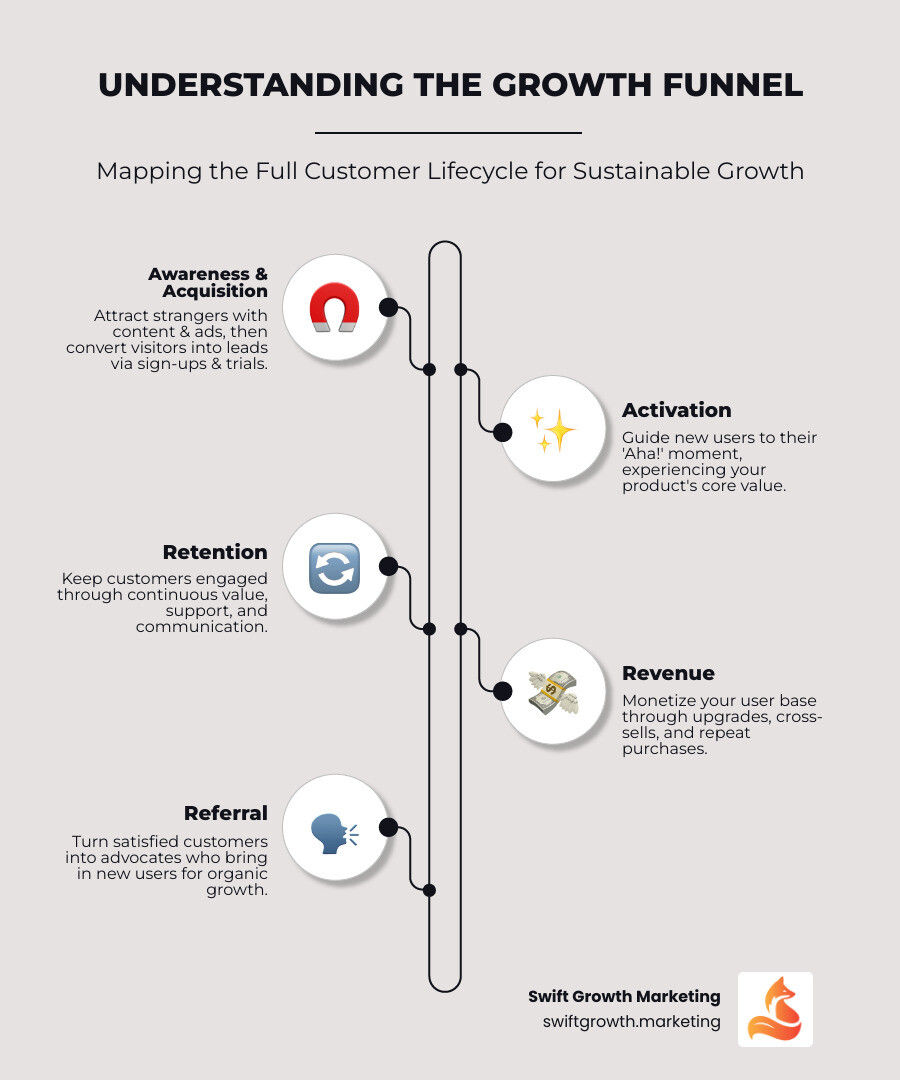
A growth funnel is a framework that maps the entire customer lifecycle—from initial awareness through acquisition, activation, retention, revenue, and referral. Unlike traditional sales funnels that end at purchase, growth funnels emphasize post-purchase behaviors like retention and advocacy to drive sustainable, compound growth.
Quick Answer: What is a Growth Funnel?
- Definition: A data-driven model that tracks customers through six stages (AARRR): Awareness, Acquisition, Activation, Retention, Revenue, and Referral.
- Key Difference: Focuses on the entire customer lifecycle, not just initial conversion.
- Goal: Create self-reinforcing growth through retention and referrals, not just new customer acquisition.
- Measurement: Tracks metrics like Customer Lifetime Value (CLV), churn rate, and viral coefficient—not just conversion rates.
Many businesses treat customer acquisition like filling a leaky bucket, pouring resources into the top while customers drain out the bottom. Traditional funnels often fail because they ignore the most profitable phase of the customer journey: after the sale. A growth funnel solves this by treating every stage as an opportunity to optimize and accelerate growth.
Without a full-funnel approach, you’re leaving money on the table. Retention is cheaper than acquisition, yet most marketing budgets are skewed toward new customers. Growth funnels flip this script by building systems where existing customers fuel new growth through referrals, upsells, and repeat purchases.
I’m Chris Hornak, Co-Founder of Swift Growth Marketing. We’ve helped companies become category authorities by building and optimizing growth funnels that drive sustainable results. We’ve seen how a well-designed funnel can turn a trickle of traffic into 45,000 monthly visitors and have used these principles to scale content operations for over 500 businesses.
Deconstructing the Growth Funnel: More Than Just Sales
If your marketing ends at “purchase,” it’s time for an upgrade. The growth funnel isn’t just a new name for an old process; it’s a different way of thinking about customer relationships and sustainable growth.
What is a growth funnel?
A growth funnel is a data-driven framework that tracks customers through their entire lifecycle. Unlike traditional models that stop at the sale, a growth funnel recognizes that the most valuable opportunities happen after someone becomes a customer. It extends beyond the initial transaction to treat retention, referral, and advocacy as core stages of the journey.
Think of it as the difference between a transaction and a relationship. A customer who sticks around, buys again, and tells their friends is worth exponentially more than a one-time buyer. This approach thrives on data-driven experimentation—testing, measuring, and optimizing at every stage to create more value and reduce friction. The growth funnel covers the full customer lifecycle, from first touch to loyal advocate, changing marketing into a growth engine. To see how these elements work together, check out our guide on Growth Marketing Components Accelerate Your Marketing Strategy.
Growth Funnel vs. Traditional Sales Funnel
The traditional sales funnel, typically following an Awareness-Consideration-Decision path, is showing its age. Its job ends at the point of sale, treating customers like finish lines instead of starting points. This model focuses almost exclusively on acquisition and measures success by conversion rate, missing the profitable opportunities in the post-purchase journey.
| Aspect | Growth Funnel | Traditional Sales Funnel |
|---|---|---|
| Focus | Lifecycle (end-to-end) | Acquisition (top-to-bottom) |
| Goal | Sustainable Growth | Closing a Sale |
| Scope | Full customer journey | Initial conversion |
| Measurement | LTV, Churn, Retention, Referrals | Conversion Rate |
The growth funnel flips this script. Its focus is on the entire lifecycle, with the goal of building sustainable growth through retention and advocacy. Instead of just conversion rates, it tracks metrics like Customer Lifetime Value (LTV), churn rate, and referrals. These metrics reveal not just how many customers you’re getting, but how valuable they are over time. This shift from linear acquisition to full-lifecycle growth is what separates businesses that plateau from those that scale predictably.
Growth Funnel vs. Growth Flywheel
You may have also heard of the growth flywheel, a cyclical model emphasizing how satisfied customers create momentum. Happy customers refer new ones, who then become happy customers themselves, spinning the wheel faster. The core idea is to reduce friction so that customer momentum naturally accelerates growth.
While the growth funnel is a more linear model mapping distinct stages, it doesn’t have to be an either/or choice. Using funnels and flywheels together often produces the best results. The growth funnel acts as a roadmap for the initial customer journey, giving you clear stages to track and optimize. Once a customer is on board, the flywheel mentality takes over, focusing on creating an experience so great they become advocates.
This word-of-mouth feeds the top of your funnel, and the cycle continues. Funnels help you build the initial path to value, while flywheels help you amplify that value through customer satisfaction. Together, they create a powerful system where satisfied customers become your best marketing channel.
The 6 Stages of a High-Performing Growth Funnel
The most effective growth funnels follow the AARRR framework, also known as Pirate Metrics. It stands for Awareness, Acquisition, Activation, Retention, Revenue, and Referral. Each stage builds on the last, creating a system that drives your business forward.
Awareness: Turning Strangers into Visitors
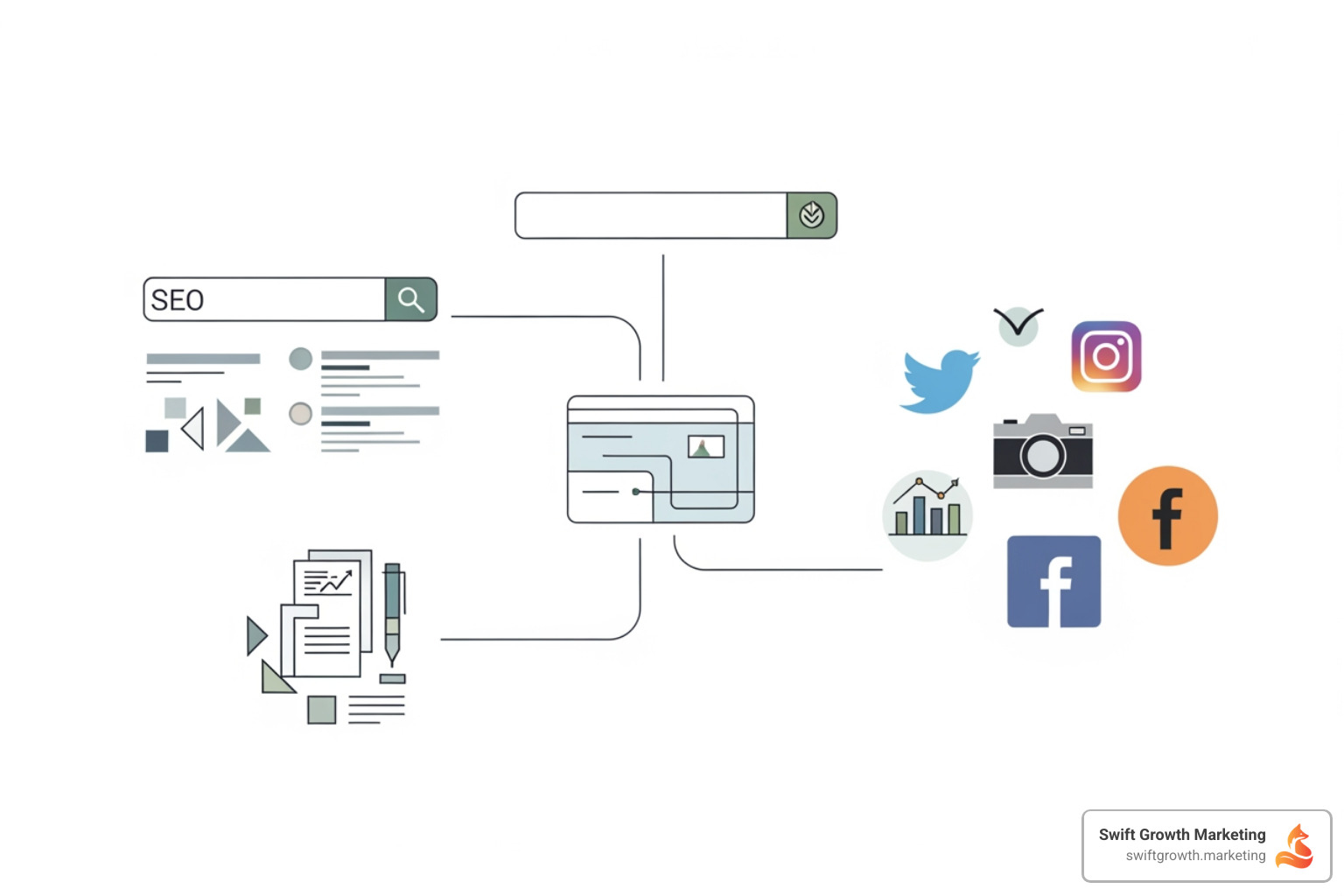
This is where strangers first encounter your brand. The goal is not to sell, but to let people know you exist and can solve their problems. Key channels include SEO, valuable content marketing (blogs, videos), paid campaigns, and social media. For a deeper look, check out our guide to a Strong SEO Strategy.
- Metrics: Impressions, website traffic, reach.
Acquisition: Converting Visitors into Leads
Here, you convert visitors into leads by asking for contact information in exchange for something valuable. This can be gated content (e-books, webinars), free trials, or a newsletter sign-up. Your landing pages must be focused on this single goal. Our Tips for Psychology-Based Landing Page Optimization That Converts can help.
- Metrics: Lead conversion rate, Marketing Qualified Leads (MQLs), cost per lead.
Activation: Creating the “Aha!” Moment
Activation is the moment a new user experiences your product’s core value and understands its benefit. To get them there quickly, use streamlined onboarding flows and product tours to guide them to a first key user action (e.g., sending their first email campaign). A seamless user experience is crucial. Learn more about creating these experiences with our insights on UX Optimization.
- Metrics: Activation rate, Product Qualified Leads (PQLs), feature adoption rate.
Retention: Keeping Customers Engaged
Keeping an existing customer costs less than acquiring a new one. Retention is about ensuring customers continue to find value in your product. Use email marketing, in-app messaging, proactive customer success programs, and community building to foster loyalty. A rising churn rate is a major red flag that something is wrong.
- Metrics: Churn rate, customer lifetime value (CLV), repeat purchase rate, daily/monthly active users.
Revenue: Monetizing Your User Base
This stage focuses on maximizing the revenue generated from your active users. Offer value-added upgrades through upselling or introduce complementary products via cross-selling. Subscription models and tiered pricing can create predictable revenue while serving different customer segments. Our 5 Tips to Getting a Better ROI from Your Growth Marketing Budget offers strategies for maximizing your investment.
- Metrics: Average Revenue Per User (ARPU), CLV, upgrade rate, expansion revenue.
Referral: Turning Customers into Advocates

The final stage turns happy customers into a marketing force. Implement referral programs with incentives, encourage reviews on relevant platforms, and showcase success with case studies and testimonials. This creates a self-sustaining growth engine. You can see examples of our client results in our Case Studies.
- Metrics: Net Promoter Score (NPS), viral coefficient, number of referrals.
Building and Optimizing Your Growth Funnel Strategy
Understanding the stages is one thing; making them work is another. A successful growth funnel relies on measurement, optimization, and adaptation.
How to measure your growth funnel’s effectiveness
You can’t improve what you don’t measure. The first step is identifying your key performance indicators (KPIs) for each stage. While benchmarks vary by industry, here are some general guidelines for conversion rates:
- Awareness to Acquisition: 1%-5% (paid campaigns)
- Acquisition to Activation: 20%-50%
- Activation to Retention: 30%-70%
- Retention to Revenue: 10%-30%
- Revenue to Referral: 5%-20%
Use analytics tools like Google Analytics, Amplitude, or Mixpanel to track user behavior. For SEO insights, Google Search Console 101 is a great starting point. A powerful technique is cohort analysis, which groups users by their start date to track how their behavior evolves over time. This helps you diagnose issues and understand abandonment patterns more clearly than aggregate data allows.
Fixing Common Drop-Off Points
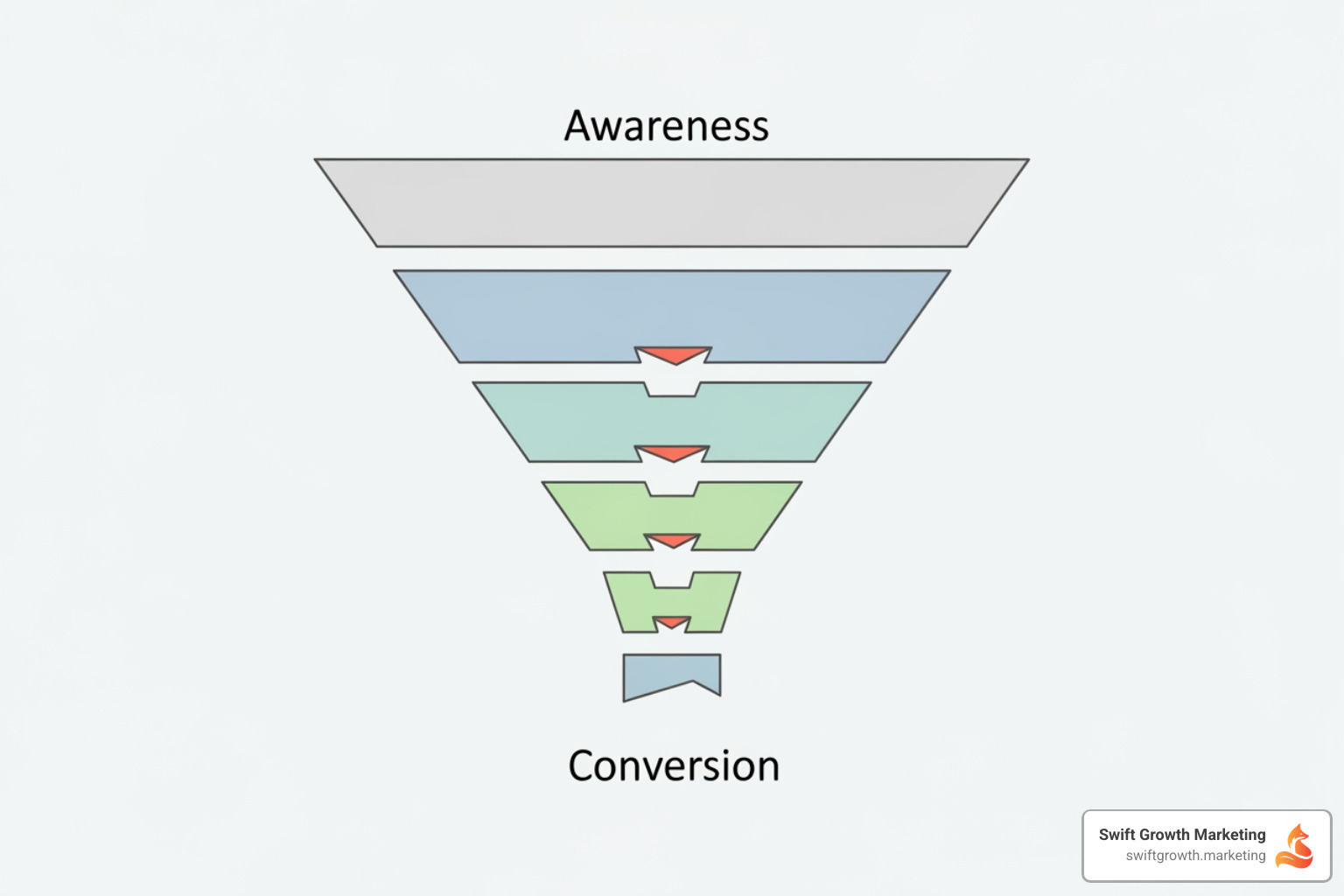
Every funnel has leaks. Identifying and plugging them is key to optimization.
- High landing page bounce: Your messaging may be unclear or your offer isn’t compelling. Tighten your copy, improve page speed, add social proof, and A/B test layouts. See our Tips for Psychology-Based Landing Page Optimization That Converts.
- Low activation rate: Onboarding friction is a common culprit. Streamline your onboarding flow, use guided tours, and send re-engagement emails to inactive users.
- High post-activation churn: Users aren’t finding ongoing value. Use in-app messages, personalized content, and community building to demonstrate continuous value.
- Low upgrade/repeat purchase rate: Customers are happy but not spending more. Use behavior-based prompts to time upsell and cross-sell offers when they are most relevant.
- Low referral rate: Happy customers aren’t spreading the word. Implement a clear referral program with attractive incentives and actively solicit reviews.
Use funnel analytics to find your biggest leaks and run focused experiments to fix them.
Adapting the Funnel for B2B and SaaS
The core principles of a growth funnel are universal, but the application must adapt to your business model.
For B2B, sales cycles are longer and involve multiple stakeholders. Your funnel must nurture relationships over time. Content marketing (whitepapers, webinars), Account-Based Marketing (ABM), and intent data are crucial. LinkedIn is a key channel for reaching decision-makers with custom content. B2B metrics include sales cycle length, deal velocity, and CAC per account. See how this works in our B2B Growth Marketing Case Study.
For SaaS, especially with Product-Led Growth (PLG), the product is the funnel. Freemium models or free trials let users experience value before paying. Onboarding is mission-critical; the faster users reach their “Aha!” moment, the better. Use trigger-based nudges to suggest upgrades based on product usage. Key metrics include free-to-paid conversion rates, DAU/MAU, and CLV. For more on maximizing your budget, explore our 5 Tips to Getting a Better ROI from Your Growth Marketing Budget.
Conclusion
Building a growth funnel is about creating a living system that powers your business. It extends beyond the initial purchase to accept the full customer lifecycle, turning one-time buyers into loyal advocates who fuel new growth. By optimizing each stage of the AARRR framework, you create compounding returns where retention reduces churn and referrals lower acquisition costs.
The most important takeaway is that sustainable growth comes from building smarter systems, not just chasing new customers. When you combine the linear path of a funnel with the cyclical momentum of a flywheel, you create a self-reinforcing engine where satisfied customers make it easier to attract the next one.
A data-driven approach, tracking metrics like CLV and churn, provides the clarity to make confident decisions. No more guessing—just actionable insights that show you where to focus for maximum impact.
At Swift Growth Marketing, we’ve seen this approach transform businesses from invisible to authoritative. We don’t just understand growth funnels; we build and optimize them every day to deliver sustainable results.
Your growth funnel is your roadmap to predictable expansion. It’s how you turn strangers into customers and customers into champions. Ready to stop leaving money on the table and start building a growth engine that lasts? Explore our Growth Marketing Consultancy services and let’s build something remarkable together.

chris
Insights on brand authority, positioning, and growth strategy from the Swift Growth Marketing team.