


Beyond the Buzz: What B2B Growth Marketing Really Means for Your Business
Why Traditional Marketing Isn’t Cutting It Anymore
Growth marketing for B2B is a data-driven, full-funnel approach focused on acquiring, converting, and retaining customers through continuous experimentation. It’s not just about generating leads; it’s about driving sustainable revenue growth.
What B2B Growth Marketing Really Means:
- Full-Funnel Focus: Optimizes every stage from awareness to advocacy.
- Data-Driven Decisions: Uses metrics like CAC, CLV, and ROI to guide strategy.
- Continuous Experimentation: Tests, learns, and iterates to improve performance.
- Revenue Alignment: Bridges marketing and sales with shared goals focused on revenue.
- Customer Lifecycle: Emphasizes retention and expansion, not just acquisition.
The B2B marketing landscape has changed. Buyer journeys are no longer linear but are digital-first and involve more stakeholders. Research shows that 80% of B2B sales interactions will occur via digital channels by 2025. Traditional marketing tactics—periodic campaigns and a singular focus on lead generation—are falling short because they treat marketing as a cost center, not a revenue driver.
Growth marketing flips this script. Instead of handing off leads, growth marketers own the entire funnel, using data and experimentation to systematically move prospects from awareness to revenue. This approach is powerful for B2B companies facing complex sales cycles and the need to prove clear ROI.
I’m Chris Hornak, Co-Founder of Swift Growth Marketing. We help established brands transform their approach to growth marketing for B2B, driving measurable revenue growth through strategic, full-funnel execution. We’ve seen how this shift from traditional marketing to a growth mindset can open up sustainable growth.
What is B2B Growth Marketing? (And How It’s Different)
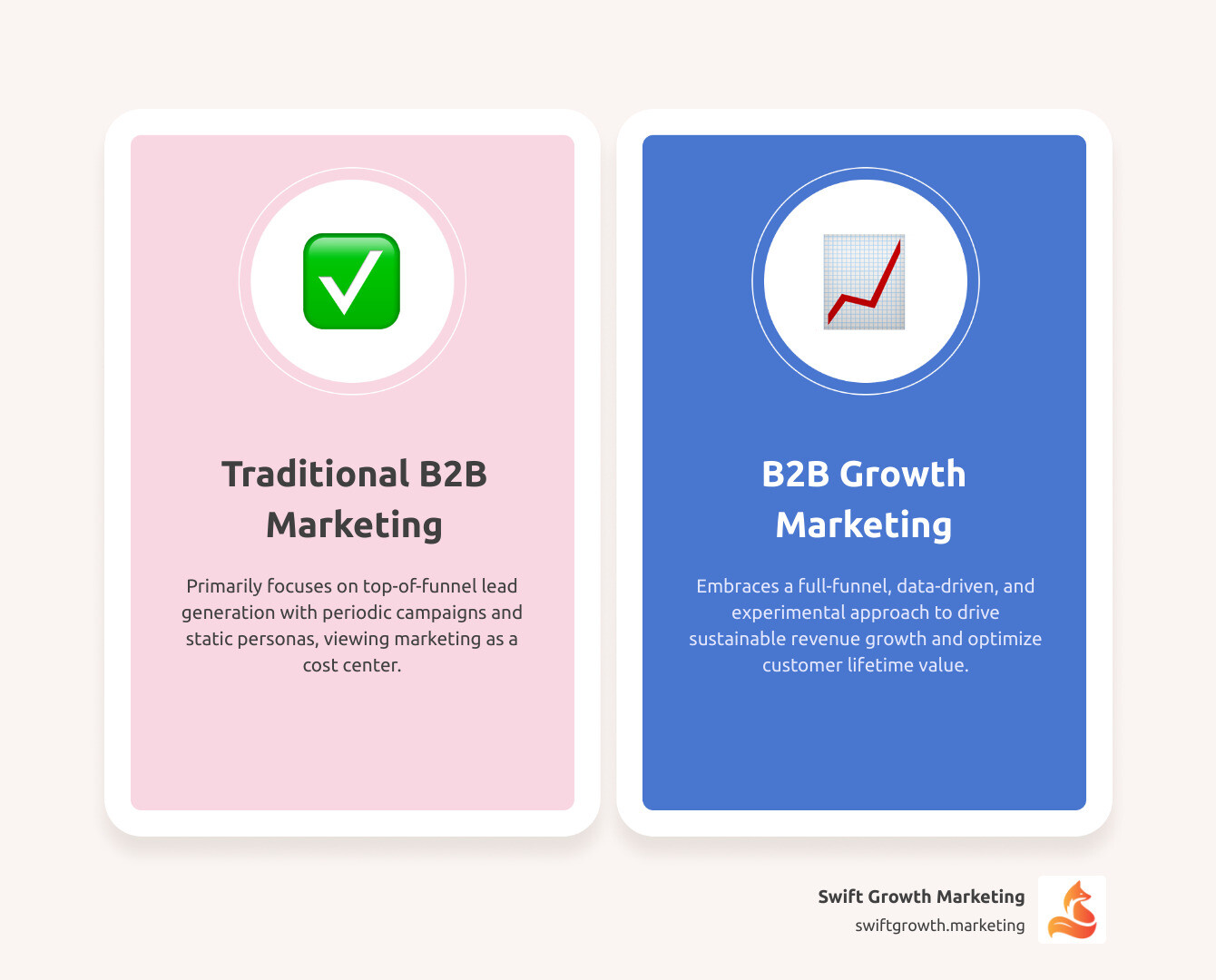
Growth marketing for b2b is a strategic, full-funnel approach focused on customer acquisition, retention, and expansion—all driven by data and continuous optimization. Unlike traditional marketing, which often stops once a lead is generated, growth marketing stays engaged through the entire customer lifecycle.
Traditional marketing runs fixed campaigns with clear start and end dates. Growth marketing is an ongoing process of testing, learning, and improving. It’s about building a Growth Marketing Mindset where every activity is a hypothesis to be tested and refined based on real results. The goal is to prove impact on revenue, not just chase attention.
| Aspect | Traditional B2B Marketing | B2B Growth Marketing |
|---|---|---|
| Funnel Focus | Top of Funnel (Awareness, Leads) | Full Funnel (Awareness to Advocacy) |
| Campaign Style | Fixed, periodic, one-off | Ongoing, iterative, experimental |
| Mindset | Brand/Lead Gen, Cost Center | Revenue & Growth, Profit Center |
| Key Metrics | Impressions, Leads, MQLs | CAC, CLV, ROI, Retention, Pipeline Contribution |
| Team Structure | Often siloed | Cross-functional, integrated |
| Decision Making | Intuition, past campaigns | Data-driven, A/B testing, analytics |
| Goal | Brand visibility, lead volume | Sustainable revenue, customer lifetime value |
This approach matters for B2B companies because buyer journeys are complicated, non-linear, and involve multiple stakeholders. Growth marketing is agile enough to adapt to changing buyer needs, customer-centric enough to speak to different stakeholders, and performance-focused enough to prove its value at every turn.
The Core Principles and Components of a Successful Strategy
Building a successful growth marketing for B2B strategy requires assembling an interconnected puzzle where each piece is vital. At Swift Growth, we build on foundational elements outlined in our Growth Strategy Framework.
Here are the Key Elements of Growth Marketing that guide our approach:
-
Customer-Centricity: We go beyond demographics to map customer pain points, decision triggers, and success metrics. This involves deep user research, surveys, and conversations with sales and customer service teams to create detailed personas.
-
Data-Driven Decisions: Data is our compass. Every choice, from campaign design to budget allocation, is informed by analytics. We track key performance metrics and use attribution models to understand what drives results, moving away from guesswork.
-
Continuous Experimentation: We use A/B testing on everything from website copy to ad visuals. This iterative process, guided by our experimentation framework, proves what works before scaling and ensures your strategy remains effective.
-
Full-Funnel Focus: We optimize every stage of the customer journey, from awareness to advocacy. This ensures we’re not just attracting prospects but also converting them, retaining them, and turning them into fans.
-
Persona and Funnel Mapping: We create detailed buyer personas and map their journey to identify key touchpoints and opportunities. We then align specific content, campaigns, and channels to each funnel stage, defining clear tactics and performance metrics to measure impact.
-
Robust Tech Stack: A connected set of tools—like CRMs, marketing automation, and analytics platforms—is essential for gathering data, automating tasks, and providing real-time insights. This empowers us to analyze results and align marketing and sales teams around shared goals.
By embracing these principles, we create a strategic framework that delivers measurable results and sets the stage for sustained, scalable growth.
Effective Tactics and Channels for Growth Marketing for B2B
The power of growth marketing for b2b lies in integrating multiple channels into one cohesive strategy. We focus on how owned, earned, and paid media work together to create momentum. Understanding the Types of Growth Marketing Channels is key to creating a harmonious and effective plan.
Content Marketing & SEO: Building Authority and Trust
Content is your best 24/7 salesperson. A reported 93% of B2B marketers use content marketing to drive growth. It’s about creating valuable resources that answer your prospects’ real questions and build trust.
We create content for different journey stages: blogs for awareness, whitepapers for lead capture, case studies for proof, and webinars for human connection. B2B companies that blog consistently see significantly more traffic and leads. Great content needs to be findable, which is where SEO comes in. Our SEO Foundations approach ensures your site is technically sound. We perform thorough keyword research to understand search intent and use pillar pages to establish authority on core topics. You can learn How Pillar Pages Play a Role in Your Growth Marketing Strategy to see their effectiveness. This is how Content Marketing for Brands is done right—resonating with your audience and performing in search.
Account-Based Marketing (ABM) & Paid Social: Precision Targeting
Sometimes you don’t need a thousand leads; you need the right ten. That’s the philosophy of Account-Based Marketing (ABM). We identify your dream clients first and then create hyper-personalized campaigns just for them. This requires strong sales and marketing alignment, where both teams work together to identify targets and coordinate outreach.
Paid social, especially on LinkedIn, is a powerful tool for ABM. It allows for precise targeting by job title, company, and industry. While the cost may be higher, the precision often delivers a stronger ROI. Understanding which LinkedIn Post Types That Dominate B2B and How to Use Them helps maximize engagement with key decision-makers.
Email Marketing & Automation: Nurturing Leads at Scale
Email is a versatile and measurable tool for B2B marketing. We focus on sophisticated, personalized communication, not batch-and-blast newsletters. The foundation is segmentation, dividing your audience based on industry, behavior, or journey stage. This allows for deep personalization that speaks to a recipient’s specific challenges and pain points.
Automated workflows, or drip campaigns, are triggered by specific user actions, ensuring prospects receive timely, relevant information without manual effort. Marketing automation platforms handle these repetitive tasks, freeing up our team to focus on strategy. These Growth Marketing Components Accelerate Your Marketing Strategy by creating consistent, personalized touchpoints throughout the customer journey.
Optimizing the Funnel and Measuring Success
The strength of growth marketing for b2b is its continuous nature. We are always refining the customer journey to make it smoother and more effective. This ongoing optimization is what separates growth marketing from traditional, finite campaigns.
Mapping the B2B Growth Marketing Funnel
Understanding your funnel provides a roadmap for the complex B2B customer journey. We map tactics to each stage:
- Awareness: Prospects realize they have a problem. We use educational blogs and SEO-optimized content to help them find answers.
- Interest: Prospects actively research solutions. We provide in-depth content like webinars and case studies to build trust.
- Evaluation: Prospects compare you against alternatives. We use product demos, ROI calculators, and personalized consultations.
- Conversion: We focus on making the buying process frictionless. The job continues post-sale with a strong onboarding experience, as companies prioritizing customer experience see 1.7x higher retention rates. We help optimize your onboarding process to ensure new customers see value quickly.
- Retention: We keep customers engaged through ongoing support and value delivery.
- Advocacy: We aim to turn satisfied customers into advocates who provide reviews and referrals.
Crucial KPIs for Measuring B2B Growth Marketing Efforts
We focus on metrics that tie directly to revenue, not vanity metrics like impressions. Key performance indicators include:
- Customer Acquisition Cost (CAC): How much it costs to acquire a new customer.
- Customer Lifetime Value (CLV): The total revenue a customer generates. A high CLV-to-CAC ratio indicates a sustainable growth engine.
- Return on Investment (ROI): The ultimate measure of marketing effectiveness. Our 5 Tips to Getting a Better ROI from Your Growth Marketing Budget can help maximize this.
- Conversion Rates: Tracked at every funnel stage to identify optimization opportunities.
- Pipeline Velocity: How quickly leads move through the sales process.
- Lead-to-Customer Ratio: An indicator of lead quality and nurturing effectiveness.
- Customer Retention Rate: A critical metric for long-term profitability, especially in recurring revenue models.
Focusing on these metrics ensures our efforts drive sustainable, profitable growth.
Building for Growth: Teams, Trends, and Small Business Strategies
Sustainable growth requires building a forward-thinking culture within your company. It’s about future-proofing your strategy by embracing agility and scalability, ensuring your organization is geared for continuous improvement.
Structuring a Growth-Oriented Marketing Team
A growth team thrives on collaboration, experimentation, and a focus on revenue. Key characteristics include:
- Growth Mindset: Curiosity and a willingness to learn from every outcome.
- Cross-Functional Collaboration: Breaking down silos between marketing, sales, product, and service.
- Sales Alignment: Shared goals and open communication to ensure a smooth customer journey.
- T-shaped Marketers: Individuals with deep expertise in one area and broad knowledge across others.
- Data Literacy: The ability to interpret analytics and make data-informed decisions.
- Experimentation Culture: A safe environment to test ideas, learn fast, and scale what works.
Emerging Trends to Watch
Staying ahead of B2B marketing trends is crucial. With 80% of B2B sales interactions projected to be digital by 2025, a strong digital strategy is critical.
- AI and Automation: Revolutionizing lead scoring, content creation, and personalization. Learn more about AI and Growth Marketing.
- Personalization at Scale: Using AI and data to tailor experiences for individual prospects.
- Omnichannel Marketing: Ensuring a consistent brand experience across all channels where buyers are active.
- Video Content Dominance: Using short-form videos, explainers, and testimonials to engage B2B audiences.
Growth Marketing for Small B2B Teams with Limited Resources
Even with a limited budget, small teams can achieve great results. Our experience as a Growth Marketing Agency for Startups shows that smart strategy overcomes resource limitations.
- Leverage Agility: Small teams can test, learn, and adapt faster than larger organizations.
- Focus on High-Impact Tactics: Prioritize strategies like content and SEO that offer the biggest return.
- Start Small and Iterate: Begin with small experiments, measure results, and refine your approach.
- Scale What Works: Once a tactic proves successful, strategically allocate more resources to it.
- Use Smart Automation: Employ affordable tools to handle repetitive tasks, freeing up your team for strategic work.
Frequently Asked Questions about B2B Growth Marketing
Here are answers to some of the most common questions we hear about growth marketing for B2B.
Why is growth marketing so important for B2B today?
The B2B buyer’s journey is now complex, digital-first, and non-linear. Traditional marketing, focused only on top-of-funnel leads, is no longer sufficient. Growth marketing for B2B is vital because it:
- Manages complex buyer journeys by meeting customers where they are.
- Focuses on revenue and ROI, turning marketing into a profit center.
- Aligns sales and marketing teams around shared goals.
- Drives sustainable growth by emphasizing customer retention and advocacy.
- Adapts to market changes through continuous experimentation and data analysis.
With 80% of B2B sales interactions projected to be digital by 2025, this approach is essential for business success.
What’s the difference between growth hacking and growth marketing?
Though often used interchangeably, they have a key difference:
- Growth Hacking focuses on short-term, rapid, and often unconventional tactics to achieve quick user acquisition. It’s about finding clever shortcuts for fast growth, common among early-stage startups.
- Growth Marketing is a broader, long-term strategy for sustainable growth across the entire customer lifecycle—from acquisition to advocacy. It uses data and experimentation within a strategic framework that considers brand and customer experience.
Growth hacking can be a tactic within a larger growth marketing strategy, but growth marketing provides the foundation for predictable, scalable growth.
How long does it take to see results from B2B growth marketing?
The timeline varies. Quick wins from A/B tests or ad campaign optimizations can appear within weeks. However, foundational strategies like SEO and content marketing are long-term plays that build authority and organic traffic over time, typically showing significant results in the 6-12 month range.
B2B sales cycles are also longer, so the journey from a prospect’s first touchpoint to a closed deal can take several months. The speed of implementation and iteration also plays a role. While some immediate gains are possible, the most significant and sustainable results from a full growth marketing for B2B strategy unfold over several months as part of a continuous improvement process.
Conclusion: Making B2B Growth Marketing Your Competitive Advantage
The B2B world is constantly changing, and your marketing must be just as agile and customer-focused. Growth marketing for B2B is a fundamental shift in mindset—moving marketing from a cost center to a powerful engine for measurable revenue.
This approach means looking at the entire customer journey, letting data guide your decisions, and always being ready to experiment and learn. By aligning your organization around clear growth goals, you can turn your marketing efforts into lasting customer relationships and steady revenue.
For businesses in Pittsburgh, PA, Wheeling, WV, and beyond, embracing this approach is how you stay ahead, steer complex buyer journeys, and achieve scalable growth. Sustainable growth isn’t just a wish; it’s a goal we can build together.
If you’re ready to transform your marketing into a predictable force for success, we’re here to help. At Swift Growth Marketing, we partner with you to accelerate this journey.

chris
Insights on brand authority, positioning, and growth strategy from the Swift Growth Marketing team.