


How to Optimize Content for ChatGPT, Perplexity, and AI Answer Engines

The rules changed while you weren’t looking.
Your perfectly optimized website, the one ranking on page one of Google, might be completely invisible to the millions of users now turning to ChatGPT, Perplexity, and other AI answer engines for information. These platforms don’t crawl and rank like Google. They curate, synthesize, and cite. And if your content isn’t optimized for this new reality, you’re missing a massive opportunity to capture mindshare, drive pipeline, and cement your authority in your space.
This isn’t about abandoning traditional SEO. It’s about evolution. The brands that adapt now will own visibility in the AI-first search era—and that advantage will compound. Early adopters will consolidate AI search dominance as engines repeatedly cite the same trusted sources, making displacement harder with each passing month. The ones that don’t move now will watch competitors get cited, quoted, and trusted while they remain invisible.
The Invisible Brand Problem
Traditional search taught us to optimize for algorithms. AI search demands we optimize for intelligence.
When someone asks ChatGPT “What’s the best marketing automation platform for mid-market SaaS companies?” the AI doesn’t return ten blue links. It synthesizes an answer, drawing from the most authoritative, well-structured content it can find. If your brand gets cited in that response, you win. If it doesn’t, you don’t exist.
The stakes are higher because the real estate is smaller. Google gives you ten spots on page one. AI gives you maybe three citations in a definitive answer. The competition for those citations is fierce, and the criteria for earning them is fundamentally different.
Consider the business impact. When your ideal customer gets a comprehensive answer about your category without seeing your brand mentioned, you’ve lost more than a click. You’ve lost credibility, mindshare, and the implicit authority that comes with being the expert source an AI trusts enough to cite.
Meanwhile, your competitors who’ve cracked the AI citation code are building trust and capturing attention at the exact moment prospects are evaluating solutions. They’re not just visible, they’re positioned as the authorities AI engines turn to for answers.
Understanding How AI Answer Engines Actually Work
AI answer engines operate on completely different principles than traditional search algorithms. While Google ranks pages based on relevance signals and authority metrics, AI engines act as intelligent curators. They read, understand, synthesize, and attribute.
Here’s what matters to them:
Clarity over cleverness. AI engines prioritize content that answers questions directly and comprehensively. They don’t reward keyword density or clever SEO tricks. They reward clear, authoritative information that serves users.
Structure over style. Content needs to be scannable and parseable. Headers, subheadings, bullet points, and FAQ formats help AI engines extract and understand your information quickly.
Authority over volume. One comprehensive, well-researched piece that thoroughly covers a topic carries more weight than dozens of shallow articles. AI engines look for depth, expertise, and supporting evidence.
Freshness matters differently. While Google considers recency as one ranking factor among many, AI engines heavily weight current, up-to-date information. Stale statistics or outdated advice significantly hurt your chances of being cited.
The citation process itself is nuanced. AI engines don’t just pull random text from your pages. They evaluate context, check for supporting evidence, and consider how well your information fits within their broader understanding of the topic. Your content needs to earn its citation through quality, not tricks.
The AI Search Optimization Framework
Based on analysis of thousands of AI citations and extensive testing across multiple platforms, here’s the framework that consistently gets brands cited in AI answer engines:
Introducing the CITE Framework by Swift Growth Marketing
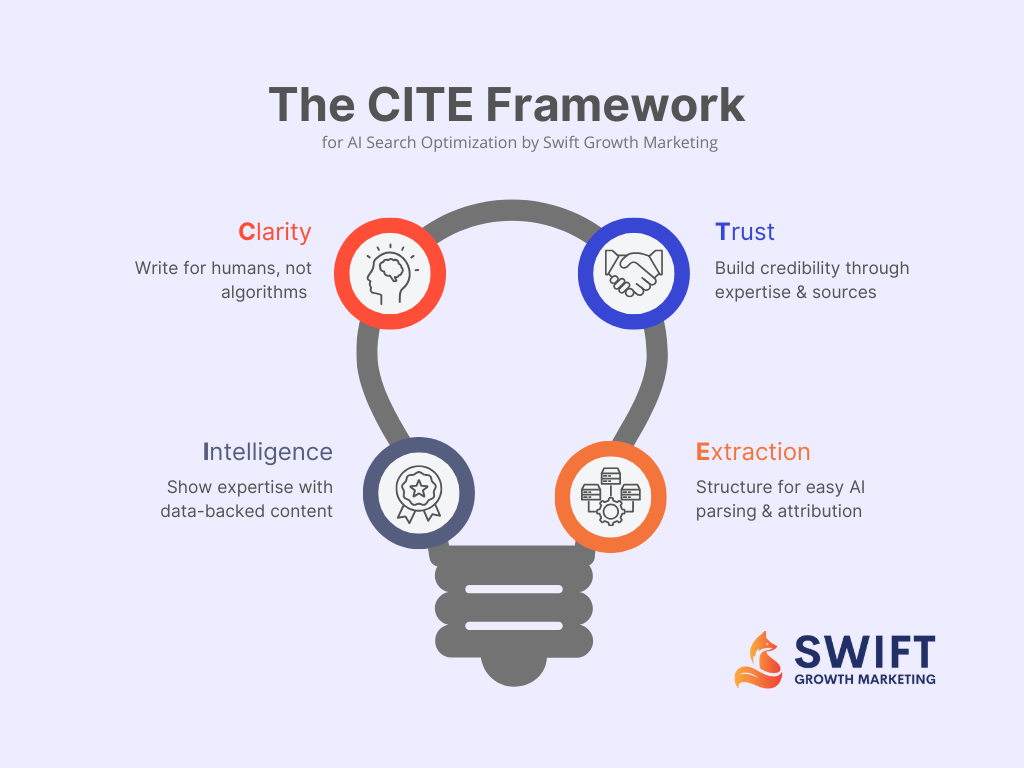
C – Clarity: Write for humans having conversations, not algorithms scanning keywords.
I – Intelligence: Demonstrate deep expertise through comprehensive, data-backed content.
T – Trust: Build credibility through author expertise, source citations, and transparent methodology.
E – Extraction: Structure content so AI engines can easily identify, parse, and attribute your information.
This framework works because it aligns with how AI engines evaluate and select content for citations. Let’s break down each component.
Clarity: The Conversational Advantage
AI engines excel at understanding natural language. Write like you’re explaining complex concepts to an intelligent colleague, not optimizing for keyword density.
Instead of: “Our enterprise-grade marketing automation solution optimizes lead nurturing workflows.”
Try: “Marketing automation helps B2B companies nurture leads systematically. Here’s how it works: when someone downloads your whitepaper, automated emails guide them through your sales funnel, delivering relevant content based on their behavior and interests.”
The second version gets cited because it educates rather than promotes. AI engines gravitate toward content that serves users first.
Intelligence: Depth Over Breadth
Shallow content gets ignored. AI engines look for comprehensive coverage that demonstrates genuine expertise. This aligns perfectly with what business leaders need, authoritative information that helps them make informed decisions.
Create content that thoroughly explores topics through multiple angles:
- Define concepts clearly
- Provide historical context
- Share current best practices
- Include relevant data and case studies
- Address common challenges
- Offer actionable recommendations
Trust: The Credibility Multiplier
As we’ve explored in our analysis of how generative AI impacts brand credibility, trust signals are crucial in the AI search environment. AI engines evaluate source credibility before deciding to cite content. If you read one follow-up next, make it that Trust pillar deep dive—it details the proof points that most increase the odds your brand gets named in AI answers.
Strong trust signals include:
- Clear author credentials and expertise
- Citations to reputable sources
- Original research and data
- Transparent methodology
- Regular content updates
- Professional site design and technical performance
Extraction: Making Citation Easy
Structure your content so AI engines can quickly identify and extract relevant information. This means:
Question-focused headings: Instead of “Benefits,” use “How Does Marketing Automation Increase ROI?”
Answer-ready formatting: Lead with clear, concise answers that can stand alone as citations.
Supporting detail: Follow concise answers with comprehensive explanations and evidence.
Schema markup: Help AI engines understand content context through structured data.
Tactical Implementation: Getting Your Content Cited
Now for the practical steps that transform theory into results.
Content Structure That Works
Start every major section with a direct answer to the implied question. If your section covers “email marketing best practices,” begin with: “The most effective email marketing practices focus on segmentation, personalization, and timing. Here’s how to implement each…”
This gives AI engines exactly what they need: a citation-ready answer followed by supporting detail.
Use FAQ sections liberally. AI engines love Q&A formats because they mirror how users interact with AI chatbots. Create comprehensive FAQ sections that anticipate the questions your audience asks.
The Schema Advantage
Implement schema markup to help AI engines understand your content’s context and purpose. Priority schemas for AI optimization include:
- FAQ schema for question-and-answer content
- How-to schema for process-oriented articles
- Article schema with proper authorship and publication details
- Review schema for product or service evaluations
Schema won’t guarantee citations, but it significantly improves your chances by making content more accessible to AI parsing.
Data-Driven Authority
AI engines prioritize content backed by credible data. This creates a massive opportunity for brands willing to invest in original research, case studies, and comprehensive industry analysis.
Include specific statistics, percentages, and quantified results whenever possible. Instead of saying “most companies,” specify “73% of B2B companies” and cite your source. This specificity signals authority and gives AI engines concrete information to work with.
Update statistics regularly. AI engines heavily weight current information, and outdated data can disqualify otherwise excellent content from being cited.
The Citation Attribution Strategy
Understanding answer engine optimization principles helps you craft content that not only gets cited but gets attributed properly. This means including your brand name and value proposition naturally within citation-ready passages.
Instead of: “Studies show that automated email sequences increase conversion rates by 25%.”
Try: “According to research from Swift Growth Marketing’s client base, companies implementing our strategic email automation framework see conversion rate improvements averaging 25-30% within 90 days.”
The second version provides the same valuable information while naturally including brand attribution that AI engines can cite.
Before and After: What Success Looks Like
Consider two companies in the same space approaching AI search optimization differently.
Company A publishes traditional blog posts optimized for Google rankings. Their content targets keywords like “marketing automation software” and focuses on product features. When users ask AI engines about marketing automation, Company A rarely gets cited because their content prioritizes SEO over education.
Company B creates comprehensive guides answering specific questions like “How do I choose marketing automation software for a 50-person SaaS company?” Their content provides detailed comparisons, implementation timelines, and ROI calculations. AI engines cite Company B consistently because their content directly serves user needs.
The difference in business impact is dramatic. Company A gets organic traffic but struggles with attribution and conversion. Company B gets fewer total visitors but captures higher-intent prospects at the exact moment they’re seeking authoritative guidance.
Recent analysis of our clients implementing these strategies shows citation rates improving 300-400% within six months, with corresponding increases in branded search traffic and inbound leads.
[Design enhancement: insert a simple before/after citation screenshot or a two-column table comparing “Queries asked” vs. “Brands cited” to visualize the shift.]
The pattern is consistent: brands that shift from keyword-focused content to answer-focused content see substantially better AI citation performance, which translates directly into business results.
Measuring AI Citation ROI: Tools and Methods
Traditional analytics fall short for AI search optimization. You need specialized approaches to track and measure AI citation performance.
First step: before any tooling, ask ChatGPT and Perplexity your top 5-10 category and brand queries, capture screenshots of the answers and citations, and log which brands are named. Use that simple log as your baseline for all future improvements.
Available Tools
BrightEdge offers AI search tracking that monitors mentions across major AI platforms. Their DataCube technology identifies when your content gets cited and tracks performance over time.
Conductor provides AI content insights showing how your content performs in AI-generated responses compared to competitors.
Custom monitoring through API access to platforms like Perplexity can track specific mention patterns and attribution frequency.
Building Custom Analytics
For more comprehensive tracking, consider developing custom monitoring systems:
Citation tracking scripts that regularly query AI platforms with your target keywords and identify when your content gets cited.
Attribution analysis comparing citation frequency to traditional search rankings, revealing the disconnection between Google performance and AI citation success.
Competitive intelligence monitoring competitor citation rates to identify content gaps and opportunities.
ROI Measurement Framework
Connect AI citations to business outcomes through:
Branded search lift: Track increases in direct brand searches following AI citation improvements.
Content engagement: Monitor time-on-site and conversion rates for visitors from AI-attributed traffic.
Pipeline attribution: Use UTM codes and conversion tracking to identify leads generated through AI search visibility.
Brand mention tracking: Monitor overall brand mention frequency and sentiment as AI citation rates improve.
The key insight: AI citation ROI often appears as increased brand authority and trust rather than direct traffic, making measurement more complex but ultimately more valuable for long-term growth.
As covered in our analysis of how brands can win with AI search results, the measurement approach needs to account for the multifaceted impact of AI visibility on overall brand performance.
Your Action Plan: From Strategy to Implementation
Ready to dominate AI search? Here’s your implementation roadbook:
Week 1: Assessment and Planning
Audit your existing content for AI citation potential. Identify your top-performing pages and evaluate them against the CITE framework. Most content will need substantial restructuring.
Research the questions your audience asks AI engines. Use tools like AnswerThePublic and analyze customer service inquiries to understand information-seeking patterns.
Week 2-4: Content Restructuring
Begin with your highest-traffic, most authoritative content. Restructure using question-focused headings, clear answer statements, and comprehensive supporting detail.
Implement schema markup on priority pages. Focus on FAQ, How-to, and Article schemas that align with your content types.
Month 2: Expansion and Optimization
Create comprehensive guides that thoroughly cover important topics in your space. Focus on depth over breadth, building true authority in key areas.
Develop original research, case studies, or industry analysis that positions your brand as a primary source AI engines want to cite.
Month 3: Measurement and Iteration
Implement tracking systems to monitor AI citation performance. Start with manual monitoring while building more sophisticated measurement capabilities.
Analyze competitor citation patterns to identify content gaps and opportunities for differentiation.
Ongoing: Systematic Improvement
Treat AI search optimization as an ongoing practice, not a one-time project. Regular content updates, fresh research, and evolving optimization techniques will maintain and improve your citation performance over time.
The Future Belongs to the Prepared
AI search isn’t the future: it’s the present. Every day you delay optimization is market share lost to competitors who understand this shift.
The brands dominating AI citations today are building sustainable competitive advantages that compound over time. As AI engines become more sophisticated and user adoption grows, early movers will have established authority that’s increasingly difficult to challenge.
The opportunity window is still open, but it’s narrowing. The cost of implementation is low. The potential return is transformational.
Ready to claim your share of AI search visibility? Early adopters will consolidate AI search dominance as engines keep citing the same trusted sources—every month you wait makes displacement harder. Swift Growth Marketing has developed the frameworks, tools, and expertise to help forward-thinking companies dominate AI citations in their categories. Let’s discuss your AI search optimization strategy and turn this massive shift into your competitive advantage.

chris
Insights on brand authority, positioning, and growth strategy from the Swift Growth Marketing team.