


From Apps to Ads: Mastering Mobile Advertising for Your Business
Why Mobile Advertising is Essential for Business Growth Today
Mobile advertising solutions are digital platforms that help businesses deliver targeted ads to users on smartphones and tablets through in-app placements, mobile web, and app store search results. These solutions include ad networks, demand-side platforms (DSPs), supply-side platforms (SSPs), and programmatic tools that use data analytics and real-time bidding to optimize campaign performance.
Quick Overview: What Mobile Advertising Solutions Offer
- Targeting Capabilities: Location-based, demographic, behavioral, and contextual targeting to reach specific audiences
- Ad Formats: Banner, interstitial, native, video, rewarded, and playable ads
- Pricing Models: CPM (cost per thousand impressions), CPC (cost per click), CPI (cost per install), CPA (cost per action)
- Key Platforms: Google Ads, Facebook Ads, Apple Search Ads, AdMob, InMobi, Smaato
- Analytics: Real-time dashboards, performance tracking, and ROI measurement tools
Mobile advertising is essential, with 54% of all web traffic now coming from mobile devices. In 2022, nearly 6.6 billion people subscribed to a mobile network worldwide. Businesses are responding to this shift—global mobile ad spend is projected to reach $400 billion in 2024, up from $360 billion in 2023.
The opportunity is clear. Mobile users are highly engaged, spending significant time in apps and on mobile browsers. This creates multiple touchpoints where businesses can reach potential customers with personalized, relevant messages. In-app advertising enjoys much higher click-through rates than mobile web ads, making it particularly effective for driving conversions.
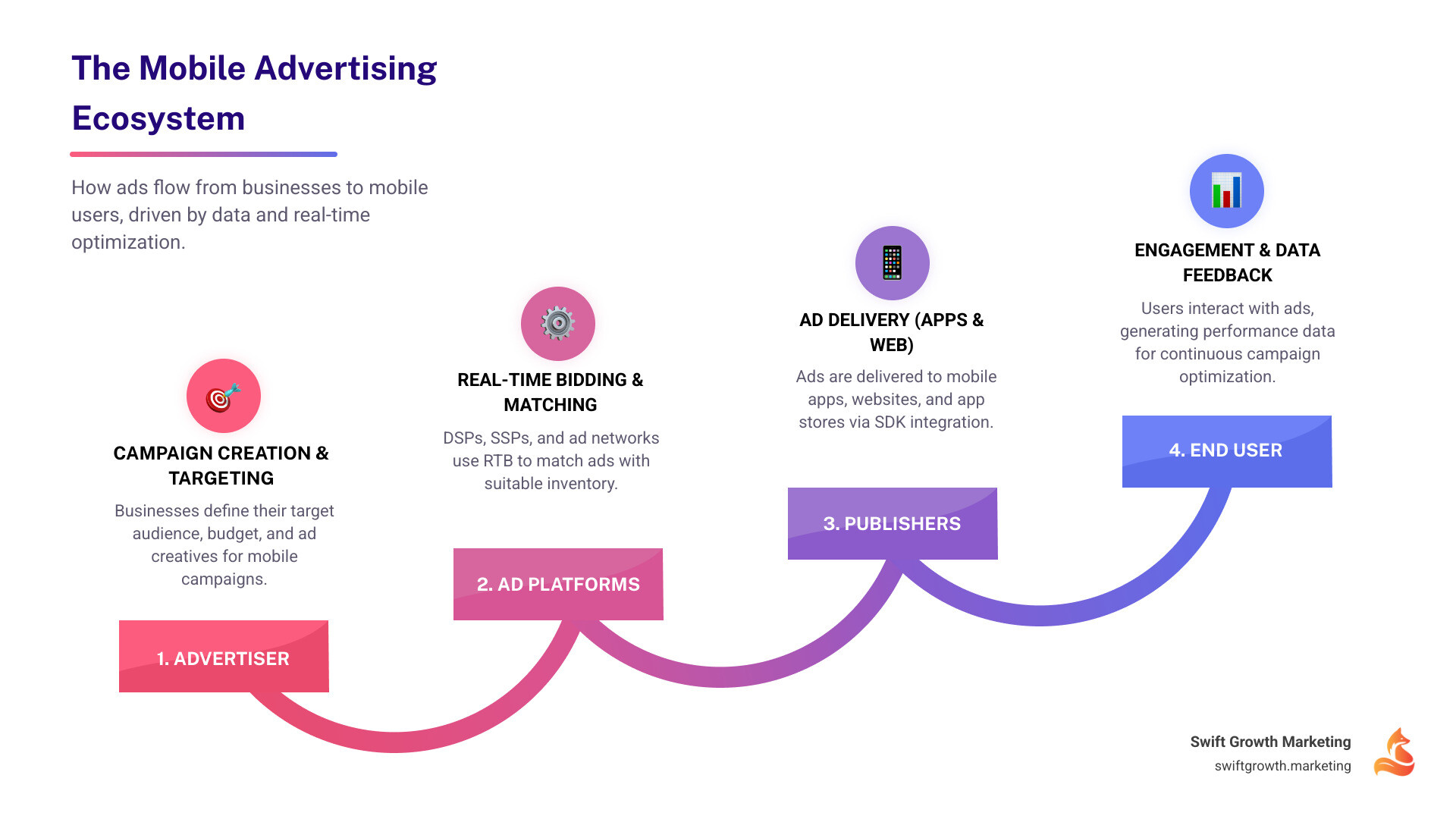
Mobile advertising works through a complex ecosystem. Advertisers use platforms to create campaigns, targeting users based on behavior, location, and preferences. These ads appear across mobile apps, websites, and app stores in various formats designed for small screens. Programmatic advertising automates the buying and selling of ad inventory through real-time bidding, ensuring ads reach the right users at the right price.
For mid-market brands and growth-stage companies, mobile advertising offers a way to reach audiences where they spend most of their time. Whether you’re in education, staffing, SaaS, or e-commerce, your customers are on their phones—researching products, comparing services, and making purchase decisions. Missing out on mobile means missing out on growth.
I’m Chris Hornak, Co-Founder of Swift Growth Marketing, where we help established brands and ambitious startups grow through strategic positioning and search optimization. Over the years, we’ve guided clients through the complexities of digital marketing, including mobile advertising solutions that drive measurable results and sustainable growth.
A Deep Dive into Mobile Advertising Solutions
Mobile advertising works by using user data and mobile-specific technologies to deliver personalized ads to smartphones and tablets. Advertisers leverage data analytics to target users based on behavior, location, and preferences, ensuring ads are contextually relevant. These ads appear in various formats such as in-app banners, videos, and push notifications, aiming to maximize user engagement.
At the heart of many mobile advertising solutions is the integration of an ad network’s Software Development Kit (SDK) into an app. This SDK is a crucial tool for serving ads seamlessly within the application. Once integrated, platforms often employ real-time bidding (RTB), a programmatic method where advertisers bid for ad impressions as they become available. This process matches ads with app inventory on a per-impression basis, improving effectiveness and reach. For instance, platforms like Smaato use “super auctions” via RTB, enabling publishers to find advertisers willing to pay the most for their ad space.
The ecosystem of mobile advertising solutions is composed of several key players:
- Ad Networks: These integrated platforms act as intermediaries, connecting advertisers with app developers or publishers who want to sell their mobile ad inventory. They simplify the buying and selling process by aggregating ad space from many publishers and matching it with advertiser demand.
- Demand-Side Platforms (DSPs): Used by advertisers and agencies to manage and buy ad impressions programmatically across various ad exchanges and publisher networks.
- Supply-Side Platforms (SSPs): Used by publishers to manage and sell their ad inventory to advertisers and DSPs programmatically, aiming to maximize revenue.
Beyond these core components, we see distinctions in how platforms operate:
- Traditional vs. Programmatic Networks: Traditional networks often involve direct sales between advertisers and publishers. Programmatic networks, conversely, leverage automation and real-time bidding to execute transactions, leading to greater efficiency and scale.
- Incentivized vs. Non-incentivized Networks: Incentivized networks reward users for engaging with ads (e.g., watching a video or downloading an app), often used in gaming apps. Non-incentivized networks rely on genuine user interest, which can lead to higher-quality engagement. Tapjoy is a prime example of an incentivized offerwall platform.
- General vs. Niche Networks: General ad networks offer a broad range of ad types and formats across diverse applications. Niche networks, like Chartboost, specialize in specific categories, such as mobile gaming audiences, providing custom ad content for a particular demographic.
Key Features to Look for in Mobile Advertising Solutions
When evaluating mobile advertising solutions, several key features are crucial for maximizing campaign effectiveness and ROI. We advise our clients to look for platforms that offer robust capabilities across these areas:
- Advanced Targeting Capabilities: To ensure ads reach the right audience, platforms must offer sophisticated targeting. This includes:
- Geolocation and Proximity Targeting: Marketers can narrow down campaigns to specific geographic regions, even engaging consumers at precise points of interest, such as in a particular neighborhood in Pittsburgh, PA, or Wheeling, WV.
- Demographic Targeting: Reaching users based on age, gender, income, and other demographic data.
- Behavioral Targeting: Targeting users based on their online activities, app usage, and browsing history.
- Contextual Targeting: Placing ads within content that is relevant to the ad’s message.
- Other options: Many platforms also allow targeting by device model, mobile carrier, operating system, connection type (Wi-Fi, 5G), interests, and even creating lookalike audiences from existing customer data.
- Ad Inventory and Quality: A strong platform provides access to a large volume of high-quality ad inventory across various apps and mobile websites. It should also prioritize brand-safe environments, ensuring your ads appear in contexts that align with your brand values. Platforms like LiftOff emphasize “high-quality ad placement inventory in brand-safe environments.”
- Reporting and Analytics: Performance tracking is paramount. Top-tier mobile advertising solutions offer advanced analytics and tracking capabilities, enabling businesses to measure campaign success and make data-driven optimizations. Look for real-time dashboards that provide comprehensive insights into impressions, clicks, conversions, and other key metrics.
- Support for Multiple Ad Formats: Versatility in ad formats is essential to capture audience attention effectively. The platform you choose should support a wide array of mobile ad formats, including native, banner, video, and interstitial ads, among others.
Understanding these features is a foundational step in crafting a successful mobile strategy. For a deeper dive into foundational digital strategies, you might find our insights on building a strong SEO foundation helpful.
How Publishers Monetize Their Mobile Inventory
For app developers and content publishers, mobile advertising solutions are vital for monetizing their mobile inventory effectively. It’s about turning app usage and website traffic into revenue, and several strategies have proven successful:
- SDK Integration: The fundamental step for any publisher is to integrate an ad network’s SDK into their app. This SDK is the gateway for serving ads and collecting necessary data for monetization.
- Ad Mediation Platforms: Since publishers often work with multiple ad networks to maximize fill rates and eCPMs (effective cost per mille), mediation platforms become indispensable. These solutions, like Google AdMob’s mediation, allow publishers to connect and manage multiple ad networks through a single SDK. This creates healthy competition for ad inventory, ensuring publishers earn the highest possible revenue for each impression. Ad Manager also offers mediation with over 40 premium networks.
- Header Bidding: While more common in web environments, header bidding is also gaining traction in mobile app monetization. It allows multiple demand sources to bid simultaneously for an ad impression before the ad server is called, increasing competition and potentially boosting publisher revenue.
- Maximizing Ad Revenue: The goal is always to maximize revenue while maintaining a positive user experience. This involves optimizing fill rates (the percentage of ad requests that are successfully filled with an ad) and eCPMs.
- Balancing User Experience with Monetization: This is a delicate art. Innovative ad formats, such as rewarded video and native ads, can help strike this balance. AdMob notes that these formats “help balance user experience with monetization to keep users happy and engaged,” while InMobi aims to “strike the perfect balance between monetization and user experience with its comprehensive programmatic platform.”
Building a High-Impact Mobile Ad Campaign
Creating a successful mobile ad campaign requires strategic design, precise targeting, and understanding the nuances of how mobile users interact with content.
Choosing the Most Effective Mobile Ad Formats
The variety of mobile ad formats available through mobile advertising solutions allows for creative and impactful campaigns. We help our clients select the best format based on their objectives and target audience:
- Banner Ads: These are static or animated image ads typically placed at the top or bottom of an app’s interface. While common, their effectiveness can vary.
- Interstitial Ads: Full-screen ads that appear at natural transition points within an app, such as between game levels or content sections. They are highly engaging due to their immersive nature.
- Native Ads: Designed to blend seamlessly with the app’s content, matching its form and function. This provides a less intrusive user experience, often leading to higher engagement.
- Video Ads: Highly effective, as video ads generally boast the highest engagement rates among all mobile ad formats.
- In-stream Video: Plays before, during, or after video content within an app, often full-screen.
- Out-stream Video: Appears within a web page or content feed in a mobile app, playing automatically when visible.
- Rewarded Video: Offers users in-app rewards (like virtual currency or extra lives) for watching a video ad, commonly used in mobile games (e.g., Tapjoy).
- Playable Ads: Interactive mini-games or demos that allow users to experience an app or game before downloading it.
- Rich Media Ads: Include advanced features like video, audio, and interactive elements that encourage deeper engagement.
- Offerwalls: In-app pages that present users with a list of offers (e.g., downloading another app, completing a survey) in exchange for in-app rewards. Tapjoy specializes in these.
- SMS and Push Notification Ads: Direct messages sent to users’ devices. While SMS is more traditional, push notifications can be highly effective for re-engagement when used thoughtfully.
Mastering Audience Targeting and Personalization
Effective targeting and personalization are what truly lift mobile advertising solutions above traditional marketing. Mobile devices offer a wealth of data that, when used responsibly, allows for unparalleled precision:
- Location-Based Data: Mobile advertising leverages user data and mobile-specific technologies to deliver personalized and location-based promotions. This is especially powerful for businesses in Pittsburgh, PA, or Wheeling, WV, looking to attract local customers.
- Proximity Targeting: This allows you to engage consumers at precise points of purchase or interest. Imagine targeting ads to users who are within a few blocks of your store in downtown Pittsburgh.
- Foot Traffic Attribution: This advanced capability allows us to measure the direct impact of digital ad exposure on physical store visits. Did a mobile ad actually drive someone to your Wheeling, WV, location? Foot traffic attribution can tell us.
- Dynamic Creative Optimization (DCO): DCO enables ads to refresh content, messaging, maps, or coupons based on a person’s location, time of day, or other real-time factors, making each ad impression highly relevant.
- Personalized Messaging: Delivering highly targeted and personalized advertisements increases relevance and engagement. This means showing the right product to the right person at the right time.
- User Segmentation: Dividing your audience into smaller, more manageable groups based on shared characteristics to tailor ad content specifically for them.
- First-Party Data: Leveraging your own customer data (with privacy compliance) for targeting is incredibly powerful. Start.io, for example, gathers “billions of first-party, privacy-compliant consumer signals every day.”
- Lookalike Audiences: Creating new audiences that share characteristics with your most valuable customers.
Listening to customer data is not just a best practice; it’s a necessity for crafting highly effective campaigns. Learn how to listen to customer data to open up deeper insights.
Navigating Mobile Advertising Pricing Models
Understanding the various pricing models is crucial for managing your budget and optimizing campaign performance within mobile advertising solutions. We work with clients to choose the model that best aligns with their campaign objectives:
| Pricing Model | Description | Best For |
|---|---|---|
| CPM (Cost Per Mille) | Pay per 1,000 ad impressions. | Brand awareness and visibility. |
| CPC (Cost Per Click) | Pay each time a user clicks on the ad. | Driving traffic to a website or landing page. |
| CPI (Cost Per Install) | Pay only when a user installs your app after clicking the ad. | User acquisition for mobile apps. |
| CPA (Cost Per Action) | Pay when a user completes a specific action (e.g., sign-up, purchase). | Conversion-focused campaigns with specific goals. |
Let’s elaborate on these:
- CPM (Cost Per Mille): With CPM, advertisers are charged per 1,000 impressions. This model is ideal for brand awareness campaigns where the primary goal is to maximize visibility.
- CPC (Cost Per Click): Advertisers pay only when a user clicks on their mobile ad. This performance-based approach is excellent for driving traffic to a website or landing page, as you only pay for engaged users.
- CPI (Cost Per Install): Specifically for app marketers, advertisers are charged only when a click on an ad results in an app installation. CPI is a critical metric for mobile app user acquisition, showing the direct cost to acquire a new customer.
- CPA (Cost Per Action): This advanced model charges advertisers only when a user completes a specific, predefined action (like an in-app purchase or sign-up) after seeing the ad. CPA is highly targeted and efficient for conversion-focused campaigns.
The final cost of mobile advertising solutions can vary based on the platform, target audience, and campaign objectives. While a small business might succeed with $500/month in mobile ad spend, large enterprises can exceed $10,000/month, especially for premium placements.
The Future of Mobile Advertising: Trends and Technologies
The landscape of mobile advertising solutions is constantly evolving, driven by technological advancements and shifting consumer behaviors. Staying ahead of these trends is crucial for sustained growth.
The Impact of AI and Machine Learning on Mobile Advertising
Artificial Intelligence (AI) and Machine Learning (ML) are making mobile advertising campaigns smarter, more efficient, and more personalized. As Moloco states, “AI should be accessible to all businesses” because “the future of advertising is powered by AI.”
- Predictive Algorithms: AI-powered algorithms analyze vast datasets to predict user behavior, optimize bidding strategies, and identify the most receptive audiences. Platforms like YouAppi leverage “proprietary predictive algorithms” for this purpose.
- Audience Exploration: Tools like Start.io’s “Maia” platform facilitate “audience exploration and activation,” allowing businesses to use rich, privacy-compliant first-party data to uncover valuable segments.
- Performance Optimization: ML capabilities, as seen in LiftOff, “adapt to changing mobile marketing ecosystems and find new pockets of performance.” This includes “robust optimization models” for brand awareness, return on ad spend, and lifetime value optimization.
- A/B Testing Automation: AI streamlines A/B testing of ad creatives, demand partners, ad frequency, and user segments, helping to identify what works best more rapidly. Applovin MAX, for instance, helps “optimize their ad creative for mobile campaigns” through quick A/B testing tools.
- Fraud Detection: AI plays a crucial role in safeguarding campaigns by detecting and preventing ad fraud, as highlighted by InMobi’s “predictive fraud detection.”
Key Trends Shaping the Industry
Beyond AI, several other significant trends are shaping the future of mobile advertising solutions:
- Omnichannel Advertising: With consumers on multiple connected devices, delivering a consistent and cohesive brand message across all touchpoints is paramount. Solutions like Smaato offer “self-serve omnichannel solution[s],” and Viant provides an “omnichannel DSP and mobile advertising solution” that reaches consumers on their mobile devices “whether they’re at home, at work or anywhere else.”
- Cross-Device Targeting: The ability to track users across their smartphone, tablet, desktop, and Connected TV (CTV) allows for a more holistic view of the customer journey and more integrated campaigns.
- Connected TV (CTV): As more content consumption shifts to streaming services on smart TVs, CTV is becoming a powerful new channel for mobile advertising, offering improved targeting capabilities.
- Privacy-First Advertising: With increasing regulations like GDPR and CCPA, user data privacy is a top priority. Mobile advertising solutions are evolving to be privacy-compliant, focusing on “anonymized data,” “explicit user consent,” and “secure data storage methods.” Platforms like Start.io emphasize gathering “first-party, privacy-compliant consumer signals.” Smaato also offers a consent management platform for publishers.
A Look at Top-Tier Mobile Advertising Solutions
Navigating the vast array of mobile advertising solutions can be daunting. Here are some of the leading platforms, each with unique strengths:
- Platforms for Social Media Reach:
- Facebook Ads (including Instagram): Known for its “extensive detail with its targeting options,” Facebook Ads is an “ideal choice for any sized company” looking to reach a massive social media audience. It supports various ad types, including native, interstitial, banner, and in-stream video ads.
- Snapchat Ads: Excellent for targeting “younger audiences” with “engaging video ads” and other formats. Snapchat boasts an active user base of over 166 million “Snapchatters” who spend significant time on the app daily.
- Pinterest Ads: Ideal for “brand awareness” campaigns, as “Pinterest users sign on to the platform to find new products and brands.” This platform allows for visual-heavy ads like Idea Pins that draw attention through immersive content.
- Twitter Ads: An “excellent method for increasing engagement” and staying connected with viewers through brief information, offering “deep linking capabilities” to specific content sections.
- Platforms for Search and App Store Visibility:
- Google Ads: Allows advertisers to create ads for the Google search engine, targeting users based on “mobile devices, operating systems, location, mobile platforms, and interests.” It also empowers businesses to reach audiences via video ads on YouTube.
- Apple Search Ads: Designed for the iOS mobile platform, enabling brands to “access a valuable network of iOS app users.” These sponsored ads appear at the top of search results within the Apple App Store, driving traffic to your app.
- Platforms for In-App Monetization:
- Google AdMob: Often highlighted as “Best for maximizing ad revenue,” AdMob is a “simple and straightforward” platform offering “multiple ad formats” like banner, video, interstitial, rewarded, and native ads. It integrates seamlessly with Google Analytics for Firebase.
- Unity: Primarily “designed specifically for monetizing mobile games using video ads,” offering CPM or CPI campaigns and support for various ad formats.
- InMobi: One of the largest independent mobile ad networks, InMobi offers “digital media organizations audience insights” to help them understand and act on their audience’s needs.
- Tapjoy: Helps advertisers “acquire and engage mobile app users at scale via offerwall campaigns,” allowing users to earn in-game rewards for completing offers.
- Start.io: This platform “helps mobile app developers and website publishers make money with ads,” delivering hundreds of millions of ads daily.
Measuring Success and Maximizing ROI
Measuring the success of your mobile advertising solutions is not just about vanity metrics; it’s about understanding what drives real business growth. We emphasize a data-driven approach to ensure every dollar spent contributes to your objectives.
Essential Metrics for Campaign Evaluation
To truly gauge the effectiveness of your mobile ad campaigns, we look at a combination of key performance indicators:
- Click-Through Rate (CTR): This measures the percentage of people who click on your ad after seeing it. In-app advertising, for example, “enjoys a much higher click-through rate (CTR) than that of mobile web ads.”
- Conversion Rate (CR): The percentage of users who complete a desired action (e.g., app install, purchase, sign-up) after clicking your ad. Platforms like Start.io have helped clients achieve “over-performing CTR metrics, driving qualified sessions to our site” and liftd “conversion rates.”
- Cost Per Acquisition (CPA): The total cost of acquiring one customer or achieving a specific action. For app installs, this is often referred to as Cost Per Install (CPI), which “shows marketers the price they pay to acquire new customers.”
- Return on Ad Spend (ROAS): A crucial metric that calculates the revenue generated for every dollar spent on advertising. We’ve seen clients achieve impressive results, such as an “11.5x ROAS (Return on Ad Spend)” in successful campaigns.
- Lifetime Value (LTV): The predicted revenue that a customer will generate throughout their relationship with your business. Optimizing for LTV ensures sustainable long-term growth, as AdMob helps developers “optimize their lifetime value.”
- User Engagement: Metrics like time spent in-app, feature usage, and repeat visits indicate how effectively your ads are attracting genuinely interested users. “High engagement rates due to the pervasive use of smartphones” are a core benefit of mobile ads.
Optimizing for Performance
Measuring success is only half the battle; the other half is using those insights to continuously optimize your campaigns.
- Data Analysis: Leveraging advanced analytics and tracking capabilities is fundamental. This enables businesses to make data-driven optimizations and gain “valuable insights for optimizing marketing strategies.”
- Using Analytics Dashboards: Top-tier mobile advertising solutions provide detailed, easy-to-view dashboards that offer real-time reporting on sales performance, impressions, clicks, installs, and more. This allows for quick identification of what’s working and what isn’t.
- Creative Optimization: The ad creative itself plays a huge role. Platforms like Applovin MAX and Chartboost help “optimize their ad creative for mobile campaigns” and “engage and convert audiences.” This often involves continuous iteration and improvement.
- A/B Testing Ad Copy and Visuals: Regularly testing different versions of your ad copy, visuals, and calls to action is vital. Applovin MAX, for instance, allows for quick implementation of A/B testing tools to “identify opportunities to improve your ad creatives.”
- Budget Allocation: Smart budget allocation is key. The cost of mobile advertising solutions can vary, with small businesses potentially spending $500/month, while large enterprises might exceed $10,000/month. Allocating resources efficiently based on performance data ensures maximum ROI.
For more strategies on maximizing your marketing investment, explore our guide on how to get a better ROI from your marketing budget.
Conclusion
The mobile landscape is the primary battleground for customer attention. Mastering mobile advertising solutions is no longer optional—it’s a necessity for businesses aiming for growth and relevance in today’s digital-first world. From the pervasive use of smartphones to the projected $400 billion global ad spend in 2024, the numbers clearly illustrate the immense opportunity.
We’ve explored how these powerful solutions work, from SDK integrations and real-time bidding to the diverse array of ad formats designed for mobile engagement. We’ve digd into the precision of audience targeting, leveraging location-based data and dynamic creatives to deliver personalized messages. Understanding pricing models like CPM, CPC, CPI, and CPA empowers strategic budget allocation. Looking ahead, the transformative power of AI and machine learning, coupled with the rise of omnichannel and privacy-first approaches, continues to shape this dynamic field.
At Swift Growth Marketing, we understand that navigating these complexities requires a strategic approach, backed by robust data, cutting-edge technology, and continuous optimization. Whether your business is in Pittsburgh, PA, or Wheeling, WV, our goal is to be your partner in using the full potential of mobile advertising to achieve measurable results and sustainable growth.
Ready to transform your mobile advertising strategy and drive impactful results? Explore our comprehensive digital marketing services and let us help you build a solution custom to your business needs.

chris
Insights on brand authority, positioning, and growth strategy from the Swift Growth Marketing team.