

From Zero to Hero: How to Boost Online Visibility for Content Marketing Success

Why Online Visibility is Your Business’s Superpower
An online visibility boost is essential for any business looking to thrive in today’s digital landscape. Here’s what you need to know:
Quick Answer: How to Boost Online Visibility
- Optimize your website for speed, mobile, and user experience
- Master SEO through keyword research, on-page optimization, and link building
- Create valuable content that solves audience problems and builds authority
- Leverage social media to amplify reach and engage with your audience
- Use paid advertising (PPC, social ads) for immediate visibility
- Monitor your reputation through reviews and online mentions
- Track key metrics like traffic, rankings, and conversions
The marketing world has gone digital. When 68% of online experiences begin with a search engine, visibility isn’t just a nice-to-have—it’s essential for survival. Around $8 out of every $10 spent on marketing today goes toward digital strategies, and businesses that can’t be found online simply don’t exist to potential customers.
Online visibility refers to how easily your brand can be finded across digital channels. It’s tied to your credibility, reputation, and ultimately, your ability to attract and convert customers. A strong online presence drives more traffic to your website, boosts customer acquisition, establishes trust, and connects you with your target audience.
The challenge is that the digital landscape keeps changing. AI is changing search results, social media algorithms shift constantly, and competition for attention grows fiercer every day. Traditional SEO alone isn’t enough anymore. You need a comprehensive strategy that combines technical excellence, quality content, strategic promotion, and continuous measurement.
According to the Content Marketing Institute, 73% of successful B2B marketers use content marketing to build credibility and trust with their audiences. But content without visibility is like a billboard in the desert—no one sees it. That’s why businesses need a holistic approach that integrates SEO, content marketing, social media, paid advertising, and reputation management.
I’m Chris Hornak, Co-Founder of Swift Growth Marketing, where we’ve helped clients achieve transformative results like growing from 400 to 45,000 monthly visitors through strategic online visibility boost tactics. We’ve learned that consistent execution of foundational strategies—combined with adaptation to new platforms and technologies—is what separates brands that thrive from those that fade into obscurity.
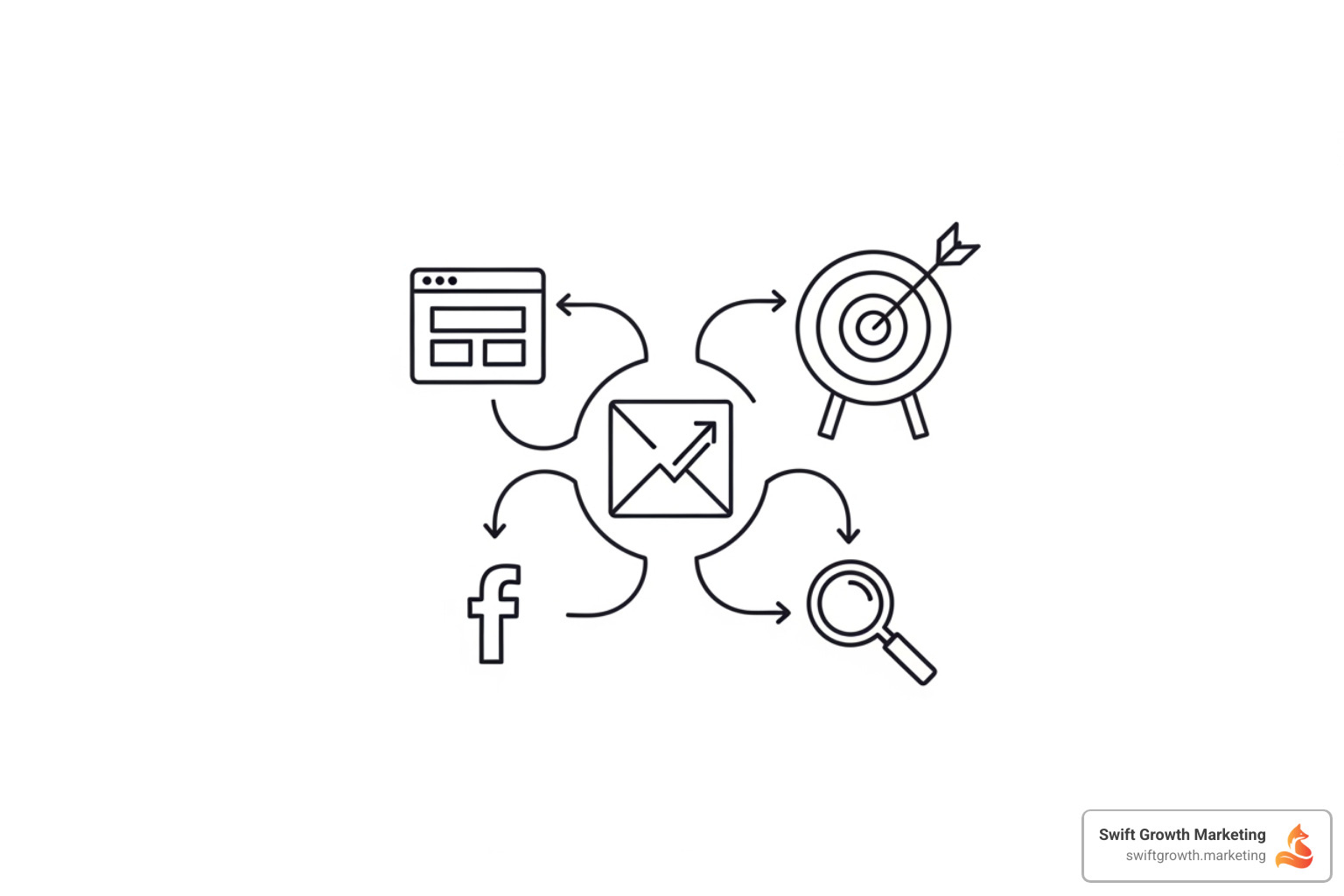
This infographic shows the five interconnected pillars of online visibility: 1) Website Foundation (UX, speed, mobile optimization), 2) Search Engine Optimization (on-page, off-page, local SEO), 3) Content Marketing (strategic content, social media distribution), 4) Paid Strategies (PPC, social ads, influencer marketing), and 5) Measurement & Reputation (metrics tracking, review management). Each pillar supports the others to create a comprehensive visibility strategy.
The Foundation: Building a High-Visibility Website
Think of your website as your digital storefront. Just as a physical store needs to be clean, well-organized, and easily accessible, your website needs to be fast, user-friendly, and technically sound to attract and retain visitors. This foundational step is crucial for any effective online visibility boost.
A well-optimized website isn’t just about looking pretty; it’s about functionality and performance. Key elements like user experience (UX), mobile-first indexing, and technical excellence work together to ensure your site is findable and enjoyable for visitors. Did you know that 53% of mobile users abandon sites that take over 3 seconds to load? That’s a lot of potential customers walking out of your digital door before they even see what you offer! That’s why we focus on robust UX Optimization and strong Core Web Vitals SEO.
Optimizing User Experience (UX) and Site Speed
User experience (UX) is all about making your website easy and enjoyable to use. This includes intuitive navigation, clear calls-to-action (CTAs) like “Book Now” or “Get a Quote,” and, crucially, fast loading times. A seamless UX keeps visitors on your site longer and increases the chances they’ll become customers.
The impact of site speed on engagement and conversions cannot be overstated. A study found that “A site that loads in 1 second had a conversion rate 3x higher than a site that loads in 5 seconds.” Slow sites lead to high bounce rates, meaning visitors leave quickly without interacting. To reduce bounce rates, we need to ensure our pages load quickly. Tools like Google’s Page Speed Insights can help us identify areas for improvement. Google’s Core Web Vitals also set benchmarks for an optimal user experience: a good Largest Contentful Paint (LCP) should be 2.5 seconds or less, and a good Interaction to Next Paint (INP) should be under 200ms. By prioritizing these metrics, we make our site more appealing to both users and search engines. For more on crafting pages that convert, check out our guide on Psychology-Based Landing Page Optimization That Converts.
Ensuring Technical and Mobile Excellence
With more than 60% of searches happening on mobile devices, your site must be mobile-friendly. Google also prioritizes mobile-friendly sites for ranking, meaning a poor mobile experience can directly hurt your visibility. This isn’t just about appearance; it’s about functionality across all devices.
Technical excellence also involves implementing structured data (Schema Markup). This code helps search engines understand the context of your content, leading to richer search results like star ratings or product prices, which can significantly boost click-through rates. An effective internal linking strategy guides both users and search engine crawlers through your site, distributing “link juice” and highlighting important pages.
Finally, website accessibility (WCAG) is paramount. Not only does one in four adults in the US have a disability, but accessible sites often rank higher and reach wider audiences. This commitment to inclusivity demonstrates our values and expands our potential customer base. Building a Future-Proof Website Design means being ready for all users, on all devices, all the time.
Mastering Search Engines for a Major Online Visibility Boost
When we talk about an online visibility boost, mastering search engines is non-negotiable. When most online experiences begin with a search, appearing prominently in those results is like having a prime spot on a busy street. This is where search engine optimization (SEO) comes into play, helping us attract organic, unpaid traffic to our website.
SEO is the process of improving your digital content to increase your brand’s visibility in organic search results. It’s about being one of the first things users see when they search for relevant terms. Search engine algorithms analyze various factors—relevance, quality, and usability—to rank pages. Our goal is to signal to these algorithms that our content is the best answer to a user’s query. Building this strong foundation is crucial, which you can learn more about in our guide on How to Build a Strong SEO Foundation with On-Page SEO.
On-Page SEO and Strategic Keyword Research
On-page SEO involves optimizing elements directly on your website. This includes everything from the words on your page to the images you use and the code behind them. It all starts with strategic keyword research. We need to identify the terms people search for when looking for our products or services. Tools like Google Keyword Planner and Answer the Public help us uncover these valuable insights.
Understanding search intent is key. Are users looking for information (informational), trying to buy something (transactional), comparing options (commercial), or trying to find a specific website (navigational)? Our content should align with this intent. For example, keywords between 10-15 words in length, often called long-tail keywords, can get 1.76x more clicks than single-word terms because they are highly specific to user intent.
Once we have our keywords, we strategically place them in:
- Title tags: Keep these under 60 characters and ensure they accurately describe the page content, including our primary keyword.
- Meta descriptions: While not a direct ranking factor, compelling meta descriptions (under 320 characters) entice users to click, boosting our click-through rate.
- Header tags (H1, H2, H3): Structure our content logically with one H1 for the main topic and H2s and H3s for sub-sections, incorporating keywords naturally.
- Content optimization: Our content itself needs to be high-quality, comprehensive, and helpful, following Google’s E-E-A-T guidelines (Experience, Expertise, Authoritativeness, and Trustworthiness).
For a deeper dive into organizing your content around topics, explore our Topical Map SEO Guide 2025. You can also find additional resources on How to Do Keyword Research.
Off-Page SEO: Building Authority and Trust
Off-page SEO refers to actions taken outside of your website to impact your rankings. The most significant factor here is link building, specifically acquiring high-quality backlinks from other reputable websites. Think of backlinks as votes of confidence; the more authoritative sites linking to ours, the more trustworthy search engines perceive us to be.
Strategies for effective link building include:
- Guest posting: Writing valuable content for other relevant industry blogs and including a link back to our site. This not only builds links but also exposes our brand to new audiences.
- Digital PR: Creating newsworthy content or campaigns that attract media attention and result in mentions and links from news outlets or high-authority publications. Our guide on Digital PR for SEO can show you how.
- Brand mentions: Even unlinked mentions of our brand across the web can signal authority to search engines. Encouraging product reviews from authoritative brands or influencers also contributes to this.
- Social media reviews: Public reviews on social media platforms, while not direct backlinks, contribute to our overall online reputation and can indirectly support off-page SEO by increasing brand visibility and trust signals.
The goal is to earn links and mentions naturally by providing immense value. For more insights on this, check out our 10 Proven Link Building Tips to Boost Your SEO in 2023.
Local SEO for a Targeted Online Visibility Boost
For businesses in Pittsburgh, PA, Wheeling, WV, and other local markets, local SEO is paramount. It’s how we ensure our business appears when customers search for products or services “near me.” This targeted approach is a powerful online visibility boost for brick-and-mortar stores and service-area businesses.
The cornerstone of local SEO is your Google Business Profile (GBP). Optimizing this free listing with accurate information, high-quality photos, and consistent updates dramatically increases local search visibility. Businesses with photos, for example, receive 42% more requests for directions and 35% more click-throughs to their websites.
Key local SEO tactics include:
- Local keywords: Integrating terms like “best pizza Pittsburgh PA” or “accountant Wheeling WV” into our website content and GBP.
- NAP consistency: Ensuring our business Name, Address, and Phone number are identical across all online platforms, including our website, GBP, and local directories. Inconsistent information can confuse search engines and customers.
- Local citations & directories: Listing our business on platforms like Yelp, Facebook, Bing Places, and Foursquare. These act as additional signals to Google about our legitimacy and location.
- Customer reviews: Encouraging and responding to online reviews is critical. Studies show that 77% of consumers always or regularly read reviews when searching for local businesses, and 90% are more likely to purchase after reading positive ones. A quick, thoughtful response to a negative review can even turn a dissatisfied customer into a loyal one.
Local SEO helps us connect with the right customers at the right time. For expert guidance custom to your region, consider a Digital Marketing Agency Pittsburgh.
Amplifying Your Reach with Content and Social Media
Content is the fuel for your online visibility boost. It’s how you communicate your expertise, connect with your audience, and demonstrate your value. Without compelling content, even the most technically perfect website will struggle to attract and engage visitors. As we mentioned, 73% of successful B2B marketers use content marketing to build credibility and trust with their audiences.
Our content marketing strategy at Swift Growth Marketing is designed to position your brand as an authority and a trusted resource. We know that creating valuable content isn’t just about writing blog posts; it’s about strategically planning, creating, and distributing information that resonates with your target audience. Find how we approach Content Marketing for Brands and how How Pillar Pages Play a Role in Your Growth Marketing Strategy can transform your content efforts.
Creating High-Value, Strategic Content
To truly stand out, our content needs to be more than just informative; it needs to be strategic. This often involves creating content clusters and pillar pages around core topics. A pillar page provides a comprehensive overview of a broad subject, while content clusters dig into specific sub-topics, all interlinked to establish topical authority.
Blogging for SEO is a powerful way to implement this strategy. Each blog post can target specific keywords, allowing you to appear in search results for a wide range of customer queries. Businesses that publish blogs four times a week, for instance, get 3.5x more traffic and 4.5x more leads than those blogging only once a week. This consistent output, combined with adherence to Google’s E-E-A-T guidelines, positions us as experts.
Our content should aim to solve audience problems, answer their questions, and provide genuine value. This approach not only attracts organic traffic but also builds trust and credibility. Learn more about crafting effective content with The Helpful Content Formula and how to engage your audience through Storytelling in Content Marketing.
Leveraging Social Media for Maximum Content Reach
Once we’ve created high-value content, we need to ensure it reaches our audience. Social media is an indispensable tool for this, offering a massive platform for content visibility and engagement. In 2024, there are estimated to be 5.17 billion total social media users worldwide, with the average person using 6.7 different social networks per month. That’s a lot of eyeballs!
Choosing the right platforms is crucial. We focus our efforts where our target audience spends their time. Our 10 Steps to Create an Effective Social Media Marketing Strategy can help you steer this landscape.
Here are some best practices for posting on social media to maximize reach and achieve an online visibility boost:
- Post at the right time: Analyze when your audience is most active and schedule posts accordingly.
- Engage: Encourage interaction through questions, polls, and responding to comments. User-generated content (UGC) can lead to 29% higher conversions.
- Include visuals: Photos, infographics, GIFs, and especially videos, dramatically increase engagement. Social video generates 1200% more shares than text and image content combined, and viewers retain 95% of a message when they watch it in a video.
- Use hashtags strategically: Research trending and relevant hashtags to expand your reach beyond your direct followers. (Twitter recommends no more than 3 hashtags per Tweet, while 10-15 is common on Instagram.)
- Strengthen your brand voice: A consistent, authentic brand voice makes your content more recognizable and memorable.
- Pin important posts: Highlight your most crucial content at the top of your profile.
- Share other people’s content: Build relationships and expand your network by sharing relevant posts from industry peers.
Social media isn’t just about likes; it’s about driving traffic and building brand loyalty. According to Sprout Social, after following a brand, 91% of consumers will visit its website, 89% will buy from the brand, and 85% will recommend it to a friend. For more statistics and insights, refer to Social media statistics.
Accelerating Growth with Paid Strategies
While organic strategies like SEO and content marketing build long-term authority, paid advertising offers an immediate online visibility boost. It’s a powerful way to get your message in front of your target audience quickly, whether they’re actively searching for your product or service, or simply browsing online.
Paid advertising can accelerate growth by placing your brand prominently on search engines, social media feeds, and websites your ideal customers frequent. This allows us to reach specific demographics, interests, and even geographic locations (like Pittsburgh, PA, or Wheeling, WV) with precision. To understand how to optimize your advertising spend, explore our insights on Maximizing ROI of Paid Media and other effective Growth Marketing Channels.
Using PPC for an Immediate Online Visibility Boost
Pay-Per-Click (PPC) advertising is a model where we pay a fee each time someone clicks our ad. Google Ads is the most common platform for this, allowing us to bid on keywords and display our ads at the top of search results. Studies have shown that over half of mobile users are more likely to click on the first three paid advertising search results. That’s a significant advantage!
Key elements of a successful PPC campaign include:
- Keyword targeting: Just like SEO, thorough keyword research is essential. We select relevant keywords that our target audience is searching for, considering various match types (broad, phrase, exact) to control who sees our ads.
- Ad copy: Crafting compelling ad copy with attention-grabbing headlines and clear, concise descriptions is crucial. Our ads need to stand out and clearly communicate our value proposition.
- A/B testing: We continuously test different versions of our ads (headlines, descriptions, calls-to-action) to see which ones perform best. This iterative process allows us to optimize our campaigns for maximum impact and ROI.
- Campaign optimization: Monitoring results, adjusting bids, refining targeting, and pausing underperforming ads are ongoing tasks that ensure our budget is spent effectively. PPC ads have proven to return $2 for every $1 spent when done right.
Mastering PPC can be complex, but our Google Ads Formula provides a clear path to success.
Integrating SEO and PPC for a Synergistic Effect
While SEO and PPC are distinct, they are far more powerful when integrated. This synergy creates a comprehensive online visibility boost strategy that covers all bases.
Here’s how they work together:
- Shared keyword data: Data from our PPC campaigns (which keywords lead to conversions, which ad copy resonates) can inform our SEO strategy, helping us optimize content and target high-value keywords organically. Conversely, high-performing organic keywords can be used to create targeted PPC campaigns.
- Remarketing to organic visitors: We can use PPC to retarget users who have visited our site organically but didn’t convert, keeping our brand top-of-mind.
- Testing ad copy for meta descriptions: A/B testing ad copy in PPC can reveal which messaging generates the highest click-through rates. We can then apply these insights to optimize our organic meta descriptions.
- Filling keyword gaps: If we’re struggling to rank organically for a competitive keyword, PPC can provide immediate visibility while our SEO efforts build momentum.
This integrated approach provides us with more data on our target audience, leading to better decision-making across all our marketing efforts. It’s truly a Data-Driven Path to Beating Goliaths in Your Industry.
Expanding Beyond PPC with Influencers and Social Ads
Beyond traditional PPC, other paid strategies can significantly improve our online visibility boost:
- Paid social media ads: Platforms like Facebook, Instagram, and LinkedIn offer sophisticated targeting options, allowing us to reach very specific demographics and interests with engaging ad formats.
- Display advertising: These visual ads appear on websites across the internet, ideal for building brand awareness and reaching users who might not be actively searching but fit our target profile.
- Influencer marketing: Collaborating with individuals who have a dedicated following in our niche can be incredibly effective. Micro-influencers (1,000-40,000 followers) often have higher engagement rates and can be more cost-effective. Research shows that 50% of millennials trust influencer recommendations. We carefully track an influencer’s CPM (cost per mile) to ensure a strong return on investment.
These diverse paid channels allow us to expand our reach, build brand recognition, and drive traffic from various sources. For more insights on maximizing your social ad spend, check out our Hack for Social Media Ad Success.
Measuring Success and Managing Your Reputation
Measuring the impact of our efforts and actively managing our online reputation are the final, yet continuous, steps in achieving a sustainable online visibility boost. Without tracking, we’re flying blind, and without a strong reputation, all our visibility efforts can be undermined. Organizations that regularly track and optimize these metrics achieve 25% better ROI on their digital marketing investments. Our AI Brand Reputation Management services can help you steer this complex landscape, and you might also be interested in understanding Why Google Search Console Impressions Are Down (And It’s Not Your Fault).
Key Metrics for Tracking Visibility and Success
To truly understand our online visibility and the success of our campaigns, we need to monitor a range of key metrics:
- Search rankings: Our position in organic search results for target keywords.
- Click-through rate (CTR): The percentage of users who click on our listing or ad after seeing it.
- Website traffic: The number of visitors to our site, broken down by source (organic, paid, social, direct).
- Bounce rate: The percentage of visitors who leave our site after viewing only one page. A low bounce rate indicates engaging content.
- Conversion rate: The percentage of visitors who complete a desired action (e.g., purchase, form submission).
- Share of voice: Our brand’s presence in online conversations and search results compared to competitors.
These metrics provide a clear picture of our performance and help us identify areas for improvement. For more details on what to track, refer to the SEO metrics you want to optimize for.
The Power of Online Reviews and Reputation
Online reviews are a cornerstone of modern reputation management and a critical factor in local online visibility boost. They act as social proof, influencing purchasing decisions and building trust. According to BrightLocal research, 77% of consumers always or regularly read reviews when searching for local businesses, and 90% are more likely to purchase after reading positive online reviews.
Our strategy involves:
- Encouraging feedback: Actively asking satisfied customers to leave reviews on relevant platforms.
- Responding to reviews: Acknowledging both positive and negative feedback demonstrates that we value customer opinions and are committed to resolving issues. This can turn a negative experience into a positive brand interaction.
- Monitoring review platforms: Regularly checking platforms where our customers might leave feedback.
Here are some of the top review platforms we recommend monitoring, especially for local businesses in Pittsburgh, PA, and Wheeling, WV:
| Top Review Platforms to Monitor |
|---|
| Google Business Profile |
| Yelp |
| Trustpilot |
| BBB (Better Business Bureau) |
By actively managing our online reputation, we not only attract new customers but also build a loyal community around our brand.
Conclusion
Achieving a significant online visibility boost in today’s dynamic digital landscape requires a holistic, multi-faceted approach. We’ve explored how building a technically excellent and user-friendly website forms the bedrock, followed by mastering search engines through strategic SEO – both on-page and off-page, with a special focus on local SEO for our communities in Pittsburgh, PA, and Wheeling, WV.
Furthermore, we’ve emphasized the power of high-value content, strategically distributed and amplified across social media channels, to engage audiences and build brand authority. Finally, we looked at how paid strategies like PPC and influencer marketing can accelerate growth and how continuous measurement and diligent reputation management are essential for sustained success.
The journey from zero to hero in online visibility isn’t a one-time fix; it’s an ongoing commitment to adaptation, optimization, and genuine engagement. At Swift Growth Marketing, we partner with businesses to steer this journey, translating complex digital strategies into tangible growth. A strong online presence isn’t just an advantage; it’s essential for survival and prosperity in the digital age.
Ready to transform your brand’s digital presence and achieve a powerful online visibility boost? Explore our digital marketing services to start your visibility boost today.

chris
Insights on brand authority, positioning, and growth strategy from the Swift Growth Marketing team.