


Pimp Your Product Pages: SEO Secrets for Ecommerce Success

Why Product Page SEO is Your Ecommerce Lifeline
Product page SEO is the practice of optimizing your product pages to rank higher in search results, drive qualified traffic, and convert browsers into buyers. For e-commerce businesses, these pages are the digital storefront where customers make their final purchasing decisions.
Effective optimization focuses on keyword-rich titles, high-quality media, fast page speed, structured data for rich snippets, customer reviews, clear URLs, and a mobile-responsive design. Why does this matter? With 57% of online shoppers starting their research on Google, your pages must be visible. Furthermore, a site that loads in one second has a conversion rate five times higher than one that loads in 10 seconds.
Many businesses make the costly mistake of treating product page SEO as an afterthought. When done right, however, optimized product pages become powerful revenue drivers, attracting customers at the exact moment they’re ready to buy. At Swift Growth Marketing, we’ve seen these strategies transform invisible stores into category authorities by creating a seamless path from search to sale.
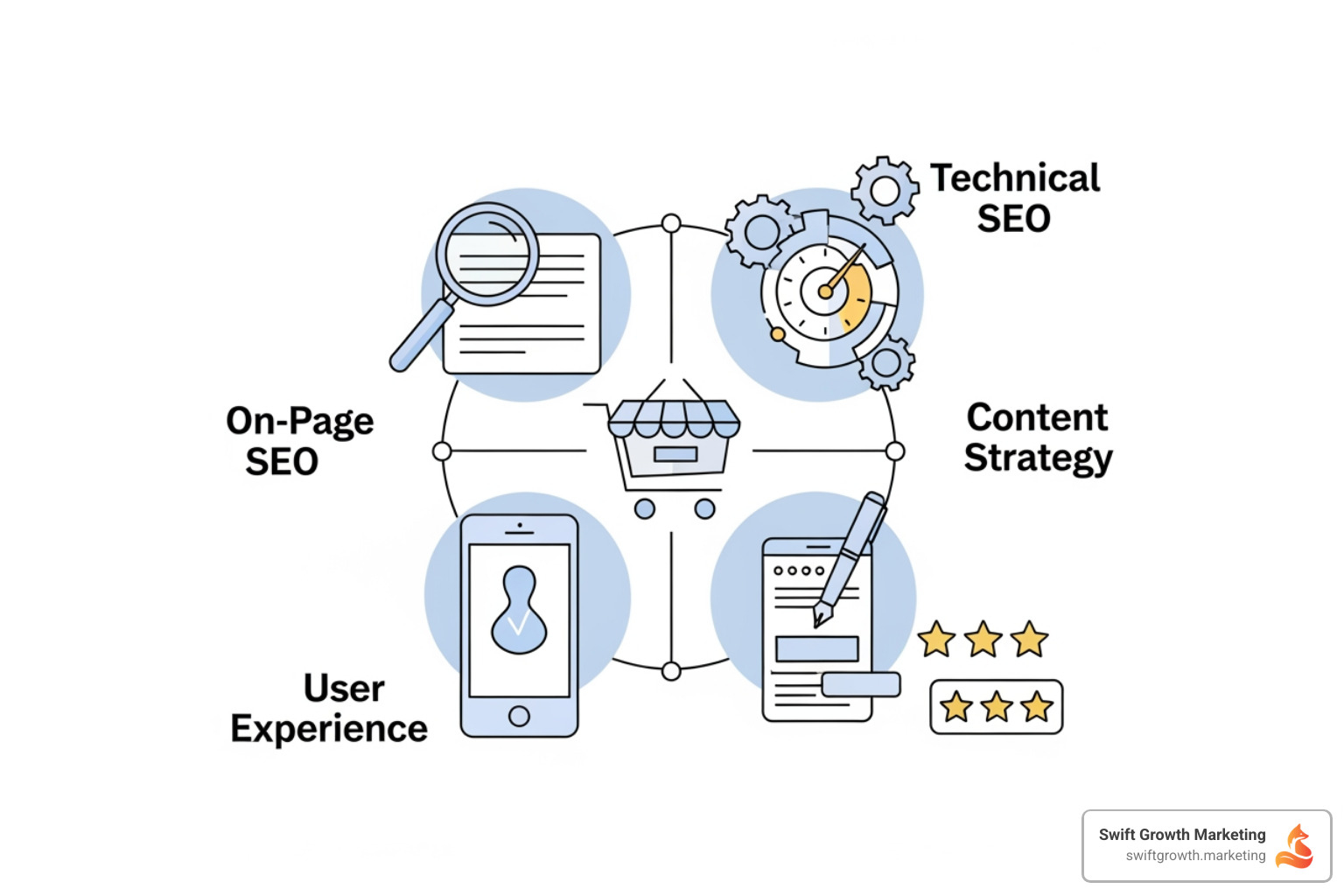
Laying the Groundwork: Essential On-Page Elements
On-page SEO involves everything visitors see on your product page, from titles to images. It’s about balancing the needs of search engines with the experience of your customers. With only 56% of e-commerce stores offering a good user experience on product pages, there’s a massive opportunity for businesses in Pittsburgh, PA, and Wheeling, WV, to stand out. A great page is informative, visually appealing, and easy to steer. For a deeper dive, explore our insights on UX Optimization for Ecommerce.
Crafting Keyword-Rich Titles & Compelling Descriptions
Your product title is a critical signal for both customers and search engines. It should be descriptive and concise, including the brand, product name, and key attributes. For example, “Nike Air Zoom Pegasus 40 – Women’s Running Shoes – White/Black” is far better than just “Running Shoes.”
The product name should be your page’s H1 tag. The meta title (seen in the browser tab) should be unique, start with primary keywords, and stay under 60 characters. The meta description, while not a direct ranking factor, is your sales pitch in search results. Keep it under 160 characters, include a call-to-action, and write for buyers, not bots.
Product descriptions are where you sell the benefits, not just list features. Instead of “Waterproof material,” try “Stay dry and comfortable in any weather with our advanced waterproof fabric.” Crucially, you must write unique descriptions for every product. Copying from the manufacturer creates duplicate content issues that harm rankings. If you have a large inventory, start by rewriting descriptions for your top-selling items. For more tips, see SEO Product Descriptions: 7 Tips To Optimize Your Product Pages.
Optimizing Product URLs for Users and Search Engines
Your product page URL is a mini-signpost for users and search engines. A well-optimized URL is short, descriptive, and includes relevant keywords. For example, yourbrand.com/category/product-name-keyword is much clearer than a string of random characters. Use hyphens to separate words and maintain a consistent structure across your site. A clear URL can improve click-through rates from search results, as users trust what they can understand. For more, see Google’s advice on URL structure.
The Role of High-Quality Images and Videos
In e-commerce, visuals sell. High-quality images and videos are essential for conversions and SEO. Use multiple high-resolution images from various angles, and include a zoom feature.
For SEO, optimize your images by:
- Using descriptive file names:
nike-air-zoom-white.jpginstead ofIMG_001.jpg. - Writing descriptive alt text: This helps with accessibility and gives search engines context.
- Compressing file sizes: Use tools and modern formats like WebP format to ensure fast page loads without sacrificing quality.
- Submitting an image sitemap: Help search engines find and index your images.
Product videos are also incredibly powerful, as they can increase the likelihood of a purchase by over 120%. They increase engagement and can drive traffic independently from Google’s video search features. For more guidance, review Google image SEO best practices.
Level Up Your Product Page SEO with Technical Tactics
Technical SEO works behind the scenes to ensure your site is crawlable, indexable, and easily understood by search engines. It’s about building an efficient foundation for your product pages to be found. For more on this, see our guide to SEO Foundations. A crucial step for e-commerce businesses in Pittsburgh, PA, and Wheeling, WV, is integrating with Google Merchant Center, which makes your products eligible to appear across Google Shopping, free listings, and more.
Why Page Speed is Crucial and How to Improve It
In online shopping, speed is everything. A slow page leads to a high bounce rate and lost sales. The data is clear:
| Factor | Impact |
|---|---|
| Conversions | A one-second load time can result in a conversion rate five times higher than a 10-second load time. |
| Bounce Rate | The probability of a mobile user bouncing increases by 123% as page load time goes from one to ten seconds. |
| Ranking | Page speed is a confirmed Google ranking factor and a key part of Core Web Vitals. |
Aim for a load time under two seconds. To achieve this, we:
- Optimize Images: Compress images and use modern formats like WebP.
- Minimize Code: Minify HTML, CSS, and JavaScript files.
- Leverage Caching: Use browser caching to speed up repeat visits.
- Use a CDN: A Content Delivery Network (CDN) delivers content from a server close to the user, reducing load times.
- Limit Apps: Too many plugins can bloat your site and slow it down.
Prioritizing page speed is a fundamental part of user experience that directly impacts your revenue. Learn more in our Core Web Vitals SEO guide.
Enhancing Visibility with Structured Data and Product Schema
Structured data helps search engines understand your page content, enabling rich snippets in search results—like star ratings, price, and availability. For product pages, we use product schema to explicitly define these details.
Key product schema properties include:
| Property | Includes |
|---|---|
Product |
Name, description, and brand. |
AggregateRating |
Average customer rating and review count. |
Offer |
Price, currency, and availability (InStock, OutOfStock). |
Implementing this schema, as outlined in Google’s Product Schema guide, makes your listings more eye-catching and can significantly increase click-through rates. We always validate our implementation with Google’s Rich Result Test.
The Importance of Mobile Optimization for product page SEO
With Google’s mobile-first indexing, your site’s mobile version is what matters most for ranking. A significant portion of e-commerce traffic and sales comes from mobile devices, so a poor mobile experience means lost revenue.
Effective mobile optimization includes:
- Responsive Design: The page layout must automatically adapt to any screen size.
- Mobile UX: Ensure buttons and text are large enough to be easily tapped and read. A “thumb-friendly” design is crucial.
- Mobile Page Speed: Speed is even more critical on mobile. A slow page is a guaranteed way to lose impatient mobile shoppers.
Build Trust & Boost Conversions with User-Focused Content
In the digital marketplace, trust is currency. For your customers in Pittsburgh, PA, and Wheeling, WV, seeing authentic user-generated content (UGC) and clear trust signals can be the final push they need to make a purchase. Integrating customer voices improves SEO and boosts conversion rates, a key part of Content Marketing for Brands.
Leveraging User-Generated Content and Reviews
Customer reviews are powerful social proof; 7 out of 10 people read them before buying, and 85% of buyers trust them as much as personal recommendations. Reviews and Q&A sections are a goldmine because they:
- Build Trust: Authentic feedback reassures new visitors.
- Provide Fresh Content: Constantly updated content signals relevance to search engines.
- Contain Keywords: Customers naturally use long-tail keywords in their reviews, improving your page’s visibility.
- Enable Rich Snippets: Using Review schema can add star ratings to your search results, boosting click-through rates.
Encourage customers to leave reviews by making the process simple. Displaying an average star rating prominently is a quick way to build confidence.
Implementing Effective Calls-to-Action (CTAs)
An effective call-to-action (CTA) guides the customer to purchase. Your “Add to Cart” button should be clear, compelling, and impossible to miss.
To optimize CTAs, we focus on:
- Visibility: Place the primary CTA above the fold, using a contrasting color to make it stand out.
- Action-Oriented Language: Use direct verbs like “Add to Cart” or “Buy Now.”
- Size and Shape: Ensure the button is large enough to be easily tapped on mobile.
- A/B Testing: Continuously test different button colors, text, and placements to find what converts best.
Well-placed CTAs are essential for turning clicks into customers. For more strategies, see our guide on Product Page Conversion Rate Optimization.
How FAQs Contribute to a Better product page SEO Experience
An FAQ section on your product page is a powerful SEO and UX tool that proactively answers common customer questions, reducing friction in the buying process.
FAQs are beneficial because they:
- Address Customer Concerns: Build confidence by providing information upfront.
- Target Long-Tail Keywords: Naturally incorporate questions your customers are searching for.
- Enable Rich Snippets: With FAQPage Schema markup, your answers can appear directly in Google search results, increasing visibility.
- Build Authority: Providing comprehensive answers positions your brand as an expert, which is a core principle of Answer Engine Optimization.
To create your FAQ, look at customer service logs and the “People Also Ask” section in Google search results.
Strategic Management & Common Pitfalls
Effective product page SEO requires ongoing management and awareness of common pitfalls. For businesses in Pittsburgh, PA, and Wheeling, WV, staying agile means avoiding mistakes like duplicate content and poor site architecture. For a full overview, see our article on the Biggest SEO Mistakes.
Improving Site Structure with Internal Linking and Breadcrumbs
A strong internal linking strategy guides both users and search engines. It helps customers find related products and helps search engines understand your site’s structure and distribute authority. This is a key part of a Hub and Spoke SEO model.
Key tactics include:
- Related Products Sections: Suggesting complementary or alternative items improves user experience and creates valuable internal links.
- Breadcrumb Navigation: These hierarchical links (e.g., Home > Category > Product) show users their location and improve site navigation. Implementing Breadcrumb schema can also display this path in search results, improving visibility.
Handling Product Variants and Discontinued Products
Managing product variations and discontinued items correctly is crucial for SEO to avoid broken links and lost rankings.
- Product Variants (Size/Color): The best practice is to use a single product page with options to select variants. If separate URLs are necessary, use a canonical tag (
rel="canonical") to point all variations to one “master” page, consolidating SEO value and preventing duplicate content.
For out-of-stock & discontinued products, never just delete a page. As noted by Google’s John Mueller, mishandled out-of-stock pages can be treated as errors.
| Status | Recommended Action |
|---|---|
| Temporarily Out-of-Stock | Keep the page live, clearly mark the item as unavailable, and suggest alternatives or an email notification for when it’s back in stock. Use the OutOfStock schema property. |
| Permanently Discontinued | Use a 301 redirect to send users and search engines to the most relevant replacement product or category page. This preserves link equity. For pages with no relevant replacement, a 410 (Gone) status code can be used to tell search engines to de-index it. |
For more on this topic, you can review the 2021 hangout with John Mueller where this was discussed.
Common Mistakes to Avoid
Avoid these recurring blunders that can undermine your e-commerce success:
- Neglecting Mobile Users: A slow or clunky mobile site alienates the majority of modern shoppers.
- Using Manufacturer Descriptions: This creates duplicate content and offers no unique value. Always write your own.
- Ignoring Page Speed: Slow pages kill conversions. Prioritize image optimization and efficient code.
- Forgetting Structured Data: Without product schema, you miss out on eye-catching rich snippets in search results.
- Broken Internal Links: An “orphan” page with no links pointing to it is invisible to both users and search engines.
Frequently Asked Questions about Product Page Optimization
What is the most important element for product page SEO?
The most critical element is a combination of a unique, keyword-optimized product title (H1) and a high-quality, user-focused product description. These elements satisfy both search engines and potential customers, forming the foundation of your optimization efforts. They communicate clearly what the product is, its benefits, and why someone should buy it, all while using language that search engines can understand to rank your page.
How long should a product description be?
There’s no magic number. It should be long enough to fully answer a customer’s questions and highlight the key benefits. Use bullet points for scannability and tabs for detailed specifications to avoid overwhelming the user, but ensure there is enough unique text for search engines to index. The length should also consider the buyer’s awareness level; a highly aware buyer might need less text than someone new to the product category.
How often should I update my product pages?
Update product pages whenever there is new information, such as new reviews, updated product specs, or fresh UGC. Regularly auditing your pages (quarterly or bi-annually) through an Ecommerce SEO Audit can help identify opportunities for improvement and ensure they remain competitive. This proactive approach keeps your content fresh and relevant, which search engines favor.
Conclusion
Optimizing your product pages is a powerful lever for e-commerce growth, blending technical precision with a deep understanding of your customer. By focusing on clear titles, compelling descriptions, fast load times, and trust-building elements like reviews, you create a better experience that search engines and shoppers will reward. Swift Growth Marketing emphasizes that a consistent, user-first approach is the secret to turning search traffic into sales. Ready to transform your product pages into conversion powerhouses? Explore our SEO Marketing services to get started.

chris
Insights on brand authority, positioning, and growth strategy from the Swift Growth Marketing team.