

Why Brand Building Through Search Matters More Than Ever
SEO for brand building is the strategic use of search engine optimization to establish your company as a trusted authority, increase brand awareness, and create lasting customer relationships—not just drive traffic. Here’s how it works:
Core Elements of SEO for Brand Building:
- Visibility – Appear consistently in search results for topics your audience cares about
- Credibility – Build trust through authoritative content and high search rankings
- Recognition – Create memorable brand touchpoints across the customer journey
- Authority – Establish expertise that sets you apart from competitors
- Loyalty – Turn searchers into repeat customers through valuable content
The digital marketplace is more crowded than it’s ever been. Every day, your potential customers conduct thousands of searches looking for solutions to their problems. And here’s what matters: 61% of millennials have finded and bought from a new brand they knew little about just by searching on their phones.
This isn’t about gaming algorithms or stuffing keywords. It’s about becoming the answer your audience is searching for. When someone types a question into Google, they’re not just looking for information—they’re looking for a brand they can trust.
Traditional rankings are just the starting point. Real brand building happens when you consistently show up in search results, provide genuine value, and create experiences that turn casual searchers into loyal advocates. That’s the difference between getting clicks and building a brand.
I’m Chris Hornak, Co-Founder of Swift Growth Marketing, where we’ve helped brands transform from invisible to authoritative through strategic SEO for brand building—like taking a local business from 400 to 45,000 monthly visitors and increasing e-commerce traffic by 764%. This guide will show you exactly how to build a brand that compounds authority over time through search.
Handy seo for brand building terms:
The Foundation: How SEO Forges Your Brand’s Digital Identity
The journey of building a brand online begins with visibility. If potential customers can’t find us, how can they trust us or even know we exist? Our goal isn’t just to rank, it’s to establish our brand as a trusted authority. Search engines are no longer just directories; they are trust signals. When our brand consistently appears at the top of search results, it signals to users that we are a reliable and relevant source of information or solutions. This is where the concept of E-E-A-T (Experience, Expertise, Authoritativeness, Trustworthiness) comes into play. Google’s Search Quality Evaluator Guidelines emphasize these qualities, and a strong SEO strategy helps us demonstrate them.
A very positive reputation can be the reason for using the High rating for an otherwise Medium page, according to Google’s own guidelines. This highlights how brand strength, even if not a direct algorithmic ranking factor, influences how our content is perceived and ultimately, how well it performs. For a deeper dive into the fundamentals, we recommend exploring The Beginner’s Guide to SEO, and to understand how brand leads growth, check out our insights on Brand Led Growth Strategy.
Branded vs. Unbranded Traffic: A Strategic Balance
Understanding the difference between branded and unbranded traffic is crucial for a balanced SEO strategy.
Branded traffic refers to users who search specifically for our brand name or products/services associated directly with our brand (e.g., “Swift Growth Marketing SEO services” or “best SEO company Pittsburgh PA Swift Growth Marketing”). These users often already have some awareness of our brand and are further along in their customer journey. For established brands, optimizing for branded queries is critical to reinforce existing awareness and capture high-intent searches. It ensures we control our narrative and convert interested prospects.
Unbranded traffic, on the other hand, comes from users searching for general terms related to our industry, products, or services, without mentioning our brand name (e.g., “how to improve website traffic” or “digital marketing agency Wheeling WV”). This traffic is vital for attracting new audiences who may not know us yet but are looking for solutions we provide. For new or emerging brands, prioritizing unbranded keywords casts a wider net, building initial awareness and trust.
The strategic balance shifts depending on our brand’s maturity. For a new business in Pittsburgh or Wheeling, we might initially focus heavily on unbranded terms to introduce ourselves to a broader audience. As our brand awareness grows, we’ll invest more in branded terms to solidify our position and capture direct interest.
| Traffic Type | Goals | Target Audience | Typical Keywords |
|---|---|---|---|
| Branded | Strengthen brand recall, loyalty | Existing customers, brand-aware | [Brand name], [Brand + product/service] |
| Unbranded | Expand reach, attract new audiences | New prospects, unaware users | [Service type], [Problem/solution] |
Building Trust Before the Click
Our presence on the Search Engine Results Page (SERP) is often the first impression a potential customer has of our brand. This “moment of truth” happens even before they click on our website. We want to maximize this opportunity to build trust and encourage engagement.
- SERP Presence: A strong SERP presence means we appear prominently and frequently for relevant queries. This consistent visibility builds familiarity and credibility.
- Rich Snippets: These are improved search results that display additional information like ratings, reviews, or product availability. Implementing schema markup (which we’ll discuss later) helps us earn these, making our listings more appealing and informative.
- Favicons: A small detail, but a recognizable favicon next to our URL in search results adds a touch of professionalism and makes our listing easier to spot.
- Title Tags and Meta Descriptions: These are our brand’s mini-advertisements on the SERP. A compelling title tag (which acts as a headline) and an informative meta description can significantly increase our Click-Through Rate (CTR). 8 out of 10 people will read headline copy, but only 2 out of 10 will read the rest. We craft these carefully, incorporating keywords and a clear value proposition to entice users.
Creating a positive first impression in search results is paramount. It tells users that we are not only relevant but also a trustworthy and valuable resource. To ensure our overall SEO strategy is robust, we continuously refine these elements. Learn more about developing a Strong SEO Strategy.
Crafting Content That Builds and Ranks
At Swift Growth Marketing, we firmly believe that content without value is spam. Our core question when creating content is always: “How is our content better than the content that currently ranks for our keyword?” We strive to be the “last click”—the resource so comprehensive and satisfying that users don’t need to return to the SERP.
This means creating value-driven content that directly solves user problems and answers their questions. It’s not about writing for search engines; it’s about writing for people, with search engines in mind. By deeply understanding search intent—what a user is truly trying to achieve with their query—we can craft content that resonates and ranks. For more on developing an effective content strategy, explore our guide on Content Strategy Brands Guide 2025.
The Role of Content in SEO for Brand Building
Content is the fuel for our SEO brand-building engine. Different formats serve different purposes, but all contribute to our brand’s authority and visibility:
- Blog Posts for Authority: High-quality, informative blog posts position us as experts in our field. For businesses in Pittsburgh or Wheeling, a blog post like “Top 5 Tips for Winterizing Your Pipes in Pittsburgh” not only answers a direct user query but also establishes local expertise. We saw how 92.7% of companies saw increased leads by adopting an inbound methodology, which heavily relies on valuable content.
- Pillar Pages and Topic Clusters: To truly build topical authority, we organize our content into pillar pages and supporting topic clusters. A pillar page broadly covers a core topic, while cluster content dives into specific sub-topics, all interlinked. This structure signals to search engines that we have comprehensive expertise on a subject. Learn more about this powerful approach with our guide on Content Clusters: Build Topical Authority with Pillar Cluster Architecture.
- Video Content for Engagement: Video is no longer optional; searches on video platforms are more frequent than ever. Branded video content, like tutorials, product demos, or behind-the-scenes glimpses, engages audiences and ranks well when optimized with relevant titles, descriptions, and tags.
- Social Media Content for Reach: Social media platforms are increasingly functioning as search engines. Optimizing our social posts with relevant captions, hashtags, and keywords extends our SEO reach. The fact that 76% of marketers admitted to using Social Media for better SEO underscores its importance. For instance, a local bakery in Wheeling could create TikToks showcasing their best-selling cupcakes with #BestCupcakesWheelingWV.
By consistently providing valuable content across these formats, we build a strong narrative around our brand, changing casual browsers into loyal advocates. Dive deeper into how narratives drive connections with our insights on Storytelling in Content Marketing.
Resonating with Your Audience Through Strategic Messaging
Our brand voice and tone consistency are paramount in all our content. This isn’t just about what we say, but how we say it. We ensure our messaging aligns with our brand values and personality, creating a consistent experience across every touchpoint. Explore what makes up a brand’s unique voice with our guide on Brand Voice Elements.
We leverage frameworks like the AIDA model (Attention, Interest, Desire, Action) to guide our content creation, ensuring each piece moves our audience closer to engagement. More on this can be found in our article on AIDA Storytelling: Crafting Brand Narratives That Convert.
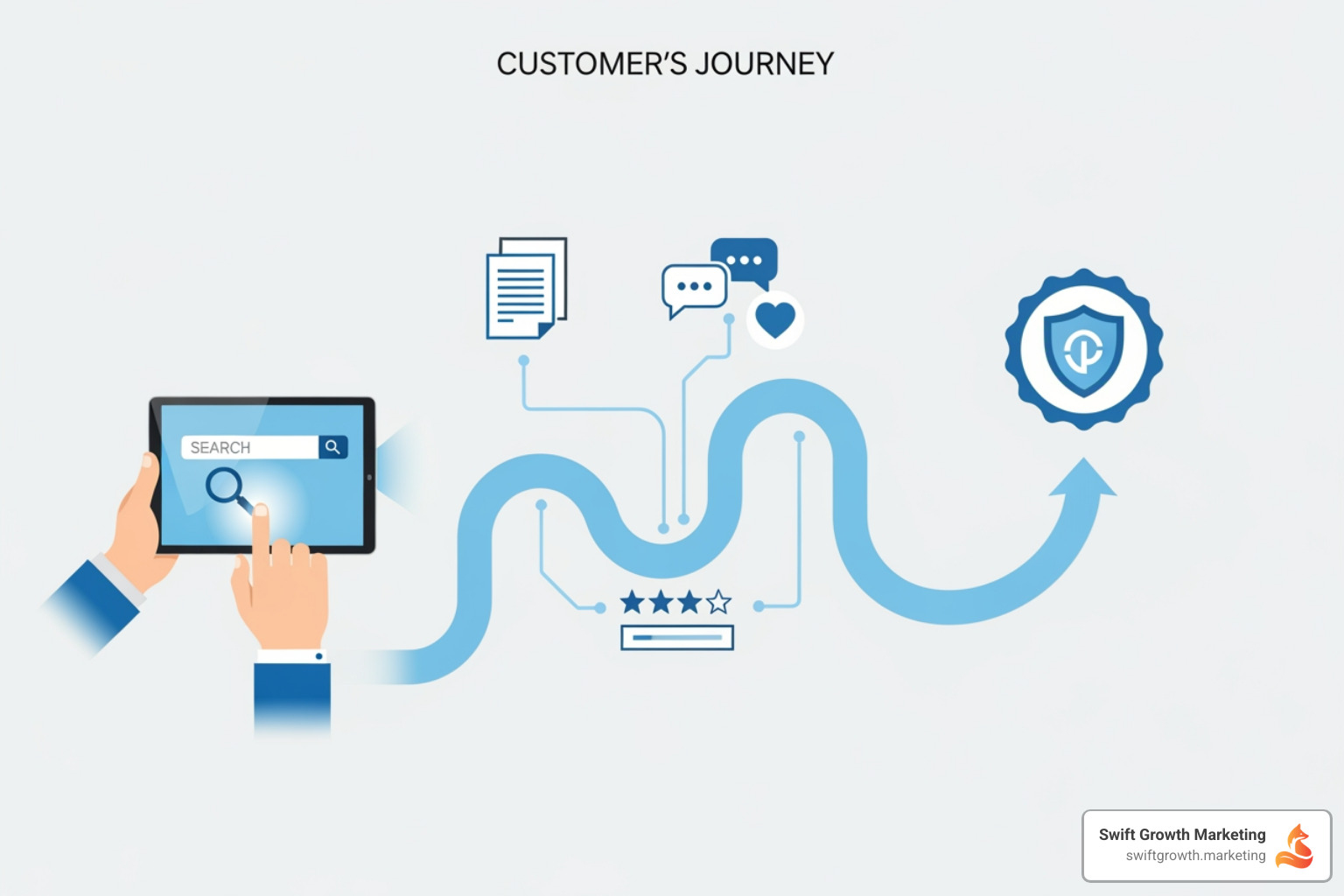
Crucially, we align our content with the customer journey, addressing their needs at every stage. This is particularly vital for ‘micro-moments’—those instances when people instinctively turn to a device to act on a need. When a potential customer in Pittsburgh searches for “emergency plumber near me,” we want our brand to be the immediate, trusted answer. We cater to these moments of need, knowing that 61% of millennials have finded and bought new brands just by searching on their phones.
A Comprehensive SEO Strategy for Long-Term Brand Building
For us, SEO is not a one-off task but a continuous, holistic approach that integrates seamlessly into our overall business process. It’s about combining technical excellence, compelling on-page content, and robust off-page authority building. These elements work in concert to create a resilient and visible brand online. Understanding these foundational elements is key to sustainable growth, and our SEO Foundations guide provides a thorough overview.
Technical SEO and User Experience (UX)
The technical backbone of our website profoundly impacts how search engines perceive us and, more importantly, how users experience our brand. A seamless user experience (UX) is crucial for building positive brand awareness.
- Website Design: An intuitive and pleasing website design impresses Google and improves brand perception. We ensure our sites are visually appealing and easy to steer.
- Site Speed: Users expect a site to load in 2 seconds. Slow speeds kill engagement, leading to high bounce rates. Since Google uses speed as a ranking factor, optimizing it is non-negotiable.
- Mobile-Friendliness: With 70% of mobile searches resulting in action being taken within an hour, and 57% of users stating they won’t recommend a business if its site isn’t optimized for mobile, responsiveness is vital. Our websites are designed to adapt seamlessly to any device.
- Core Web Vitals: These Google metrics measure loading performance, interactivity, and visual stability. Optimizing them is essential for both user experience and search rankings. Explore our insights on Core Web Vitals SEO.
- Secure Site (HTTPS): An HTTPS certificate signals to both users and search engines that our site is secure, protecting data and building trust.
- Easy Navigation: Clear site architecture and navigation help users find what they need quickly, reducing frustration and improving engagement.
Every $1 invested in UX can have a return of up to $100. This is why we prioritize a Future-Proof Website Design that combines aesthetics with technical rigor.
Off-Page SEO: Building Authority Beyond Your Website
Off-page SEO activities extend our brand’s reach and authority beyond our website, signaling to search engines that we are a reputable and trustworthy entity.
- Digital PR: This involves earning mentions and links from authoritative publications, news sites, and industry blogs. PR has always been valuable for brand building and brand integrity, and now it sends strong signals to both Google and AI search models. Our Digital PR for SEO guide offers more details.
- Link Building: High-quality backlinks from relevant and authoritative websites act as votes of confidence for our brand. They drive referral traffic and significantly boost our domain authority.
- Guest Posting: Contributing valuable content to other reputable sites not only earns us backlinks but also exposes our brand to new audiences, establishing our expertise.
- Online Reviews and Reputation Management: Online reviews are incredibly powerful. 88% of consumers stated that they trusted online reviews as much as personal recommendations, and 55% of millennials ignore brands with poor reviews. Positive reviews build trust, influence purchasing decisions, and are considered by search engines (Moz attributed an 8.4% contribution to review signals in Google’s local ranking factors). We actively encourage and manage reviews to cultivate a stellar online reputation. Our insights on AI Brand Reputation Management can help steer this complex area.
Leveraging Local SEO for Brand Building in Your Community
For businesses serving specific geographic areas like Pittsburgh, PA, or Wheeling, WV, local SEO is paramount for brand building. It ensures we connect with customers in our immediate vicinity who are actively looking for our products or services.
- Google Business Profile Optimization: Our Google Business Profile is our digital storefront. Optimizing it with accurate information, engaging photos, and active Q&A responses is crucial. Proactively answering questions in Google Business Profile can boost engagement and aid customer decision-making.
- Local Citations (NAP Consistency): Ensuring our Name, Address, and Phone number (NAP) are consistent across all online directories (Yelp, Yellow Pages, etc.) builds trust and helps search engines verify our business information.
- Location-Specific Content: Creating content custom to our local community, such as “Best Family-Friendly Activities in Pittsburgh” or “Top Dog Parks in Wheeling, WV,” establishes our local expertise and relevance.
- Community Engagement: Actively participating in local events, sponsoring local teams, and engaging with local online communities further solidifies our brand’s presence and reputation within Pittsburgh and Wheeling.
The Future is Now: Adapting Your Strategy for AI Search
The landscape of search is rapidly evolving. With the rise of AI Overviews and the increasing prevalence of zero-click searches, where users find answers directly on the SERP without visiting a website, our traditional SEO strategies must adapt. Generative AI is like a boostd SEO, summarizing information and making it more challenging to increase direct website visibility. However, this also presents new opportunities for brands to become authoritative sources within these new formats.
Winning with Generative Engine Optimization (GEO)
Generative Engine Optimization (GEO) is about optimizing our content specifically for generative AI tools and AI Overviews. This means understanding how AI processes information and structuring our content to be easily digestible and citable.
- Optimizing for Conversational Queries: AI search often involves more natural, conversational language. We use conversational keywords that mirror how people actually ask questions, rather than just short, choppy phrases.
- Structuring Content for AI Summaries: We structure our content with clear headings, bullet points, numbered lists, and concise answers to common questions (50-60 words for FAQs). This makes it easy for AI to extract key information and include it in its summaries.
- Becoming a Cited Source: The ultimate goal is for our brand to be consistently cited by AI. This requires creating original, expert-level content with unique data, insights, and real-world examples—content that AI models will deem authoritative and trustworthy. Our guide on GEO Explained: How Brands Can Win With AI Search Results digs deeper into this.
The Power of Answer Engine Optimization (AEO)
Answer Engine Optimization (AEO) focuses on providing direct, concise answers to user queries, especially for voice search and SERP features like “People Also Ask” and featured snippets.
- Voice Search: With the growing popularity of voice assistants, optimizing for how people speak their queries is crucial. We craft content that directly answers questions in a natural, conversational tone.
- Optimizing for “People Also Ask”: These sections on the SERP are goldmines for capturing related queries. By providing clear, concise answers to these questions within our content, we increase our chances of appearing there.
- Featured Snippets: The coveted “position zero” is a prime spot for brand visibility. We structure our content to directly answer common questions in a summary format, making it easier for Google to pull our answer as a featured snippet.
- Creating Concise, Direct Answers: For AEO, brevity and clarity are key. We aim for answers that are 50-60 words, getting straight to the point while still providing value. Our Answer Engine Optimization Strategy guide offers practical steps.
Measuring What Matters: KPIs for SEO Brand Building
Moving beyond just traffic and rankings, we measure the true impact of our SEO efforts on brand building. It’s not enough to see numbers; we need to understand how those numbers translate into increased brand awareness, trust, and loyalty.
Key Performance Indicators to Track
To measure the success of our SEO brand-building efforts, we focus on a blend of traditional SEO metrics and brand-centric KPIs:
- Branded Search Volume: This measures how many people are searching directly for our brand name or branded terms (e.g., “Swift Growth Marketing”). A consistent increase indicates growing brand awareness.
- Direct Traffic Increases: When users type our URL directly into their browser or access our site via bookmarks, it shows strong brand recall. This is a powerful indicator of brand awareness.
- Brand Mentions and Sentiment Analysis: We track mentions of our brand across the web, including news articles, blogs, social media, and forums. Analyzing the sentiment (positive, neutral, negative) gives us insights into public perception.
- Share of Voice (SOV): This KPI measures our brand’s visibility compared to competitors for a given set of keywords. A higher SOV means our brand is more prominent in our industry’s conversations.
- SERP Feature Ownership (Featured Snippets, Knowledge Panels): Appearing in featured snippets, “People Also Ask” boxes, or owning our brand’s knowledge panel indicates strong authority and direct answers to user queries.
Tools for Measurement
We leverage a suite of tools to track and analyze these KPIs effectively:
- Google Search Console: Provides invaluable data on organic search performance, including impressions, clicks, and average ranking position for our keywords. It helps us understand why our Google Search Console Impressions Are Down or up.
- Google Analytics 4 (GA4): Offers detailed insights into user behavior on our website, including direct traffic, user paths, and conversion metrics. We actively explore the power of GA4 in our reports.
- Google Alerts: A simple yet effective tool to monitor brand mentions across the web, helping us stay on top of our online reputation.
- Social Media Monitoring Tools: These help us track brand mentions, sentiment, and engagement on social platforms, providing a holistic view of our brand’s online presence.
Conclusion
In an increasingly crowded digital landscape, SEO for brand building is no longer an optional add-on; it’s a foundational imperative. It’s about strategically leveraging search to establish our brand’s digital identity, build undeniable authority, and foster lasting trust with our audience. We’ve seen how integrating technical excellence, value-driven content, robust off-page strategies, and community-focused local SEO can transform a brand’s visibility and impact.
As search continues to evolve with AI, adapting our strategies for Generative Engine Optimization (GEO) and Answer Engine Optimization (AEO) ensures our brand remains at the forefront, becoming a trusted source in an AI-driven world. This isn’t a sprint; it’s a long-term investment that yields compounding returns, building a lasting digital presence where visibility, trust, and loyalty converge.
At Swift Growth Marketing, we’re passionate about helping businesses in Pittsburgh, PA, and Wheeling, WV, not just rank, but thrive. We craft custom SEO strategies that turn searchers into loyal brand advocates. Ready to lift your brand’s presence and authority? Transform your brand’s presence with a strategic SEO partner like us.