


SEO 101: Laying the Groundwork for Search Engine Dominance

Why Every Website Needs a Strong SEO Foundation
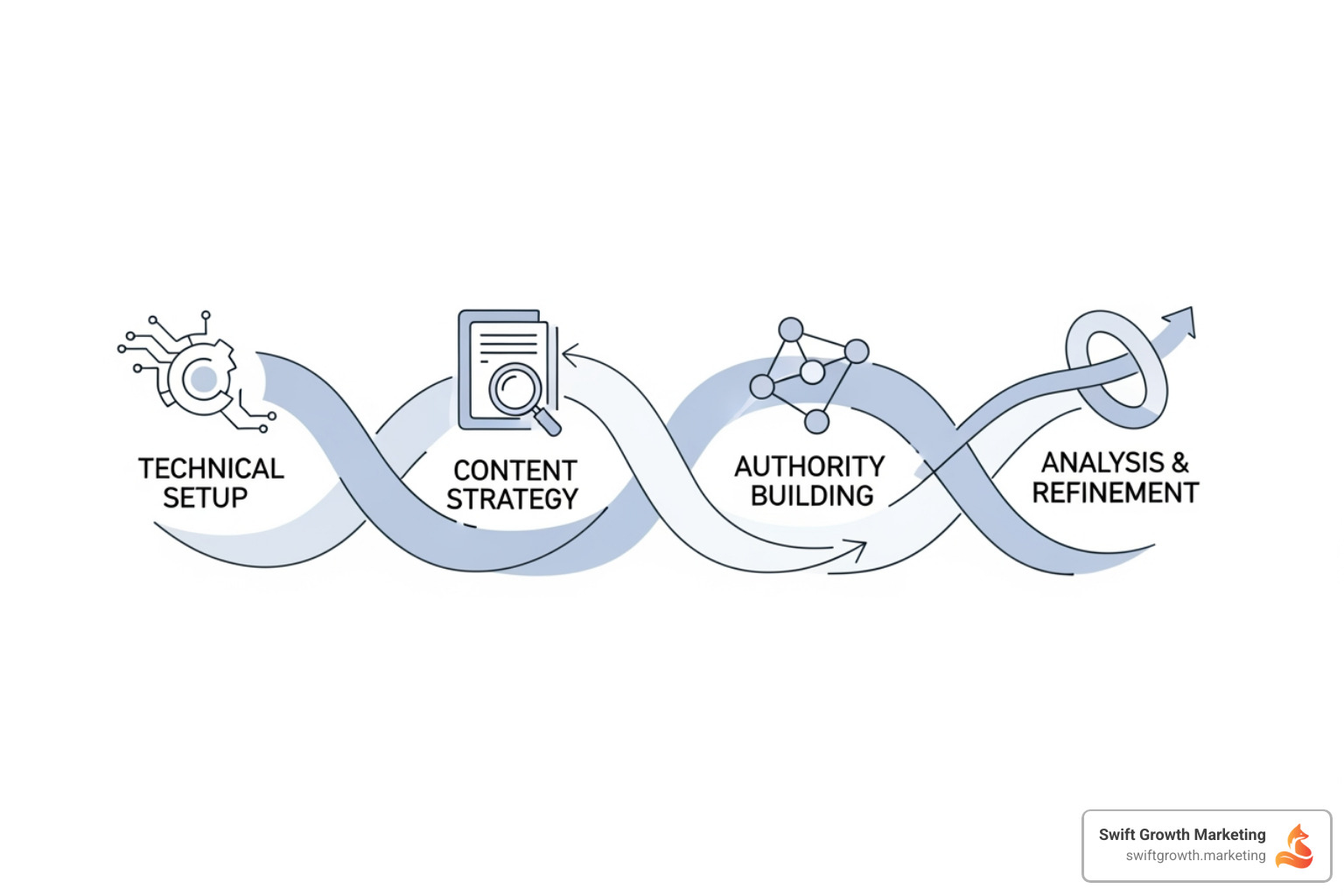
Building a successful online presence starts with a strong SEO foundation—the essential technical setup, content strategy, and authority-building practices that make your website findable and trustworthy in search engines. Without these fundamentals in place, even the most beautiful website or compelling product can remain invisible to the customers actively searching for it.
A solid SEO foundation consists of three core pillars:
- Technical SEO – Ensuring search engines can crawl, index, and understand your site
- On-Page SEO – Optimizing your content and pages for relevance and user experience
- Off-Page SEO – Building authority through backlinks, brand mentions, and trust signals
Search engines are answer machines. They scour billions of pieces of content and evaluate thousands of factors to determine which pages best match what someone is searching for. When you build a strong foundation, you’re essentially creating a clear pathway for both search engines and real people to find, understand, and trust your content.
The stakes are high. Over 58.72% of all web traffic from September 2021 to September 2022 originated from a mobile device, and search engines now prioritize sites that load quickly, work seamlessly across devices, and provide genuine value. Google’s algorithms have evolved far beyond simple keyword matching—they now evaluate content depth, user experience signals, and even whether your pages demonstrate real expertise and trustworthiness through their H-E-E-A-T framework.
Here’s the reality: SEO isn’t a quick fix or a one-time project. It’s a long-term investment in making your website the best possible answer to the questions your customers are asking. And it all starts with getting the fundamentals right.
I’m Chris Hornak, Co-Founder of Swift Growth Marketing, where we’ve transformed businesses from 400 to 45,000 monthly visitors by building rock-solid SEO foundations through strategic positioning and technical excellence. Over the past decade, my team has produced over 15,000 blog posts and helped hundreds of companies establish the SEO foundation they need to dominate their categories.
Understanding the Engine: How Google Ranks Websites
Before we dive into the nuts and bolts of building your SEO foundation, it’s crucial to understand how search engines, particularly Google, actually work. Think of them as incredibly sophisticated librarians for the entire internet. Their fundamental purpose is to organize the world’s information and make it universally accessible and useful.
The process of how search engines determine rankings can be broken down into three main phases:
- Crawling: Search engines use automated programs called “crawlers” (like Googlebot) to find new and updated web pages. These crawlers follow links from page to page, gathering information. If your site isn’t crawlable, Google can’t find it, and thus can’t rank it.
- Indexing: Once a page is crawled, the search engine analyzes its content, categorizes it, and stores it in a massive database called an index. This index is like the library’s catalog. The search engine’s algorithms are now sophisticated enough to evaluate whether your page’s content, format, and depth match the user’s expectations.
- Ranking: When someone types a query into a search engine, the search engine sifts through its index to find the most relevant and authoritative pages. It then orders these pages based on hundreds of ranking factors, presenting the most useful results first.
Google’s algorithms are complex, interconnected webs driven by AI and a deep understanding of user intent. They look at quantifiable signals, noting that if you looked up “dogs”, you probably aren’t looking for a webpage that simply says the word “dogs” a million times. Instead, Google algorithms work to identify other relevant content that goes beyond the keyword “dogs”, such as photos, videos, or a list of dog breeds.
The goal is to provide a truly valuable and trustworthy experience that satisfies both humans and machines. This includes matching search intent – understanding not just the words a user types, but what they really want to find. For example, a search for “Pittsburgh weather” clearly indicates a need for a local forecast, while “history of Wheeling, WV” seeks informational content.
User experience signals also play a significant role. If users click on your site and quickly bounce back to the search results (a “pogo-sticking” effect), it tells Google that your page might not be the best answer. Conversely, if they spend time on your page, explore other sections, and find what they need, these positive user signals contribute to better rankings.
For a deeper dive into how Google determines its rankings, you can explore Google’s ranking systems.
The Three Pillars of a Strong SEO Foundation
Building a successful website is much like constructing a sturdy building. You need a solid foundation, a well-designed interior, and a respected exterior. In SEO, these correspond to Technical SEO, On-Page SEO, and Off-Page SEO. These three core components work in harmony, each supporting the others to create a strong structure for search visibility. Ignoring one pillar can weaken your entire SEO foundation, making it harder for your site to achieve and maintain top rankings.
Pillar 1: Technical SEO – The Blueprint of Your Website
Technical SEO is the scaffolding that supports all other SEO efforts. It’s about ensuring that search engines can efficiently crawl, index, and understand your website. Without a solid technical SEO foundation, even the best-written pages won’t rank or be finded.
Key elements of technical SEO include:
- Crawlability and Indexability: We need to ensure that search engine crawlers can access and interpret your site’s content. This involves correctly configuring your
robots.txtfile (which tells crawlers what to access and what to ignore) and creating a well-structured XML sitemap (a roadmap for search engines). - Site Architecture: A logical, well-structured site architecture ensures that both users and bots can find the most important content quickly. This involves clear navigation, using breadcrumbs with schema markup, and ensuring top-level categories are easily accessible.
- Site Speed & Core Web Vitals: Speed and stability are no longer “nice-to-haves” in SEO; they’re prerequisites. In 2026, Google and Bing still rely heavily on Core Web Vitals as key signals of user experience. These metrics measure:
- Largest Contentful Paint (LCP): How long it takes for the largest content element on the page to become visible. (Target: under 2.5 seconds).
- Interaction to Next Paint (INP): How quickly the page responds to user interactions like clicks or taps. (Target: under 200ms).
- Cumulative Layout Shift (CLS): How much unexpected layout shift there is on the page. (Target: under 0.1 second).
We can improve these by optimizing code and images (compressing images using tools like Imagify or using WP Rocket for WordPress sites), leveraging browser caching, and using a Content Delivery Network.
- Mobile-First Indexing: Mobile-first indexing is no longer new; it’s the standard. Google’s Mobile-First Indexing primarily crawls the mobile site, meaning your mobile site’s content, speed, and user experience directly impact your rankings. With 58.72% of all web traffic from September 2021 to September 2022 originating from a mobile device, a responsive design that adapts seamlessly to all screen sizes is non-negotiable. We ensure content parity: all content on your desktop site must also be present on your mobile version.
Pillar 2: On-Page SEO – Optimizing Your Content for Visibility
On-page SEO is about optimizing the content and HTML source code of a page to rank higher and earn more relevant traffic in search engines. It’s how we tell search engines exactly what your page is about.
- Key Components of On-Page Optimization:
- Title Tags: The title tag is the clickable headline that appears in search results and browser tabs. It should be compelling, concise, and include your primary keyword.
- Meta Descriptions: A brief summary of your page’s content that appears under the title tag in search results. While not a direct ranking factor, a well-written meta description can significantly improve click-through rates (CTR).
- Header Tags (H1-H6): These tags structure your content, making it easier for both users and search engines to read. H1 is your main topic, and subsequent headers (H2, H3, etc.) break down subtopics.
- URL Structure: Keep your URLs readable, short, and concise, incorporating relevant keywords. For example,
dev.swiftgrowth.marketing/seo-foundation-guideis far better thandev.swiftgrowth.marketing/pageid=123&cat=4. - Internal Linking Strategy: A logical, well-structured site architecture ensures that both users and bots can find the most important content quickly, while an intentional internal linking strategy distributes link equity and reinforces topical authority. We ensure every important page has at least one internal link pointing to it.
- Image Optimization and Alt Text: Compress image sizes and serve them in next-generation formats like WebP. Use descriptive alt text for images, which helps search engines understand the image content and improves accessibility for visually impaired users.
- User Experience (UX) as a Ranking Factor: User experience (UX) is a critical ranking factor that measures how users interact with your website. Core Web Vitals, including page speed, interactivity, and visual stability, directly impact UX. A fast, mobile-friendly, and easy-to-steer site signals a good user experience to Google, which in turn can lead to higher rankings.
Pillar 3: Off-Page SEO – Building Authority and Trust
Off-page SEO refers to all the activities that happen outside of your website to improve its search engine ranking. It’s primarily about building your website’s authority, relevance, and trust through external signals.
- Building Website Authority: Search engines determine authority by looking at external signals, such as links from other prominent websites. Think of it as a popularity contest where votes come in the form of backlinks.
- Backlinks as Votes of Confidence: A backlink is essentially a vote of confidence from one website to another. When a reputable site links to your content, it signals to search engines that your content is valuable and trustworthy.
- Link Quality Over Quantity: Not all backlinks are created equal. A single, high-quality link from a respected, relevant source is far more valuable than dozens of low-quality, spammy links. We focus on earning links from authoritative, relevant websites.
- How to Earn Organic, High-Quality Backlinks: The best way to build organic, high-quality backlinks is to create great content. This includes original research, detailed guides, or unique data. We also engage in strategic outreach and build relationships with other experts in your niche.
- Domain Authority: While not an official Google metric, many SEO professionals use a concept called ‘domain authority’ to predict how likely a website is to rank in search engine results. This score, which is calculated by third-party tools, is influenced by the quantity and quality of backlinks, among other factors.
- Significance of Domain Age and History: An older, established domain with a clean history has an advantage in search rankings, as it represents a long-term track record of trust with search engines. Conversely, we avoid using expired domains to try and boost the ranking of low-quality content, as Google will view this as misleading users. We always maintain a clean history, avoiding domains with a past of spam or manipulative practices.
- Brand Mentions and Social Signals: Beyond direct links, search engines also consider brand mentions (even unlinked ones) and social signals (shares, likes, comments) as indicators of a brand’s popularity and relevance. Building a strong brand presence outside of search (through social media, word-of-mouth, and industry recognition) can contribute significantly to your authority.
Content & Keywords: The Voice of Your SEO Strategy
Content is the heart of your SEO foundation. It’s how you communicate with your audience, provide value, and ultimately, how you rank in search engines. Without compelling, relevant content, even the most technically perfect website will struggle to attract organic traffic. The right content, informed by meticulous keyword research, acts as the fuel that powers your rankings.
The Role of Keyword Research in your SEO Foundation
Keyword research is the cornerstone of any effective SEO strategy. It’s the process of understanding the exact words and phrases your target audience uses when searching for information, products, or services related to your business.
- Understanding User Search Intent: This is paramount. We need to identify what users intend to find when they type a query. Keywords typically fall into categories based on intent:
- Informational: Users seeking answers to questions (e.g., “what is SEO foundation?”).
- Navigational: Users looking for a specific website or brand (e.g., “Swift Growth Marketing”).
- Transactional: Users ready to buy or convert (e.g., “SEO services Pittsburgh”).
- Keyword Research Process: Our process involves:
- Brainstorming: Starting with core topics relevant to your business.
- Seed Keywords: Identifying broad terms.
- Expanding: Using SEO tools to find related terms, long-tail keywords, and common questions.
- Analyzing Competition: Seeing what keywords your competitors rank for.
- Grouping: Organizing keywords by topic and intent.
- Using Tools to Find Opportunities: SEO software platforms are invaluable for identifying relevant keywords, analyzing search volume, and understanding keyword difficulty. We also leverage Google’s “People Also Ask” section and other search features to uncover commonly asked questions that we can address in your content.
- Mapping Keywords to the Customer Journey: We align keywords with different stages of your customer’s journey, ensuring we create content that addresses their needs whether they’re just researching (informational) or ready to make a purchase (transactional).
Creating High-Quality, Optimized Content
Google’s algorithms are now sophisticated enough to evaluate whether your page’s content, format, and depth match the user’s expectations. To rank high, your content must be helpful, comprehensive, and trustworthy.
- Matching User Expectations: We analyze top-ranking pages for your target keywords to understand the type of content (e.g., listicle, guide, video tutorial) and depth users expect.
- Comprehensiveness and Depth: Focus on comprehensive keyword coverage rather than density. While keywords still matter, search engines penalize content that uses them excessively or unnaturally. Your goal is to show a deep level of expertise on a topic, which means using a variety of related terms naturally.
- Google’s H-E-E-A-T signals: This framework (Helpfulness, Experience, Expertise, Authoritativeness, and Trustworthiness) is Google’s way of evaluating content quality.
- Helpfulness: Does your content truly solve problems and answer questions?
- Experience: Does it demonstrate first-hand knowledge or personal experience? (e.g., a photo of you testing a product or a video walkthrough of a process).
- Expertise: Is the content produced by a knowledgeable source?
- Authoritativeness: Is the website a recognized authority on the topic?
- Trustworthiness: Is the content accurate, transparent, and safe? (e.g., testimonials, awards, and Schema markup, especially author schema, can build trust. The proof is in the pudding, with 72.6% of pages on the first page of Google using author schema markup.)
- Optimizing for Rich Results and Featured Snippets: These are improved search results that can significantly boost visibility. Featured Snippets still exist, so it’s important to continue to optimize for them. Google often pulls from lists, tables, and bullet points for Featured Snippets. We optimize by:
- Answering commonly asked questions concisely.
- Using Schema markup (like Q&A or HowTo schema) to help Google understand your content structure.
- Formatting content with lists, tables, and bullet points.
The Future is Now: AI, Analytics, and Adaptation
The SEO landscape is constantly evolving, with AI playing an increasingly significant role. To maintain a strong SEO foundation, we must continuously measure our success, analyze our performance, and adapt our strategies.
- Measuring SEO Success: We rely on key metrics to understand what’s working and what’s not.
- Google Search Console: This free tool is essential. It shows us how often your site appears in Google searches, which queries bring users to your site, and helps us identify and fix technical issues.
- Google Analytics: Provides invaluable data on user behavior, such as traffic sources, time on page, bounce rate, and conversion paths.
- User Signals: These metrics provide insights into how users interact with your website, influencing its ranking. High click-through rates (CTR) and longer time on page signal to Google that your content is relevant and engaging. Conversely, a high bounce rate or short session duration can indicate that users aren’t finding what they need. We aim for the “perfect click,” where a user clicks on a page and is satisfied thereafter, not needing to go to other pages.
- The Impact of AI on Search and Content Creation: AI is rapidly changing search. Generative AI is becoming the search solution for many, and our in-depth research suggests that strong SEO is the foundation for strong AEO (Answer Engine Optimization). Google’s algorithms now understand entities (people, places, and organizations) and their relationships. We optimize for entity recognition by ensuring your brand, key people, and products are clearly defined with consistent information across your site and other web properties. This helps build your Knowledge Graph.
- Structuring Content for AI Overviews: With AI-powered search engines pulling from indexed pages to generate summaries, your content needs to be both Human-First (engaging, well-written, authoritative, H-E-E-A-T) and Machine-Readable (organized with clear headings, lists, and schema). This ensures your content can be easily extracted and cited by AI. We can even add an
LLMs.txtfile, similar torobots.txt, but specifically designed for AI crawlers powering generative search and conversational agents.
Effective analysis and adaptation are ongoing processes. It’s not enough to build a great SEO foundation; we must continuously monitor its performance and make adjustments to stay ahead of the curve. For more detailed insights into how we track and report on your SEO success, you can learn more about our reporting.
Frequently Asked Questions about SEO Foundations
What are Core Web Vitals and why are they important?
Core Web Vitals are a set of specific metrics that Google uses to measure real-world user experience for loading performance, interactivity, and visual stability of a page. They include Largest Contentful Paint (LCP), Interaction to Next Paint (INP), and Cumulative Layout Shift (CLS). They are important because they are direct ranking signals, meaning that pages with good Core Web Vitals scores are more likely to rank higher in search results, as they indicate a better user experience.
Why are backlinks so important for SEO?
Backlinks are crucial for SEO because they act as “votes of confidence” from other websites to yours. When a reputable website links to your content, it signals to search engines that your page is authoritative, trustworthy, and valuable. These signals help search engines understand the quality and relevance of your content, leading to higher rankings. We prioritize earning high-quality links from relevant and authoritative sources, as these carry much more weight than numerous low-quality links.
How does user experience (UX) affect SEO?
User experience (UX) profoundly affects SEO because search engines, especially Google, prioritize delivering results that users will find satisfying. A good UX means your website is fast, easy to steer, mobile-friendly, and provides clear, helpful content. When users have a positive experience on your site, they are more likely to stay longer, engage with more content, and return in the future. These positive user signals (like low bounce rate, high time on page, and direct traffic) tell search engines that your site is valuable, which can lead to improved rankings. Conversely, a poor UX can lead to negative user signals and lower rankings.
Conclusion: Building Your Path to Search Dominance
Establishing a robust SEO foundation is not merely a task; it’s a strategic investment in your online future. We’ve explored the three core pillars: Technical SEO, On-Page SEO, and Off-Page SEO, each essential for ensuring your website is findable, relevant, and authoritative in the eyes of search engines. From optimizing crawlability and site speed to crafting high-quality, H-E-E-A-T-compliant content and earning valuable backlinks, every element contributes to a powerful online presence.
SEO is a continuous, long-term strategy, not a sprint. The digital landscape, influenced by rapidly evolving AI and user behavior, demands constant monitoring, analysis, and adaptation. By diligently building and maintaining a strong SEO foundation, you’re not just chasing rankings; you’re building a sustainable path to connect with your audience in Pittsburgh, Wheeling, and beyond, driving consistent organic growth for your business.
At Swift Growth Marketing, we act as your dedicated partner, leveraging our expertise to construct and fortify your SEO foundation. We’re here to help you steer the complexities of search, ensuring your website stands tall and achieves its full potential for search engine dominance.
Ready to lay the groundwork for your success? Learn more about our SEO marketing services today.

chris
Insights on brand authority, positioning, and growth strategy from the Swift Growth Marketing team.