


Don’t Ghost Your Leads: Social Media Nurturing Secrets

Why Social Nurturing is Your Secret Weapon
Social media for lead nurturing is the art of building relationships with potential customers through valuable, consistent interactions on platforms like LinkedIn, Instagram, Facebook, and TikTok. Here’s how it works:
- Share educational content that addresses your audience’s pain points.
- Engage authentically through comments, direct messages, and community discussions.
- Provide social proof via testimonials, case studies, and user-generated content.
- Use targeted content to move leads through the buying journey.
- Measure and optimize using platform analytics and CRM integration.
The modern buying journey starts on social media. Nurtured leads produce a 20% increase in sales opportunities compared to non-nurtured leads. Yet many brands still treat social platforms as broadcast channels instead of relationship-building tools.
Lead nurturing differs from lead generation. Generation captures interest; nurturing builds trust over time. It’s the difference between collecting a business card and having a meaningful conversation.
Many businesses focus only on the first touchpoint, but the follow-up is what converts a lead. Social media provides the ideal space to stay top-of-mind without being pushy.
I’m Chris Hornak of Swift Growth Marketing. I help brands turn sporadic social media posting into strategic relationship engines. We’ve guided companies in education, staffing, and SaaS to build authority and trust, turning followers into loyal customers.
Developing Your Social Media for Lead Nurturing Strategy
A robust strategy for social media for lead nurturing is essential for converting prospects. It moves beyond attracting attention to building meaningful connections that guide leads through their buying journey. Social media is an ideal platform for fostering trust without being overly salesy.
The benefits are compelling: it’s cost-effective, builds authentic relationships, improves brand authority, and provides valuable audience insights. For businesses in Pittsburgh, PA, and Wheeling, WV, it’s a key way to connect with the local community.
A well-crafted strategy integrates social media into an omnichannel approach. McKinsey notes that B2B companies with omnichannel strategies see 13.5% higher EBIT growth, proving social media is a vital part of a cohesive marketing ecosystem.
Our approach to developing a strategy involves several key steps:
- Goal Setting: Define what you aim to achieve (e.g., increased conversion rates).
- Buyer Personas: Develop detailed profiles of your ideal customers.
- Channel Selection: Identify the platforms where your target audience is most active.
- Content Plan: Create a content calendar for different stages of the buying cycle.
- Engagement Guidelines: Establish protocols for interacting with leads.
- Measurement & Optimization: Implement tools to track performance and refine your strategy.
For a deeper dive, explore our guide on 10 Steps to Create an Effective Social Media Marketing Strategy. This foundation, combined with an understanding of Growth Marketing Components: Accelerate Your Marketing Strategy, ensures you’re strategically growing.
Identifying and Understanding Your Audience
Effective social media for lead nurturing starts with knowing your audience. Without this understanding, your efforts will fall flat. Go beyond demographics to understand their motivations, challenges, and online habits.
To identify your target audience, focus on:
- Pain Points: What problems are they trying to solve?
- Demographics: Basic information like age, location, and job title.
- Interests: What topics and content do they engage with online?
- Buyer Behavior: How do they research and make purchasing decisions? 75% of B2B buyers prefer a rep-free experience, seeking information independently.
- Online Habits: Which social platforms do they frequent?
We use social listening tools to monitor conversations, track brand mentions, and analyze competitors. This helps us understand what our audience discusses, their questions, and what content resonates, which is a crucial data-driven approach detailed in Fast Marketing Wins Happen When You Listen to Customer Data.
Armed with this information, we create detailed buyer personas to guide our content and engagement strategies. Understanding your audience’s goals helps craft Strategic Messaging That Builds Trust and Drives Action.
Choosing the Right Platforms for Nurturing
Choosing the right platforms is critical for effective social media for lead nurturing. The best platform depends on your business and target audience. Meet your leads where they already are.
Here’s a breakdown of popular platforms:
| Platform | Primary Audience | Best for B2B/B2C | Top Nurturing Content |
|---|---|---|---|
| Professionals, business decision-makers | B2B | Thought leadership, case studies, webinars, industry reports | |
| Broad demographic (Gen X, Millennials, Baby Boomers) | B2B & B2C | Groups, live Q&As, community posts, educational videos | |
| Millennials, Gen Z, visually-driven consumers | B2C | Stories, Reels, user-generated content (UGC), product showcases, lifestyle content | |
| TikTok | Gen Z, younger Millennials | B2C | Short-form video, trends, behind-the-scenes, entertaining educational snippets |
LinkedIn for B2B: For B2B, LinkedIn is the champion. With over a billion members, 62% of B2B marketers report it generates leads. It’s ideal for sharing thought leadership and connecting with decision-makers. We dig deeper into this on our Social Media Marketing on LinkedIn page.
Facebook: Facebook’s massive user base makes it suitable for both B2B and B2C. Facebook Groups are powerful for building communities and fostering discussion, while live sessions drive engagement.
Instagram for B2C: As a visual powerhouse, Instagram is ideal for B2C brands targeting Millennials and Gen Z. Use Stories, Reels, and user-generated content to showcase products and build brand loyalty.
TikTok: TikTok is the go-to for short-form, authentic video content targeting Gen Z. Brands can leverage trends and educational snippets to connect with a younger audience, and its instant forms streamline lead capture.
Messaging apps like WhatsApp and Facebook Messenger are also evolving into powerful nurturing channels, especially when integrated with chatbot flows for instant qualification.
Overcoming Common Nurturing Challenges
Even with a solid strategy, businesses face challenges with social media for lead nurturing. Here’s how to overcome them.
- Low Lead Quality: Attracting a high volume of unqualified leads is common. This often stems from overly broad targeting or generic content.
- Solution: Refine audience targeting, create specific lead magnets, and use interactive content like quizzes to help leads self-qualify. LinkedIn’s targeting, for example, can ensure higher-quality B2B leads.
- Attribution Complexity: Pinpointing which social interaction led to a conversion is difficult.
- Solution: Use UTM parameters for all links and integrate social data with your CRM. This enables multi-touch attribution models for a clearer picture of social media’s impact.
- Channel Silos: Disconnected marketing and sales teams lead to a disjointed customer experience.
- Solution: Align marketing and sales teams using integrated platforms for shared lead data. This ensures a seamless handover and a consistent Brand Voice on Social Media.
- Fragmented Customer Journeys: Buyers interact with brands across numerous touchpoints.
- Solution: Adopt an omnichannel strategy to create a holistic customer journey where social media nurturing aligns with other channels like email and sales calls.
- Lack of Real-time Insights: Delayed data prevents marketers from reacting to high-intent signals.
- Solution: Use social media management tools with real-time analytics to make agile adjustments to campaigns.
- Maintaining Consistency: Delivering value and engaging with leads consistently is challenging to scale.
- Solution: Use automation for scheduling and initial interactions, but always balance it with genuine human engagement.
Overcoming these challenges requires strategic planning, technology, and continuous optimization, as discussed in Data-Driven Path to Beating Goliaths in Your Industry.
Crafting Content That Connects and Converts
At the heart of successful social media for lead nurturing is content that resonates with your audience. It must provide genuine value, educate, inspire, and build trust.
We focus on creating value-driven content that addresses audience pain points. This includes educational resources like blog posts, e-books, and webinars, as well as emotionally engaging content like short-form videos and testimonials.
Social proof is powerful. Showcasing customer stories, reviews, and user-generated content (UGC) improves credibility, as 49% of users trust influencer recommendations. Authenticity, especially with UGC, makes your message more relatable. We often emphasize Storytelling in Content Marketing to connect with audiences on a deeper level.
Tailoring Content for Social Media for Lead Nurturing
Content must be custom to the lead’s stage in the buying cycle. A one-size-fits-all approach is ineffective for social media for lead nurturing.
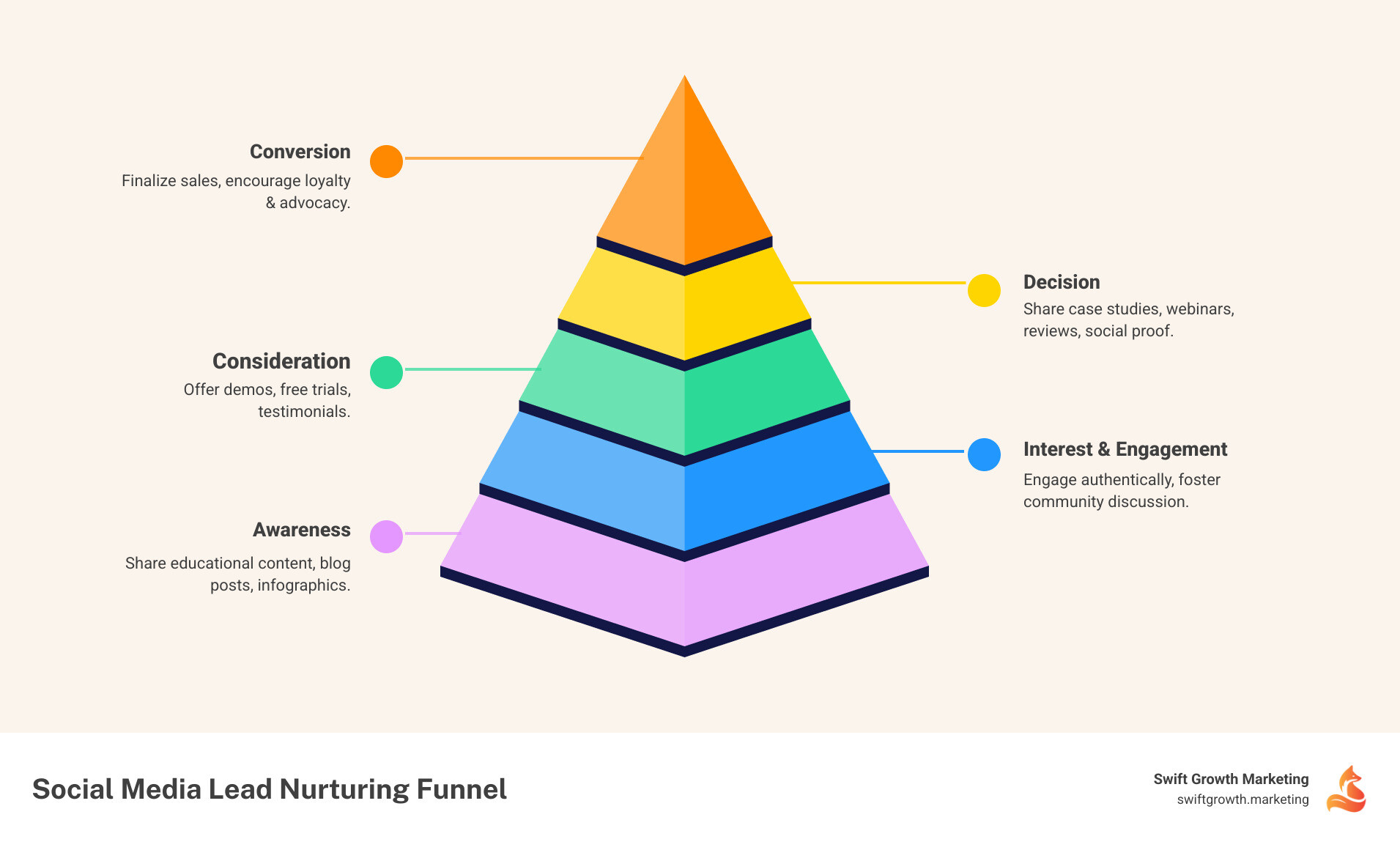
- Awareness Stage: Leads are identifying a problem. Content should be broad, educational, and problem-focused, without being overtly promotional.
- Content examples: Blog posts, infographics, industry reports, and “how-to” guides.
- Consideration Stage: Leads are researching solutions. Content should show how your offerings solve their problems.
- Content examples: Case studies, webinars, product comparisons, and expert interviews.
- Decision Stage: Leads are ready to buy. Content should address final objections and offer a clear path to conversion.
- Content examples: Demos, free trials, personalized consultations, and customer testimonials.
Mapping content to these stages ensures leads receive relevant information at the right time, as detailed in our guide to AIDA Storytelling: Crafting Brand Narratives That Convert.
High-Impact Content Formats
To connect and convert leads, leverage high-impact content formats that capture attention and encourage interaction.
- Short-form Video: Short-form video (30-60 seconds) is the top format for marketers on platforms like Instagram Reels and TikTok. Use it to tease content, showcase products, and share quick tips. 96% of video marketers find it increases user understanding of a product.
- Interactive Content: Polls, quizzes, and surveys engage audiences and gather valuable insights. They encourage participation and can act as soft lead capture mechanisms.
- Gated Content: High-value resources like e-books, whitepapers, and reports are powerful lead magnets. Promote them on social media to drive users to a landing page where they exchange contact information for the content. Reducing friction in this process is key.
- Live Video Sessions: Live video on platforms like Facebook Live and YouTube Live allows for real-time Q&As and demos. This fosters community and transparency, letting leads engage directly.
- Collaborations with Trusted Voices: Partnering with influencers or industry experts expands reach and credibility. These collaborations leverage the trust an influencer has built with their audience, which is a key part of our Hack for Social Media Ad Success.
Mastering Engagement and Community Building
Engagement is the lifeblood of social media for lead nurturing, turning passive viewers into active participants. Social media is a two-way street for building genuine relationships, not a broadcast channel.
Audience engagement is pivotal for nurturing leads because it:
- Builds Trust: Consistent interaction shows you are attentive to their needs.
- Gathers Insights: Conversations reveal pain points and preferences that inform future content.
- Enables Personalization: Social selling allows you to connect directly with prospects and address their specific challenges.
- Humanizes Your Brand: Authentic engagement showcases your brand’s personality.
We prioritize responding promptly to all comments and questions. Initiating conversations through polls and open-ended questions encourages interaction, while direct messages (DMs) are crucial for one-on-one nurturing. Crafting Strategic Messaging That Builds Trust and Drives Action ensures every interaction is purposeful.
Leveraging Social Listening for Deeper Insights
Social listening improves social media for lead nurturing by tapping into broader conversations. Monitoring relevant discussions provides invaluable insights to refine our strategies.
We use social listening to:
- Track Brand Mentions: Understand who is talking about us and their sentiment.
- Monitor Keywords: Identify discussions related to our industry to find leads or content opportunities.
- Analyze Competitors: Observe what competitors are doing and how their audience engages.
- Identify High-Intent Signals: Look for phrases indicating a user is ready to buy, like “looking for recommendations for X.”
- Uncover Customer Pain Points: Find unfiltered pain points to inspire new content or product improvements.
Leveraging these insights allows us to tailor our nurturing content more precisely. Integrating AI into this process can further boost our ability to segment audiences, as discussed in How SMBs Can Use AI to Win on Social Media in 2025.
Using Groups and Communities for Hyper-Nurturing
Social media groups and communities are powerful for hyper-focused social media for lead nurturing. They connect you with engaged individuals, creating an ideal environment to build trust and authority.
- Facebook Groups: Create or join groups to foster community. Choose a relevant, broad topic to provide value without constant self-promotion, building your credibility as an expert.
- LinkedIn Groups: These are invaluable for B2B nurturing. Engage with professionals in specific industries by sharing insights and solutions to connect with potential clients.
In these communities, the focus is on fostering genuine relationships. Avoid overt sales pitches and instead concentrate on:
- Providing Value: Share exclusive content and advice.
- Fostering Discussion: Pose questions and encourage member interaction.
- Building Trust: Consistently show up as a helpful, knowledgeable resource.
Measuring, Analyzing, and Optimizing Your Efforts
Measuring the success of your social media for lead nurturing efforts is non-negotiable. Data-driven decisions are essential to understand what works and how to continuously improve your strategies.
The ultimate goal is to connect social media activities to tangible business outcomes and demonstrate a clear return on investment (ROI). This involves tracking metrics, A/B testing, and iterating on your approach. As we highlight in 5 Tips to Getting a Better ROI from Your Growth Marketing Budget, acting on data is crucial.
We regularly analyze campaign performance to identify trends and make informed adjustments. This continuous improvement cycle ensures our nurturing strategies remain agile and effective.
Key Metrics for Measuring Success in Social Media for Lead Nurturing
To measure success in social media for lead nurturing, focus on metrics spanning engagement, lead quality, and conversion.
- Engagement Rate: Includes likes, comments, shares, and saves. High engagement indicates your content is resonating.
- Click-Through Rate (CTR): Measures how many people clicked on your calls-to-action (CTAs).
- Lead Quality Score: Assign scores to leads based on their interactions and demographics to gauge interest.
- Conversion Rate: The percentage of leads that complete a desired action. For example, LinkedIn Lead Gen Forms have an impressive 13% average conversion rate, far above the average landing page.
- Cost Per Lead (CPL): For paid campaigns, CPL helps measure spending efficiency.
- Customer Lifetime Value (CLTV): Tracks the long-term value of socially nurtured leads.
- Marketing Qualified Leads (MQLs) from Social: Tracks how many leads from social media become ready for sales outreach.
Watching these metrics provides a comprehensive understanding of your performance and enables data-driven optimization.
Tools of the Trade
To execute and measure effective social media for lead nurturing, use a suite of tools to streamline processes and provide insights.
- Native Platform Analytics: Each platform (Facebook, LinkedIn, etc.) has native analytics for insights on audience, performance, and engagement.
- Social Media Management Software: Management software like HubSpot centralizes scheduling, monitoring, engagement, and reporting.
- CRM Integration: CRM integration (e.g., HubSpot, Salesforce) is crucial for tracking interactions, enriching lead profiles, and ensuring a seamless sales handover.
- Lead Capture Forms: Use native lead gen forms (e.g., Meta, LinkedIn) that pre-populate user info to reduce friction. For your website, use landing page builders for gated content.
- Web Analytics Tools: Google Analytics helps track website traffic from social media, user behavior, and conversion paths.
By leveraging these tools, we ensure our social media for lead nurturing efforts are efficient, trackable, and continuously optimized. These solutions are part of how Swift Growth Marketing provides comprehensive digital support.
Frequently Asked Questions about Social Media Lead Nurturing
How is lead nurturing different from lead generation on social media?
Lead generation is the initial step of capturing interest and contact information. Social media for lead nurturing is the ongoing process of building relationships with those leads by providing consistent value to guide them toward a purchase. In short, generation is the “collect,” and nurturing is the “convert.”
Which social media platform is best for B2B lead nurturing?
LinkedIn is generally the best platform for B2B lead nurturing. As a professional network with over a billion members, 62% of B2B marketers report it generates leads. Its advanced targeting and professional environment are ideal for sharing thought leadership and connecting with decision-makers.
How long should a social media nurturing sequence be?
Unlike a fixed email sequence, social media for lead nurturing is an ongoing process of consistent value delivery. While specific campaigns might have a short sequence (e.g., for a webinar), the overall effort should be continuous, adapting to lead engagement until conversion. The goal is to always provide value and keep the conversation going.
Conclusion: Start Building Relationships That Last
Neglecting leads is a lost opportunity. Social media for lead nurturing is a fundamental pillar of modern marketing, recognizing that the buying journey starts with a conversation, not just a click.
We’ve covered the importance of identifying your audience, choosing the right platforms, crafting stage-specific content, and mastering engagement. By using social listening and community building, you can turn followers into prospects. Measuring and optimizing your efforts ensures every interaction contributes to your bottom line.
The future of lead nurturing is conversational and personalized. Building these relationships drives sustainable growth. At Swift Growth Marketing, we help businesses in Pittsburgh, PA, and Wheeling, WV, turn their social media into a powerful lead nurturing engine.
Ready to stop ghosting your leads and start building relationships that truly last? Take your social media strategy to the next level by exploring our Social Media resources.

chris
Insights on brand authority, positioning, and growth strategy from the Swift Growth Marketing team.