


Streamline Your Story: Top Messaging Templates for Teams
Why Your Company Needs a Messaging Strategy Template
A messaging strategy template is a structured framework that helps businesses define and maintain consistent communication across all channels. Here’s what you need to know:
Core Components of a Messaging Strategy Template:
- Mission Statement – Why your company exists
- Target Audience & Personas – Who you’re talking to
- Value Proposition – What makes you different
- Brand Pillars – 3-5 key messages that support your position
- Proof Points – Evidence (stats, testimonials, case studies)
- Brand Voice & Tone – How you sound
- Key Messaging Guidelines – Words to use and avoid
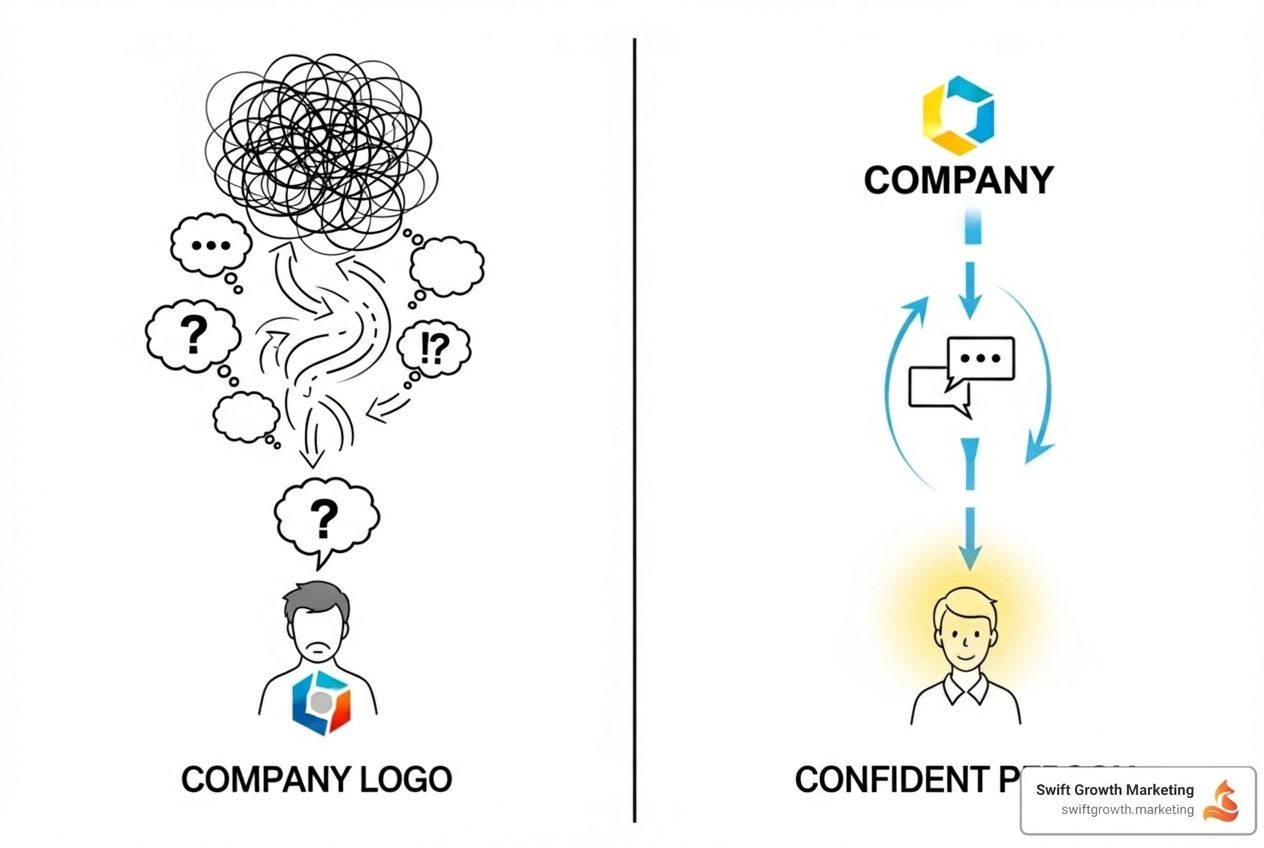
Research shows consistent messaging can increase revenue by 33%, yet many companies struggle with scattered communication that confuses prospects. Without a documented framework, teams interpret the brand differently, leading to a disconnect that costs conversions. Since messaging can determine up to 80% of your conversion rate, clarity is crucial.
A messaging strategy template solves this by giving everyone a single source of truth. It documents your positioning, defines your voice, and provides the language your entire team needs to represent your brand consistently.
I’m Chris Hornak, Co-Founder of Swift Growth Marketing, where we’ve helped education, staffing, SaaS, and e-commerce companies build messaging strategy templates that transformed invisible brands into category authorities. Over the past decade, we’ve seen how the right framework drives measurable growth.
Why a Cohesive Message is Your Greatest Asset
A messaging strategy is a marketing framework outlining how your brand communicates its key messages to its target audience. It defines what you say, how you say it, and how you ensure consistency across all touchpoints, acting as your brand’s communication blueprint.
In today’s crowded marketplace, clear communication is paramount. Since messaging can determine up to 80% of your conversion rate, a weak message means leaving money on the table.
A robust messaging strategy helps achieve several critical objectives:
- Increased Conversions: Clearly communicating your value gives prospects a compelling reason to choose you, leading to higher conversion rates.
- Brand Consistency: A unified message across all touchpoints reinforces your core identity, building trust and making your brand memorable. Consistent messaging can increase revenue by 33%.
- Internal Alignment: A messaging template acts as a playbook for all teams, reducing feedback loops and empowering everyone to speak with a single, powerful voice.
- Stronger Connections: Strategic messaging helps foster human connections with your audience, deepening trust and influencing loyalty.
For a deeper dive into crafting effective communication, explore our insights on Strategic Messaging.
Positioning vs. Messaging: What’s the Difference?
While often used interchangeably, positioning and messaging are distinct yet complementary concepts. Understanding their differences is key to building an effective messaging strategy template.
| Positioning (Internal) | Messaging (External) |
|---|---|
| Foundation: Defines your place in the market. | Expression: Translates positioning into communication. |
| Who you are: Your unique value and differentiation. | What you say: How you communicate that value to customers. |
| Consistent: Remains stable over time. | Adaptable: Can change based on campaigns or focus areas. |
| Market perception: How you want to be perceived. | Customer communication: How you actually speak to customers. |
Positioning is an internal exercise that articulates your unique benefits and how you stand apart from competitors. It’s the strategic backbone that defines your place in the market.
Messaging is external. It translates that internal positioning into tangible communication for customers. While positioning is stable, messaging can be adapted for different campaigns and channels.
The Benefits of a Unified Messaging Strategy
A unified messaging strategy is a strategic investment that pays dividends in growth and brand equity. Here are some key advantages:
- Stronger Brand Identity: Well-defined messaging ensures every customer interaction reinforces who you are, making your brand recognizable and trustworthy.
- Improved Conversion Rates: Clear messages communicate your product’s value and how it solves problems, leading to higher conversion rates.
- Internal Team Alignment: A central playbook aligns all teams around a shared story, reducing friction and streamlining workflows.
- Differentiation from Competitors: In a saturated market, clear messaging gives you a distinct identity and helps you stand out.
- Foundation for Growth: A solid messaging framework allows you to adapt and evolve campaigns while maintaining brand integrity for sustainable growth.
For guidance on building comprehensive content plans, check out our Content Strategy Brands Guide 2025.
The Building Blocks of a Powerful Messaging Framework
A powerful messaging framework is like the skeleton of your brand’s story. It provides structure, ensuring that every message we craft is consistent, impactful, and aligned with our overall business objectives. These building blocks are essential for creating a messaging strategy template that truly resonates with our audience and drives results.
We believe in a top-down hierarchy for our messaging frameworks: starting with our overarching value statement, then developing messaging pillars, and finally supporting these with compelling proof points. This systematic approach ensures clarity and coherence. To understand how we structure these elements, take a look at our insights on building a robust Brand Messaging Framework.
1. Identify Your Target Audience & Buyer Personas
The first step in developing an effective messaging strategy template is to deeply understand who you’re talking to. Without this clarity, your messages won’t connect.
To understand your target audience, engage in comprehensive voice of customer (VoC) research by listening to those who have bought or are likely to buy your solutions. Key methods include:
- Customer Interviews: Speak directly with customers to uncover their challenges, goals, and motivations.
- Surveys: Gather quantitative data on demographics, pain points, and preferences.
- Online Forums & Social Listening: Monitor online discussions for unfiltered feedback and customer language.
- Customer-Facing Teams: Leverage insights from sales and support teams who interact with customers daily.
Organizing this VoC data helps create detailed buyer personas that go beyond basic demographics to include their goals and pain points. Since 75% of customers view personalized offers positively, speaking directly to their needs is critical for results.
For B2B SaaS companies, understanding these personas is particularly vital. Focusing on the customer’s “Jobs-to-Be-Done” framework can help uncover motivations beyond surface-level needs, which is key to creating effective personas for any campaign.
2. Define Your Unique Selling Proposition (USP) & Value Pillars
Once you know who you’re talking to, define what makes you uniquely valuable to them. This is your Unique Selling Proposition (USP), which articulates what sets you apart from the competition.
To define a compelling USP, conduct a competitive analysis to identify gaps and opportunities to be different. Look at competitors’ taglines, benefits, and customer reviews to understand their positioning. By identifying what truly sets us apart, you can craft a message that resonates.
Your USP is the core benefit that makes you distinct. For example:
- Gumroad targets creators by addressing the pain point of “not getting paid enough (or at all).”
- Dollar Shave Club‘s USP focused on the convenience of monthly razor delivery.
- Yeti differentiated itself with “Grizzly Bear Proof” coolers, appealing to an audience seeking extreme durability.
- TOMS Shoes highlights its charitable mission, with “⅓ of their profits go to charitable causes.”
- LUSH stands out by focusing on sustainability and eco-friendly products.
Beyond the core USP, develop 3-4 value pillars. These are key messages that support your main differentiation. Each pillar should be backed by proof points—like statistics, testimonials, or case studies—to provide credible evidence for your claims. This structure makes your messaging both distinctive and believable.
Understanding and articulating your unique selling proposition is fundamental to cutting through the noise.
3. Craft Your Brand Story & Voice
With your audience and USP defined, the next step is to infuse personality into your communication through your brand story and voice.
Brand storytelling creates an emotional connection by explaining not just what you do, but why you do it. Your story should cover your origins, principles, and mission. Brands that are viewed as human entities are more successful at building connections and fostering trust.
Your mission statement is your North Star, guiding your brand’s purpose. It articulates why your company exists and what it aims to achieve. Delving into your company’s ethos helps craft an authentic story.
Your brand values are your promises to customers and what you believe in. Since 77% of consumers buy from brands that share their values, clearly communicating them helps attract like-minded customers. For example, Burt’s Bees reflects a love of nature in its copy, embodying an eco-conscious and friendly voice.
A distinct brand voice defines how you sound to your audience. Is your brand happy, serious, or witty? Your voice is your brand’s personality, encompassing word choice, grammar, and style. Create detailed tone of voice guidelines, including words to use and avoid, to ensure consistency.
These elements are crucial for engaging your audience. Dive deeper into this topic with our guides on Storytelling in Content Marketing and Brand Voice Elements.
Your Go-To Messaging Strategy Template Toolkit
Now that we’ve covered the foundational elements, let’s talk about the practical application: the messaging strategy template itself. This toolkit is designed to be our single source of truth, ensuring that our messaging remains clear, consistent, and customer-focused across all teams and channels. Using these frameworks and templates helps us streamline our processes, improve collaboration, and ensure scalability as our business grows.
Building effective messaging can be time-consuming, and maintaining consistency across diverse teams can feel like an impossible challenge. That’s why a structured framework is so valuable. It deconstructs complex messaging into manageable elements like value statements, core concepts, and proof points, improving clarity and our ability to launch new initiatives more swiftly.
For a practical resource, consider frameworks like The messaging cheat sheet, which offers a structured approach to creating clear, consistent, and customer-focused messaging.
The Comprehensive Messaging Strategy Template
A robust messaging strategy template should include the following sections to provide a complete and actionable guide for your team:
- Mission Statement: A concise statement articulating our company’s core purpose, what we aim to achieve, and the principles we uphold. This is our North Star.
- Target Audience & Personas: Detailed profiles of our ideal customers, including demographics, psychographics, pain points, goals, and communication preferences. This ensures we’re always speaking to the right people.
- Positioning Statement: An internal statement that defines how our brand differentiates itself from competitors and occupies a unique space in the market.
- Value Proposition: A clear, concise statement explaining the unique benefits our product or service offers and why it’s the best solution for our target audience.
- Brand Pillars (3-4 key messages): The core themes or messages that consistently support our value proposition and positioning. These are the main ideas we want our audience to remember.
- Proof Points (Stats, Testimonials, Case Studies): Evidence that validates our claims and builds trust. This includes data, customer success stories, and endorsements.
- Brand Voice & Tone: Guidelines describing our brand’s personality and how it should sound across different channels and contexts (e.g., professional, friendly, humorous).
- Key Words (To use/avoid): A list of specific terminology, industry jargon, or emotional words to incorporate, and those to steer clear of, to maintain consistency and clarity.
- Tagline/Elevator Pitch: A memorable, succinct phrase or short narrative that encapsulates our brand’s essence and value proposition, brief enough to deliver in a short time.
A Simple Framework for Quick Wins: Pain-Claim-Gain
While a comprehensive template is ideal for in-depth strategy, sometimes we need a simpler framework for quick wins or to solidify a core message. The Pain-Claim-Gain framework is an excellent tool here, simplifying and solidifying messaging so that it’s concise, impactful, and speaks directly to our target audience.
Here’s how it works:
- Pain: Clearly articulate the specific problem, challenge, or pain point our target audience is experiencing. This shows empathy and immediately grabs their attention.
- Example (Software for small businesses): “Struggling to manage your customer relationships across multiple spreadsheets and platforms?”
- Claim: State your solution directly and confidently. This is your promise to alleviate their pain.
- Example: “Our intuitive CRM software centralizes all your customer data in one easy-to-use system.”
- Gain: Describe the tangible benefit or positive outcome the customer will experience by using your solution. This highlights the change.
- Example: “Save hours every week, boost sales efficiency by 20%, and build stronger customer loyalty with seamless communication.”
This framework allows us to quickly identify the core elements of our message and ensures we are always focusing on the customer’s needs and the value we provide.
From Document to Dialogue: Activating and Refining Your Message
A messaging strategy template is a living document that requires ongoing implementation, testing, and optimization to remain effective. This iterative process ensures your messages resonate with your audience at every stage of their journey.
Our approach to growth marketing emphasizes continuous improvement. Learn more in our guide on Growth Marketing Components Accelerate Your Marketing Strategy.
How to Test and Refine Your Messaging
Testing and refining messaging is an ongoing commitment. Here are some go-to methods:
- A/B Testing: Test different headlines, CTAs, and value propositions on web pages and ads to see which versions perform best.
- Customer Feedback Surveys: Periodically survey customers for direct feedback on messaging clarity and relevance.
- Heatmaps and User Behavior Analytics: Use tools to see how visitors interact with your content and identify areas of confusion.
- Conversion Rate Analysis: Track analytics and conversion rates to identify which messages are driving results.
- Sales Team Feedback: Gather real-world feedback from your sales team on which phrases and objections come up during calls.
- Specialized Testing Services: For in-depth validation, services like Wynter can test your messaging against a target audience.
By continuously testing, you ensure your messaging remains sharp and effective. For expert assistance, consider our Conversion Rate Optimization Service.
Personalizing Messages for Different Channels & Touchpoints
Personalizing messages for different channels is critical, as 75% of customers view personalized offers positively. Use customer journey mapping to adapt your messaging for each stage.
- Social Media: Focus on thought leadership on professional platforms like LinkedIn and use concise, visual copy on others. Our Brand Voice on Social Media guide offers more tips.
- Email: Personalize emails based on user behavior and interests. For more insights, explore email messaging strategies.
- In-Product Messaging: Use tooltips and guided tours for onboarding and feature announcements.
- Website Copy: Use simple, benefit-driven language with strong CTAs and social proof.
- Paid Ads: Craft attention-grabbing headlines and compelling CTAs custom to specific customer segments.
Maintaining consistency across all channels is paramount to avoid customer confusion.
When to Update Your Messaging Strategy
A messaging strategy must evolve with the market. Here are key triggers for an update:
- Market Shifts: Changes in trends, customer behavior, or the competitive landscape.
- Product Updates: New features or services require new messaging to explain their benefits.
- Rebranding: A Company Rebranding Strategy requires a complete messaging overhaul.
- Low Sales Adoption: If the sales team struggles to explain your value, the messaging may be unclear.
- Negative Customer Feedback: Consistent confusion or negative feedback signals a need for adjustment.
- Competitor Actions: If a competitor shifts their positioning, assess if your messaging still stands out.
For example, Zoom’s messaging evolved during the pandemic from focusing on business meetings to becoming a full communications platform. Regularly reviewing data and feedback (at least quarterly) ensures your messaging remains effective.
Frequently Asked Questions about Messaging Strategy
How is a messaging strategy different from a content strategy?
A messaging strategy defines the “what” and “why” of our communication – the core ideas, values, and unique propositions we want to convey. It’s the strategic blueprint. A content strategy, on the other hand, is the “how” and “where” we deliver that message. It outlines the types of content we’ll create (blog posts, videos, social media updates), the channels we’ll use, and the editorial calendar. Think of messaging as the script, and content strategy as the production plan.
How long does it take to create a messaging strategy?
The timeline for developing a comprehensive messaging strategy template can vary significantly depending on the size and complexity of the business, as well as the resources allocated. For smaller businesses or specific product lines, it might take a few weeks. For larger organizations with multiple products and diverse target audiences, it could extend to several months. The process typically involves extensive research, internal collaboration across departments, and iterative testing and refinement.
Can I use one message for all my customers?
While tempting for simplicity, using one generic message for all customers is generally not recommended. Our research shows that 75% of customers view personalized offers positively. Segmenting your audience and tailoring messages to their specific pain points, goals, and stage in the customer journey leads to significantly higher engagement and conversion rates. A robust messaging strategy template allows for this personalization while maintaining overall brand consistency.
Conclusion
Developing and implementing a solid messaging strategy template is not merely a marketing exercise; it’s a fundamental investment in your brand’s future. We’ve explored how a cohesive message acts as your greatest asset, driving conversions, fostering internal alignment, and building a strong, memorable brand identity. Understanding the distinction between positioning and messaging, and leveraging frameworks like the Pain-Claim-Gain model, empowers our teams to communicate with unparalleled clarity and impact.
The key takeaways are clear: consistency is paramount, templates provide the necessary structure, and continuous testing and refinement are essential for long-term success. By deeply understanding your audience, defining your unique value, and crafting an authentic brand story and voice, you lay the groundwork for messages that not only resonate but also convert.
At Swift Growth Marketing, we understand that a strong messaging strategy is a core part of any successful growth marketing plan. Let our experts help you build yours. Find how we can transform your communication and accelerate your growth by visiting our Growth Marketing Consultancy.

wadeo
Insights on brand authority, positioning, and growth strategy from the Swift Growth Marketing team.