


The Ultimate Topical Content Strategy: Boost Your SEO Authority
Why Search Engines Reward Subject Matter Experts Over Keyword Stuffers
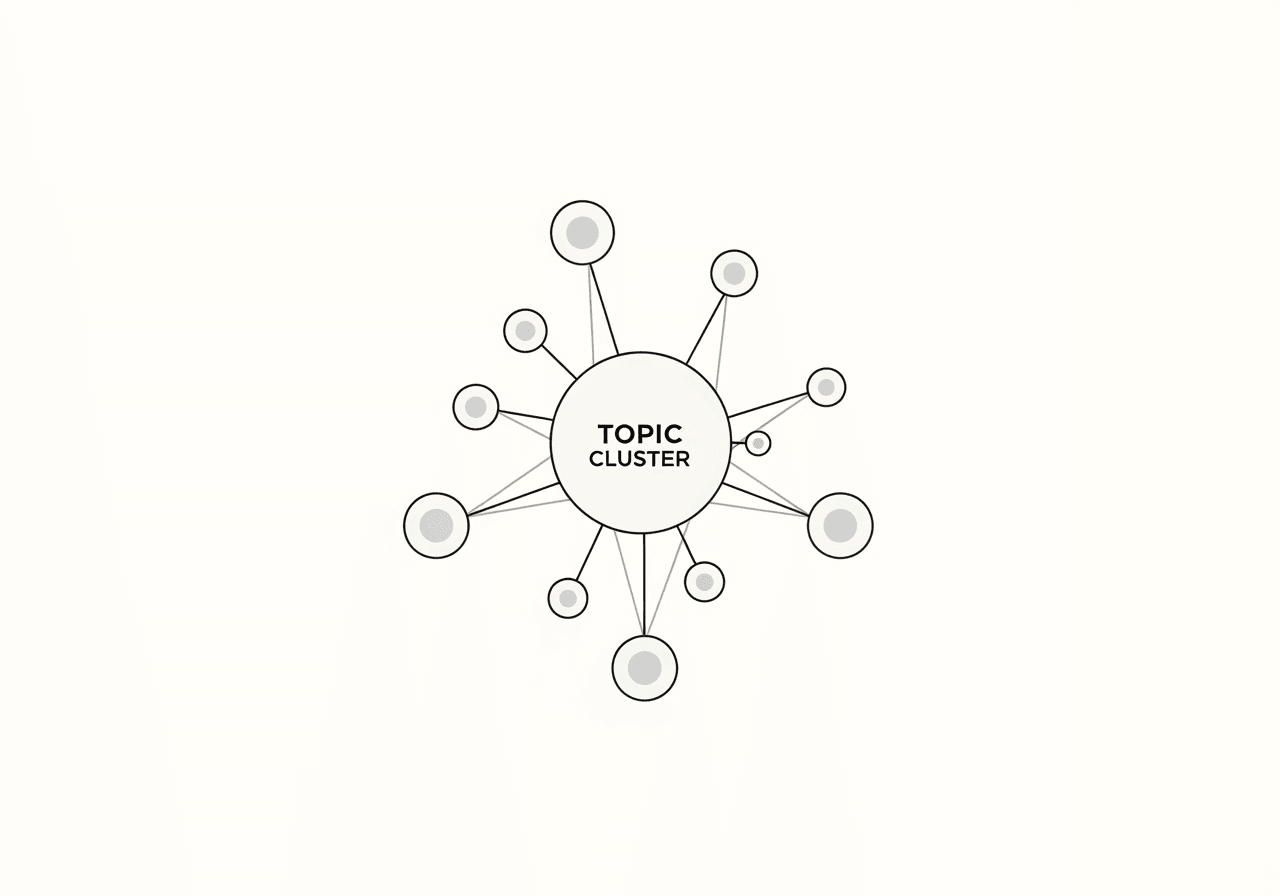
A topical content strategy is a modern SEO approach focused on building comprehensive coverage around specific subjects rather than targeting individual keywords. Instead of creating isolated articles, you develop an interconnected content ecosystem that demonstrates deep expertise in your niche. This involves identifying core topics, mapping out subtopics, creating in-depth pillar and cluster content, and linking them strategically.
This approach works because search engines have evolved beyond simple keyword matching. They use semantic search to understand context and expertise. Data shows that websites ranking in the top positions cover significantly more related subtopics. For businesses, this shift is crucial: websites with strong topical authority receive 47% more organic traffic for related queries and rank for more keywords within their niche. Instead of fighting for single high-volume keywords, you capture hundreds of related searches by proving your expertise.
At Swift Growth Marketing, we’ve seen this strategy transform businesses, helping clients achieve massive growth in monthly visitors. A strategic topical approach builds lasting authority and consistently outperforms outdated keyword tactics.
Understanding Topical Authority: The Shift from Keywords to Comprehensive Coverage
In the past, SEO was often about keyword density. Today, search engines are far more sophisticated; they prioritize genuine expertise over keyword stuffing. This shift toward topical relevance changes how we create content. It’s no longer enough to mention a keyword. Search engines want to see a deep understanding of the entire topic, including its context, nuances, and related concepts.
This change is driven by semantic search, which understands meaning and intent, not just words. When a user searches for a broad query, Google anticipates related needs—like backlinks, content quality, and technical SEO—even if those terms weren’t used. Your content must address this full spectrum of user needs, demonstrating a content depth that search engines reward.
This is directly tied to Google’s E-E-A-T guidelines (Experience, Expertise, Authoritativeness, and Trustworthiness). Consistently publishing comprehensive, helpful content signals that you are a reliable source. User satisfaction signals, such as dwell time and click-through rates, reinforce this authority. When users find your content valuable, search engines take note.
| Feature | Traditional Keyword-Focused SEO | Topical Content Strategy |
|---|---|---|
| Intent | Narrows focus on individual keyword intent. | Addresses holistic user intent across the topic. |
| Effort | Often leads to duplicated effort for similar keywords. | Efficiently covers broad topics, reducing redundancy. |
| Prioritization | Based on individual keyword search volume. | Based on topic search volume and business value. |
| Scope | Single-page optimization for specific terms. | Interconnected content ecosystem building expertise. |
| Goal | Rank for a few high-volume keywords. | Become the expert resource for an entire subject. |
What is Topical Authority and Why is it Crucial for SEO?
Topical authority is the credibility your website earns by demonstrating deep knowledge in a specific area. It’s your digital reputation as the go-to expert. This is achieved by thoroughly covering a subject, addressing main questions, follow-ups, and related concerns.
This comprehensive approach signals expertise to search engines and aligns with E-E-A-T principles. While not a direct ranking factor, topical authority influences many measurable factors. Research by Semrush found that top-ranking websites cover 1.5x more related subtopics than lower-ranking ones. This competitive advantage translates directly into better search visibility and more organic traffic. By building strong topical authority, you don’t just rank for one keyword; you appear for hundreds of related searches, capturing traffic from multiple angles.
The Core Principles of Building Topical Authority
To build it, focus on these core principles:
- Content Comprehensiveness: Go deep on subjects to create a resource that fully answers user questions.
- Strategic Topic Clustering: Organize content into pillar pages (broad overviews) and cluster pages (deep dives on subtopics), all interconnected with links.
- Entity Recognition: Consistently mention relevant people, places, and concepts to help search engines understand context.
- Consistent Terminology: Use the same terms across your content to create clarity for both users and search engines.
- User Journey Mapping: Create content that addresses informational, navigational, and transactional intent, guiding users at every stage.
How to Build Your Topical Map: A 5-Step Blueprint
A topical map is your content’s GPS, organizing existing and future content around central themes to ensure comprehensive coverage. It’s a visual plan that helps structure your website, strengthen internal linking, and identify content gaps. Here’s how to create one step-by-step.

Step 1: Identify Your Core Topics and Areas of Authority
First, define what you want to be known for. Ask fundamental questions: What are your core business goals? What are your target audience’s needs? What is your unique niche expertise? At Swift Growth Marketing, our core topics—SEO, social media, content creation, and web design—directly align with our services and client needs in Pittsburgh, PA, and Wheeling, WV.
Start with a content audit to assess your current strengths. Then, conduct a competitive analysis to find gaps in the market where you can establish unique authority. We recommend focusing on three to five core topic areas that align with your value proposition to avoid diluting your efforts.
Step 2: Research Subtopics and Related Entities
With core topics defined, dive into the details. Use keyword research tools to find clusters of related terms, but go further. Analyze the Search Engine Results Pages (SERPs) to understand what content is ranking and what user intent it satisfies. The “People Also Ask” boxes in Google are excellent for finding direct questions your audience is asking.
Focus on identifying semantic relationships between concepts. This helps build a robust list of subtopics and related entities (specific people, places, and concepts) that thoroughly cover your main theme. For a core topic like “SEO,” subtopics might include local SEO, technical audits, and link building.
Step 3: Organize Subtopics by User Intent
Align your content with what users need at different stages of their journey. Organize your subtopics around the primary types of user intent:
- Informational: Users looking for answers or general knowledge (guides, educational posts).
- Navigational: Users trying to find a specific website or page.
- Commercial Investigation: Users researching a product or service before purchase (comparisons, reviews).
- Transactional: Users ready to buy or take action (service pages, pricing guides).
Categorizing subtopics by intent ensures your content meets users wherever they are, improving both SEO performance and conversion rates.
Step 4: Visualize Your Topical Map and Identify Gaps
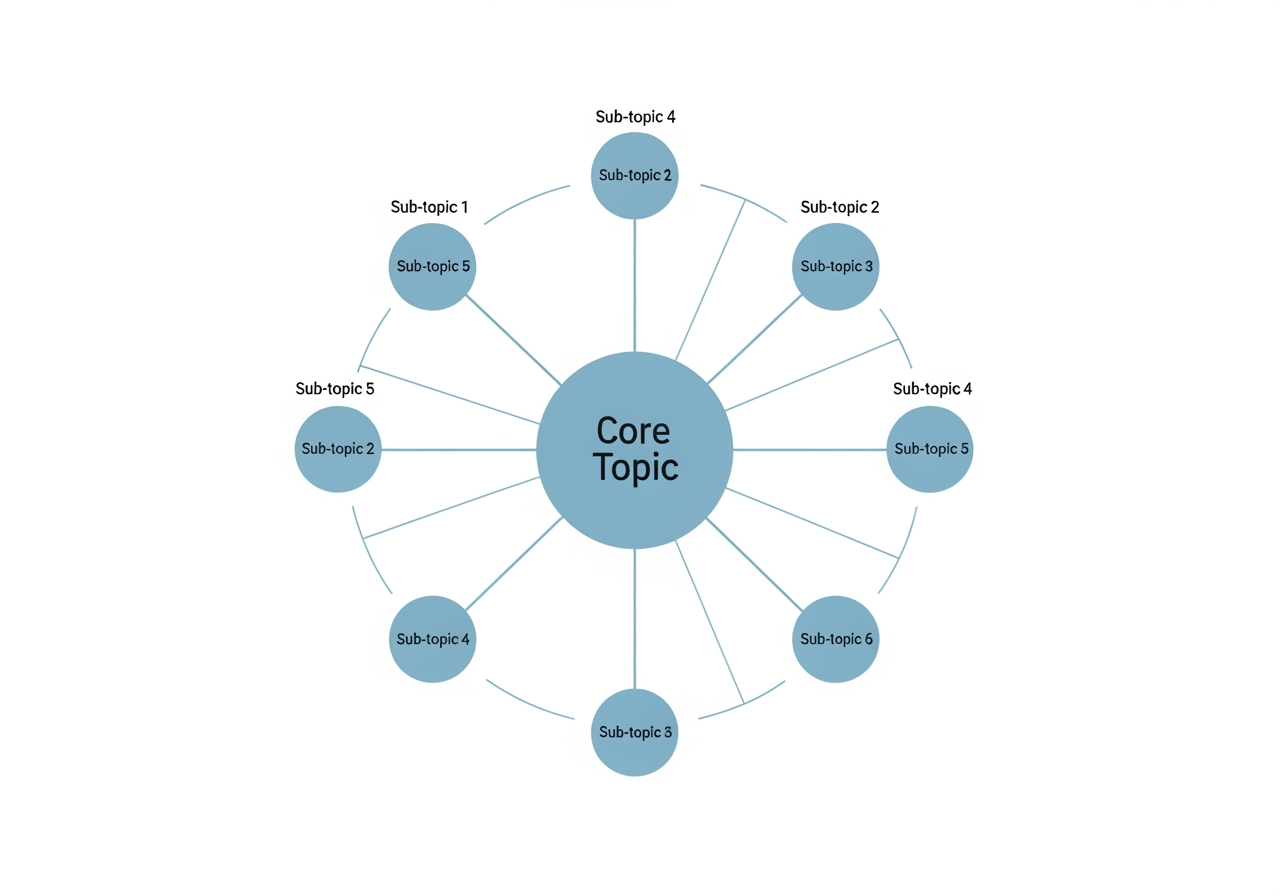
Use tools like Miro, MindMeister, or XMind to create a visual map of your content structure. Place your core topic at the center and branch out to subtopics and individual content ideas. This visualization helps distinguish your pillar content (broad guides) from your cluster content (deep dives).
This map makes content gaps obvious. You might see that one subtopic is over-saturated while another is completely neglected. Use this content gap analysis to prioritize new content creation based on user interest and business value.
Step 5: Create a Content Calendar
Your topical map guides the creation of a strategic content calendar. This is a publishing schedule that outlines what content to create, in what format, and when. Consider different formats like videos, infographics, or interactive tools to appeal to diverse audience preferences.
Allocate resources realistically—quality is more important than quantity. Create detailed content briefs for each piece, including target keywords, user intent, and your unique angle. This ensures consistency and focus. Your calendar should be flexible, allowing you to adapt your strategy based on performance data and audience feedback.
Executing Your Topical Content Strategy for SEO Dominance
Building a topical map is the first step; execution brings it to life. This involves consistent, high-quality content creation, a strategic internal linking architecture, and supportive technical SEO. When these elements align, you create an exceptional user experience that signals authority to search engines.
How to Structure Content for Your Topical Content Strategy
Organizing content effectively is key. The topic cluster model is a popular structure with three main components. At the center are pillar pages, which are comprehensive, long-form guides that broadly cover a core topic. Surrounding each pillar are topic clusters—individual articles that dive deep into specific subtopics mentioned in the pillar. Each cluster piece links back to the pillar page and often to other relevant cluster pages.
For example, a pillar page on “SEO Services in Pittsburgh, PA” would be supported by cluster content like “Best Local SEO Strategies for Restaurants in Pittsburgh.” Sometimes, broader hub pages are used to organize multiple pillar pages. Diversifying content formats like videos, infographics, and guides within this structure helps engage a wider audience.
How to Use Internal Linking to Reinforce Authority
Internal linking is the framework that connects your content, guiding readers and showing search engines how your pages relate. Use descriptive anchor text that provides context (e.g., “learn more about local SEO strategies” instead of “click here”).
Establish a clear link hierarchy where cluster pages link to their pillar page. Also, link between related cluster pages to create a web of information. These contextual links, embedded naturally within the content, add value for the reader. This strategy also helps avoid content cannibalization, where multiple pages compete for the same keywords, and passes link equity throughout your site, boosting the performance of the entire topic cluster.
Technical SEO Elements that Support Your Topical Content Strategy
Great content needs a solid technical foundation to ensure search engines can find and understand it.
- Schema Markup: Use structured data like Article or FAQPage schema to explicitly tell search engines what your content is about. This can lead to rich snippets in search results.
- URL Structure: Create logical, topic-focused URLs (e.g.,
/seo-services/local-seo/) that reflect your site’s hierarchy. - Site Architecture: Design a clean, logical site structure that mirrors your topical map, making it easy for search engines to crawl and index your content.
- Mobile Optimization: Ensure your content is easily readable and navigable on all devices, as this directly impacts user satisfaction.
- Page Speed: Optimize images and code to ensure your pages load quickly. A fast site keeps users engaged and sends positive quality signals to search engines.
Measuring Success and Navigating Common Pitfalls
Building topical authority requires ongoing effort and measurement. To ensure your strategy is effective, track the right metrics and be aware of common traps that can derail your progress.

How to Measure the Success of Your Strategy
There isn’t a single metric for topical authority. Instead, track a combination of Key Performance Indicators (KPIs) to get a clear picture:
- Organic Traffic Growth: Monitor the overall increase in search traffic, paying close attention to pages within your topic clusters.
- Keyword Rankings for Clusters: Track how groups of related keywords perform together. An increase in rankings across a whole topic is a strong positive signal.
- Engagement Metrics: Look at dwell time, bounce rate, and pages per session. Healthy numbers indicate your content is satisfying user intent.
- Featured Snippet Acquisition: Earning these “answer boxes” at the top of search results is a strong sign of expertise.
- Lead Quality: For a business like Swift Growth Marketing, success means attracting qualified leads from our target areas like Pittsburgh, PA, and Wheeling, WV, that convert into clients.
Common Pitfalls to Avoid When Building Topical Authority
- Superficial Coverage: Avoid publishing many thin articles. Quality and depth beat quantity. One comprehensive guide is better than five shallow posts.
- Content Dilution: Don’t try to be an expert in everything. Focus on one to three core topics, dominate them, and then expand.
- Inconsistent Terminology: Use consistent terms for the same concepts across your content to avoid confusing readers and search engines.
- Disconnected Content: Ensure your articles are interconnected through internal links. Isolated content doesn’t build authority.
- Neglecting Content Updates: Regularly audit and update your content to keep it fresh, accurate, and trustworthy.
The Impact of AI on Building Topical Authority
AI is a powerful tool for content creation, but it’s not a replacement for human expertise. Use AI for research and to generate initial drafts, but always have experts review, edit, and enrich the content. At Swift Growth Marketing, our team adds unique perspectives and real-world experience that AI cannot replicate.
The content that builds true authority includes original data, case studies, and proprietary frameworks. This is where human insight and experience are irreplaceable. Use AI to work faster and smarter, but ensure your authentic voice and genuine knowledge remain at the core of your content.
Frequently Asked Questions about Topical Content Strategy
How long does it take to build topical authority?
Building topical authority is a long-term investment. You can expect to see initial improvements in rankings and traffic within 3-6 months. However, establishing true, lasting authority typically takes 12-18 months of consistent, high-quality content creation and maintenance. The good news is that once established, this authority compounds, helping new content rank faster and solidifying your position as a trusted resource.
What’s the difference between topical authority and domain authority?
These two concepts are related but distinct. Topical authority measures your website’s expertise in a specific subject area, earned through comprehensive and credible content. Domain authority (a metric from Moz, not Google) measures your website’s overall strength and trustworthiness, based largely on its backlink profile.
A site can have high topical authority in a niche with only moderate domain authority. As your topical authority grows, you’ll naturally attract quality backlinks, which in turn helps increase your domain authority. They reinforce each other.
How many topics should I focus on initially?
Less is more when you’re starting. We strongly recommend focusing on 1-3 core topics that are central to your business. This allows you to invest the necessary resources to build deep, meaningful authority in those areas before expanding.
It’s more effective to be the definitive resource for a few topics than to have shallow coverage across many. Once you’ve gained significant traction in your initial topics—ranking well, driving traffic, and seeing high engagement—you can gradually expand to related subjects. This focused approach makes resource allocation manageable and leads to better results faster.
Conclusion
As search engines become more sophisticated, outdated SEO tricks are no longer effective. A topical content strategy isn’t about gaming the system; it’s about becoming the genuine resource your audience needs. By committing to comprehensive coverage of your chosen topics, you invest in long-term SEO success that can withstand algorithm updates.
This approach transforms your brand from just another website into a trusted authority. This positioning attracts the right kind of traffic—users who trust your expertise are more likely to become customers. The authority you build is a compounding asset that competitors cannot easily replicate.
At Swift Growth Marketing, we’ve helped businesses in Pittsburgh, PA, and Wheeling, WV, achieve this change. Crafting a powerful topical strategy takes time and expertise, and our team is here to build a custom plan around your unique goals.
Ready to establish your brand as the go-to expert? Let’s create a strategy that drives real, sustainable growth.

chris
Insights on brand authority, positioning, and growth strategy from the Swift Growth Marketing team.