


The SEO Topical Map Explained: How to Create Yours
Why You Need a Topical Map to Win Modern SEO
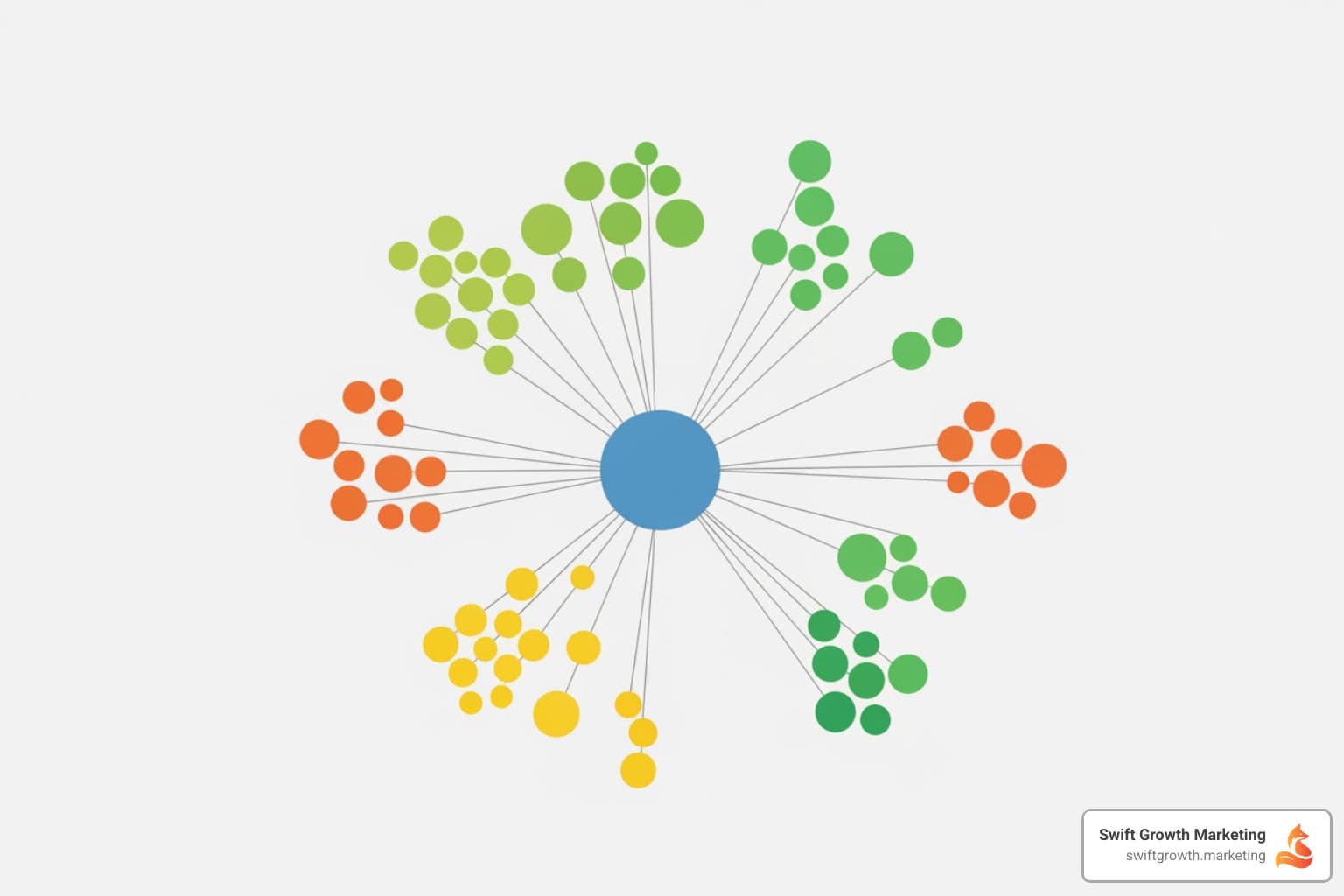
A topical map is a strategic blueprint of your website’s content, organized hierarchically around a core subject to demonstrate comprehensive expertise to search engines and users.
Key elements of a topical map include:
- Main Topics – Broad foundational pillars of your expertise
- Subtopics – Specific aspects that create depth and comprehensive coverage
- Content Clusters – Groups of related content organized by user intent
- Internal Links – Strategic connections that show relationships between topics
- Hierarchy – A logical structure from broad concepts to specific details
The days of keyword stuffing are over. Search engines have evolved to understand topics, not just isolated keywords. They reward websites that demonstrate comprehensive expertise across an entire subject area.
This shift means your content strategy must evolve. Instead of chasing individual keyword rankings, you need to build topical authority—proving to Google that you’re a legitimate expert. A topical map is your blueprint for doing just that.
When you implement a topical map, you create a web of interconnected content that answers every question your audience might have. This approach delivers real results: websites focusing on topical authority see a 2.5x increase in organic traffic, and content within a structured map has a 3x higher chance of ranking on page one.
Over 90% of SEO practitioners now recognize topical authority as crucial, yet many businesses still publish scattered articles that fail to build the authority needed to compete.
I’m Chris Hornak, Co-Founder of Swift Growth Marketing, where we’ve transformed brands into industry authorities by implementing strategic topical maps. Understanding what a topical map is and how to create one has been central to achieving results like 45,000 monthly visitors for a local business and a 764% traffic increase for an e-commerce client.

A topical map helpful reading:
What is a Topical Map and Why is it Crucial for Modern SEO?
Think of a topical map as your website’s master plan—a strategic blueprint that guides you to cover every important angle of a subject. It’s not just about having lots of content; it’s about creating a knowledge web where each piece connects to the others, forming a complete resource that positions you as the go-to authority in your field.
This is fundamentally different from old-school SEO. Instead of chasing individual keywords, we’re building around entire topics, moving from siloed pages to an interconnected ecosystem of content. When someone asks what is a topical map, this is the core of it: a shift from keyword-centric thinking to a topic-centric strategy.
Why does this matter? Because search engines have gotten remarkably smarter. They no longer just match words; they understand meaning, context, and intent. Updates like Hummingbird, RankBrain, and BERT have enabled Google to grasp the nuances of language. You can explore this fascinating evolution in our guide on the Evolution of Google’s Search Algorithm.
Today’s search engines use semantic search to interpret what users actually mean. This technology looks at context, relationships between concepts, and the deeper meaning behind words. For a technical look, Google’s guide to semantic search technology offers valuable insights. A topical map helps us create content that’s rich in meaning and context, matching how search engines think.
How Topical Maps Differ from Traditional Keyword Research
The shift from traditional keyword research to topical mapping is a fundamental evolution in content strategy. Keywords are still important, but their role has changed. Here’s how the two approaches compare:
| Feature | Topical Maps | Traditional Keyword Research |
|---|---|---|
| Primary Focus | Topic-centric: comprehensively covers an entire subject area | Keyword-centric: targets individual keywords or phrases |
| Content Structure | Interconnected content: builds a “knowledge web” with pillar pages and supporting cluster content | Siloed pages: often results in disconnected articles optimized for single keywords |
| Goal | Builds topical authority: positions the website as an expert source for a broad subject | Achieves individual keyword rankings: aims to rank for specific search terms |
| Search Engine Perception | Signals deep expertise and relevance across a domain, aligning with semantic search | May appear less authoritative if content is shallow or disconnected |
| User Experience | Improved: users find comprehensive answers and easily steer related content | Potentially fragmented: users might need multiple sites to gather complete information |
| Content Strategy | Strategic blueprint: guides planning, identifies gaps, prevents cannibalization | Reactive: creates content based on individual keyword opportunities without a cohesive plan |
| Long-Term Impact | Sustainable growth: builds lasting authority resilient to algorithm changes | Short-term gains: vulnerable to updates, requires constant adaptation |
The traditional approach often leads to “content islands”—individual pages that rank for specific terms but don’t connect to anything else. They might get some traffic, but they don’t build the comprehensive authority that modern search engines reward.
Understanding Topical Authority
Topical authority is what happens when search engines recognize your website as a trusted expert in a specific subject area. It’s not something you claim—it’s something you earn through comprehensive, high-quality content that covers a topic from every relevant angle.
Google wants to connect users with sites that demonstrate comprehensive knowledge and real expertise. This is why Google’s E-E-A-T guidelines emphasize demonstrating experience and building trust. When you create a robust topical map, you’re proving to search engines that your site deserves to be the go-to resource, establishing authority across an entire domain of knowledge.
We dive deeper into this concept in our article on Content Clusters Build Topical Authority with Pillar Cluster Architecture, where we explore the mechanics of building this authority through strategic content structure.
The Core Components of an Effective Topical Map
Building a topical map is like designing a city. You need main highways (pillar pages), neighborhood streets (cluster content), and clear signs (internal links) to guide visitors and search engines. Without this structure, everyone gets lost.
An effective topical map relies on several interconnected elements: pillar pages as main hubs, cluster content for detailed exploration, strategic internal linking to connect everything, and a deep understanding of search intent. This entire structure follows a Hub and Spoke SEO model, where content radiates from central points of expertise. These components work together to demonstrate your comprehensive understanding of a subject.
Pillar Topics: The Foundation of Your Expertise
Your pillar pages are the bedrock of your topical map. These are comprehensive, authoritative articles that cover a broad topic in substantial detail. If you’re wondering about what is a topical map’s architecture, think of pillar pages as the main chapters in a textbook.
A strong pillar page provides genuine value by answering the most important questions about its core subject while serving as a launchpad to more detailed content. For example, a pillar on “Email Marketing” would cover the fundamentals and then link out to focused articles on subject lines, automation, or list segmentation.
This structure helps users steer your content intuitively and signals to search engines that you’ve created a comprehensive resource, proving your authority on the subject. Learn more about their strategic value in How Pillar Pages Play a Role in Your Growth Marketing Strategy.
Topic Clusters: Building Depth and Relevance
While pillar pages provide the foundation, topic clusters build the depth that establishes true expertise. These are specialized articles that branch out from your pillar pages, each exploring a specific subtopic in detail.
If your pillar page covers “Content Marketing,” your topic clusters might dive into content strategy, distribution channels, or measuring ROI. Each cluster article provides focused, actionable information that the pillar page can only touch on briefly.
This is where keyword clustering is essential. You group related search terms based on semantic relationship and user intent. For instance, keywords like “how to create a content strategy” and “content planning template” share the same intent and belong in the same article.
This approach solves keyword cannibalization, where multiple pages accidentally compete for the same keywords. Clustering ensures each piece of content has a distinct purpose, making your site more organized. Clusters also help capture long-tail keywords—longer, more specific search phrases that often signal higher purchase intent.
For a deeper look at how this strategy works, check out our guide on Topical Cluster SEO.
Search Intent: The Guiding Principle for Your Topical Map
Understanding search intent—the “why” behind a search—is crucial. It’s not just about the words people use, but their goal. This understanding must guide every content decision in your topical map.
- Informational: The user wants to learn something (“how to,” “what is”). Create educational guides, tutorials, and explainer articles.
- Navigational: The user is trying to find a specific site or page (e.g., searching for your brand name). Ensure your site is easy to steer.
- Commercial Investigation: The user is researching before making a decision (“best,” “review,” “comparison”). Offer comparison guides, detailed reviews, and case studies.
- Transactional: The user is ready to act (“buy,” “pricing,” “free trial”). Your landing pages, product pages, and service pages must be clear and conversion-focused.
By mapping your content to these intent types, you create a complete journey for your audience, from initial learning to final purchase. This comprehensive approach is what transforms a simple content plan into a powerful topical map.
How to Create a Topical Map in 6 Essential Steps
Building a topical map is a logical process. Think of it like planning a road trip: know your destination, map the route, and ensure all stops connect smoothly. Here’s a simplified guide to creating your content roadmap.
Step 1: Identify Your Core Topic
Every topical map starts with a clear destination: the broad subject area where you want to become the go-to expert. This decision should align with your business goals, target audience, and niche expertise.
- Business Goals: What products or services drive your revenue?
- Target Audience: What are their pain points and questions?
- Niche Expertise: Where does your team have genuine, deep knowledge?
- Competitor Analysis: What topics are competitors covering well, and where are the gaps?
Finally, brainstorm seed keywords—broad terms related to your core offering—to use as a starting point for research.
Step 2: Research and Identify Subtopics
Once you have your core topic, map out the surrounding landscape. Use keyword research tools like SEMrush or Ahrefs to identify subtopics and gauge search volume and competition.
Beyond tools, look for real user questions. Google’s People Also Ask boxes, related searches, and autocomplete suggestions are goldmines. Also, explore forums and Q&A sites where your audience discusses their pain points. The goal is to identify content gaps—questions your competitors aren’t answering well.
Step 3: Group Keywords into SERP-Based Clusters
Instead of just listing keywords, group them based on user intent. The secret is SERP analysis: when you see the same pages ranking for multiple keywords, it means those terms share the same intent. Google has already determined that users are looking for the same information.
This approach allows you to create one authoritative article that satisfies user needs comprehensively, rather than three shallow ones. Most importantly, it helps you avoid content duplication and prevents your own pages from competing against each other for rankings.
Step 4: Structure and Visualize Your Topical Map
A topical map needs to be a visual blueprint you can work with. Use mind mapping software like Miro or a well-organized spreadsheet to create a clear hub-and-spoke model. Your core topic sits at the center, with pillar pages branching out and cluster content extending from each pillar.
This visual map makes it easy to see how everything connects and identify any gaps in your strategy. At this stage, plan your URL structure to reflect your content hierarchy (e.g., yourdomain.com/pillar/cluster). This logical organization helps both users and search engines, a key element of a Strong SEO Foundation with On-Page SEO.
Step 5: Plan Content and Assign Content Types
With your map laid out, decide on the best format for each piece of content. Integrate your map into a content calendar to stay organized and think about content diversity.
- Blog posts are great for informational queries.
- Guides make excellent pillar pages.
- Videos and infographics can simplify complex topics.
- Landing pages are essential for transactional intent.
The key is to match the content type to the user’s needs at that moment. For more on this, see our insights on Content Marketing for Brands.
Step 6: Build, Interlink, and Publish
This is where your map comes to life. Strategic internal linking is the architecture that holds your topical map together. Your pillar pages should link down to their cluster content, cluster articles should link up to their parent pillar, and related cluster articles should link sideways to each other.
This isn’t busy work. Google’s algorithms use internal links to understand how your content relates to itself, as noted in their official SEO Starter Guide. A well-connected site signals expertise and authority, creating a better experience for visitors by guiding them naturally from one helpful piece of content to the next.
Maintaining Your Map for Long-Term SEO Success
Think of your topical map as a garden, not a statue. It needs regular care to stay vibrant. A topical map is a living document that should evolve with your business, industry, and audience. This commitment to continuous improvement helps maintain topical authority and align with Google’s E-E-A-T standards.
Regular maintenance isn’t just about staying relevant—it’s about staying ahead. By conducting content audits, tracking performance metrics, and refreshing evergreen content, you ensure your site remains the go-to resource in your field. This approach is at the heart of The Helpful Content Formula.
How Topical Authority Aligns with Google’s E-E-A-T
Google’s E-E-A-T guidelines (Experience, Expertise, Authoritativeness, and Trustworthiness) are the lens through which it evaluates content. A well-maintained topical map naturally checks every box.
- Expertise: You prove it through the depth and quality of your comprehensive content.
- Authoritativeness: Your interconnected content establishes you as the definitive source.
- Trustworthiness: This comes from accuracy, transparency, and consistency.
- Experience: Sharing first-hand experience—real case studies, results, and insights—builds credibility that can’t be faked.
The connection is simple: both topical maps and E-E-A-T are about creating genuinely helpful content that serves your audience first, a principle Google reinforces in its guidelines on creating helpful content.
The Importance of Regular Review and Updates
Your industry doesn’t stand still, and neither should your topical map. The maps that succeed are the ones that adapt.
Regularly review your map to account for evolving search trends and identify new content gaps as your field changes. This is your chance to establish authority in emerging areas.
Refreshing old content is also critical. An article from two years ago may have outdated information, which erodes trust. We regularly revisit existing content to update stats, add new insights, and ensure it aligns with current best practices. Refreshed content often sees significant ranking improvements.
Finally, performance monitoring tells you what’s working. Tracking traffic and conversions reveals what resonates with your audience and where adjustments are needed, whether it’s better internal linking or a new cluster opportunity. This ongoing optimization is what separates temporary wins from sustainable, long-term SEO success.
Frequently Asked Questions about Topical Maps
How is a topical map different from a topic cluster?
Think of it this way: what is a topical map is your entire content universe, while a topic cluster is just one solar system within it.
A topical map is the complete strategic blueprint for an entire subject. It includes all your pillar pages, every topic cluster, and the web of internal links connecting them.
A topic cluster is one component of that map: a central pillar page surrounded by related articles that explore specific aspects of the pillar topic in detail. The map shows how multiple clusters connect to build comprehensive authority.
Do I still need to build backlinks if I have topical authority?
Yes, but your strategy becomes far more efficient. Topical authority makes your site inherently more attractive for earning high-quality links naturally. When other reputable sites see your comprehensive expertise, they are more likely to link to your content as a resource.
Backlinks then act as a powerful accelerator, amplifying the authority you’ve already built. A topical map also helps focus link-building efforts on your most important pages for maximum impact.
How long does it take to see results from a topical map strategy?
Building topical authority is a long-term strategy, not a quick fix. While you may see initial improvements in a few weeks as search engines index your new content, significant results in traffic and rankings typically take 6-12 months.
This timeframe allows you to build out a substantial portion of your content and gives Google time to recognize and reward your growing expertise across the entire topic. Patience and consistent execution are key, but the results are sustainable and compound over time.
Conclusion
Creating a topical map isn’t just about organizing content—it’s about fundamentally shifting your digital strategy. You move from chasing individual keywords to building a comprehensive knowledge base that positions you as the trusted expert in your field.
This strategic approach aligns perfectly with how modern search engines work and, more importantly, serves your audience exactly what they need. When a user finds your interconnected content, it builds trust with every click.
The benefits we’ve discussed—increased traffic, better rankings, higher engagement—are the natural result of providing genuine value through well-organized content. You’re not gaming the system; you’re giving search engines and users what they want.
At Swift Growth Marketing, we’ve seen how powerful this approach is, helping businesses in Pittsburgh, PA, and Wheeling, WV, transform their digital presence into authoritative hubs. It’s not about quick tricks; it’s about building something sustainable that grows stronger over time.
The journey to topical authority takes commitment, but the results speak for themselves. You’re not just improving SEO metrics; you’re establishing your brand as an industry leader.
Ready to build your authority? Explore our SEO services and let’s create your strategic blueprint together.

chris
Insights on brand authority, positioning, and growth strategy from the Swift Growth Marketing team.